

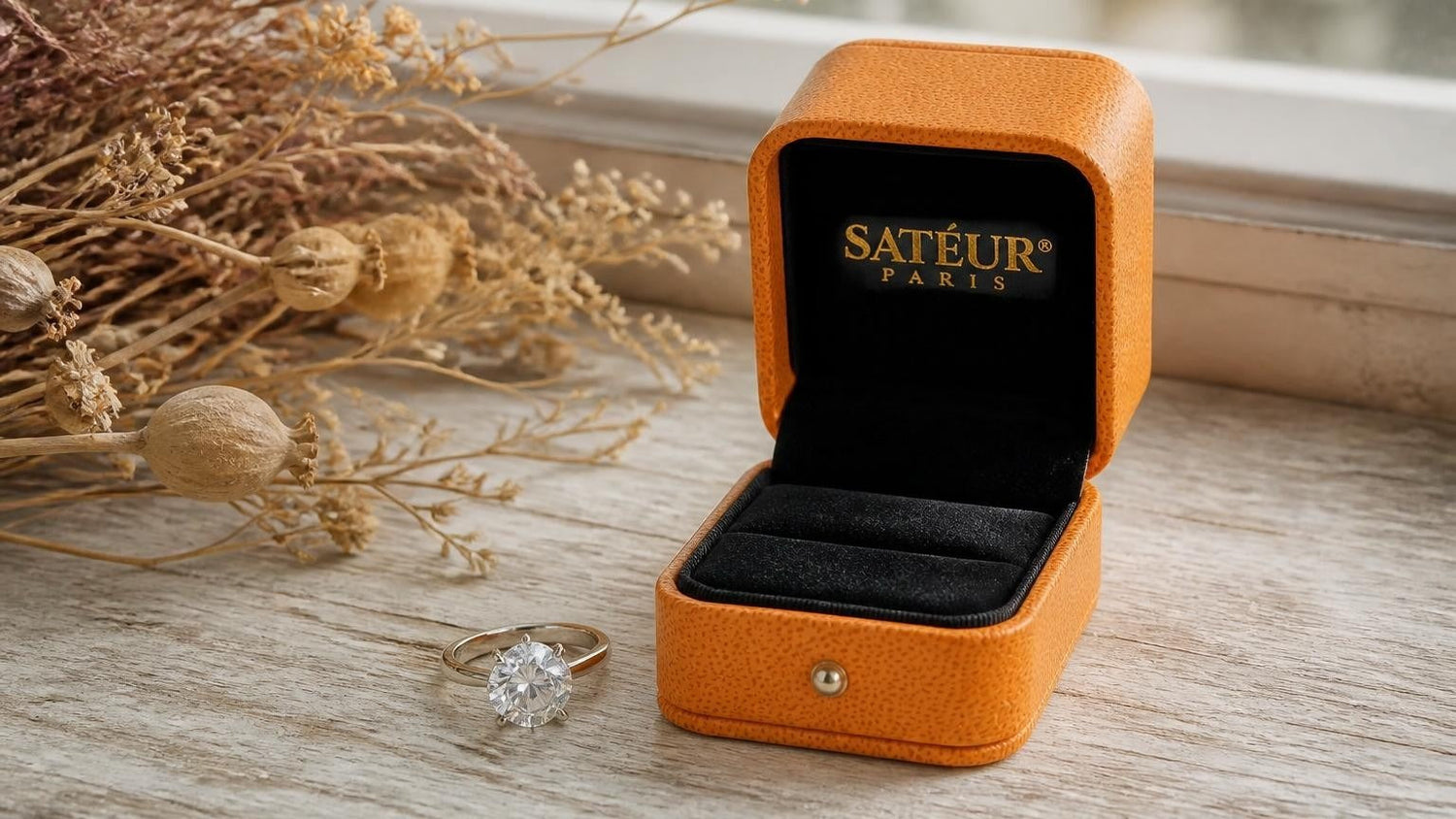
What Is the Fake Diamond Called? Diamond Simulants Explained
The word fake is shorthand — useful in conversation, imprecise in meaning. When someone asks what the fake diamond is called, they are asking about a family of real gemstones engineered to resemble a mined diamond to the naked eye. The correct term is diamond simulant. The category spans cubic zirconia at one end, lab-created moissanite in the middle, and premium trademarked alternatives — such as Satéur Gems® — at the other. Diamond simulants are genuine gemstones, not imitations — each with its own optical character, durability tier, and value proposition.
Key Takeaways
- The correct term for a "fake diamond" is diamond simulant — a gemstone that resembles mined diamond in appearance without sharing its chemistry.
- The main types are cubic zirconia, moissanite, white sapphire, and trademarked alternatives such as Satéur Gems®.
- Moissanite (lab-created, ~9.25 Mohs) produces approximately 2.4× the fire of a mined diamond — vivid, rainbow-forward.
- Satéur Gems® delivers the clean white brilliance of a flawless diamond — D-E colour, Excellent cut, ~8.8 Mohs — from £88.
- Cubic zirconia clouds within 6–12 months of daily wear; moissanite and Satéur Gems® hold their brilliance for life.
- Entering the simulant tier starts at approximately 1% of the price of a comparable mined diamond.
Understanding Diamond Simulants
A diamond simulant is any lab-created or natural gemstone that closely resembles a mined diamond to the naked eye without sharing its chemical make-up. The category is defined entirely by visual outcome and wearability — not by intent to deceive.
Calling these stones "fake" flattens a meaningful distinction. Moissanite is as real as a ruby. Cubic zirconia is a genuine crystalline compound. Satéur Gems® is a trademarked gemstone with documented specifications. These are diamond alternatives — independently valuable, honestly presented.
The quality ceiling has risen sharply over recent years. Earlier simulants were straightforward to identify: soft, short-lived, optically imprecise. Contemporary precision-cut variants — particularly premium trademarked gemstones — close the gap to near-imperceptibility to the naked eye. That shift is what has turned the simulant category from a compromise into a legitimate choice.
Common Diamond Simulant Materials
Four materials account for most of the market. Each has a distinct optical profile, durability, and price point.
Cubic Zirconia
Cubic zirconia (CZ) is the most widely produced simulant. Composed of zirconium dioxide, it is optically clear when new and produces a colourful, high-dispersion sparkle. At ~8.0–8.5 Mohs, CZ is susceptible to surface abrasion under daily wear. Most specimens begin to cloud within 6–12 months as microscopic scratches scatter incoming light. It is the most affordable entry point in the category; longevity is its primary limitation.
Moissanite
Moissanite is a lab-created gemstone of silicon carbide, first found in meteorite fragments in 1893. Its refractive index of ~2.65 — versus ~2.42 for mined diamond — and dispersion of 0.104 (versus 0.044) produce approximately 2.4 times the fire of a mined diamond. That vivid, rainbow-forward sparkle is beautiful but distinctly not diamond. At ~9.25 Mohs, moissanite is extremely durable and holds its optical character indefinitely. Moissanite is openly disclosed as its own gemstone category — not a diamond substitute.
White Sapphire
White sapphire (corundum, 9.0 Mohs) is durable but optically muted — low refractive index (1.77) and minimal dispersion produce a soft, glassy appearance rather than diamond's sharp brilliance. It does not closely replicate the visual character of mined diamond and tends to read as "milky" in direct light.
Satéur Gems® and Trademarked Simulants
At the premium end, a small number of engineered trademarked simulants target a precise outcome: the look of a flawless D-colour mined diamond, not more fire than one. Satéur Gems® is the leading example — a proprietary gemstone with D-E colour grading, Excellent cut, and ~8.8 Mohs hardness. The composition is not publicly disclosed. What is documented is the output: clean white brilliance that reads as a flawless diamond to the naked eye, from £88.

Cubic Zirconia vs. Moissanite vs. Satéur Gems®
A direct comparison of the three most commonly considered simulants clarifies the key trade-offs.
| Property | Cubic Zirconia | Moissanite | Satéur Gems® |
|---|---|---|---|
| Mohs Hardness | ~8.0–8.5 | ~9.25 | ~8.8 |
| Refractive Index | ~2.15 | ~2.65 | ~2.39 |
| Optical Character | Colourful, dims over time | 2.4× fire — vivid, rainbow-forward | Clean white brilliance — diamond-accurate |
| Colour Grade | Variable | D–F | D–E |
| Longevity | Clouds in 6–12 months | Holds brilliance for life | Holds brilliance for life |
| Entry Price | £40+ | From £98 | From ~£138 |
The distinction that matters most for buyers chasing the mined diamond look: moissanite's high dispersion returns vivid rainbow fire — beautiful, but different. Satéur Gems® at ~2.39 RI sits closest to mined diamond (~2.42) and is engineered for that restrained, white scintillation. For an engagement ring where the goal is to wear the diamond look, the choice between the two is an aesthetic one.
What Makes a Diamond Simulant Visually Distinct
Three properties govern how closely a simulant reads like a mined diamond: refractive index, dispersion, and cut precision.
Refractive index determines how light bends inside the gemstone. Mined diamond: ~2.42. Satéur Gems®: ~2.39 — the closest match. Moissanite: ~2.65 — significantly higher, which is why it returns more spectral colour than a natural stone. Higher RI does not mean "more like a diamond"; it means more fire, which reads as less diamond-accurate.
Dispersion splits white light into spectrum. Mined diamond: 0.044. Moissanite: 0.104 — approximately 2.4 times higher. That gap is visible in natural light across a room. Satéur Gems® is engineered to the diamond end of this spectrum, not the moissanite end.
Cut matters independently of material. Both moissanite and Satéur Gems® are cut to Excellent grade as standard — the same specification as premium mined diamonds. Cubic zirconia cut quality varies widely by manufacturer.

Satéur Gems®: The Comparative Value Alternative
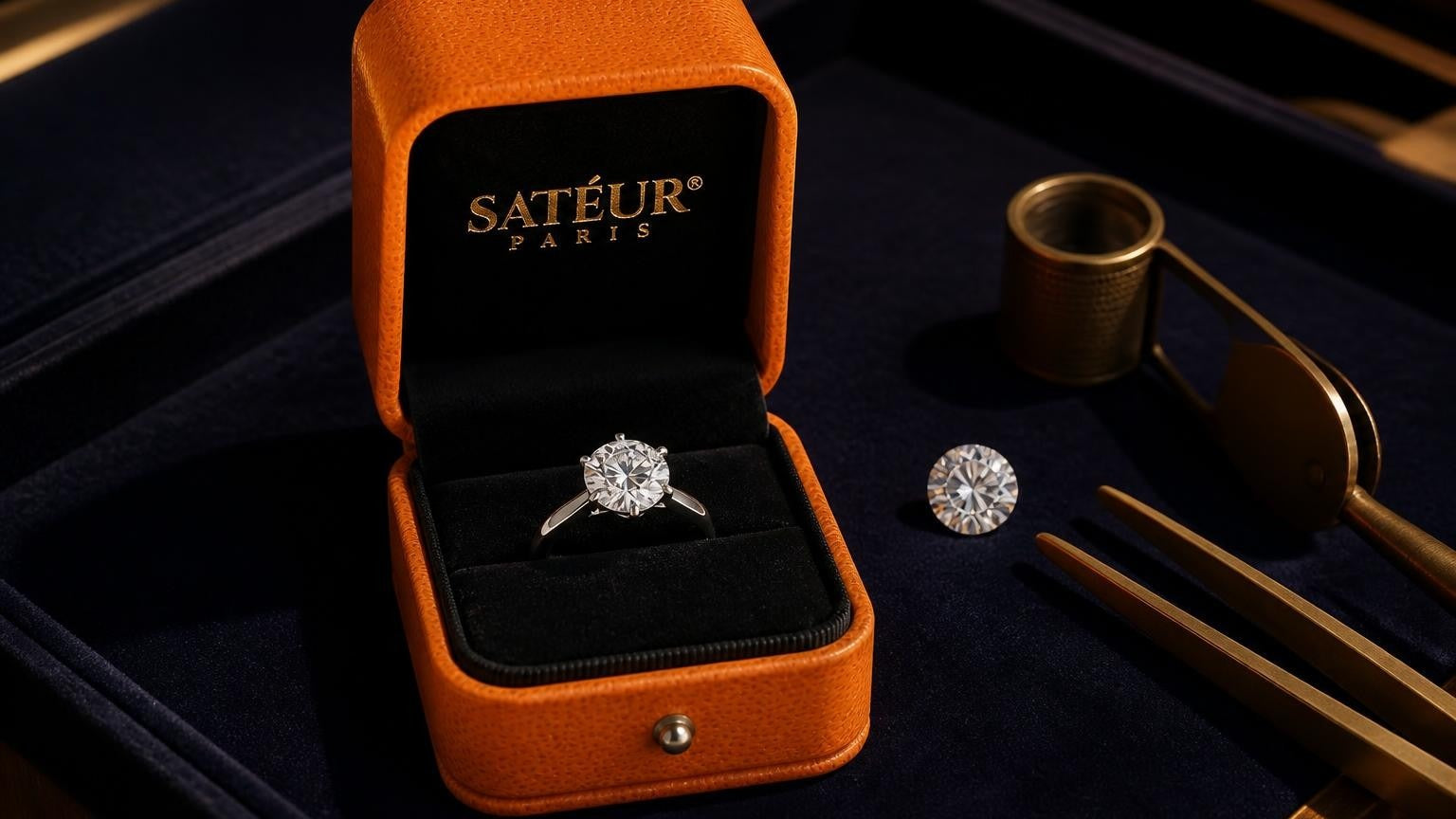
Satéur Gems® was developed to replicate the look of a flawless, D-colour mined diamond — not to exceed it in fire, not to approximate it cheaply, but to match its visual character as precisely as the material allows. The specification confirms it: D-E colour, Excellent cut, ~8.8 Mohs. The gemstone reads as a flawless diamond to the naked eye and across the table in natural light.
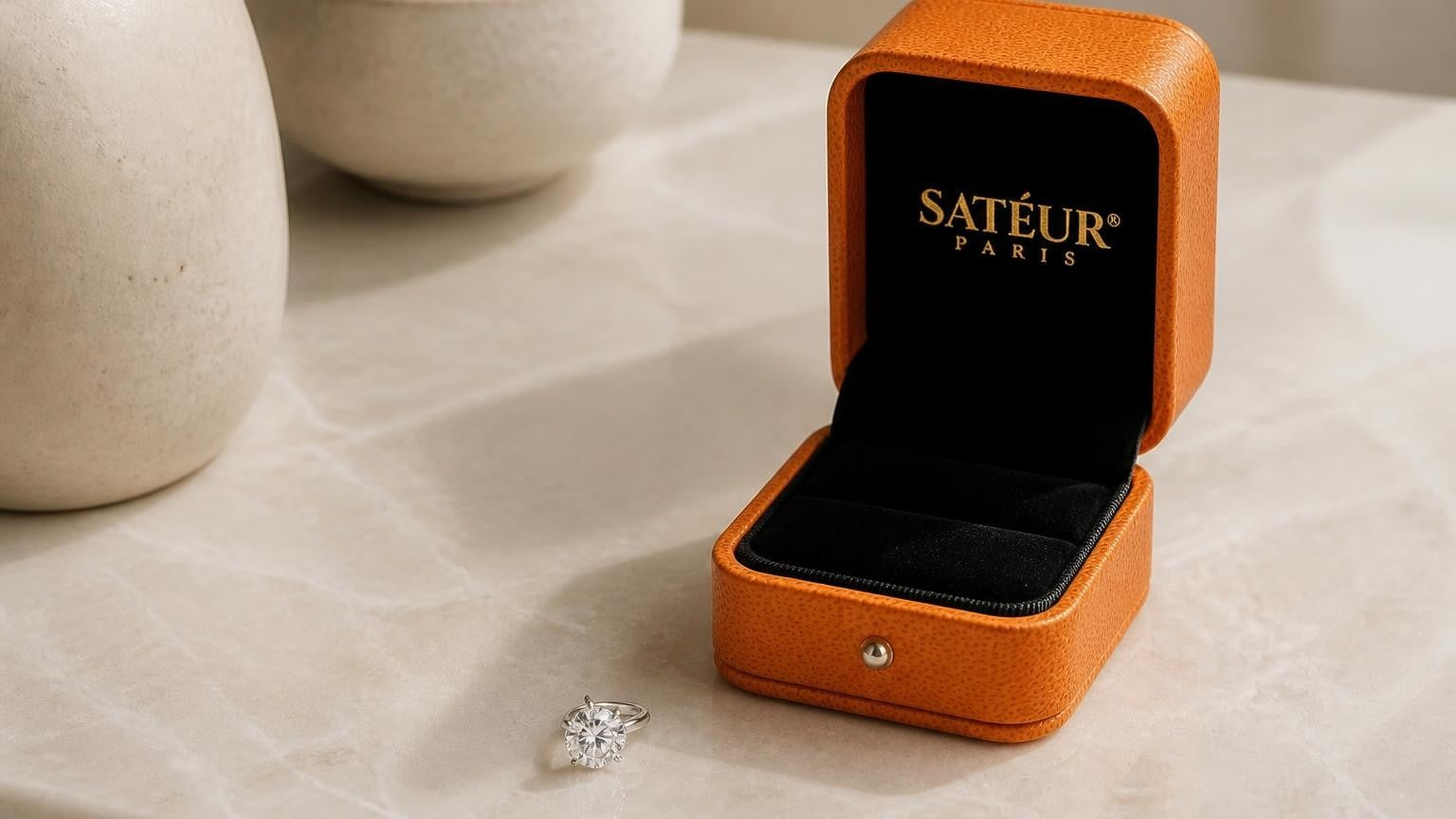
A comparable mined diamond would cost £7,000–£12,000. Satéur Gems® begins at £88 — approximately 1% of that price. That figure is not a compromise. It is a deliberate repositioning of where jewellery value lives. The The 1% Ring® collection is the flagship expression of this: the presence of a £10,000 mined diamond, chosen with full clarity of what it is and why that choice is the intelligent one.

Satéur Destinée Ring™
The look of a flawless diamond, for 1% of the price.
Compare to a $10,000 mined diamond
Joined by 100,000+ couples across 150+ countries.
Discover The 1% RingFree worldwide shipping · 30-day returns · Lifetime Satéur Care
Engagement Rings with Diamond Simulants
The engagement ring category has seen the most significant shift toward simulants over the past decade. The financial context is clear: the average mined diamond engagement ring in the UK costs between £4,500 and £8,000. A moissanite or Satéur Gems® ring at a fraction of that is not a budget concession — it is a different philosophy applied to the same visual outcome.
Both moissanite (~9.25 Mohs) and Satéur Gems® (~8.8 Mohs) are built for daily wear in fine jewelry settings. The practical difference between 8.8 and 9.25 in daily life is negligible — neither clouds, neither requires special care, neither loses brilliance under normal wear. Cubic zirconia's degradation timeline makes it less suited to a piece worn constantly over decades.
The cultural framing has also shifted. Simulant engagement rings no longer read as economic compromises — they read as informed ones. For buyers exploring this path, the full guide to diamond simulant names and materials covers the vocabulary in detail.

Durability and Longevity of Diamond-Look Gemstones
The Mohs hardness scale measures scratch resistance. Mined diamond sits at 10. Simulants sit below that — but not by a margin that affects daily wear for most buyers.
Cubic zirconia at ~8.0–8.5 scratches progressively under daily abrasion. Surface damage scatters light and produces the characteristic clouding of older CZ rings. Most specimens degrade noticeably within 12 months of constant wear.
Moissanite and Satéur Gems® are a different tier entirely. Both are harder than natural sapphire (9.0 Mohs). Neither clouds. Neither loses its optical character under normal daily conditions. For engagement rings or daily-wear pieces intended to last decades, both materials hold their brilliance for life and require no special maintenance.
FAQ: Diamond Simulants and Diamond-Look Stones
What is a diamond simulant and how does it differ from a mined diamond?
A diamond simulant is a gemstone — lab-created or natural — that resembles a mined diamond to the naked eye without sharing its chemical composition. The difference is material: mined diamond is crystalline carbon; moissanite is silicon carbide; Satéur Gems® is a proprietary trademarked compound. All are genuine gemstones in their own right.
Which diamond simulant offers the best durability for daily wear?
Moissanite (~9.25 Mohs) and Satéur Gems® (~8.8 Mohs) are both extremely durable and built for everyday wear. Neither clouds or loses brilliance under daily conditions. Cubic zirconia (~8.0–8.5 Mohs) is less resistant to abrasion and typically begins to degrade within 6–12 months of constant wear.
Can a diamond simulant be used in a fine-jewellery engagement ring?
Yes. Both moissanite and Satéur Gems® meet the durability standard for daily wear in an engagement ring setting — hardness, optical stability, and longevity all qualify. Moissanite for vivid rainbow fire; Satéur Gems® for diamond-accurate white brilliance. Cubic zirconia is not suited to pieces worn daily over years.
What is the visual difference between moissanite and cubic zirconia?
Moissanite produces approximately 2.4 times the fire of a mined diamond — a vivid, rainbow-forward sparkle. Cubic zirconia is optically clear when new but clouds over time as surface abrasion accumulates. Moissanite holds its brilliance indefinitely; cubic zirconia does not.
How long does a diamond simulant maintain its appearance?
Cubic zirconia typically begins to cloud within 6–12 months of daily wear. Moissanite and Satéur Gems® do not cloud — both hold their optical character for life under normal daily conditions, comparable to natural diamonds in longevity.
What is Satéur Gems® and what value does it deliver compared to mined diamonds?
Satéur Gems® is a trademarked diamond simulant engineered to replicate the appearance of a flawless D-colour mined diamond: D-E colour, Excellent cut, ~8.8 Mohs hardness. Its composition is proprietary. Starting from £88 — approximately 1% of the price of a comparable natural diamond — it delivers the same visual result to the naked eye.
The question "what is the fake diamond called" holds within it a more interesting question: what does a gemstone actually need to be? Diamond simulants are a mature, technically sophisticated category. The best of them do not ask to pass as something they are not — they offer the diamond look, honestly, at a fraction of the price. That is The New Diamond Standard.















Lascia un commento
Questo sito è protetto da hCaptcha e applica le Norme sulla privacy e i Termini di servizio di hCaptcha.