

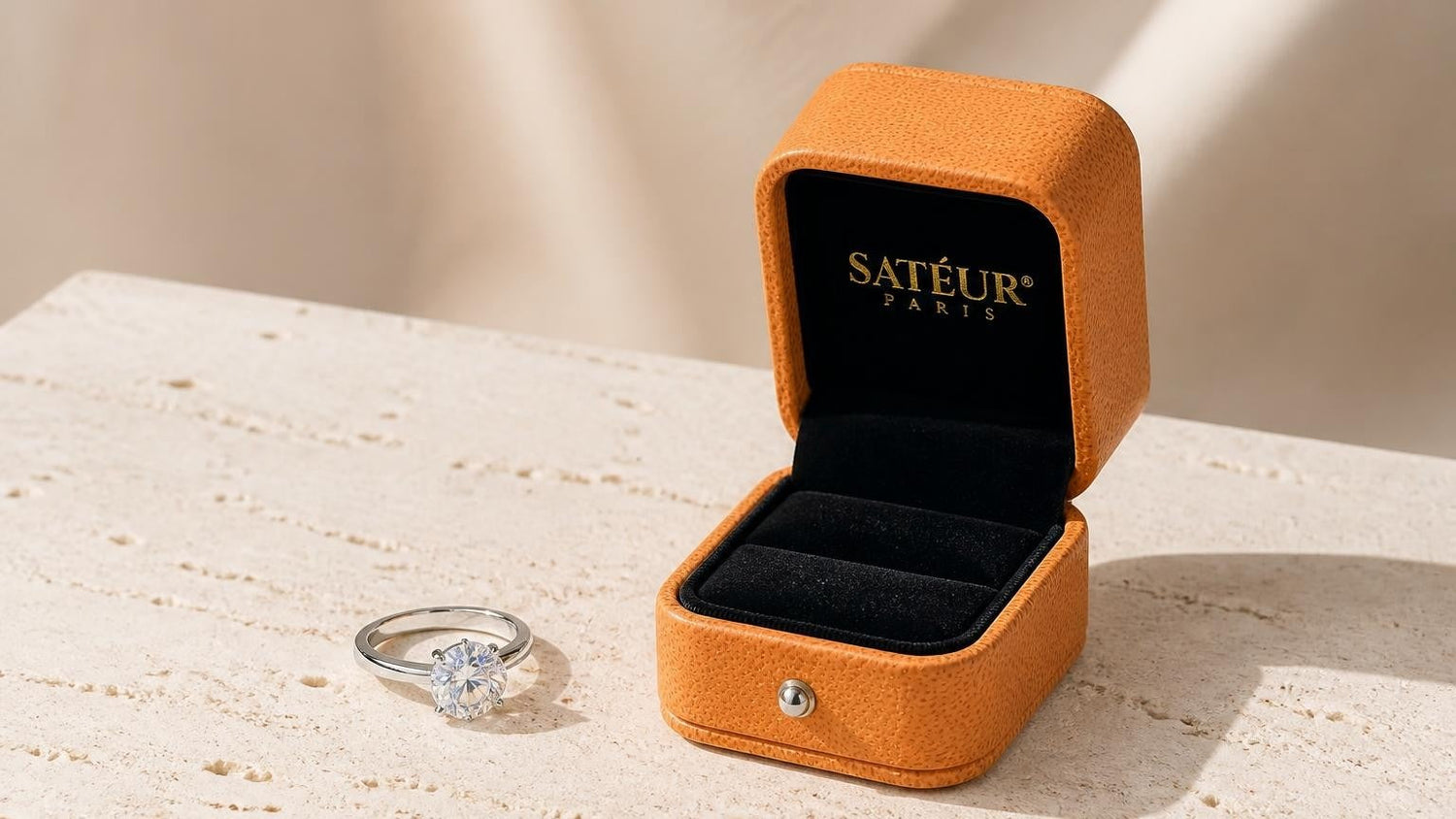
Moissanite Price Per Carat: A Complete Cost Guide
Moissanite costs approximately 1% of the price of a comparable mined diamond — and the price per carat varies by colour grade, cut quality, and carat weight. This guide maps the real numbers clearly: from sub-carat solitaires to three-carat statement rings, with transparent pricing before you buy.
For a broader foundation on moissanite's properties and value, the Satéur Moissanite Guide covers optical performance, durability, and how each gemstone tier compares in practice.
Key Takeaways
- Moissanite costs roughly 1% of a comparable mined diamond. A 1-carat moissanite ring typically sits under $500, versus $5,000–$15,000 for an equivalent diamond.
- Colour grades D–E (colourless) carry a modest premium over G–I (near-colourless); cut quality is the single most important performance variable.
- Moissanite has a Mohs hardness of approximately 9.25 — among the most durable gemstones for daily wear.
- Moissanite displays approximately 2.4× the fire of a diamond — a vivid, rainbow-forward brilliance distinct from diamond's crisp white sparkle.
- Satéur moissanite rings start from approximately $98, with carat-weight tiers scaling in proportion to the lab-growing process.
How Much Does Moissanite Cost Per Carat?
Moissanite pricing follows carat weight — but not linearly. The lab-growing process becomes more complex as crystals scale up, so price per carat rises with size. A 1-carat round moissanite of D colour and Excellent cut typically sits in the $300–$600 range. An equivalent mined diamond costs $5,000–$15,000 or more.
The factors that move price within moissanite:
- Carat weight — the most significant factor. Each tier step carries a meaningful premium.
- Colour grade — D–E (colourless) carries a 10–20% premium over G–H (near-colourless). Both grades read visually clean to the naked eye.
- Cut quality — Excellent or Ideal cut maximises fire and light return. This is where moissanite's vivid brilliance is won or lost.
- Metal setting — platinum, 18k gold finish, and sterling silver carry different price points. The gemstone cost is constant; the setting varies the total.
For a focused comparison of these costs against diamond pricing, see moissanite vs diamond cost per carat.
Moissanite Engagement Ring Costs by Carat Weight
The table below uses a standard solitaire setting — Excellent cut, D–F colour (colourless range), 18k white gold finish. These are the honest benchmarks a buyer should expect across the main carat tiers.
| Carat Weight | Moissanite Ring (est.) | Equivalent Diamond (mined) | Value Gap |
|---|---|---|---|
| 0.5 ct | $150–$280 | $1,500–$3,500 | ~90% |
| 1.0 ct | $300–$550 | $5,000–$10,000 | ~95% |
| 1.5 ct | $450–$750 | $9,000–$18,000 | ~96% |
| 2.0 ct | $700–$1,200 | $15,000–$30,000 | ~97% |
| 3.0 ct | $1,100–$2,000 | $30,000–$60,000 | ~97% |
A 2-carat moissanite engagement ring typically costs under $1,500. The gap widens in percentage terms as carat weight rises — diamonds price exponentially due to scarcity; moissanite does not face the same curve.

For a deeper look at entry-level carat pricing and what to expect at the 1-carat mark, how much moissanite costs per carat covers sub-carat and 1-carat options in detail.
Moissanite Pricing vs. Diamond Cost
The price gap between moissanite and mined diamonds is structural, not marginal. Diamond pricing is governed by controlled rarity and decades of market conditioning. Moissanite is priced on the actual cost of lab-growing, cutting, and grading. These are different cost structures with different underlying economics.
A 1-carat mined diamond of comparable D colour and Excellent cut costs approximately $5,000–$10,000. The same visual presence — the same size on the hand, the same sparkle across the table — for roughly 3–5% of the cost. That is not a discount. It is a different decision framework entirely.
Moissanite prices also rise more gradually with carat weight than diamonds. At 3 carats, the gap between what you pay for a moissanite and what a diamond costs has expanded to 97%. The value case compounds at scale.
For a direct comparison at the 1-carat mark specifically, 1-carat moissanite vs diamond price goes through the full breakdown.
Colour Grades: D, E, F (Colourless) & G, H, I (Near-Colourless)
Moissanite is graded on a colour scale adapted from the GIA diamond standard. The two practical tiers:
- D–F (Colourless): No discernible colour with the naked eye. D–E carries the highest per-carat price. The visual difference between D and E is imperceptible outside a grading environment.
- G–I (Near-Colourless): A faint warmth that most buyers cannot detect when the gemstone is set in a ring. Priced 10–20% below colourless grades. In yellow gold settings, the warmth is entirely undetectable.
The practical pricing impact of colour grade in moissanite is modest compared to diamonds — where colour can shift a stone's value by thousands. In moissanite, the premium for D over G is measured in tens of dollars per carat, not hundreds or thousands. For most buyers, near-colourless is the rational choice at the lower carat weights.
Cut Quality & Price Impact
Cut quality affects price — but more importantly, it determines how the gemstone performs. Moissanite's defining optical property is its fire: approximately 2.4× the light dispersion of a diamond, producing vivid, rainbow-forward brilliance. An Excellent or Ideal cut maximises this. A poorly cut gemstone suppresses it.
The incremental cost of an Excellent-cut moissanite over a Very Good cut is typically 5–15%. For a gemstone whose entire appeal is optical performance, this is the most consequential quality choice. Cut is the one dimension where the premium is unconditionally justified.
Round brilliant cuts represent the highest-demand shape for moissanite — engineered for maximum light return. Fancy cuts (oval, cushion, pear) cost similarly or slightly less, with each presenting moissanite's fire differently. The round brilliant at Excellent cut is the reference standard for price comparisons.

Satéur Moissanite Value: The Flawless Look at 1% of Diamond Price
Satéur moissanite rings start from approximately $98 — Excellent cut, D–F colour, approximately 9.25 Mohs hardness. The Satéur moissanite collection covers solitaires, halo designs, and multi-stone settings across carat tiers.
The entry point reflects the principle. At $98, a round moissanite solitaire delivers the visual presence of a gemstone that would cost $3,000–$5,000 in a diamond equivalent. At 2 carats, the gap is wider still. The compound value curve is one of moissanite's genuinely distinctive properties — and the reason it has become the intelligent choice for moissanite engagement rings.

Satéur Moissanite Rings
The look of a flawless stone, for 1% of the price.
Compare to a $10,000 mined diamond
Joined by 100,000+ couples across 150+ countries.
Explore Moissanite RingsFree worldwide shipping · 30-day returns · Lifetime Satéur Care
Why Moissanite Offers Superior Value
The value case for moissanite is structural. Three properties converge:
- Optical performance: Fire approximately 2.4× that of a diamond — vivid, brilliant, and distinctly alive in light. Not a visual compromise; a different and, to many eyes, more striking optical signature than a diamond.
- Durability: At approximately 9.25 on the Mohs scale, moissanite is among the hardest gemstones in common jewellery use. It does not scratch under everyday wear, and its brilliance does not diminish with time.
- Price structure: Lab-created moissanite is priced on actual production costs rather than artificial scarcity. The per-carat price has held relatively stable over time — unlike diamond prices, which are subject to market and supply dynamics outside the buyer's control.
Moissanite engagement rings offer the appearance of a flawless stone without the premium of mined diamonds. For the considered buyer, that is not a concession — it is The New Diamond Standard. Over 100,000 customers across 150+ countries have reached the same conclusion.
Frequently Asked Questions About Moissanite Pricing
How much does a moissanite ring cost compared to a diamond?
A moissanite ring costs approximately 3–5% of the price of a comparable mined diamond ring. A 1-carat moissanite solitaire in an 18k gold finish setting typically costs $300–$550, versus $5,000–$15,000 for a diamond equivalent of matching quality. The gap widens at higher carat weights, where diamond pricing rises exponentially due to scarcity of large high-quality rough stones.
What is the price range for moissanite by carat weight?
Using Excellent cut, D–F colourless grade as the benchmark: 0.5 ct sits at approximately $150–$280; 1 ct at $300–$550; 1.5 ct at $450–$750; 2 ct at $700–$1,200; and 3 ct at $1,100–$2,000. Metal setting choice (platinum, 18k gold finish, sterling silver) affects the total ring cost, but the gemstone price itself is consistent across each tier.
Does moissanite hold its value over time?
Moissanite does not carry a secondary resale market comparable to high-end diamonds. Its value lies in its appearance, durability, and the experience of wearing it — not as a financial instrument. The gemstone itself does not degrade, cloud, or lose brilliance with time; it holds its physical properties for life. For buyers choosing moissanite for its quality and look rather than as an investment asset, this distinction is largely irrelevant.
How are moissanite stones graded and priced?
Moissanite is graded using a colour and cut scale adapted from the GIA diamond standard. Colour grades run from D (colourless) through to near-colourless (G–I). Cut grades include Excellent, Very Good, and Good. Price is determined primarily by carat weight, then cut quality, then colour grade. Lab-created moissanite is consistently produced at high clarity — a separate clarity grading system is not typically applied, as eye-visible inclusions are rare.
Is moissanite a good investment for an engagement ring?
Moissanite is an excellent choice for a ring that will look brilliant for a lifetime at a fraction of diamond cost. It is not a financial investment in the commodity sense. For couples who prioritise the appearance, durability, and meaning of an engagement ring over potential resale value, moissanite consistently delivers more visual presence per dollar spent than any comparable alternative.
What factors affect the price of moissanite jewellery?
Five main variables: (1) carat weight — the largest single driver; (2) cut quality — Excellent cut commands a premium and delivers peak optical performance; (3) colour grade — D–F colourless grades cost 10–20% more than G–I near-colourless; (4) shape — round brilliant is typically priced at the top of the range; (5) metal setting — platinum costs more than 18k gold finish or sterling silver. The gemstone price and the setting cost are separable — the stone price is consistent for equivalent grades across quality jewellers.

Moissanite is not positioned as a compromise. At approximately 9.25 Mohs, with fire 2.4× that of a diamond, and price-per-carat benchmarks that remain a fraction of the mined alternative, it occupies its own position in fine jewellery — The New Diamond Standard. The Satéur engagement ring collection presents moissanite alongside Satéur Gems® and lab diamond, each with transparent pricing and consistent quality.










Lascia un commento
Questo sito è protetto da hCaptcha e applica le Norme sulla privacy e i Termini di servizio di hCaptcha.