

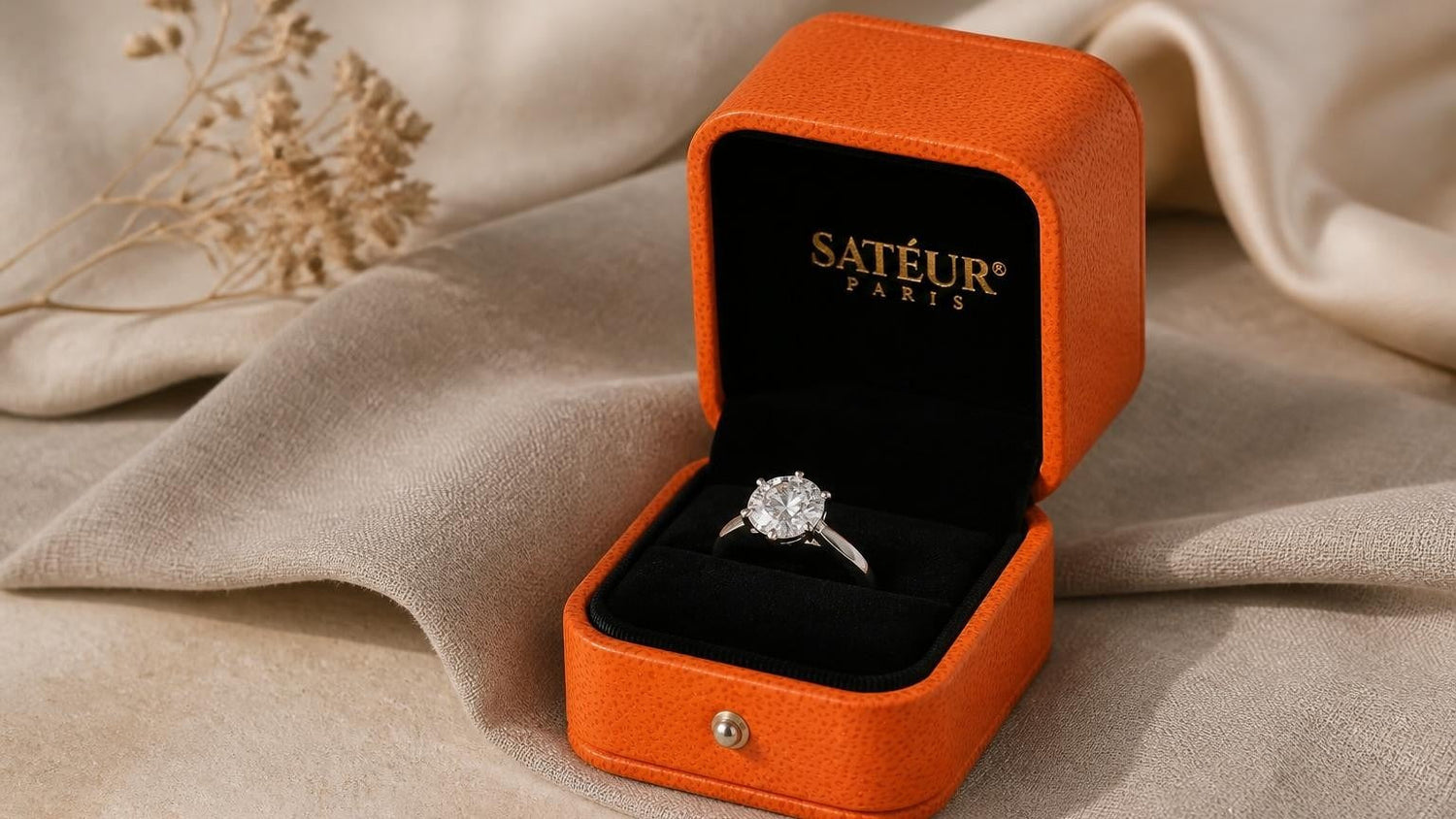
Engagement ring prices span roughly $500 to $20,000 and beyond — and almost all of that range comes down to one thing: the centre gem. A one-carat mined diamond alone can run past $10,000 before the metal and setting are even added. That's why the most important money decision isn't how much to spend — it's what the centre gem is made of. A Satéur Destinée Ring™ gives the look of that flawless diamond for about 1% of the price, from $138, set in real 18K gold finishing.
This is the complete guide to what an engagement ring actually costs — the real averages, how much you should genuinely spend, what the Four Cs do to the price, the metal-and-setting maths, and how a diamond-look gem changes the whole equation. Each section links to a deeper guide or collection where one exists.
Key Takeaways
- Engagement ring prices span roughly $500 to $20,000+, driven mostly by the centre gem — a one-carat mined diamond alone can run past $10,000.
- The "three-month salary" rule is a marketing line from the diamond trade, not a real guideline — spend what fits your life.
- The average mined-diamond engagement ring is about 1.10 carats, but average is not a target — it's just where spending happens to land.
- The Satéur Destinée Ring™ gives the look of a flawless diamond for about 1% of the price, from $138, set in 18K gold finishing.
- Satéur Gems® carry the restrained, white brilliance of a fine diamond — D–E colour equivalent, Excellent cut — and are extremely durable, so the look doesn't depend on the price.
- Metal and setting add to the total, but the centre gem is the single biggest lever on cost.
Does the Money Have to Go to a Diamond?
Here's the question almost no one asks first: does the money have to go to a mined diamond at all? For a century, the answer was assumed — the diamond trade made sure of it, including inventing the "three-month salary" rule out of thin air as a marketing line. But the centre gem is simply the most expensive part of the ring, and it's also the one part a careful buyer can rethink without giving up the look.
Once you separate the look of a flawless diamond from the mined diamond itself, the maths changes completely. A mined-diamond ring forces a trade-off between size, quality and price. A diamond-look ring removes it: you choose the size and quality that look right, and the price follows at a fraction. The rest of this guide covers the real numbers either way — what mined rings cost, what's reasonable to spend, and where the value sits.

What Is the Average Engagement Ring Cost?
What does the average engagement ring actually cost? Surveys cluster the average mined-diamond ring in the low thousands, on a centre gem of about 1.10 carats — but the range is enormous, from a few hundred dollars to well over $20,000, because the centre gem swings the total so hard. A one-carat mined diamond of good colour and clarity (VS2, G) typically runs $5,000–$10,000 on its own, before the metal and setting.
The most useful thing about "average" is calibration: once you can see what the same diamond look costs across every gem type and carat weight, the number you should spend gets a lot clearer. Here's the full landscape, by 1-, 2- and 3-carat equivalent:
The contrast is the whole story: a 2-carat mined diamond ring runs $15,000–$30,000, while a 2-carat Satéur Gems® ring with the same flawless-diamond look is $350–$600 — about 1% of the cost, set in real 18K gold finishing.
| Gem type | 1 ct ring | 2 ct ring | 3 ct ring |
|---|---|---|---|
| Satéur Gems® (trademarked simulant) | $150–$350 | $350–$600 | $600–$1,100 |
| Satéur Moissanite (lab-created) | $100–$300 | $300–$500 | $500–$900 |
| Lab-grown diamond (IGI VS2, G) | $800–$1,800 | $2,500–$5,000 | $5,000–$10,000 |
| Mined diamond (VS2, G) | $5,000–$8,000 | $15,000–$30,000 | $30,000–$60,000+ |

Explore in depth:
How Much Should You Actually Spend?
So how much should you spend? The honest answer is what fits your life — the "three-month salary" figure was a 20th-century advertising line, not financial advice, and no one who matters is checking. A more useful method is to decide the look you want first, then match the gem to the spend you're comfortable with. Because the diamond look is no longer tied to the mined-diamond price, almost any budget can now buy a large, brilliant, flawless-white centre gem.
Here's what each budget realistically achieves, and the smartest gem choice at that level:
The takeaway: if the look you want is a large, flawless-white centre gem, a Satéur Gems® ring (from $138) delivers it at the bottom of this table — so the money you save goes to the wedding, the honeymoon, or simply stays yours. Couples now have a name for that approach — Smart Engagement™, the new proposal standard: the ring is the symbol, the life is the point. The guides below cover how much people genuinely spend and how to plan the full ring.
| Budget | What it achieves | Best gem choice |
|---|---|---|
| Under $500 | 1–2 ct brilliant solitaire, white-gold-finish or silver band | Satéur Gems® or Moissanite |
| $500–$1,500 | 2–5 ct brilliant solitaire, silver or 14k/18k gold finish | Satéur Gems® or Moissanite |
| $1,500–$5,000 | 1 ct lab diamond, or a higher-tier Satéur Gems® piece in 18K gold finishing | Lab-grown diamond or Satéur Gems® |
| $5,000–$15,000 | 1–2 ct mined or lab diamond, designer setting | Lab-grown or mined diamond |
| $15,000+ | 2 ct+ mined diamond, designer brand setting | Mined diamond |

Explore in depth:
The Four Cs and What Drives Price
Where does the money actually go inside a diamond? Into the Four Cs — and they don't all carry equal weight for the price-to-look ratio. Carat drives cost the hardest: price rises faster than size, so a two-carat diamond costs far more than two one-carat diamonds. Cut is where you should spend, because it controls brilliance more than size does. Colour and clarity are where mined-diamond buyers overspend most — paying for a flawless, D-colour grade whose difference from a near-colourless, eye-clean gem is invisible without magnification.
This is the key insight at any price: you're often paying for grades you cannot see. The smart mined-diamond buyer prioritises cut, accepts an eye-clean clarity and a near-colourless grade, and puts the difference into size. The smart diamond-look buyer skips the markup entirely — Satéur Gems® are engineered straight to the grades that read best to the eye (a D–E colour equivalent, an Excellent cut), so you get the flawless-white look without paying for certificates of perfection you'd never notice.
| The C | Effect on price | Smart move |
|---|---|---|
| Carat | Steepest — price rises faster than size | Size to the look, not the number |
| Cut | High — and worth it | Prioritise; Excellent cut first |
| Colour | Moderate — often overpaid | Near-colourless looks white set |
| Clarity | Moderate — often overpaid | Eye-clean; skip flawless |

The Satéur Gems® Path: The Look, a Fraction of the Cost
What does the diamond look actually cost if you skip the mined diamond? About 1% of the mined price. A Satéur Gems® ring starts at $138 and is set in real 18K gold finishing — for the restrained, white brilliance of a fine diamond, in the size and quality that read best. The same appearance that runs into five figures in a mined diamond is attainable for the price of a nice dinner out, because you're buying the look and the durability directly, graded by abstract spec rather than a mined-diamond price tag.
That changes what a given spend can buy. The money that would have bought a modest mined solitaire can buy a larger, more brilliant diamond-look ring outright — or the same look for a fraction, with the difference kept. Satéur Gems® are a trademarked diamond simulant graded to a D–E colour equivalent and an Excellent cut, extremely durable for everyday wear, and visually a flawless diamond across a dinner table. The value-focused collections and guides below show what's possible at every price point.

Explore in depth:
Cost by Metal & Setting
How much do the metal and setting add? Less than the centre gem, but enough to plan for. The metal is the next biggest line after the gem: platinum is the priciest, gold sits in the middle, and Satéur's 18K gold finishing gives the look and feel of fine gold without the four-figure metal cost. The setting adds according to complexity — a plain solitaire is the most economical, while halos, three-stone designs, vintage detailing and full-eternity bands add metalwork and gems, and therefore cost.
A few practical notes on the total. A halo setting is the classic way to make a centre gem read larger for less outright spend, since smaller accent gems cost far less than one big centre. Ring size has a small effect (more metal in a larger band), and insurance is worth considering on a higher-value mined ring — though with a diamond-look ring at a fraction of the price, replacement rather than insurance is usually the simpler answer. Plan the gem first, then the metal and setting, and the total stays predictable.


Satéur Destinée Ring™
The look of a flawless diamond for about 1% of the price, from $138.
Compare to a $10,000 mined diamond
Joined by 100,000+ couples across 150+ countries.
Discover Satéur Engagement RingsFree worldwide shipping · 30-day returns · Lifetime Satéur Care
Frequently Asked Questions
How much should I realistically spend on an engagement ring?
What fits your life — there is no real rule. The "three-month salary" figure was a 20th-century advertising line, not financial advice. Decide the look you want first, set a number you're genuinely comfortable with, and choose the gem source (mined, lab-grown or diamond simulant) that meets both. A Satéur Gems® ring delivers the flawless-diamond look from $138.
What is the average engagement ring cost?
Most surveys put the average mined-diamond ring in the low thousands, on a centre gem of about 1.10 carats, with a huge range from a few hundred to over $20,000. Average is just where spending lands, not a target — a one-carat mined diamond alone can pass $10,000, while a Satéur Gems® ring replicates the look from $138.
How do the four Cs affect engagement ring pricing?
Carat drives price the hardest (cost rises faster than size); cut is where the money is best spent because it controls brilliance; colour and clarity are where buyers overpay most, since the difference between flawless and eye-clean, or D and near-colourless, is invisible without magnification. Satéur Gems® are engineered straight to the grades that look best to the eye.
Can I get a high-quality appearance without a traditional diamond?
Yes — that's the entire point of a diamond simulant. Satéur Gems® carry the restrained, white brilliance of a fine diamond (D–E colour equivalent, Excellent cut) and are extremely durable, replicating the look of a flawless diamond for about 1% of the price, from $138, set in 18K gold finishing.
What metal should I choose for durability and value?
Satéur's 18K gold finishing gives the look and feel of fine gold — in white, yellow or rose — without the four-figure cost of solid platinum or heavy solid gold. White-gold finishing is the brightest, most diamond-like backdrop. All Satéur rings are built to be extremely durable for everyday wear.
Does ring size or setting style significantly impact the total cost?
The setting matters more than the size: a plain solitaire is the most economical, while halos, three-stone designs and full-eternity bands add metalwork and gems. A halo is the classic way to make a centre gem read larger for less. Ring size adds only a little (slightly more metal in a larger band).














Lascia un commento
Questo sito è protetto da hCaptcha e applica le Norme sulla privacy e i Termini di servizio di hCaptcha.