

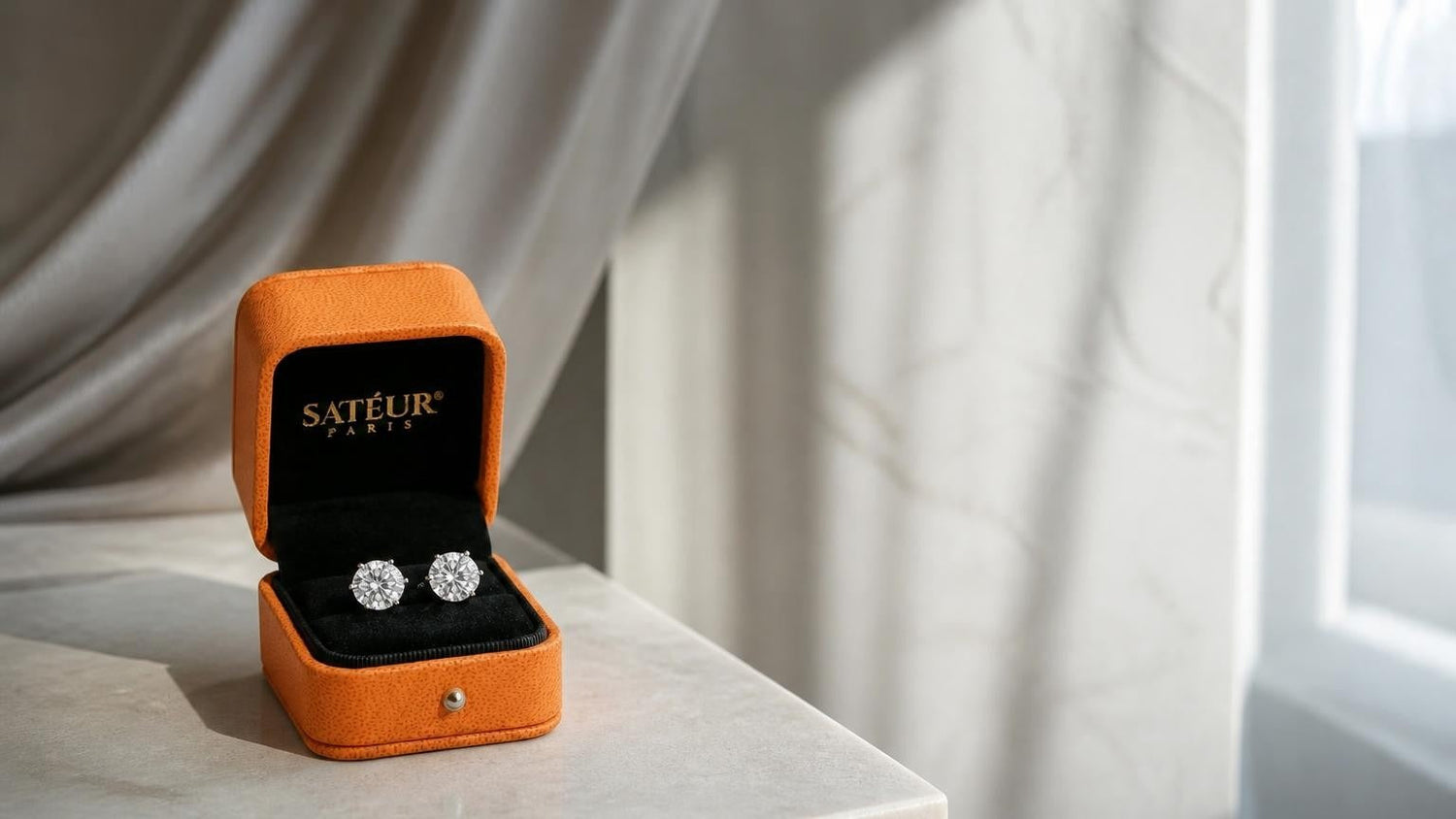
Moissanite vs Diamond Studs: Sparkle, Price, and Which to Buy
A pair of studs is the most worn piece in fine jewelry. It sits beside the face, in every light, on every day. So the question of moissanite vs diamond studs is not academic. It decides what you wear forever, and what you pay for it.
The short answer: across the table, a moissanite stud and a diamond stud are indistinguishable to the naked eye. The difference is in the science of the sparkle, the durability over decades, and the price — where the gap is enormous. A pair of natural diamond studs runs $2,000 to $10,000 or more. A moissanite stud delivers the same diamond look from $88.
This guide compares both, property by property, then shows where the smarter choice sits.
Key Takeaways
- Moissanite measures 9.25 on the Mohs scale; diamond measures 10 — both are built for a lifetime of daily wear.
- Moissanite's refractive index (2.65) is higher than diamond's (2.42), so a moissanite stud throws more rainbow fire.
- A pair of natural diamond studs costs $2,000 to $10,000 or more; moissanite studs start from $88.
- Across the table, moissanite and diamond studs are indistinguishable to the naked eye.
- Satéur Gems® sit above moissanite — the restrained, white brilliance of a fine diamond, from $138.
Moissanite vs Diamond Studs at a Glance
Before the detail, the quick comparison. This table is the fast answer most buyers are looking for.
| Property | Moissanite Stud | Diamond Stud | Satéur Gems® Stud |
|---|---|---|---|
| Sparkle character | More fire — vivid, rainbow-forward | Crisp white brilliance | The restrained, white brilliance of a fine diamond |
| Refractive index | ~2.65 | ~2.42 | ~2.39 |
| Mohs hardness | ~9.25 | 10 | ~8.8 |
| Price (per pair) | From ~$98 | $2,000–$10,000+ | From $138 |
| Everyday wear | Yes | Yes | Yes |
| Naked-eye difference | None at conversational distance | — | None at conversational distance |

The pattern is clear. The two read almost the same to the eye. They part ways on sparkle character and, above all, on price. For the full picture beyond studs, our complete moissanite vs diamond guide covers every setting and carat weight.
Sparkle and Fire (Refractive Index)
Sparkle is not one thing. It is three: brilliance (the white light a gem returns), fire (the rainbow flashes), and scintillation (the play of light as it moves). Moissanite and diamond handle each differently.
How moissanite sparkles
Moissanite has a refractive index of about 2.65 — higher than diamond's 2.42. A higher refractive index means more dispersion, and dispersion is what the eye reads as fire. So a moissanite stud throws more rainbow flashes, especially under bright light. It is a vivid, lively sparkle. A lab-created gemstone engineered for maximum brilliance.
How a diamond sparkles
A diamond returns light as crisp, classic white brilliance. Less rainbow, more clean fire. Some buyers prefer this restraint — it is the look most people picture when they imagine a diamond stud. Neither sparkle is better. They are different characters of light.
Which fire suits a stud
On an earring near the face, fire is amplified by movement. Every turn of the head sends light dancing. If you want a stud that flashes, moissanite delivers more visible fire. If you want the quieter, whiter sparkle of a classic solitaire, that points toward diamond — or toward Satéur Gems®, which deliver that restrained white brilliance without the diamond price.
Hardness and Durability (Mohs)
A stud is worn through everything — sleep, showers, the gym, a thousand small knocks. Durability matters more here than in almost any other piece.
The Mohs numbers
Moissanite measures 9.25 on the Mohs scale. Diamond measures 10, the hardest natural material known. On paper, diamond wins. In practice, the gap is academic. Anything above 9 is exceptionally hard and resists scratching from daily contact. Both a moissanite stud and a diamond stud will look the same in ten years as they do today.
What durability means in real life
Hardness measures scratch resistance. Toughness — resistance to chipping — also matters, and moissanite performs strongly here too. For a piece you never take off, both gems are built to endure. This is one reason studs are the most practical entry point into fine jewelry: you can wear them every day without a second thought. Our stud earrings are made for exactly that life.
Price Comparison
This is where moissanite vs diamond studs stops being close and becomes a decision about value.
What diamond studs cost
A pair of natural diamond studs costs $2,000 to $10,000 or more, depending on carat weight, color, and clarity. A respectable one-carat-total-weight pair sits in the middle of that range. The price reflects scarcity and the diamond trade — not, in any visible way, the sparkle on your ear.
What moissanite studs cost
Moissanite studs start from $88. The same diamond look, the same near-identical sparkle, at a fraction of the price. For the cost of one modest diamond pair, you could own a wardrobe of studs.
The value frame
The brilliance of a gem has nothing to do with its price tag. It has everything to do with how it is cut and set. That is the insight Satéur was built on. The look of a flawless diamond, for 1% of the price. Compare to a $10,000 mined diamond — then look at the same brilliance on your ear for a fraction of the cost. The choice stops being about money and becomes about discernment.
Satéur Destinée Earrings™
The look of a flawless diamond, in 18K white gold finishing. Twin stars. Double the brilliance. From $88.
Explore the earrings
How to Tell the Difference
The honest answer: at the distances people actually see your ears, you cannot. Across the table, moissanite and diamond studs are indistinguishable to the naked eye. The look reads as a flawless diamond either way.
Up close, in bright light
Held close under strong light, a trained eye might notice moissanite's extra fire — those rainbow flashes diamond shows less of. That is the only visible tell, and it is a matter of sparkle character, not quality. Most people read more fire as more sparkle, full stop.
In everyday life
At conversational distance — the way anyone actually experiences your studs — there is no difference to see. Wearing them, nobody knows. This is the quiet truth the diamond trade does not advertise: the eye cannot price-check a sparkle.
Which Should You Buy
The decision comes down to what you value.
Choose moissanite studs if…
You want maximum visible fire, lab credibility, and the diamond look at a fraction of the price. Moissanite is a lab-created gemstone with more fire than a diamond — a brilliant, lively sparkle for those who want the eye drawn to their ears.
Choose diamond studs if…
You specifically want a natural mined diamond and the price is not a constraint. For the look alone, you are paying a steep premium for a difference the naked eye cannot register.
Consider a lab grown diamond if…
You want the genuine article — a real lab-grown diamond with the same chemical and optical structure as a mined one, IGI-certified — without the old-school markup. It is the diamond, made differently and priced more honestly. Browse our diamond earrings for that route.

Where Satéur Fits In
There is a smarter step above moissanite. Satéur Gems® are a trademarked diamond simulant engineered to replicate the look of a flawless diamond. Where moissanite leans into fire, Satéur Gems® deliver the restrained, white brilliance of a fine diamond — the more diamond-true sparkle — at the same kind of value.
The tier, simply
Satéur Gems® are the flagship, positioned above moissanite. From $138. The 1% Ring® built the movement on this idea: the look of a $10,000 diamond, for 1% of the price. The same standard runs through our earrings, where the Destinée Earrings™ pair colorless brilliance with 18K white gold finishing.
Three ways to wear the look
Whatever you choose, the outcome is the same on your ear: a flawless diamond look, worn every day, that no one can price from across a room. That is The New Diamond Standard® — value measured by what you choose, not what you spend.
Frequently Asked Questions
Can you tell moissanite from diamond studs?
Not with the naked eye at the distances people actually see your ears. Across the table, moissanite and diamond studs are indistinguishable. Held close under bright light, a careful eye might catch moissanite's extra rainbow fire — but in everyday life, the look reads as a flawless diamond either way.
Are moissanite studs cheaper than diamond?
By a wide margin. A pair of natural diamond studs costs $2,000 to $10,000 or more. Moissanite studs start from $88 for the same diamond look. The difference is price, not sparkle — the brilliance on your ear is near-identical.
Do moissanite studs last as long as diamond?
Yes. Moissanite measures 9.25 on the Mohs scale and diamond measures 10. Both are exceptionally hard, resist scratching from daily wear, and will look the same in ten years as the day you bought them. For a piece worn every day, both are built to endure.
Which sparkles more, moissanite or diamond?
Moissanite throws more fire. Its refractive index of 2.65 is higher than diamond's 2.42, so it disperses more light into rainbow flashes. Diamond returns crisper white brilliance. Neither is better — moissanite is more vivid, diamond more restrained. Satéur Gems®, at refractive index ~2.39, give that restrained white-diamond brilliance from $138.
Are moissanite studs real diamonds?
No — moissanite is a lab-created gemstone, not a diamond, and we never claim otherwise. It gives the look of a flawless diamond for about 1% of the price. If you want a genuine diamond, our IGI-certified lab-grown diamond tier is a real diamond, grown rather than mined; the moissanite and Satéur Gems® collections deliver the diamond look at a fraction of the cost.

Satéur Destinée Earrings™
The look of a flawless diamond, hand-set in 18K white gold finishing — from $88.
Compare to a $10,000 mined diamond
Joined by 100,000+ couples across 150+ countries.
Shop Destinée EarringsFree worldwide shipping · 30-day returns · Lifetime Satéur Care















Laat een reactie achter
Deze site wordt beschermd door hCaptcha en het privacybeleid en de servicevoorwaarden van hCaptcha zijn van toepassing.