

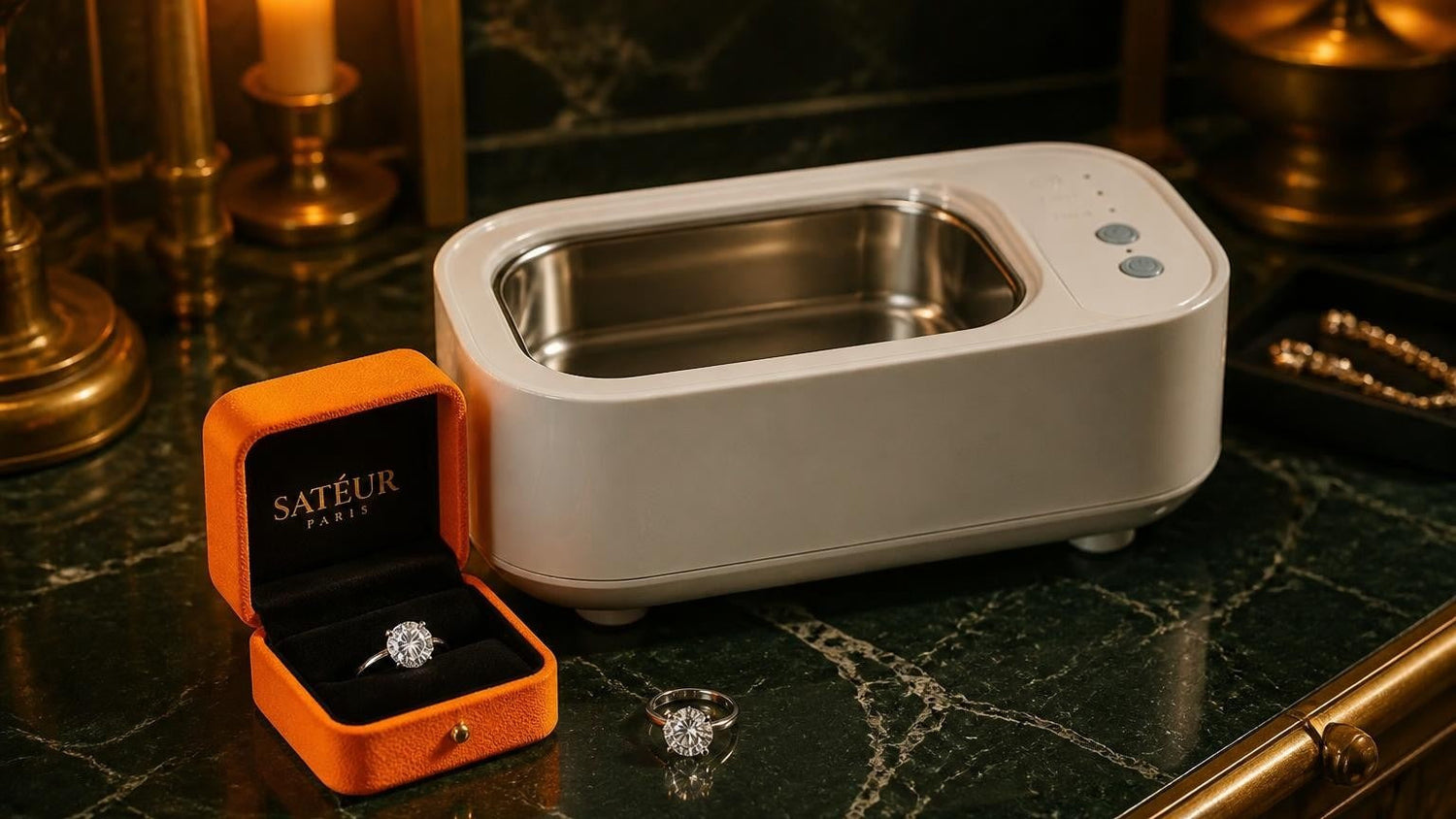
Is an Ultrasonic Cleaner Safe for Moissanite? A Complete Guide
Yes — moissanite is one of the safest gemstones for ultrasonic cleaning. At approximately 9.25 on the Mohs scale, moissanite ranks among the most durable lab-created gemstones available. Ultrasonic vibrations, which operate at 40–60 kHz, pose no risk to the gem when the setting is secure. The result is a jewel that returns to full brilliance in minutes, free of the soap residue and daily build-up that dull even the finest fire.
This guide covers how ultrasonic cleaning works, what makes moissanite jewellery an ideal candidate, and how to use the Satéur® Ultrasonic Jewelry Cleaner (2nd Generation) safely at home. For a broader look at the care landscape, see our guide to the best jewellery cleaners.
Key Takeaways
- Moissanite at ~9.25 Mohs is highly resistant to ultrasonic vibration — safe for regular cleaning.
- Ultrasonic cleaners generate 40–60 kHz vibrations that lift soap residue and daily build-up from faceted gems.
- Always inspect the setting before and after ultrasonic cleaning — the gem is safe; a loose prong is not.
- Use mild detergent diluted in deionised or distilled water; avoid bleach, ammonia, and acetone.
- Professional jewellers recommend ultrasonic cleaning every 3–6 months for daily-worn jewellery.
- Satéur Gems® (~8.8 Mohs) are also extremely durable — safe for ultrasonic cleaning when settings are verified secure.
What Is an Ultrasonic Cleaner
An ultrasonic cleaner is a compact device that uses high-frequency sound waves — typically 40,000 to 60,000 cycles per second — to agitate water and a mild cleaning solution. This agitation creates microscopic bubbles that collapse against jewellery surfaces in a process called cavitation. The effect reaches into the smallest crevices around prongs and beneath gem settings, removing oils, soap, and environmental build-up that a brush cannot reach.
For faceted gemstones with complex light-return geometry — moissanite and Satéur Gems® being primary examples — this matters considerably. Even a thin layer of residue across the table facet diffuses fire and brilliance. An ultrasonic cycle restores the stone to its original optical performance in three to five minutes.
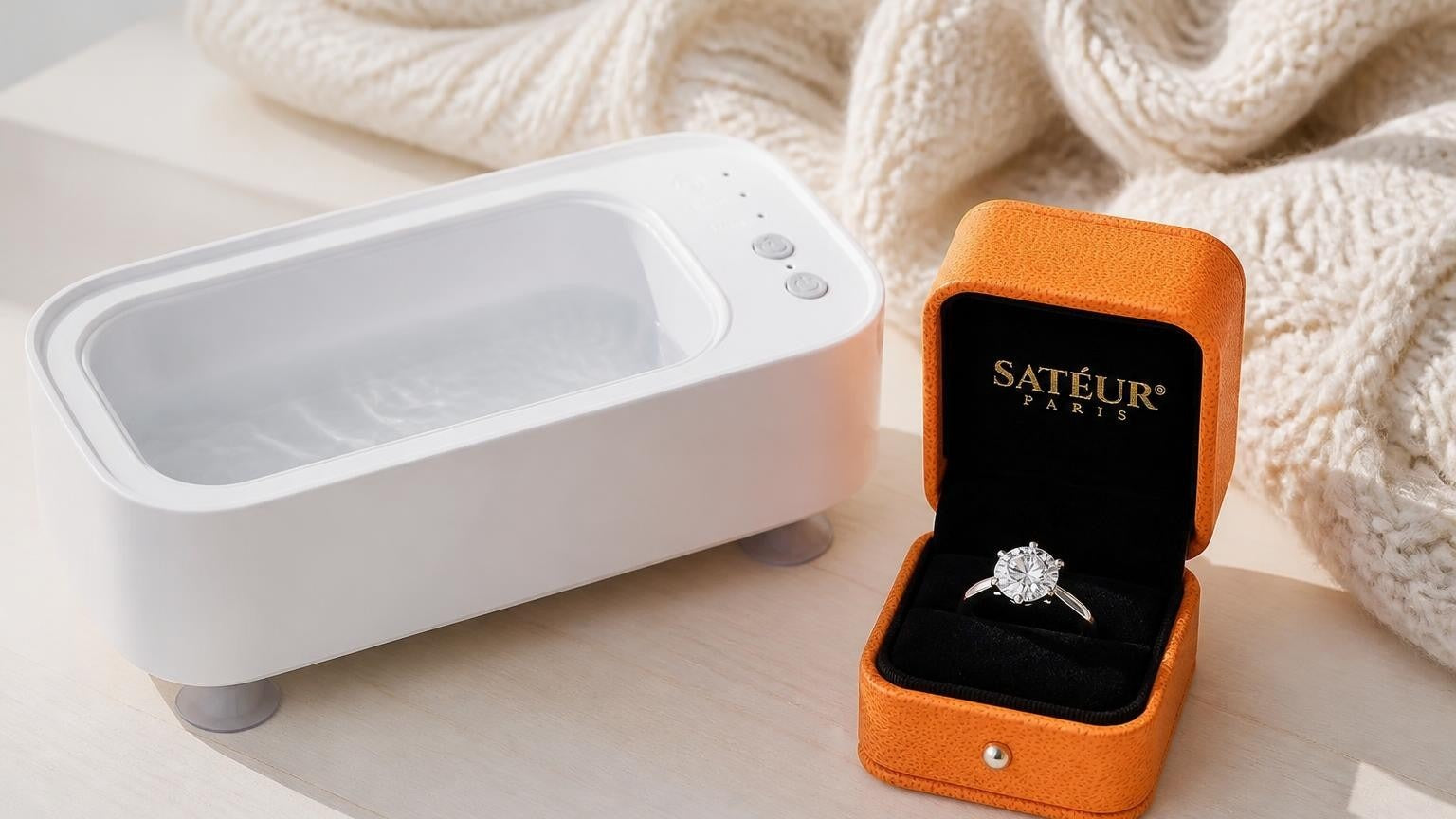
The Satéur® Ultrasonic Jewelry Cleaner (2nd Generation) is sized for home use, compact enough for a dressing table, and designed specifically for fine jewellery. For a step-by-step introduction to ultrasonic cleaning generally, see our four-step guide to sparkling jewellery.

Ultrasonic Cleaning for Diamond Simulants
Moissanite is a lab-created gemstone — not a diamond — with a refractive index of approximately 2.65, producing a vivid, rainbow-forward sparkle distinctly more fiery than a mined diamond. Its hardness of approximately 9.25 on the Mohs scale places it second only to diamond in scratch resistance. Both properties hold up well in an ultrasonic environment.
Satéur Gems®, our trademarked diamond simulant, carry a Mohs hardness of approximately 8.8 — extremely durable, built for everyday wear, and equally safe for ultrasonic cleaning when settings are inspected beforehand. The gem does not wear or scratch inside the ultrasonic tank. The risk, if any, is purely mechanical: a prong already slightly loose may be further stressed by vibration. Inspect settings before every session.
D–E colour simulants maintain visual clarity through repeated ultrasonic cleaning. Deionised water combined with mild detergent prevents mineral deposit build-up on gemstone surfaces — a meaningful concern in hard-water areas. Distilled water is the simplest alternative.
Safety and Durability Considerations
Ultrasonic cleaning is safe for moissanite jewellery, for Satéur Gems®, and for laboratory-grown diamonds. The primary consideration is the setting, not the gem.
Before running any piece through an ultrasonic cleaner:
- Check that all prongs are flush against the girdle — no visible gaps or raised tips.
- Ensure channel-set or pavé stones feel stable when the piece is gently handled.
- Avoid ultrasonic cleaning for pieces with visibly worn or damaged mountings until a jeweller has assessed them.
Gems to avoid in ultrasonic cleaners include emeralds, opals, pearls, and fracture-filled stones — none of which are Satéur product categories. For moissanite and Satéur Gems®, there is no such restriction when settings are sound.

Step-by-Step Ultrasonic Cleaning Guide
Using the Satéur® Ultrasonic Jewelry Cleaner (2nd Generation) takes approximately five minutes from set-up to rinse.
- Fill the tank. Use deionised or distilled water to the marked fill line. Add two to three drops of mild dish soap. Avoid detergents containing bleach, ammonia, or acetone.
- Place the jewellery. Lower the basket gently. Do not stack multiple pieces directly against each other — contact between rings can cause surface marks.
- Select the cycle. The 2nd Generation cleaner offers timed cycles. A three-to-five minute cycle is sufficient for regular maintenance on moissanite rings and earrings.
- Remove and rinse. Lift the basket. Rinse each piece under cool running water to remove loosened residue and detergent solution.
- Dry and inspect. Pat dry with a lint-free cloth. Check prongs and settings before returning jewellery to its box.
For a full range of at-home cleaning tools, the Satéur jewellery cleaner collection covers every tier of care.

Alternative Cleaning Methods
When an ultrasonic cleaner is not available, a warm water and mild soap soak followed by a soft-bristle brush achieves a comparable result — it requires more manual effort and cannot reach the smallest recesses of a setting, but it is a sound weekly routine between ultrasonic sessions.
Soak for five minutes in warm water with a drop of dish soap, then brush gently around the prongs with a clean soft toothbrush. Rinse thoroughly under cool running water and pat dry. Repeat weekly to maintain moissanite jewellery between full ultrasonic cleaning cycles.
Steam cleaning can be effective but carries a theoretical thermal-shock risk for any gem under rapid temperature change, though moissanite's stability reduces this considerably. For home maintenance, the ultrasonic approach remains the preferred method — consistent, low-effort, and reliably restorative.
Satéur Gems® Care and Maintenance
Satéur Gems® are engineered for life — not solely for special occasions. Both Satéur Gems® and our moissanite tier are extremely durable, built for everyday wear, and hold their brilliance for life. Ultrasonic cleaning, done with care and proper setting inspection, is a natural part of that maintenance rhythm.
The recommended cadence for daily-worn jewellery is every three to six months, supplemented by weekly warm-water rinses. For pieces worn occasionally, once or twice a year is sufficient. The Satéur® Ultrasonic Jewelry Cleaner is designed to make this ritual simple enough that it actually happens.
Moissanite's vivid, rainbow-forward fire and Satéur Gems®' clean, diamond-accurate brilliance both depend on optical clarity at the facet surface. Cleaning is not optional — it is how the jewellery performs as designed. Over 100,000 customers across 150+ countries have chosen a different path to brilliance; keeping that brilliance at its peak is straightforward.
Explore the full moissanite range at Satéur moissanite jewellery — or begin with The 1% Ring, The New Diamond Standard, kept brilliant for life.

Satéur® Ultrasonic Jewelry Cleaner
The look of a flawless diamond — kept that way, for life.
Compare to a $10,000 mined diamond
Joined by 100,000+ couples across 150+ countries.
Shop the Ultrasonic CleanerFree worldwide shipping · 30-day returns · Lifetime Satéur Care
Frequently Asked Questions
Is it safe to use an ultrasonic cleaner on diamond simulants?
Yes — moissanite at approximately 9.25 Mohs and Satéur Gems® at approximately 8.8 Mohs are both highly resistant to the 40–60 kHz vibrations an ultrasonic cleaner produces. The gemstone itself is not at risk. The only caveat is the setting: inspect prongs before and after to ensure no mechanical loosening has occurred.
How often should I ultrasonic clean my simulant jewellery?
Every three to six months for daily-worn pieces. Supplement with a weekly warm soapy water rinse to keep surface oils from building up. For occasional-wear jewellery, once or twice a year is sufficient.
What water temperature works best for ultrasonic cleaning?
Room temperature to mildly warm — around 30–40°C. Very hot water is unnecessary and can stress certain adhesive settings over time. The Satéur® Ultrasonic Jewelry Cleaner's built-in heating brings the solution to the optimal temperature automatically.
Can ultrasonic cleaning affect the sparkle of a diamond simulant?
Ultrasonic cleaning restores sparkle rather than diminishes it. By removing soap residue, skin oils, and micro-particulate from around and beneath the gemstone, the cleaner allows maximum light entry and return. Moissanite's fire and Satéur Gems®' diamond-accurate brilliance both improve visibly after a cycle.
What detergent should I use in an ultrasonic cleaner?
A mild dish soap diluted in deionised or distilled water — two to three drops per tank is sufficient. Avoid any detergent containing bleach, ammonia, acetone, or chlorine. Purpose-made jewellery cleaning solutions are also appropriate when diluted per the manufacturer's instructions.
Should I have my setting inspected before ultrasonic cleaning?
Yes — before every session, visually check that all prongs are lying flush against the gemstone's girdle. If any prong appears lifted or bent, have it re-tipped by a jeweller before using an ultrasonic cleaner. The vibrations can accelerate movement in an already-loose prong, potentially freeing a stone.

















Laat een reactie achter
Deze site wordt beschermd door hCaptcha en het privacybeleid en de servicevoorwaarden van hCaptcha zijn van toepassing.