

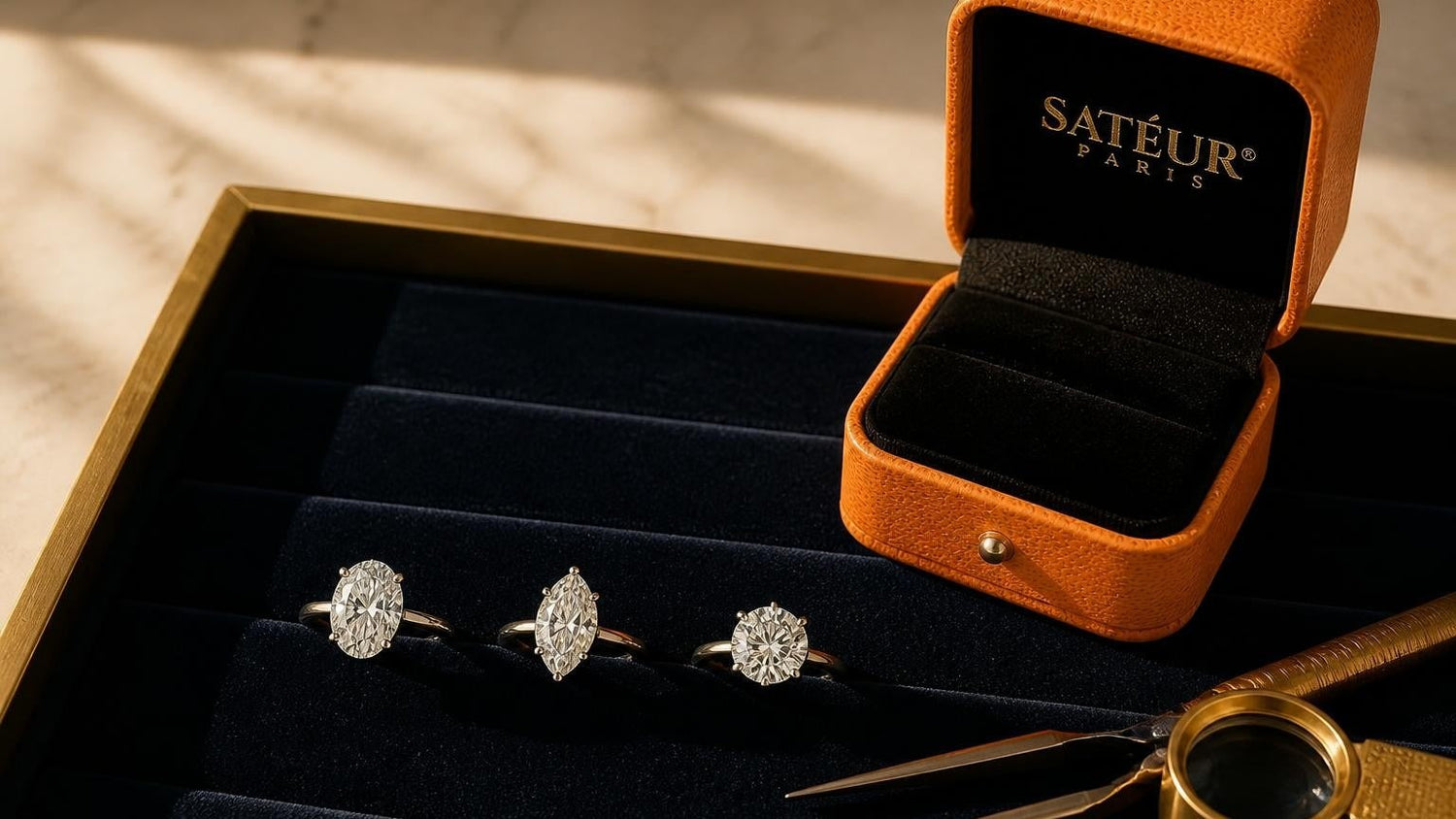
Engagement Ring for Small Hands: The Proportion Guide
The right engagement ring for small hands is not about finding the smallest stone or the thinnest band. It is about proportion. A well-chosen cut, the correct band width, and an appropriate stone scale create the illusion of an elongated, balanced finger — regardless of hand size. This guide covers what actually works, drawn from the same principles jewellers have applied for decades to flatter small and petite hands.
Key Takeaways
- Oval, marquise, and pear cuts elongate the visual line of small hands — the single most effective styling tool for petite fingers.
- Band width of 1.2 mm–1.8 mm is optimal for small hands; 2 mm–2.5 mm remains viable with a properly balanced stone.
- Band thickness of 1.2 mm–2 mm preserves durability while maintaining a refined, elegant look.
- Satéur Gems® entry price begins at approximately $138 — roughly 1% of the cost of an equivalent mined diamond.
- D–E colour, Excellent cut grade, ~8.8 Mohs hardness — extremely durable and built for everyday wear.
Why Proportion Matters for Engagement Rings on Small Hands
Small hands have narrower fingers and a shorter visual canvas. A band that reads as elegant on a larger hand can overwhelm a smaller one — not because of the stone itself, but because the ratio of stone-to-band-to-finger falls out of balance. The goal is always proportion, not miniaturisation.
Two dimensions define that architecture: the finger's length-to-width ratio, and the distance between the knuckle and the base of the finger. Elongating cuts work by drawing the eye vertically along the finger. Wider bands interrupt that line. The relationship between cut, band width, and stone scale is where proportion is made or lost. The New Diamond Standard begins with understanding these mechanics.

Cut and Stone Shape for Delicate Fingers
The most significant styling decision for small hands is the stone shape. Certain cuts elongate the visual line of the finger with remarkable efficiency, while others can make small fingers appear shorter or wider.
Oval. The optimal choice for small and petite hands. An oval's east-west width spreads across the finger naturally while the north-south axis stretches upward, creating the appearance of a longer finger. It distributes light across the full face of the stone, maximising visual presence without requiring a large carat weight. Oval engagement rings flatter small hands more consistently than any other shape.
Marquise. The most aggressively elongating shape available. Its pointed ends draw the eye along the fingers — upward and outward — creating a striking silhouette. Even a modest 0.5-carat marquise reads as a substantial presence on small hands because the shape does the heavy lifting. Stone size matters less; the proportional effect of the cut matters more.
Pear. The teardrop shape shares the marquise's elongating logic with a rounder, softer base. Worn point-up, it creates a refined visual line along the finger. A pear-shaped engagement ring is particularly well suited to hands with shorter, wider fingers — the shape's asymmetry introduces visual energy while still elongating.
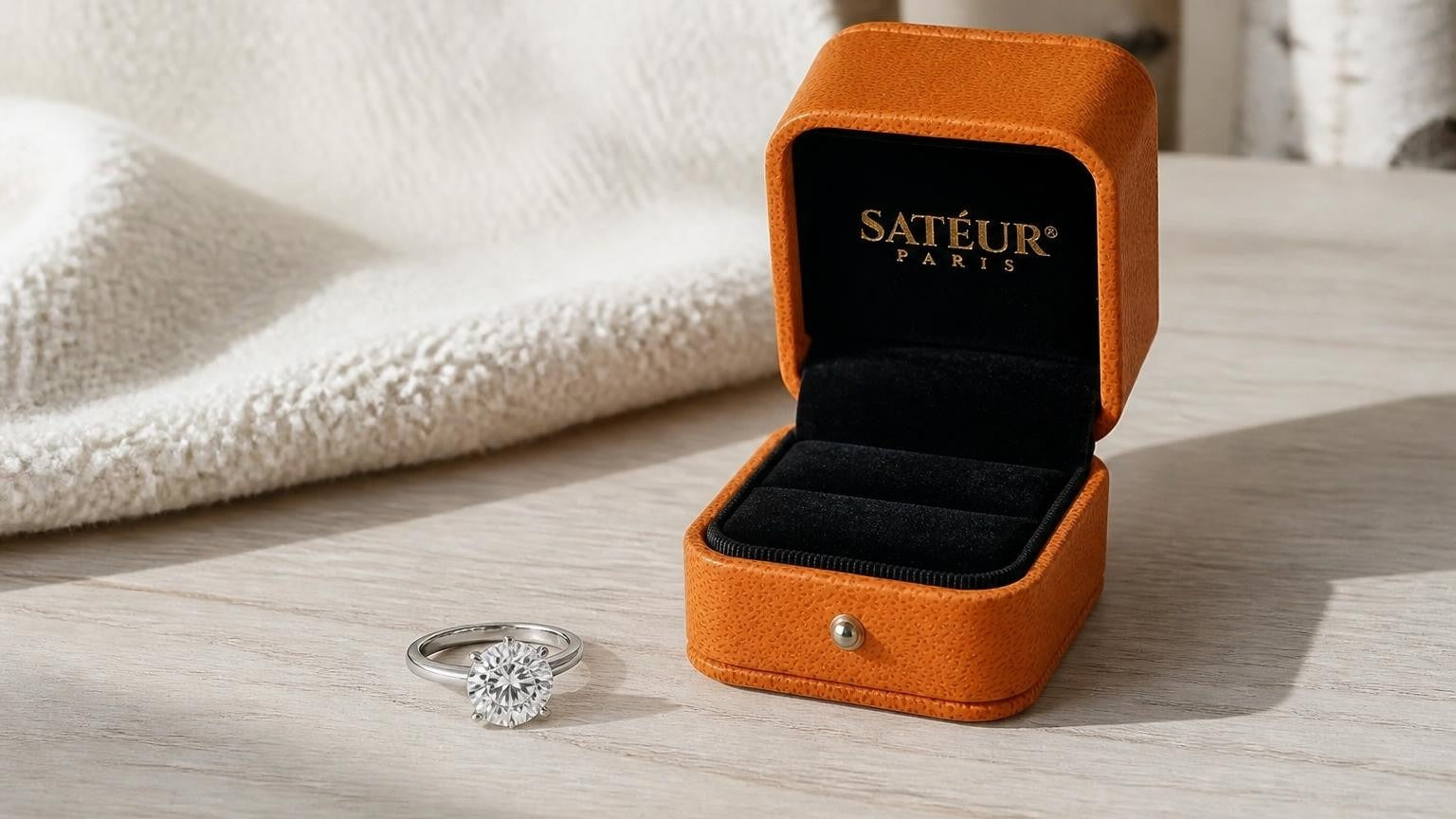
Round brilliant. The classic. A round does not elongate, but its symmetry means it never overwhelms. On small hands, a round brilliant in the 0.5–1.0-carat range sits in ideal proportion. The issue arises only with very large rounds; the shape itself is not the problem.
Princess and emerald. Square and rectangular cuts can read as proportionally wide on small fingers. They require a narrower band and deliberate sizing to preserve balance. Emerald cuts in particular suit hands with longer, narrower fingers rather than shorter, wider ones.
Band Width and Thickness Guidance
Band width is measured across the face of the finger. Band thickness is the depth of the shank from inside to outside. Both matter for small hands, and they are independent variables that work together.
Width: 1.2 mm–1.8 mm. This range is the established optimum for small and petite hands. A band in this range sits close to the finger, does not interrupt the elongating line of the stone, and reads as proportionally light. At 2 mm–2.5 mm, the band remains viable — particularly if the stone has sufficient scale to anchor it — but the margin for visual imbalance increases. The band should frame the stone, not compete with it.
Thickness: 1.2 mm–2 mm. Thicker shanks add visual bulk when viewed from the side. For small hands, staying in the 1.2 mm–2 mm range preserves elegance while maintaining structural durability. Below 1.2 mm, white metal bands — particularly white gold — risk structural compromise at the finger joint over time. Durability and refinement are not in conflict within this range.
Metal tone also reads differently on small hands. Platinum and white gold appear narrower and lighter than yellow gold at the same physical width — an optical effect of the cooler tone against skin. For hands where maximum elongation of the fingers is the priority, white metals are the practical choice.

Solitaire vs Three-Stone Settings on Small Hands
The solitaire is the clearest answer for most small hands. A single stone on a fine band maximises the elongating effect of the cut and reads as proportionally clean and uninterrupted. Fewer horizontal elements allow the vertical line of the stone's shape to do its work.
Three-stone settings are not precluded. They require scale discipline: side stones proportionate to the centre — typically half the carat weight or smaller — keep the horizontal spread contained and visually balanced. Oversized side stones widen the ring's footprint beyond what small fingers can anchor.
Halo settings amplify the apparent size of the centre stone. A micro-halo — a single row of small accent stones — works well on small hands. A double halo, or a halo with large pavé rounds, risks reading as disproportionately wide. The look of a stone should be larger; the look of the ring should not be wider. Consider the hidden halo engagement ring — a refined solution that adds presence without visible width, preserving the elongating silhouette.
For small and petite hands, the guiding principle across all setting styles is the same: every horizontal element — band width, side stones, halo — should serve the vertical line, not compete with it.

Satéur Gems® — The Value Proposition
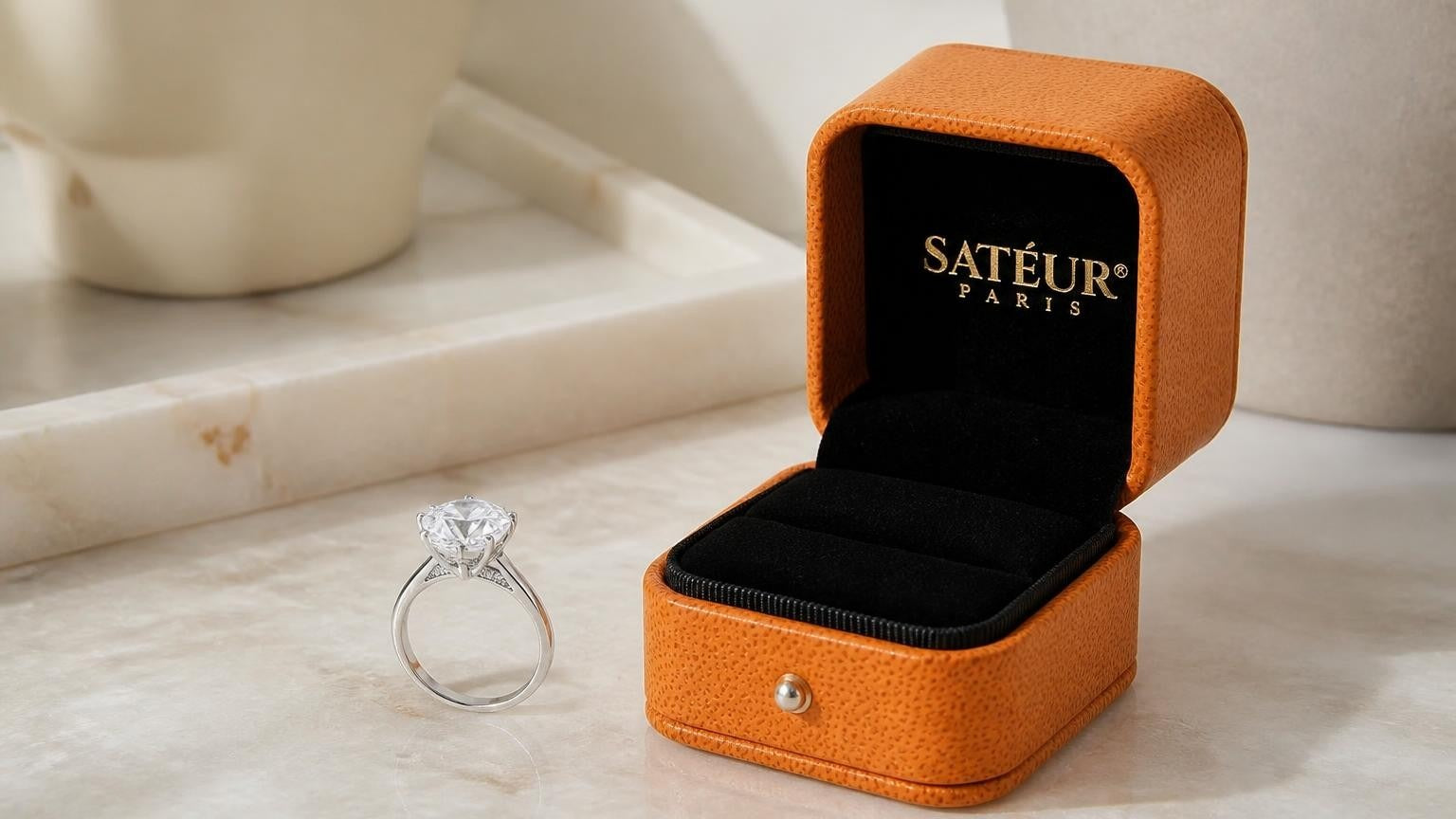
Satéur Gems® is the Maison's signature gem: a trademarked diamond simulant engineered to replicate the look of a flawless diamond. D–E colour. Excellent cut grade. The clean, white brilliance of a fine diamond — diamond-accurate, indistinguishable with the naked eye. Approximately 8.8 on the Mohs hardness scale, making it extremely durable and built for everyday wear.
The entry price begins at approximately $88 — roughly 1% of the cost of an equivalent mined diamond. The same presence. The same weight of light across the finger. The same effect on small hands when the cut is chosen with proportion in mind.
For small hands, the value calculation sharpens further. The cuts that flatter petite fingers — oval, marquise, pear — are available across the Satéur collection at entry points that allow investment in band quality and setting craftsmanship, not just stone cost. A fine 1.5 mm-band solitaire in white gold with a 1.00-carat oval Satéur Gems® is a proportionally complete ring at a price point that leaves room for a matching wedding band.
Over 100,000 customers across 150+ countries have chosen a different path. The stone is not what you pay for — it is what it looks like, and how it endures.

The Destinée is The 1% Ring® — proportioned for small and petite hands as much as for any. Fine band. Considered scale. Designed to look exactly right.
The New Diamond Standard is not a compromise. It is the smarter choice.

Satéur Destinée Ring™
The look of a flawless diamond, for 1% of the price.
Compare to a $10,000 mined diamond
Joined by 100,000+ couples across 150+ countries.
Discover The 1% RingFree worldwide shipping · 30-day returns · Lifetime Satéur Care
Frequently Asked Questions
What band width is best for engagement rings on small hands?
1.2 mm–1.8 mm is the established optimum for small hands. This range preserves the visual line from band to stone, does not interrupt the elongating effect of the cut, and keeps the ring proportionally light on the finger. A band of 2 mm–2.5 mm remains viable if the stone's scale is sufficient to anchor it — but the margin for imbalance increases beyond 1.8 mm.
Does stone shape affect how a ring looks on smaller fingers?
Significantly. Oval, marquise, and pear cuts elongate the visual line of small and petite fingers — the north-south axis of these cuts draws the eye upward along the finger, creating the appearance of additional length. Round brilliants are visually neutral. Princess and emerald cuts can read as wide on small hands if the band is not carefully proportioned.
How does band thickness balance durability and elegance?
Band thickness of 1.2 mm–2 mm preserves both structural durability and a refined aesthetic. Below 1.2 mm, white metal bands — particularly white gold — risk structural compromise at the finger joint with daily wear over time. Within the 1.2 mm–2 mm range, elegance and longevity are well served simultaneously.
What is the visual difference between solitaire and three-stone settings on small hands?
A solitaire on a fine band maximises the elongating effect of the cut and reads as proportionally clean and uninterrupted. A three-stone setting works well on small hands when the side stones are proportionate to the centre — roughly half the carat weight — keeping the horizontal spread contained. Oversized side stones widen the ring's footprint and can overwhelm smaller fingers.
How does Satéur Gems® compare in appearance to mined diamonds?
Satéur Gems® replicates the clean, white brilliance of a flawless diamond — diamond-accurate, indistinguishable with the naked eye. D–E colour, Excellent cut grade. Rated approximately 8.8 on the Mohs hardness scale: extremely durable, built for everyday wear. The difference from a mined diamond is the price — Satéur Gems® begins at approximately $138, at roughly 1% of the cost of an equivalent mined gemstone.
What price range should I expect for a quality engagement ring designed for small hands?
A mined diamond engagement ring in the cuts that best flatter small hands — oval, marquise, pear — typically begins at $3,000–$5,000 for a quality 0.5-carat stone and setting, rising steeply with carat weight. In Satéur Gems®, the same presence and cut quality begins at approximately $138. The look of a flawless diamond, across the table, at roughly 1% of the traditional price.
















Laat een reactie achter
Deze site wordt beschermd door hCaptcha en het privacybeleid en de servicevoorwaarden van hCaptcha zijn van toepassing.