

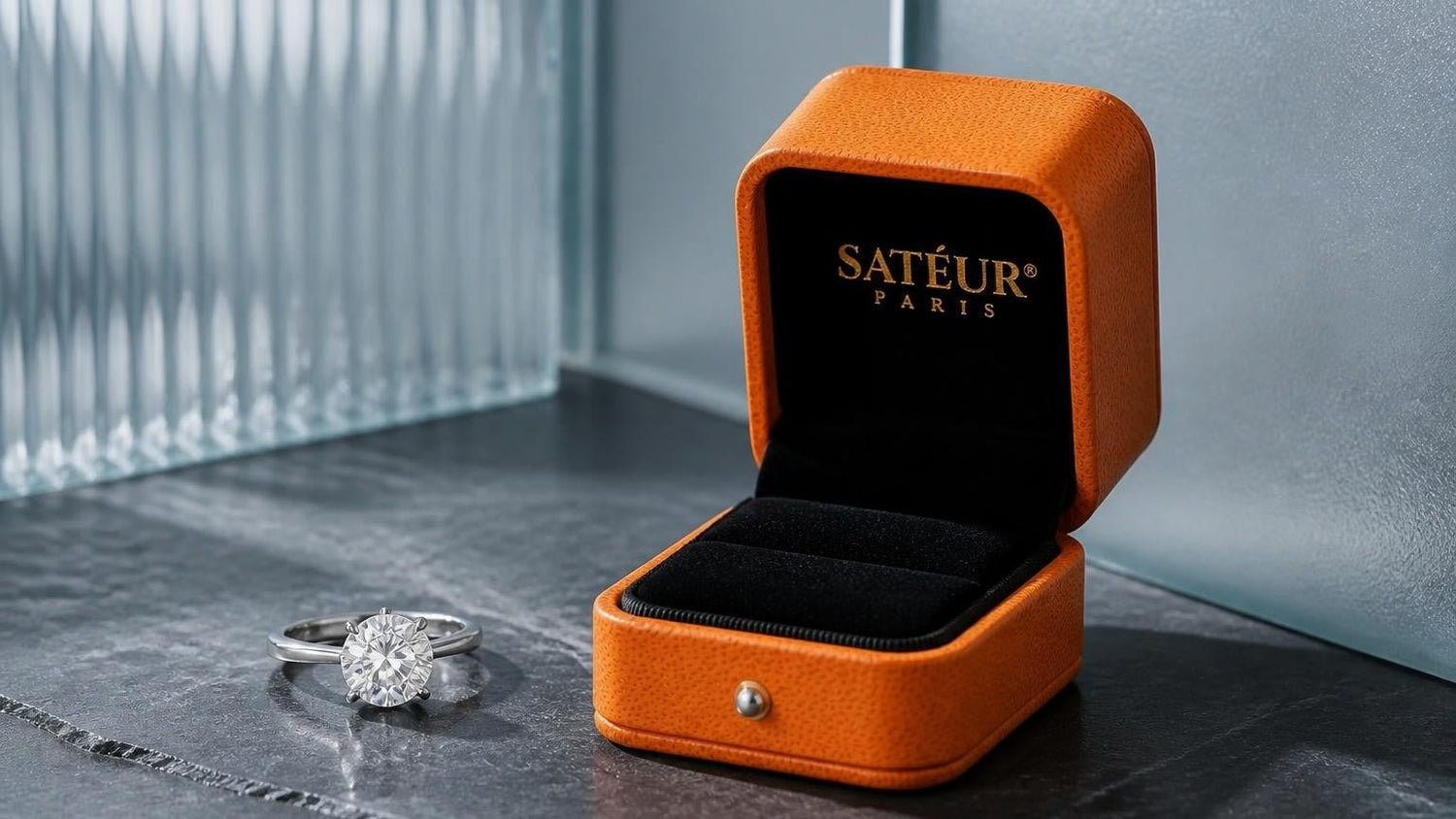
Is Brilliant Earth Legit? An Honest Review for the Discerning Buyer
Yes. Brilliant Earth is a legitimate jeweller. It has operated since 2005, holds an A+ Better Business Bureau rating, and carries genuine certifications — GIA, IGI, SCS-007 — across its mined, lab-grown, and recycled-metal lines. If you are researching whether to trust the company with a purchase, the short answer is: the company is real, its gemstones are what it says they are, and its customer service has a functioning escalation path.
The more interesting question is not legitimacy. It is value. Brilliant Earth's entry-level lab-grown diamond engagement rings typically begin near £1,000 and climb quickly into the £3,000–£8,000 range for a 1-carat centre stone with a meaningful setting. Mined-diamond options stretch further still. That pricing reflects genuine certification, genuine material — and a genuine markup structure that has defined the industry for generations.
A different premise exists. The look of a flawless diamond — D-E colour, Excellent cut, the quiet brilliance that stills a room — does not require a diamond. It requires precision gem-crafting and the right optical properties. This is the logic behind The New Diamond Standard, and why over 100,000 customers have chosen a different path.
Key Takeaways
- Brilliant Earth is a legitimate, accredited jeweller selling certified mined and lab-grown diamonds since 2005.
- Its lab-grown diamond rings typically start near £1,000 and rise sharply with carat weight and setting complexity.
- Satéur Gems® achieve D-E colour grading and Excellent cut standards — visually indistinguishable from a flawless diamond with the naked eye.
- Satéur Gems® rate approximately 8.8 on the Mohs hardness scale — extremely durable and built for everyday engagement ring wear.
- Diamond simulant technology now delivers comparable visual brilliance at approximately 1% of mined diamond pricing.
- Entry-level Satéur engagement rings begin at approximately $88, with the signature Destinée Ring at $138.
What Makes a Reliable Engagement Ring Choice
Before evaluating any retailer, it helps to separate two questions: Is this company trustworthy? And is the product worth what I am paying? Brilliant Earth passes the first test with little dispute. It publishes its sourcing standards, its conflict-free protocols, and its gemstone certifications transparently. Its return policy is 30 days, its warranty covers manufacturing defects, and its physical showrooms — across the United States and a growing international footprint — add a layer of accountability that pure e-commerce brands cannot replicate.
The second question is where intelligent buyers spend more time. Mined diamonds carry what economists call rent — a price premium sustained not by the stone's intrinsic properties but by decades of marketing and controlled supply. Lab-grown diamonds have eroded part of that premium, but they still price as diamonds: the certification, the chemical structure, and the retailer margin all compound. Brilliant Earth's lab-grown 1-carat solitaire rings range from roughly $1,500 to $5,000 depending on cut quality, clarity, and setting.
A third category exists entirely outside that pricing gravity: diamond simulants engineered to match the optical profile of a flawless mined stone, sold on their own terms, without the inherited markup. For couples who want the diamond look — the clear white brilliance, the proportional light return, the heirloom scale — diamond simulant technology has advanced to the point where the visual result is compelling. Understanding the difference is the starting point for any engagement ring decision.
Diamond Simulants vs. Mined Diamonds: Specs and Appearance
The conversation about diamond simulants has changed materially over the past decade. Early simulants — cubic zirconia chief among them — were identifiable almost immediately by optical inconsistency: over-dispersion, a blue-grey face-up appearance, and a hardness that made scratching a near-certainty within months of daily wear. The category has moved on.
Satéur Gems® represent the current state of precision diamond simulant engineering. They achieve D-E colour grading — the top two grades on the standard GIA scale — and carry Excellent cut standards, the same benchmark applied to the finest mined diamonds. The result is the clean, white brilliance of a flawless diamond: proportional light return, sharp facet definition, a face-up appearance that reads as a fine gemstone to the naked eye.
The comparison table below maps the key properties across the three main options a buyer encounters when researching engagement rings today.
| Property | Mined Diamond | Lab-Grown Diamond | Satéur Gems® |
|---|---|---|---|
| Colour grade | D–Z (varies) | D–Z (varies) | D-E (standard) |
| Cut standard | Excellent – Good | Excellent – Good | Excellent |
| Mohs hardness | 10 | 10 | ~8.8 (extremely durable) |
| Optical character | White brilliance | White brilliance | White brilliance — diamond-accurate |
| Price range (1ct solitaire) | $5,000–$15,000+ | $1,500–$5,000 | From $138 |
| Certification | GIA / AGS | IGI / GIA | Satéur specification |
| Natural origin | Yes | No (lab-grown) | No (engineered gem) |
The hardness figure for Satéur Gems® — approximately 8.8 on the Mohs scale — places them firmly in the category of durable gemstones built for everyday wear. The difference between 8.8 and 10 is negligible in ordinary life; corundum (sapphire and ruby) sits at 9.0 and is worn in fine jewellery daily without incident. What matters is that the gem holds its surface and its brilliance across years of real wear. Satéur Gems® do.
The one observable difference between a Satéur gem and a diamond, under technical conditions, is optical. Diamonds have a refractive index of approximately 2.42. Satéur Gems® carry a refractive index of approximately 2.39 — effectively identical to the naked eye, producing the same white, balanced brilliance that characterises a fine diamond. This is the distinction that separates Satéur Gems® from moissanite, which has a higher refractive index of approximately 2.65 and exhibits greater colour dispersion — more rainbow fire, vivid and distinctive, but less diamond-accurate in appearance. The choice between the two is a matter of preference: diamond-true look, or heightened spectral effect.

Satéur Gems® Value Proposition
Diamond simulant technology has advanced significantly in optical performance and durability over the past decade. Satéur Gems® are the expression of that progress at its most refined: a trademarked diamond simulant engineered for D-E colour, Excellent cut, and the clean white brilliance of a flawless diamond — available from $138 in the signature Destinée setting.
Compare that to a Brilliant Earth lab-grown 1-carat ring, which enters the catalogue near $1,500 and rises with each improvement in clarity and setting quality. A mined equivalent — the category Brilliant Earth built its reputation on — starts near $5,000 and has no ceiling. The difference is not that Brilliant Earth charges unfairly for what it sells. It is that what it sells — real diamond material, real certification overhead, real supply chain — carries a cost structure that the simulant category does not inherit. The look across the table is, to the naked eye, the same.
This is what The 1% Ring means, precisely. Not that the gem is inferior. That it achieves the same visual presence — the same D-E white brilliance, the same Excellent cut light return — at approximately 1% of the cost of a mined diamond equivalent.

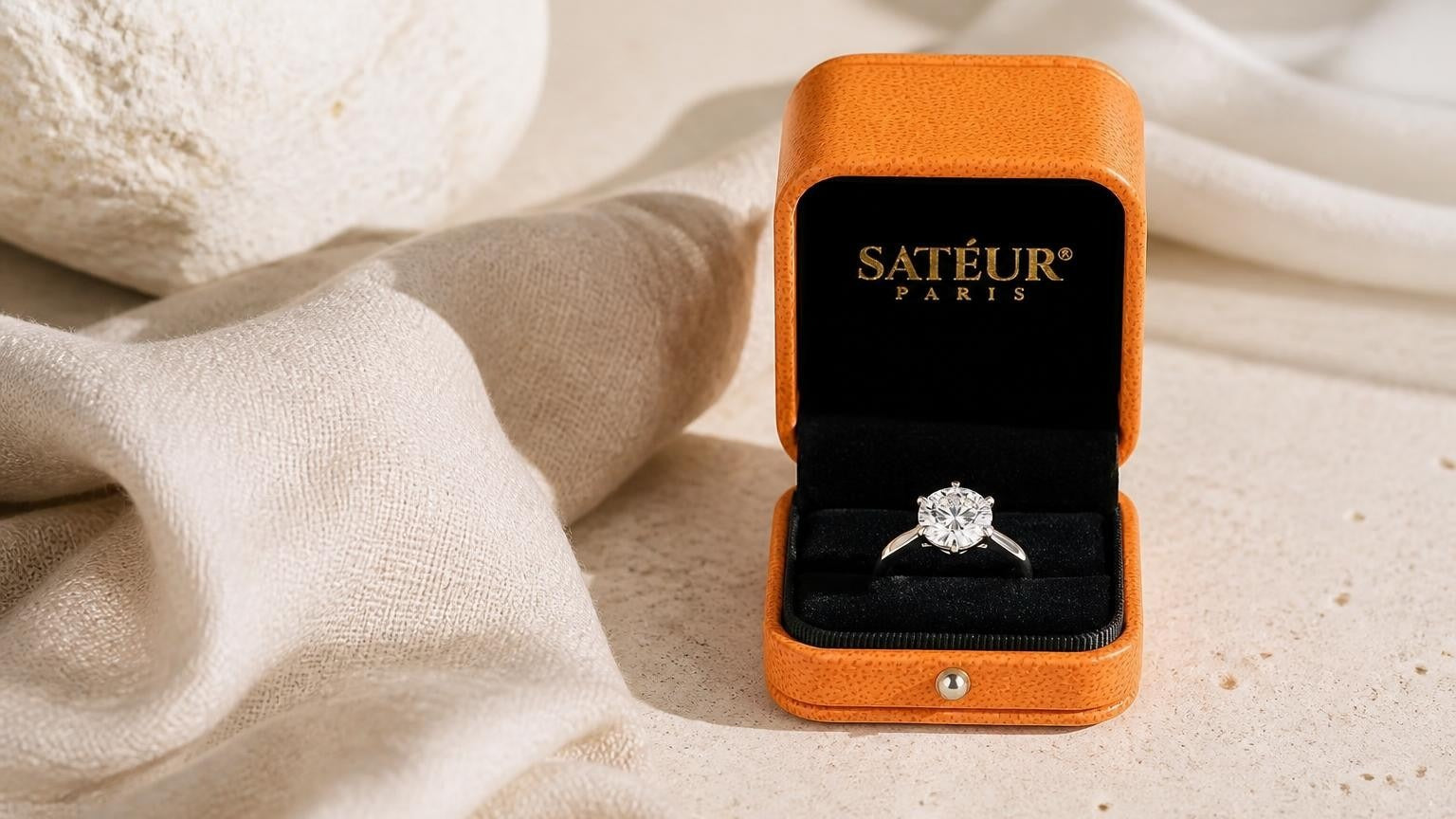
Satéur Destinée Ring™
The look of a flawless diamond, for 1% of the price.
Compare to a $10,000 mined diamond
Joined by 100,000+ couples across 150+ countries.
Discover The 1% RingFree worldwide shipping · 30-day returns · Lifetime Satéur Care

Engagement Ring Design and Customisation
Brilliant Earth's design catalogue is broad. It offers over 100 setting styles — solitaire, pavé, halo, three-stone, vintage — and a configure-your-ring tool that allows the buyer to select a centre stone by cut, carat, colour, and clarity, then pair it with a setting of their choice. The customisation depth is genuine, and the photography is clear. For a buyer who wants a GIA-certified mined or lab-grown diamond and is willing to spend accordingly, the experience is well-constructed.
Satéur's approach is different in kind, not in quality. The The 1% Ring collection focuses on proportion and clarity of design — settings that serve the gem without competing with it. The Destinée Ring, which accounts for a significant share of total Satéur sales, is a study in this approach: a 1.00-carat round cut in 18k white gold finishing, delicate in scale, correct in every proportion. The ring that has been chosen by over 100,000 customers across 150 countries does not require a bespoke configurator. It requires getting the fundamentals right.
That said, Satéur's catalogue extends across earrings, necklaces, and statement rings — including moissanite ring options for those who prefer the higher-dispersion, openly lab-created gemstone — so the range of design expressions is real, if curated rather than exhaustive.
Gemstone Options for Your Ring
The gemstone landscape for engagement rings has expanded considerably. A buyer today encounters four main categories, each with a distinct character and price point.
Mined diamonds — the traditional choice — carry natural origin, geological rarity, and a secondary market. They are what Brilliant Earth's reputation was built on. The price range is wide, but the floor for a quality 1-carat ring is rarely below $5,000 when certification, setting, and retail margin are combined.
Lab-grown diamonds are chemically and optically identical to mined diamonds. They carry IGI or GIA certification, the same hardness (10 Mohs), and the same refractive properties. They represent the most direct alternative within the diamond category, available through Brilliant Earth and a growing number of specialist retailers. Prices have fallen sharply since 2021 but remain in the £1,000–£5,000 range for a quality solitaire. Satéur offers a curated lab diamond collection for buyers who want the real diamond material at a more considered price point.
Moissanite is a lab-created gemstone — not a diamond — with a refractive index of approximately 2.65 and a fire dispersion approximately 2.4 times that of a mined diamond. The result is vivid, rainbow-forward sparkle. Moissanite rates 9.25 on the Mohs scale, making it exceptionally durable. It is openly disclosable as its own gemstone, with its own optical character. Satéur's moissanite collection represents this tier at premium specification.
Satéur Gems® are a trademarked diamond simulant engineered for diamond-accurate visual performance: D-E colour, Excellent cut, a refractive index of approximately 2.39, and the clean white brilliance of a flawless diamond. At approximately 8.8 Mohs, they are built for everyday wear — extremely durable, holding their brilliance for the life of the ring. They are not lab-grown diamonds, and they do not claim to be. They deliver the same visual presence across the table and to the naked eye, at approximately 1% of the cost.
The question of which gemstone is right for an engagement ring is ultimately a question of what you are paying for. If the certificate, the chemical origin, and the secondary market value matter to you, a mined or lab-grown diamond is the answer — and Brilliant Earth is a credible place to buy one. If the visual result, the daily wearability, and the intelligent use of capital are the primary considerations, the simulant category has arrived at a point where the trade is genuinely different from what it was a decade ago.

Frequently Asked Questions
What is the difference between a diamond simulant and a mined diamond?
A mined diamond is a naturally occurring carbon crystal, rated 10 on the Mohs scale, with a refractive index of approximately 2.42 and GIA or AGS certification attesting to its origin and quality. A diamond simulant is an engineered gemstone designed to replicate the visual appearance of a diamond — the same white brilliance, the same D-E colour face-up appearance, the same Excellent cut light return — without the natural origin or the associated price. Satéur Gems® are a trademarked diamond simulant with D-E colour grading, Excellent cut standards, and a refractive index of approximately 2.39 — producing diamond-accurate brilliance that is visually indistinguishable from a flawless diamond with the naked eye.
How durable are diamond simulants for everyday engagement ring wear?
Satéur Gems® rate approximately 8.8 on the Mohs hardness scale — extremely durable and purpose-built for everyday wear. For context, sapphire and ruby sit at 9.0 on the same scale and are worn as fine gemstones daily without issue. The ~8.8 rating means the gem resists everyday scratching from materials encountered in ordinary life. Satéur Gems® hold their surface and their brilliance across years of real wear. The small gap between 8.8 and diamond's 10 is not meaningful in the context of an engagement ring worn through normal daily activity.
What colour and clarity grades does Satéur offer in its gemstones?
Satéur Gems® are produced to D-E colour grading — the top two grades on the standard diamond colour scale, representing the clearest, most colourless appearance possible — and are cut to Excellent standards. This combination produces the clean, white brilliance associated with the finest mined diamonds. Satéur's moissanite tier is similarly top-specification, openly disclosed as a lab-created gemstone with its own distinctive optical character.
Can you customise an engagement ring with a diamond simulant centre stone?
Yes. Satéur's collection offers the Destinée Ring in multiple settings, sizes, and metal finishing options, including 18k white gold finishing. The range extends to statement rings, three-stone designs, and collections named after cultural landmarks — each a considered design expression rather than a configure-your-own-diamond tool. For buyers who want broader setting customisation options alongside simulant or moissanite gems, Satéur's collection is complemented by a growing catalogue across earrings and necklace categories.
How does the price of a diamond simulant ring compare to a traditional diamond ring?
A quality 1-carat mined diamond engagement ring — with GIA certification, Excellent cut, and a standard solitaire setting — typically costs between $5,000 and $15,000 depending on clarity and colour. Brilliant Earth's lab-grown equivalent ranges from roughly $1,500 to $5,000. The Satéur Destinée Ring, with its 1.00-carat Satéur Gems® centre stone and 18k white gold finishing, starts at $138. The visual result across the table — D-E colour, Excellent cut, white brilliance — is achieved at approximately 1% of the mined diamond price point.
What should you know before choosing a diamond simulant for an engagement ring?
Three things matter. First, the hardness: a quality simulant like Satéur Gems® (approximately 8.8 Mohs) is built for daily wear — it is not cubic zirconia, which scratches readily and clouds within a year. Second, the optics: not all simulants are equal. Satéur Gems® are engineered for D-E colour and Excellent cut — the same benchmarks applied to fine mined diamonds — producing diamond-accurate brilliance, not a pale imitation. Third, the terms: a simulant is not a diamond, and a transparent jeweller will tell you so. Satéur does. The value of the choice lies in what it delivers visually and durably, not in what it claims to be.
Brilliant Earth is what it says it is — a legitimate jeweller with documented sourcing standards, genuine certifications, and a functional customer experience. For buyers committed to diamond material, it is a credible choice. The question worth sitting with is what that commitment is actually buying. The visual presence of a fine diamond ring — the quiet brilliance, the D-E clarity, the Excellent cut light return — is now achievable through a different category entirely, at a price that redirects the balance of that budget toward a life rather than a stone.
That is the idea behind The 1% Ring. It does not ask you to compromise on appearance. It asks you to reconsider what you are paying for.















留下评论
此站点受 hCaptcha 保护,并且 hCaptcha 隐私政策和服务条款适用。