

Are Lab Grown Diamonds a Good Investment?
The direct answer: lab grown diamonds are not a reliable financial investment in the traditional sense. They depreciate — often by 70% or more relative to purchase price on the secondary market. But that framing misses what most buyers actually receive: a chemically identical diamond, at 30 to 50% less than a comparable mined stone, worn and cherished for a lifetime. The investment is in the piece and the person wearing it, not in future resale.
This article sets out the full picture — resale reality, quality specifications, production methods, and what distinguishes a lab grown diamond from other diamond-look options at different price points.

Key Takeaways
- Lab grown diamonds are chemically and physically identical to mined diamonds — same carbon structure, same Mohs 10 hardness, same brilliance.
- Resale value typically falls 70% or more below the original purchase price, reflecting supply dynamics and market perception rather than any flaw in the diamond itself.
- A 1-carat round brilliant lab diamond (D color, VS2 clarity) purchased for $4,000–$6,000 may resell for $1,200–$1,800.
- Lab diamonds cost 30–50% less than mined equivalents at point of purchase — the value is in what you get, not what you recover later.
- For those who want the diamond look at the lowest possible entry point, diamond-look gems with D-E color, Excellent cut, and Mohs hardness of approximately 8.8 to 9.25 are available from approximately $88 — about 1% of comparable mined diamond cost.
- The right question is not "will this appreciate?" but "what do I want to own, and what does it actually cost?"

Lab Grown Diamonds as an Investment: The Reality
Lab grown diamonds have moved from niche to mainstream within a decade. That growth has also meant something specific for resale markets: supply has expanded dramatically, while consumer demand for pre-owned lab diamonds has not kept pace. The result is a secondary market that prices lab diamonds at a steep discount relative to original purchase price.
The 70% or greater resale discount is not a reflection of quality. Lab diamonds and mined diamonds of identical specifications show no visible difference to the naked eye. The difference lies in origin — and origin does not appear on the hand.
The discount exists because the secondary market for diamonds has always been thin, and lab grown diamonds face an additional structural challenge: new lab diamonds can be produced at relatively predictable cost, which anchors expectations about what a used stone is worth. When a buyer can purchase a new 1-carat lab diamond for $4,000, the incentive to pay close to that for a pre-owned one is limited.
This is not a temporary condition. It reflects the economics of lab production — expandable supply, declining costs — and it is the honest starting point for any conversation about lab grown diamonds as an investment.
What Are Lab Grown Diamonds?
A lab grown diamond is a real diamond. Carbon atoms arranged in the same cubic crystal structure as a mined diamond, the same chemical composition, the same optical properties, and the same Mohs 10 hardness that makes diamond the hardest natural material known.
Two production methods exist. CVD (Chemical Vapor Deposition) grows a diamond crystal by introducing carbon-rich gas into a chamber at controlled temperature and pressure, allowing carbon atoms to deposit layer by layer onto a substrate. HPHT (High Pressure High Temperature) replicates the geological conditions of natural diamond formation — extreme heat and pressure applied to carbon sources in a controlled press environment.
Both methods produce diamonds that are graded by the same gemological institutes as mined diamonds — IGI, GIA, and others — using the same 4C criteria: cut, color, clarity, and carat weight. An IGI-certified lab diamond carries the same grading documentation as an IGI-certified mined diamond.
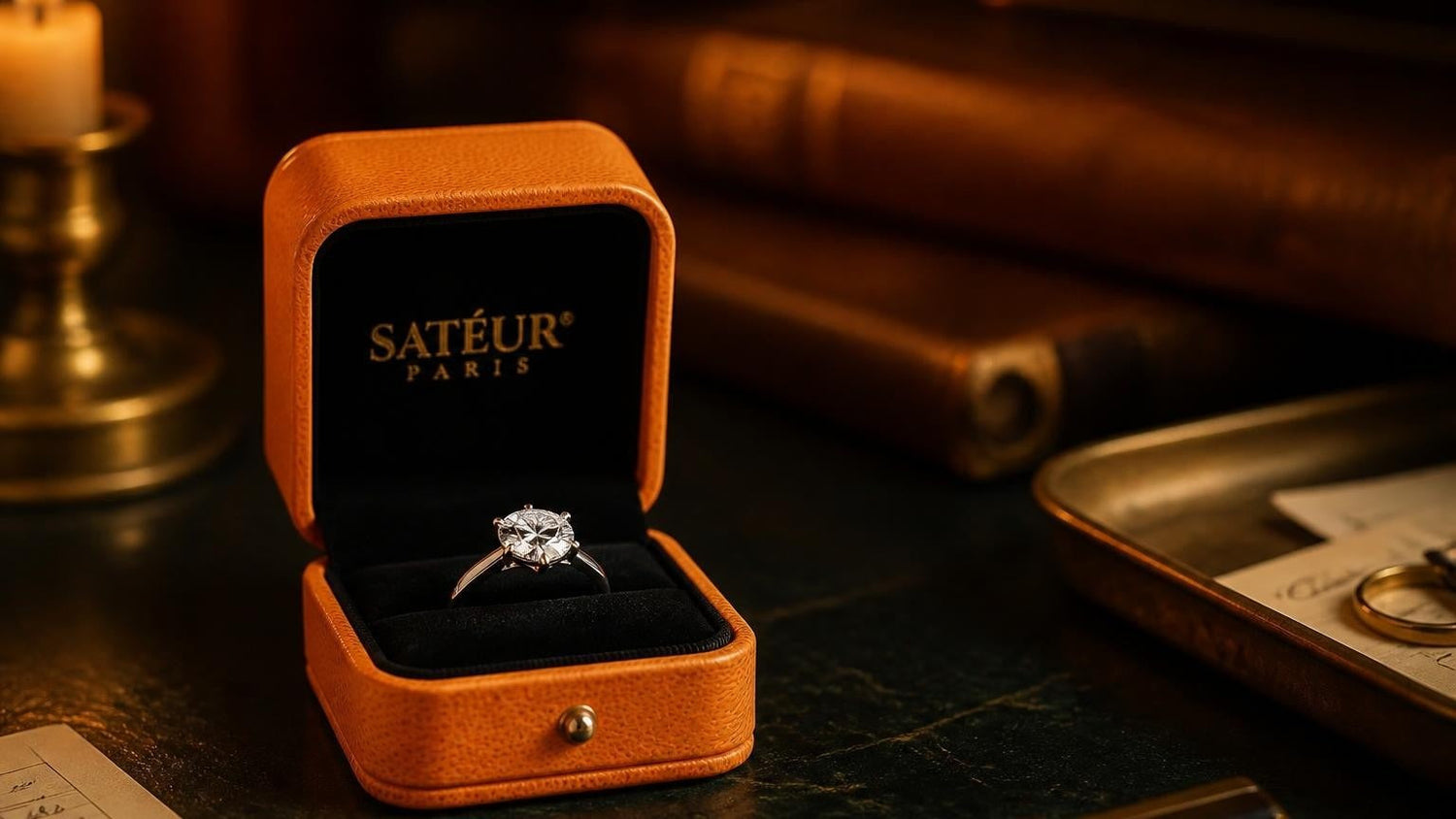
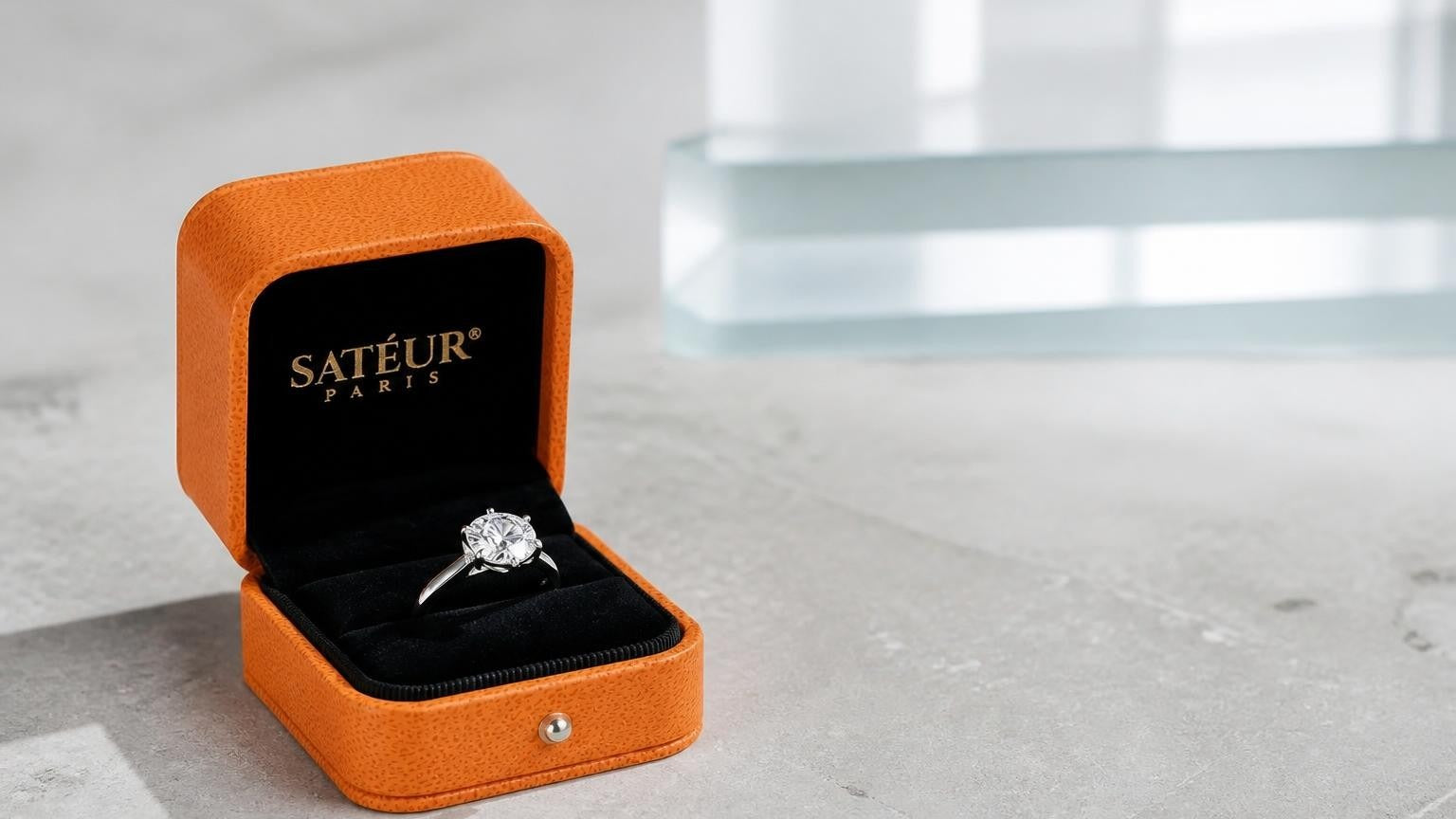
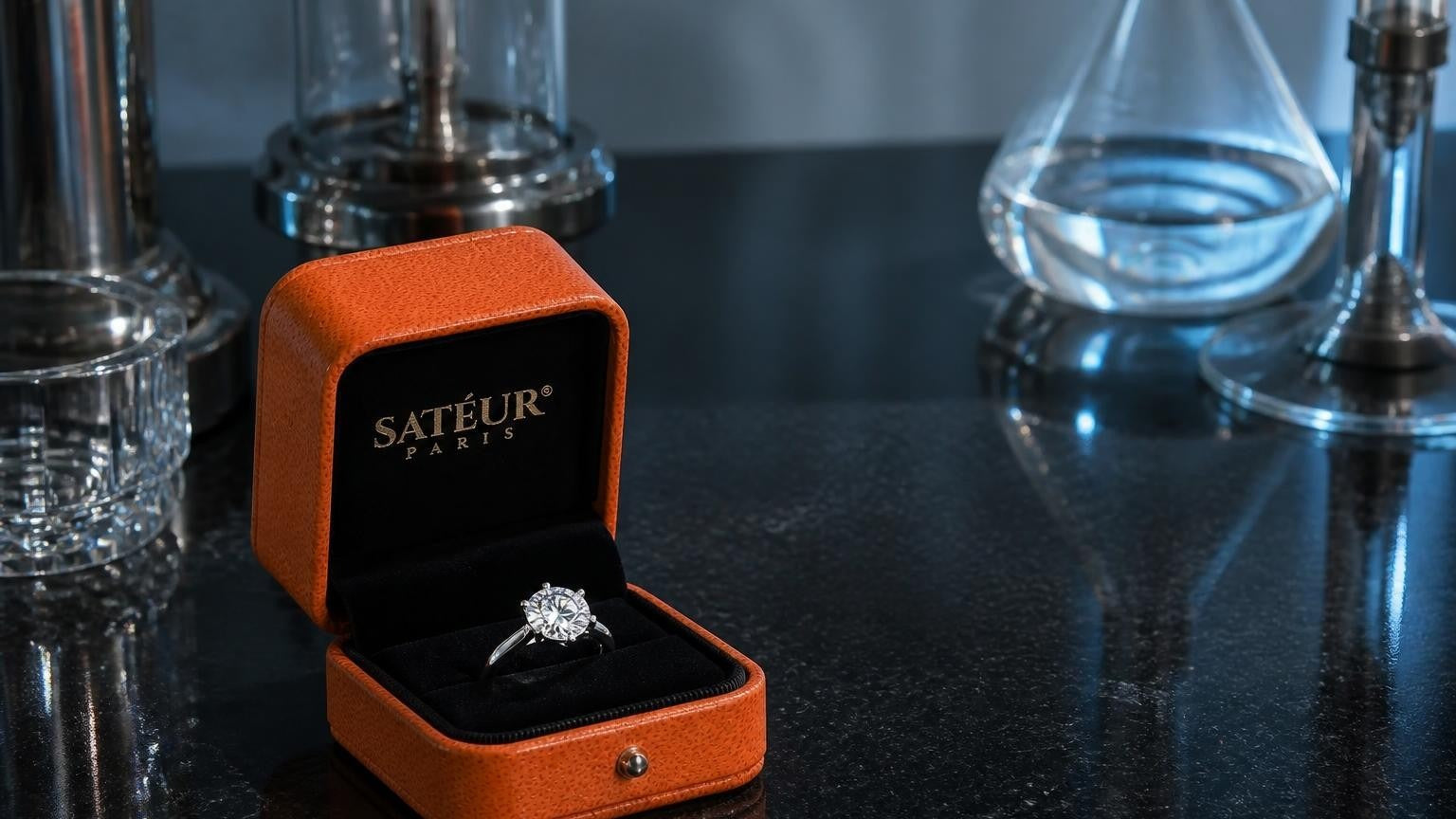
Satéur's lab diamond collection features IGI-certified lab grown diamonds set in solid 18K white gold. The certification travels with the stone.
Lab Diamond Resale Value: Understanding Depreciation
The depreciation pattern for lab grown diamonds is steeper and faster than for most luxury goods that retain some collector or secondary-market value.
A 1-carat round brilliant lab diamond purchased for approximately $4,000–$6,000 today may resell for $1,200–$1,800 on the secondary market — a loss of 60 to 70% or more. This is not a projection; it reflects observable market pricing from resellers, auction platforms, and estate dealers currently active in the category.
By comparison, mined diamonds also depreciate from retail price, though typically less severely — often 20 to 40% from original retail. The secondary market for mined diamonds is more established, inventory is finite, and the perception of rarity supports floor values, however imperfectly.
For lab diamonds, the floor is lower because the ceiling on supply is, in principle, unlimited. Production can scale. Costs have fallen consistently since lab diamond technology matured, and there is no structural reason to expect that trajectory to reverse.
None of this diminishes the quality of the diamond itself. It is how this market is currently structured. Understanding that structure before purchase is the responsible approach — and it reframes the question meaningfully. If you are buying a lab grown diamond, you are buying it for what it is, not for what it might return in ten years.
Lab Grown vs. Mined Diamonds: Price Comparison
The purchase price differential is real and meaningful. Lab grown diamonds enter the market at 30 to 50% less than mined diamonds of equivalent specifications — sometimes more, depending on carat weight and grading tier.
A 2-carat round brilliant mined diamond at D color, VS1 clarity might retail for $25,000–$40,000. The same specifications in a lab grown diamond might be $8,000–$12,000. The stones are visually indistinguishable to the naked eye. The price difference is not about appearance; it is about origin and the economics of supply.
This means a buyer purchasing a lab grown diamond receives more diamond — more carats, higher color grade, better clarity — per unit of spending than a buyer purchasing a mined equivalent at the same budget. From a value-for-money perspective, lab grown diamonds offer a compelling position: an identical object for materially less.
The trade-off is the resale market, as described above. The purchase-price advantage does not translate to a resale-price advantage. The secondary market for both categories discounts from retail, but lab grown diamonds discount more.
For those comparing lab created diamond rings across different carat weights, the per-carat advantage of lab over mined typically widens at larger sizes — a 3-carat lab diamond may represent a significantly larger proportional saving versus mined than a 1-carat equivalent. See the full range of 3 carat lab grown diamond ring options for current pricing.
Energy and Environmental Factors in Lab Production
The environmental case for lab grown diamonds is often presented as clear-cut. The reality is more nuanced than the marketing typically suggests.
Production of lab diamonds via CVD or HPHT methods consumes significant energy. The environmental impact varies by facility and, critically, by the energy source powering it. A CVD facility running on renewable energy carries a materially different footprint than one drawing from a carbon-intensive grid. Neither method involves the land displacement, water use, or community disruption associated with open-pit mining at scale — but the energy calculation is not automatically in lab production's favour when the grid is carbon-heavy.
Responsible producers publish energy source data. It is worth examining when a significant purchase is under consideration.
For the purposes of investment analysis, the environmental profile does not currently translate into a market premium on resale. Green credentials in the lab diamond category have not, at this stage, produced a meaningful difference in secondary market pricing.

The Investment Case: Why Lab Diamonds Differ from Mined
The traditional argument for diamonds as investment objects has always rested on thin foundations. Even mined diamonds — the category most associated with value retention — have not performed consistently as financial assets. They are illiquid, difficult to authenticate without documentation, and subject to market fluctuations shaped as much by perception as by supply.
Lab grown diamonds amplify these challenges because their supply is expandable. Mines are finite; growth chambers are not. This structural difference is why the secondary market prices lab grown diamonds more conservatively than mined diamonds of equivalent grade.
The honest investment case for a lab grown diamond is not financial. It is personal. You receive a chemically and physically identical diamond — graded by the same institutions, set in the same metals, worn across decades — for significantly less than a mined equivalent. The saving is realized at point of purchase, not at resale. That is a different kind of value, and a real one.
Why Lab Diamonds Depreciate Faster
Three forces drive the faster depreciation of lab grown diamonds on the secondary market.
Supply scalability. Because production can be expanded in response to demand, there is no scarcity mechanism to support floor values over time. A rare 5-carat mined diamond benefits from genuine scarcity. A 5-carat lab grown diamond does not carry that characteristic in the same way.
Declining production costs. The cost of producing a lab grown diamond has fallen significantly over the past decade. When new lab diamonds can be produced more cheaply, the market value of existing ones adjusts accordingly.
Narrower secondary buyer pool. Many secondary market buyers prefer mined diamonds for reasons of perception or sentiment. This concentrates resale demand and supports mined prices at the relative expense of lab diamond floor values.
None of these forces relate to the intrinsic quality of the diamond. They are market dynamics — and market dynamics can shift. But the current condition is well-established and reflects structural rather than cyclical pressures.
Lab Diamond Specifications and Quality Grades
Lab grown diamonds are graded identically to mined diamonds. The 4Cs apply in full.
Cut determines how light moves through the stone. For round brilliants, an Excellent or Ideal cut grade produces maximum brilliance and fire. Cut is the most significant factor in how a diamond presents in person.
Color is graded on a D-to-Z scale, where D is colorless. Lab grown diamonds are routinely produced at D, E, and F color — grades that are rare and correspondingly expensive in mined production but more readily available from lab growth. This is one area where lab diamonds deliver tangible specification advantages per dollar.
Clarity is graded from Flawless to Included. Lab grown diamonds can be produced at VS2 or better with regularity; eye-clean stones at SI1 are common. As with color, the per-dollar clarity available in lab diamonds exceeds what mined equivalents offer at the same budget.
Carat weight is measured identically. A 1.00-carat lab diamond is the same physical size as a 1.00-carat mined diamond of the same cut proportions.
IGI certification is the standard documentation for lab grown diamonds. The certificate specifies all four grades and confirms the method of production (CVD or HPHT). All diamonds in the Satéur lab-grown diamond collection carry IGI certification as standard.
Satéur Gems: The Diamond-Look Alternative at Entry Price
For those whose priority is the diamond look rather than the diamond itself — and who are not purchasing for investment purposes of any kind — there is a different entry point worth understanding clearly.
Satéur Gems® are not diamonds. They are diamond-look gems engineered to replicate the visual presence of a flawless diamond to the naked eye. They carry a D-E color equivalent, Excellent cut, and a Mohs hardness of approximately 8.8 to 9.25 — two gem types within the tier, both durable for daily wear over years. They enter at approximately $88, representing roughly 1% of the cost of a comparable mined diamond.
The comparison is deliberate. If the question is appearance — what someone sees on your hand across a table — Satéur Gems® answer that question at a fraction of the price. They are not substitutes for those who want a certified diamond, and should not be described as such. But for wearers whose priority is the visual result rather than the gemological category, they represent a genuinely considered choice.
The two tiers serve different decisions. Lab diamonds — real diamonds, grown in a controlled environment, certified by independent institutions — for those who want the diamond itself. Satéur Gems® for those who want the diamond look, without the diamond price.

Frequently Asked Questions About Lab Diamond Investment
Is a Lab Grown Diamond Worth Anything on the Resale Market?
Yes, but significantly less than the purchase price. Lab grown diamonds typically resell at 70% or more below their original cost. A stone purchased for $5,000 might recover $1,200–$1,800 through a reseller or auction platform. The secondary market exists — it simply prices lab diamonds conservatively, driven by supply scalability and a narrower pool of secondary buyers.
Do Lab Grown Diamonds Hold Their Value?
Not in the sense that collectibles or rare mined stones have historically held value. Lab grown diamonds depreciate faster than mined diamonds on the secondary market, driven by expandable supply and declining production costs. The value of a lab diamond lies in what you receive at purchase — a real diamond at a materially lower price — not in what you recover at resale.
What Is the Price Difference Between Lab and Mined Diamonds?
Lab grown diamonds typically cost 30 to 50% less than mined diamonds of equivalent specifications at point of purchase, with proportionally larger savings at higher carat weights. A 2-carat mined diamond at D/VS1 might retail for $25,000–$40,000; the same grade in lab grown form might be $8,000–$12,000. The stones are visually identical to the naked eye — the price difference reflects origin and supply dynamics, not appearance or durability.
Are Lab Grown Diamonds More Environmentally Friendly?
The environmental picture is more complex than is commonly presented. Lab production avoids the land disruption and displacement associated with open-pit mining, but CVD and HPHT processes consume significant energy. Whether that energy is renewable varies by facility. Some producers are transparent about their energy sources — it is worth examining before a significant purchase. There is no universal answer that applies across all producers.
Should You Buy a Lab Diamond as an Investment or for Personal Wear?
For personal wear. Lab diamonds are not structured as financial assets that appreciate. The investment they represent is the quality of the piece — a chemically identical diamond at a lower cost than mined, worn daily for decades. If the goal is resale return, lab grown diamonds are the wrong vehicle. If the goal is the finest possible diamond for a given budget, they are often the most considered choice available.
How Do Lab Diamonds Compare in Durability and Appearance?
Lab diamonds are identical to mined diamonds in both durability and appearance. Mohs 10 hardness — the same as mined diamond, the highest on the scale — means they resist scratching from everyday materials and remain wearable for a lifetime with normal care. Under standard lighting conditions, lab diamonds and mined diamonds of identical specifications show no visible difference to the naked eye. The origin does not affect how the stone looks or performs across years of daily wear.
What Should You Consider Before Buying a Lab Diamond for Long-Term Value?
Several factors matter. First, understand the resale market clearly — lab grown diamonds depreciate steeply, so purchase with the expectation of wearing the piece, not recovering the cost. Second, prioritize specifications that maximize the wearing experience: cut quality above all, then color and clarity within budget. Third, ensure the stone comes with IGI certification, which documents the grade and method of production. Finally, consider the setting — solid 18K gold holds better over time than plated alternatives and frames the stone appropriately for a piece intended to be worn for years.
Satéur Destinée Diamond Ring
A real, IGI-certified lab-grown diamond, hand-set in solid 18K gold — a fraction of the mined-diamond price.
Compare to a $10,000 mined diamond
Joined by 100,000+ couples across 150+ countries.
Shop the Destinée Diamond RingFree worldwide shipping · 30-day returns · Lifetime Satéur Care















留下评论
此站点受 hCaptcha 保护,并且 hCaptcha 隐私政策和服务条款适用。