

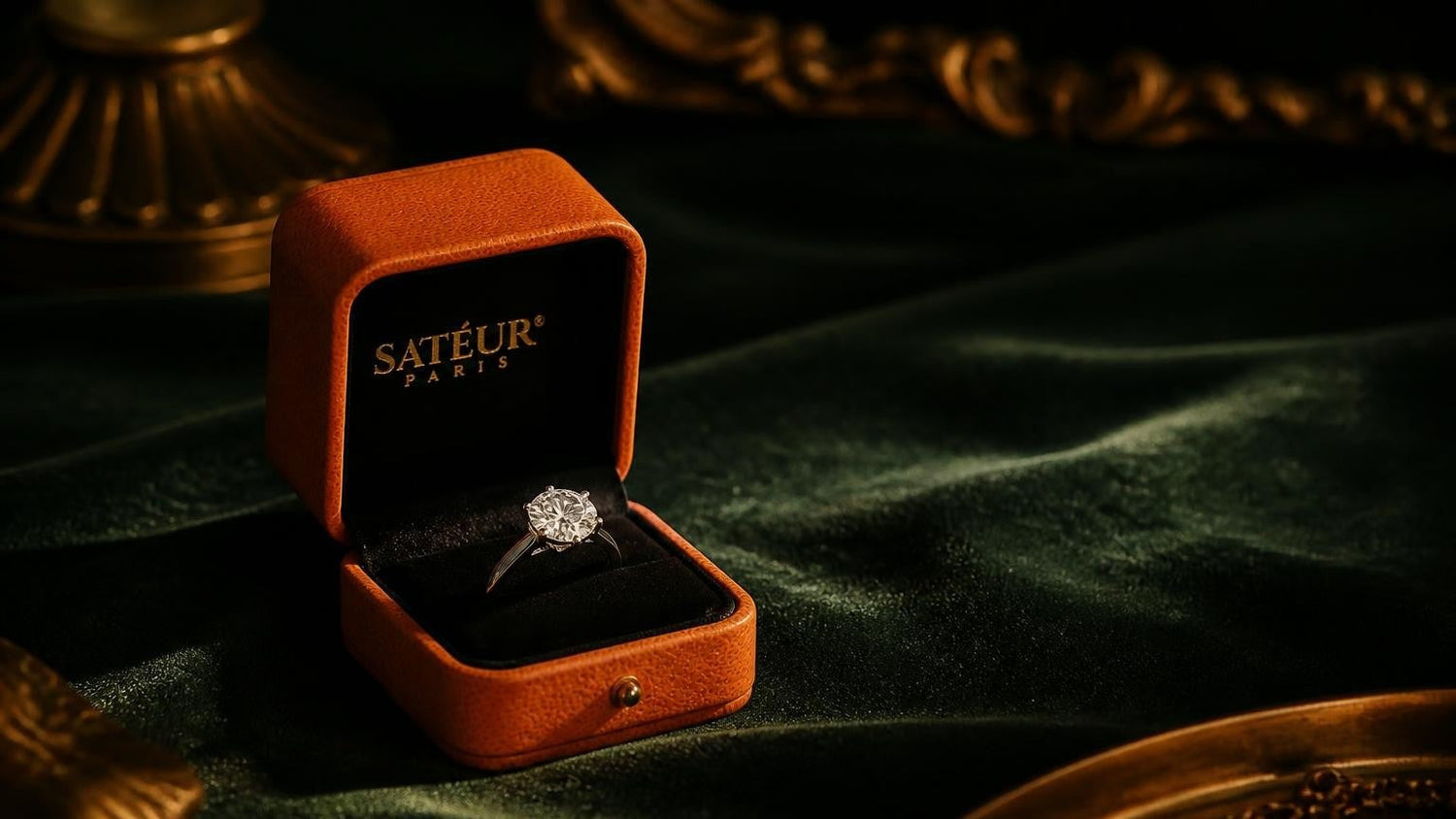
Moissanite vs Diamond Side by Side: The Complete Comparison
Placed side by side in natural light, moissanite and diamond tell two very different stories. One burns with vivid, rainbow-forward fire. The other delivers the restrained, white brilliance most people associate with a flawless diamond. Understanding which story is yours begins with the facts — and the facts are more interesting than the marketing on either side.
This guide compares moissanite and diamond across every axis that matters: optical properties, hardness, colour, price, and the naked-eye experience that decides what an engagement ring actually looks like on the hand. If you have been reading the moissanite vs diamond rings debate, this is the specification layer beneath it.
Key Takeaways
- Moissanite rates 9.25 on the Mohs hardness scale — just below diamond at 10 — making it entirely suitable for a lifetime of daily wear.
- Diamond fire measures approximately 0.044; moissanite exhibits roughly 2.4× greater fire under standard light, producing a vivid, rainbow-forward sparkle.
- Moissanite is available in D–E colour grades, matching the highest diamond colour standards.
- A comparable natural diamond engagement ring runs $8,000–$15,000; Satéur moissanite engagement rings start from approximately $98.
- Both stones resist scratching and clouding in everyday conditions — neither requires special daily care.
- The principal visual difference is not size or clarity: it is the quality of light. Diamond returns white light. Moissanite returns vivid colour.
What Is Moissanite
Moissanite is a lab-created gemstone composed of silicon carbide. It was first discovered in 1893 by French chemist Henri Moissan inside a meteorite crater in Arizona — a provenance that has given it a useful origin story. Natural moissanite is extraordinarily rare. Every moissanite in the market today is grown in controlled laboratory conditions to precise optical specifications.
Its defining characteristic is dispersion — the degree to which a stone separates white light into spectral colour. Moissanite's dispersion coefficient of approximately 0.104 is roughly 2.4 times that of diamond. Under bright or direct light, this produces the vivid, rainbow-forward sparkle that distinguishes moissanite from every other gemstone. For buyers who want maximum visual impact, that is a feature. For buyers who want the specific white brilliance of a fine diamond, it is a meaningful difference.
On the Mohs hardness scale, moissanite rates 9.25 — the second-hardest gemstone in common use, behind only diamond at 10. In practical terms, a moissanite will not scratch from contact with everyday surfaces, will not cloud, and will not change appearance over decades of wear.
What Is a Diamond
Diamond is carbon in its crystalline form — the hardest natural material on earth, rated 10 on the Mohs scale. Natural diamonds form over billions of years under extreme heat and pressure deep in the earth's mantle. They are graded by four criteria: cut, colour, clarity, and carat weight. The finest examples carry D colour (completely colourless) and VS+ clarity.
Diamond's optical signature is white brilliance — the precise return of white light that gives a well-cut stone its characteristic brightness. Its dispersion is lower than moissanite (0.044 vs 0.104), which means less spectral colour and more of what the industry calls "adamantine" lustre: that cold, clean, highly directional flash associated with the finest mined stones.
Natural diamonds carry costs that have little to do with the gem itself — mining operations, supply chain markups, and a decades-long marketing apparatus. The result is pricing that can reach $8,000–$15,000 for a one-carat stone in a quality engagement ring setting. Lab-grown diamonds offer the same chemical composition at reduced cost, though still significantly above moissanite pricing. For those considering all alternatives, the full guide on moissanite vs diamond vs lab diamond covers the three-way comparison in detail.
Moissanite vs Diamond: Optical Properties
Optical performance is where the genuine difference lives. The table below places both stones against each other on the specifications that determine what they look like in use.
| Property | Moissanite | Natural Diamond |
|---|---|---|
| Refractive Index | 2.65–2.69 | 2.42 |
| Dispersion (Fire) | 0.104 — approx. 2.4× diamond | 0.044 |
| Brilliance type | Vivid, rainbow-forward | White, restrained, adamantine |
| Mohs Hardness | 9.25 | 10 |
| Colour Range | D–E (colourless) available | D–Z (colourless to yellow) |
| Origin | Lab-created | Mined or lab-grown |
| Price (1ct equivalent) | From ~$98 (Satéur) | $8,000–$15,000+ (natural) |
| Ethical profile | No mining required | Mining-dependent (natural); conflict-free certification available |

The refractive index of moissanite (2.65–2.69) exceeds diamond (2.42), which is part of why moissanite's fire is so pronounced. A higher refractive index means more light is bent and separated as it exits the stone — the mechanism behind that vivid spectral display. For the engaged buyer comparing stones side by side, the difference in fire is visible in the first minute of looking.
Hardness and Durability
Both moissanite and diamond are appropriate for lifetime daily wear. The Mohs scale measures resistance to surface scratching, and at 9.25, moissanite is resistant to scratches from virtually every material encountered in everyday life — metal, concrete, ceramic, other gemstones below its rating. Diamond at 10 is the hardest natural material known, though the practical advantage in a ring setting is marginal for most people's lives.
Neither stone clouds in regular use. Neither is affected by household cleaning products, water, or the mild impacts of daily wear. The 0.75-point hardness gap between moissanite and diamond is a specification, not a lifestyle concern.
Where durability matters most is in the setting — the metal that holds the stone. A well-made setting in 18k gold finish protects both stones equally. The ring as a system matters more than the hardness point difference between the two gems.
Color and Clarity Across Both Stones
Colour in gemology is measured on a scale from D (completely colourless) to Z (visibly yellow or brown). The finest natural diamonds — the ones that command premium pricing — sit at D–F. Modern moissanite is manufactured to D–E colour standards, meaning the stone itself is colourless or near-colourless and will not show warmth to the naked eye.
Clarity refers to internal inclusions — microscopic features formed during growth. Premium moissanite is produced to VS+ clarity standards, placing it alongside the upper tier of natural diamonds by that measure. The difference is that moissanite achieves this through controlled laboratory conditions, not geological chance.
One colour note: under specific lighting conditions — particularly strong overhead fluorescent or direct sunlight — moissanite's higher dispersion can produce a faint greenish or greyish tint in larger stones. This is dispersion-related, not a colour grade issue, and is not present in most lighting environments. A well-cut premium moissanite in D–E colour will appear white to the naked eye in the vast majority of conditions.

Fire and Sparkle: A Visual Comparison
Fire is the technical term for a gemstone's spectral dispersion — the degree to which it separates white light into visible colour. Diamond fire (0.044) is low and precise, which is what makes diamond look clean, white, and highly directional. The flash of a well-cut diamond is sharp, controlled, and unmistakably bright without being colourful.
Moissanite fire (0.104) is roughly 2.4 times diamond's. The result is a vivid, rainbow-forward sparkle that many buyers find dramatic and visually impressive — especially in motion. The stones genuinely look different side by side in direct light. Some buyers prefer the drama of moissanite's display. Others find it departs too far from the classic diamond look and prefer something closer to the natural diamonds they are comparing against.
Neither is objectively superior. The question is which visual signature matches the hand it will sit on, and the eye that will look at it across the table.
For those who want the look of a flawless diamond — the restrained white brilliance, the diamond-accurate appearance — the comparison of moissanite vs diamond vs Satéur explores how different gem tiers address that specific objective, including Satéur Gems®, which is calibrated for the clean, white brilliance of a fine diamond rather than moissanite's vivid fire.

Price Comparison
Price is where the comparison becomes most straightforward. A one-carat natural diamond engagement ring of reasonable quality (VS2 clarity, G colour, excellent cut, solitaire setting) runs $8,000–$15,000 depending on supplier and market. A comparable lab-grown diamond sits at $2,000–$4,000. A premium moissanite of equivalent carat weight and D–E colour costs a fraction of either.
The price difference is not about visual quality — it is about supply, economics, and the accumulated mythology of the traditional diamond industry. Moissanite's optical properties are measurably different from diamond, but in a setting, at conversational distance, both are brilliant and both look exceptional. The question is what the remaining budget means to the buyer.
At Satéur, moissanite engagement rings start from approximately $98. That positioning is not a compromise — it is a reallocation. The money not spent on mining and markup goes into design, cut, and the context the ring exists in.

Satéur Destinée Ring™
The look of a flawless diamond — hand-set in 18k gold finishing, from $88.
Compare to a $10,000 mined diamond
Joined by 100,000+ couples across 150+ countries.
Shop Destinée RingFree worldwide shipping · 30-day returns · Lifetime Satéur Care
Satéur Moissanite Rings: The Value Proposition
Satéur moissanite rings are positioned as the considered choice for buyers who want maximum brilliance without the price infrastructure of the natural diamond industry. Every Satéur moissanite is a lab-created gemstone selected for D–E colour and VS+ clarity, set in 18k gold finish settings built for lifetime wear.
The Satéur moissanite ring collection begins at approximately $98 — a price point that traditionally buys a lower-quality cubic zirconia in a fast-fashion setting. The difference is in the gem itself: a lab-created gemstone with 9.25 Mohs hardness, genuine optical performance, and a fire coefficient that exceeds any diamond alternative.
For buyers who want the vivid, rainbow-forward sparkle that moissanite uniquely offers — and who want it in a setting that reflects the quality of the stone — Satéur's moissanite collection represents the value proposition the market has been waiting for. Over 100,000 customers across more than 150 countries have chosen Satéur. Many of them began exactly where you are now: weighing moissanite against diamond, side by side, asking which choice is the smarter one.
The Satéur Destinée Ring™ — The 1% Ring® — represents a different gem tier entirely: Satéur Gems®, calibrated for the clean, white brilliance of a flawless diamond rather than moissanite's vivid fire. If that optical signature interests you, it is worth understanding the distinction. Both are exceptional. They simply answer different questions about what brilliance should look like.
The New Diamond Standard is not about which stone is the hardest. It is about which choice is the wisest — and whether the ring you choose reflects what you actually value.
Frequently Asked Questions
What is the main visual difference between moissanite and diamond?
Placed side by side, the principal difference is the quality of light return. Diamond returns white, clean, highly directional brilliance — what gemologists call adamantine lustre. Moissanite returns vivid, rainbow-forward fire, with a dispersion coefficient approximately 2.4 times that of diamond. In direct or bright light, the spectral colour display of moissanite is clearly visible and clearly different from a diamond's more restrained flash. Both are visually impressive. They are simply impressive in different ways.
How does moissanite compare to diamond in terms of hardness?
Moissanite rates 9.25 on the Mohs hardness scale, making it the second-hardest gemstone in common use. Diamond rates 10 — the hardest natural material known. In practical daily wear, the difference is negligible. Moissanite will not scratch from contact with surfaces encountered in normal life, will not cloud, and will not change appearance over time. Both stones are appropriate for lifetime wear in an engagement ring setting.
Why does moissanite cost significantly less than diamond?
Moissanite is a lab-created gemstone — grown in controlled laboratory conditions rather than extracted from the earth. This eliminates the mining infrastructure, global supply chain, and market scarcity that drive natural diamond pricing. The optical properties of moissanite are not inferior to diamond — in some respects (fire, refractive index) they exceed it. The lower price reflects economics and origin, not a compromise in visual quality.
Can moissanite be used in an engagement ring?
Yes — moissanite is entirely appropriate for an engagement ring intended for lifetime daily wear. At 9.25 on the Mohs scale, it resists scratching from virtually every surface encountered in daily life. It does not cloud, does not lose its optical properties over time, and performs as well as diamond in a correctly constructed setting. Many buyers who compare moissanite vs diamond choose moissanite specifically for its vivid fire and the intelligence of its price position.
How do the colour grades of moissanite and diamond compare?
Premium moissanite is produced to D–E colour standards — the same colourless grade as the finest natural diamonds. Moissanite is available in genuinely colourless form, without the warmth that appears in lower-grade diamonds (G–Z range). One nuance: in specific lighting conditions (particularly strong overhead fluorescent), larger moissanite stones can show a faint greenish tint related to their high dispersion. This is not a colour grade issue and does not appear in most lighting environments.
Will moissanite look different to the naked eye over time?
No. Moissanite does not cloud, scratch from daily surfaces, or change its optical properties over time. A moissanite purchased today will look the same in twenty years, assuming normal care (periodic cleaning with mild soap and water). This is one of the advantages of its 9.25 Mohs hardness — the surface remains resistant to the abrasion that dulls softer gemstones. Both moissanite and diamond are considered lifetime gemstones for this reason.















留下评论
此站点受 hCaptcha 保护,并且 hCaptcha 隐私政策和服务条款适用。