

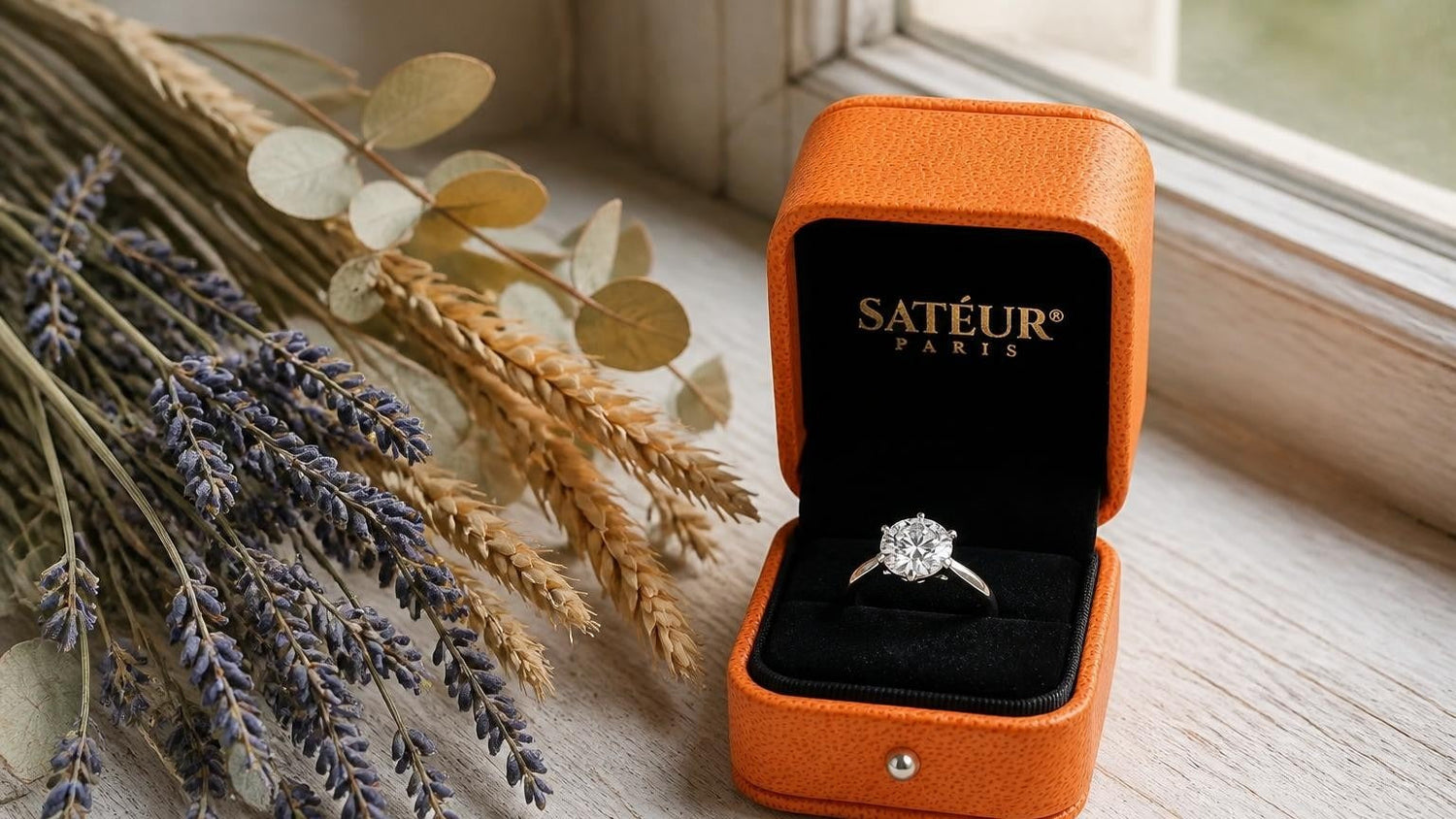
The Best Affordable Engagement Ring Brands in 2026
The engagement ring market has shifted. What once required months of savings and a trip to a high-street jeweller can now be navigated from a browser — with considerably more intelligence, and considerably less compromise. This guide covers the brands worth considering across every budget tier: from established lab-grown diamond retailers to the Maison that built an entirely different approach to the diamond look. The engagement ring cost guide covers what the market charges on average; this article addresses which brands make the most of your budget and what each option actually delivers.
Key Takeaways
- The average US engagement ring diamond runs 1.08–1.2 carats — the look most buyers want is attainable for far less than the mined price.
- Satéur replicates the look of a flawless diamond for approximately 1% of a mined diamond's price — D–E colour, Excellent-cut gemstone, diamond-look guarantee standard.
- Mainstream affordable settings (Blue Nile, James Allen) still start around $750 before the stone; moissanite or lab-diamond alternatives bring total costs below $1,500.
- Brilliant Earth, Ritani, and With Clarity offer IGI-certified lab-grown diamonds from roughly $1,000–$3,000 for a 1-carat ring.
- Etsy independent makers offer the most personalisation at the lowest metal cost; stone quality varies considerably.
- The ring's visual presence — what it reads like across a table — is achievable at every tier listed here.
What Makes an Engagement Ring "Affordable"?
Affordable is relative. For most buyers, it means spending less than the traditional benchmark — three months' salary — without sacrificing the look they had in mind. In practice, the cost of any engagement ring breaks into three components: the setting (metal, design, labour), the centre stone (the largest single cost), and the brand margin built into both.
The stone drives most of the price. A 1-carat mined diamond with D–E colour and Excellent cut retails between $8,000 and $14,000 for the gemstone alone. A lab-grown diamond of the same specification costs roughly $1,000–$2,000. A moissanite — lab-created, 9.25 Mohs hardness, with more fire than a diamond — runs $200–$600. And a Satéur Gems® stone, engineered to carry the clean, white brilliance of a flawless diamond, is available in a complete ring from $138.
Each tier is a genuine choice. The question is which options matter most: the certificate, the look, the story, or the value. Knowing where the price actually lives makes it easier to find the right ring without overpaying for the wrong thing.

Satéur — The $10,000 Look for 1% of the Price
Satéur occupies a category of its own among affordable engagement ring brands. The Maison's core offering — the Satéur Destinée Ring™, known as The 1% Ring® — is built around a trademarked diamond simulant graded D–E colour, Excellent cut, with a refractive index of approximately 2.39. To the naked eye, it carries the restrained, white brilliance of a fine diamond. Not the vivid rainbow fire of moissanite — the specific, diamond-accurate look that most buyers are actually seeking when they picture an engagement ring.
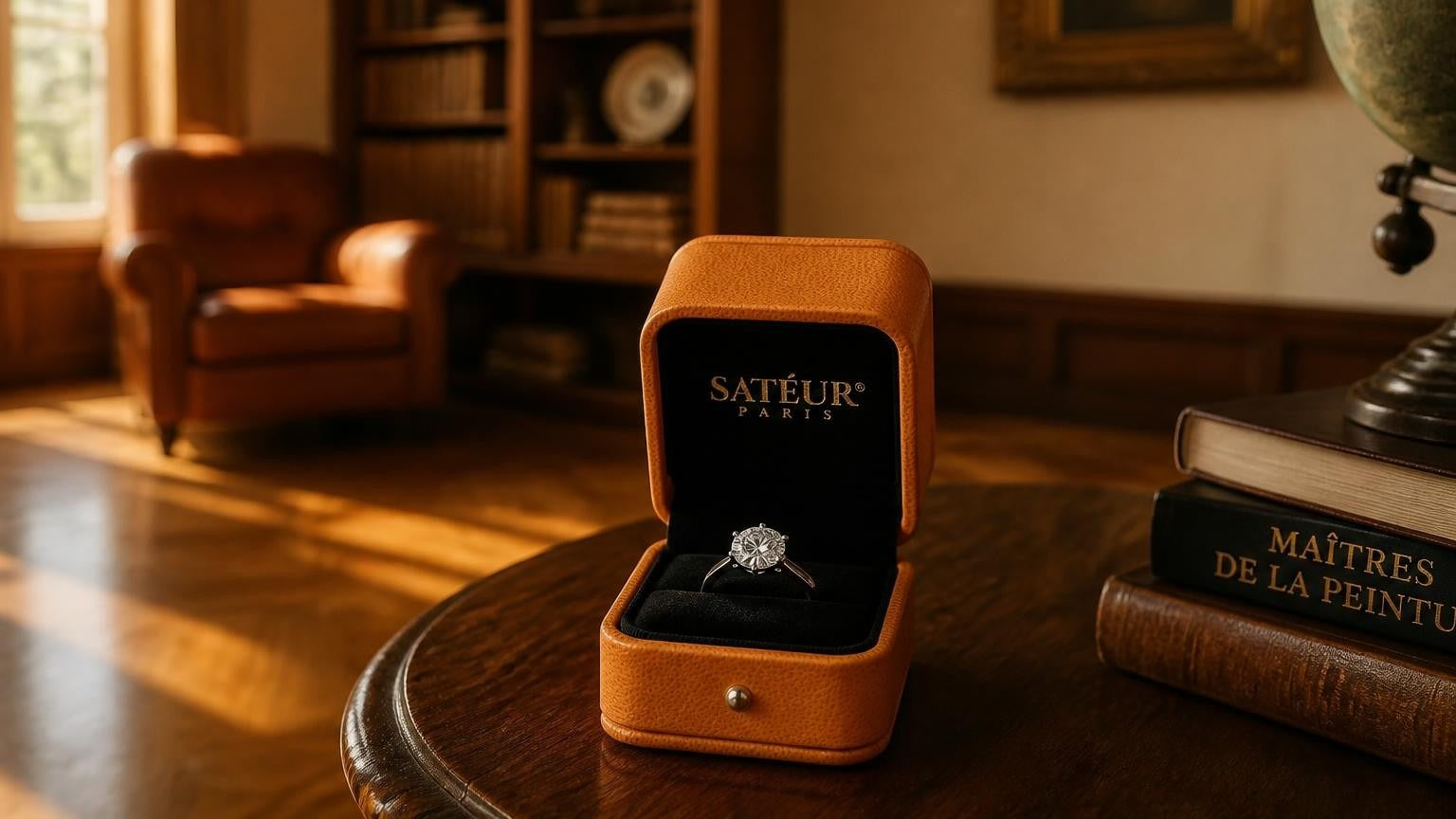
A diamond-look guarantee and the signature orange Satéur box come standard on every ring. The full Destinée Ring retails from $138. Compare that to the $8,000–$14,000 a mined 1-carat diamond engagement ring commands at retail, and the case becomes clear. This is not a compromise. It is a more considered allocation of the same engagement ring budget.
Satéur also offers a moissanite tier — lab-created, 9.25 Mohs hardness, with more fire than a diamond for buyers who prefer vivid, rainbow-forward sparkle — and an IGI-certified lab-grown diamond tier for those who want the chemical and optical credentials of a real diamond. Three distinct answers to the same question, each priced and positioned with precision.

Satéur Destinée Ring™
The look of a flawless diamond, for 1% of the price.
Compare to a $10,000 mined diamond
Joined by 100,000+ couples across 150+ countries.
Shop The 1% RingFree worldwide shipping · 30-day returns · Lifetime Satéur Care

Brilliant Earth, Blue Nile & Ritani Compared
These three brands represent the established end of the online affordable engagement ring market. They share a common model: choose a certified stone, select a setting, receive a finished ring. Each has built a reputation on transparency, selection, and documented provenance.
Brilliant Earth is the sustainability-led option. It offers both lab-grown and responsibly sourced mined diamonds, with particular emphasis on ethical chain of custody. A 1-carat lab-grown diamond engagement ring starts around $1,200–$2,000. The design language is refined; the prices reflect the brand's positioning in the sustainable-luxury space.
Blue Nile pioneered online diamond retail and remains the largest by volume. Its strength is selection — hundreds of thousands of certified stones, with filters for every specification. Settings start around $750 in 14k gold; a complete 1-carat lab-grown ring typically runs $1,500–$3,500 depending on cut and clarity grade. Blue Nile's pricing is competitive; its presentation is functional and thorough.
Ritani bridges online and in-store — rings can be previewed at partner jewellers before purchase. Pricing is broadly comparable to Blue Nile; the try-before-you-buy model suits buyers who find the fully online process impersonal. A useful option for those whose engagement ring budget sits in the lab-grown diamond tier.
All three carry IGI or GIA certifications for lab-grown diamonds. They are credible, reliable options for buyers whose priority is a certified stone with full documentation. For those willing to reconsider what that certification actually proves about the ring's visual presence, the value case for alternatives shifts considerably.
James Allen & With Clarity
James Allen set the standard for online diamond visualisation. Its 360-degree imagery and real-time ring builder remain the clearest in the category. Lab-grown diamonds are available alongside mined options; prices for a 1-carat lab-grown engagement ring typically range from $1,000 to $4,000. James Allen suits the buyer who wants complete control over every specification and finds value in the research process itself.
With Clarity differentiates on the home try-on programme — a replica ring shipped free before the real purchase. For buyers uncertain about how a specific style or carat size looks on their hand, this removes the central anxiety of buying fine jewellery online. Pricing is mid-range; the home preview is genuinely useful for first-time buyers navigating their options.
Both brands occupy the same fundamental position: lab-grown diamond specialists with transparent pricing and strong digital experiences. The stones are real, the certificates are real, and the cost is a fraction of mined. The remaining gap — between a lab diamond ring and a Satéur Gems® ring — is a question of whether the certificate is the priority, or whether the look is.
Etsy & Independent Makers
Etsy has become a legitimate destination for engagement rings, particularly for unusual settings, vintage-inspired designs, and personalised work. The best independent goldsmiths on the platform offer craftsmanship comparable to established jewellers at lower overhead. A custom solitaire setting in 14k gold, without a stone, typically runs $200–$600 — making Etsy the most cost-efficient route to a distinctive metal design.
The caveat is stone consistency. Etsy sellers source gemstones independently, and the range of quality is wide — from excellent moissanite at transparent specifications to low-grade options with no documentation. Buyers who supply their own gemstone, pairing a trusted Etsy metalsmith with a Satéur stone sourced separately, can achieve a highly personalised affordable engagement ring at a fraction of the department-store price.
Etsy rewards buyers who already know what they want. For those less comfortable navigating stone specifications independently, the established brands above offer more predictable outcomes. It is the right option for a specific kind of buyer: one who has already decided on the gemstone and wants complete control over the setting design.

How to Get More Ring for Your Budget
The single highest-leverage decision is stone type. Metal costs are relatively fixed across the category — a 14k gold solitaire setting runs $300–$800 at most brands. The gemstone is where most of the engagement ring price lives, and where the most intelligent savings are available.
A useful framework: decide what the ring needs to do, then find the stone tier that delivers it. If the priority is documented provenance and a certified lab-grown diamond, Brilliant Earth or James Allen are the right options. If the priority is the precise visual of a flawless diamond — the clean white light, the specific presence that the diamond look carries — without the cost of certification, Satéur Gems® is the more considered choice.
See also: what engagement rings cost on average and how much to spend on an engagement ring — both provide the market context that makes these brand comparisons useful.
Where to Save: Stone, Setting & Carat
Three practical levers for getting more ring for your budget:
Stone type. Moving from a mined diamond to a lab-grown diamond saves 60–80% on the stone. Moving to moissanite saves 90–95%. Satéur Gems® — as a trademarked diamond simulant engineered for the diamond look — delivers the appearance at approximately 1% of the mined diamond price. Each step down in stone category saves money; the question is what the ring needs to carry.
Carat weight. Diamond prices scale non-linearly at round-number carat weights (1.00ct, 1.50ct, 2.00ct). A 0.97-carat gemstone is visually indistinguishable from a 1.00-carat stone with the naked eye, and typically costs 15–20% less. The same logic applies across every tier. Most buyers are paying for the number, not the visible difference.
Setting complexity. A solitaire in 14k gold is the cleanest option at every price point. Pavé shoulders, halo settings, and elaborate band work add cost without changing the centre gemstone — which is what most people actually notice on the hand.
Price Comparison Table
| Brand / Option | Stone Type | 1-Carat Ring (Approx.) | Certificate | Diamond Look |
|---|---|---|---|---|
| Satéur | Satéur Gems® (trademarked diamond simulant) | From $138 | Diamond-look guarantee | Diamond-accurate — clean white brilliance |
| Satéur Moissanite | Lab-created moissanite | From ~$98 | — | More fire than diamond — vivid, rainbow-forward |
| Satéur Lab Diamond | IGI-certified lab diamond | From $698 | IGI | Real diamond (lab-grown) |
| Brilliant Earth | Lab-grown diamond | $1,200–$2,500 | IGI / GIA | Real diamond (lab-grown) |
| Blue Nile | Lab-grown diamond | $1,500–$3,500 | IGI / GIA | Real diamond (lab-grown) |
| James Allen | Lab-grown diamond | $1,000–$4,000 | IGI / GIA | Real diamond (lab-grown) |
| With Clarity | Lab-grown diamond | $1,200–$3,000 | IGI / GIA | Real diamond (lab-grown) |
| Etsy (independent) | Varies (moissanite / other) | $300–$1,500 | Varies | Varies by stone |
Why Satéur Wins on Value
Every brand listed here is a legitimate option. The question is what value actually means in this context — and who it is for.
For buyers who require a certified lab-grown diamond — for personal, family, or resale reasons — Brilliant Earth, Blue Nile, and James Allen are the most reliable routes. The cost is real, the documentation is real, and the stone is optically a real diamond.
For buyers whose priority is the look of a flawless diamond — what it reads like across the table, what it looks like on the hand, what it communicates in a room — Satéur arrives at the same visual destination for a fraction of the cost. The Destinée Ring carries D–E colour, Excellent cut, and the diamond-accurate brilliance that most people associate with a fine engagement ring. It comes with a diamond-look guarantee. It ships in the signature orange box.
Over 100,000 customers across 150+ countries have made that calculation. The full engagement ring collection is at sateur.com. The New Diamond Standard is not a claim about chemistry. It is a claim about intelligence.
Affordable Engagement Ring FAQ
What makes an engagement ring affordable?
The stone type is the primary lever. Moving from a mined diamond to a lab-grown diamond, moissanite, or a trademarked diamond simulant like Satéur Gems® reduces the stone cost by 80–99% while preserving the visual. Setting material and complexity account for the remainder — a solitaire in 14k gold remains the most efficient option at every price point.
What is the best affordable engagement ring brand?
It depends on what the ring needs to do. For the certified lab-grown diamond experience at a transparent price, Brilliant Earth and James Allen are consistently strong. For the precise visual of a flawless diamond at the lowest possible cost — without requiring certification — Satéur's Destinée Ring delivers D–E colour, Excellent cut, and a diamond-look guarantee from $138.
How much should you spend on an engagement ring?
There is no fixed answer. The three-months-salary rule is a marketing convention, not a meaningful benchmark. A more useful frame: spend what makes the ring feel right for your relationship and your finances. See the average engagement ring cost guide for what couples actually spend in 2026.
Do engagement rings have to have diamonds?
No. The expectation of a diamond is a 20th-century industry convention. Moissanite, lab-grown diamonds, sapphires, and Satéur Gems® all make excellent centre gemstones — each with different optical properties, durability ratings, and price points. The ring should reflect the relationship, not comply with a convention.
What is a realistic budget for an engagement ring?
A complete ring with a quality centre gemstone starts around $138 for a Satéur Gems® ring, $500–$1,500 for a moissanite ring from a quality retailer, and $1,000–$3,000 for a 1-carat lab-grown diamond ring. Mined diamonds at the same specification run $9,000–$15,000. A realistic budget exists at any of those figures — the choice is the stone tier, not the affordability.
Which brand looks expensive but is affordable?
Satéur is the most consistent answer. The Destinée Ring carries diamond-accurate brilliance — D–E colour, Excellent cut, clean white light — in a setting designed at Maison level. It retails for 1% of the price a comparable mined diamond ring would command. With the naked eye, the difference is not visible. The price is.










留下评论
此站点受 hCaptcha 保护,并且 hCaptcha 隐私政策和服务条款适用。