

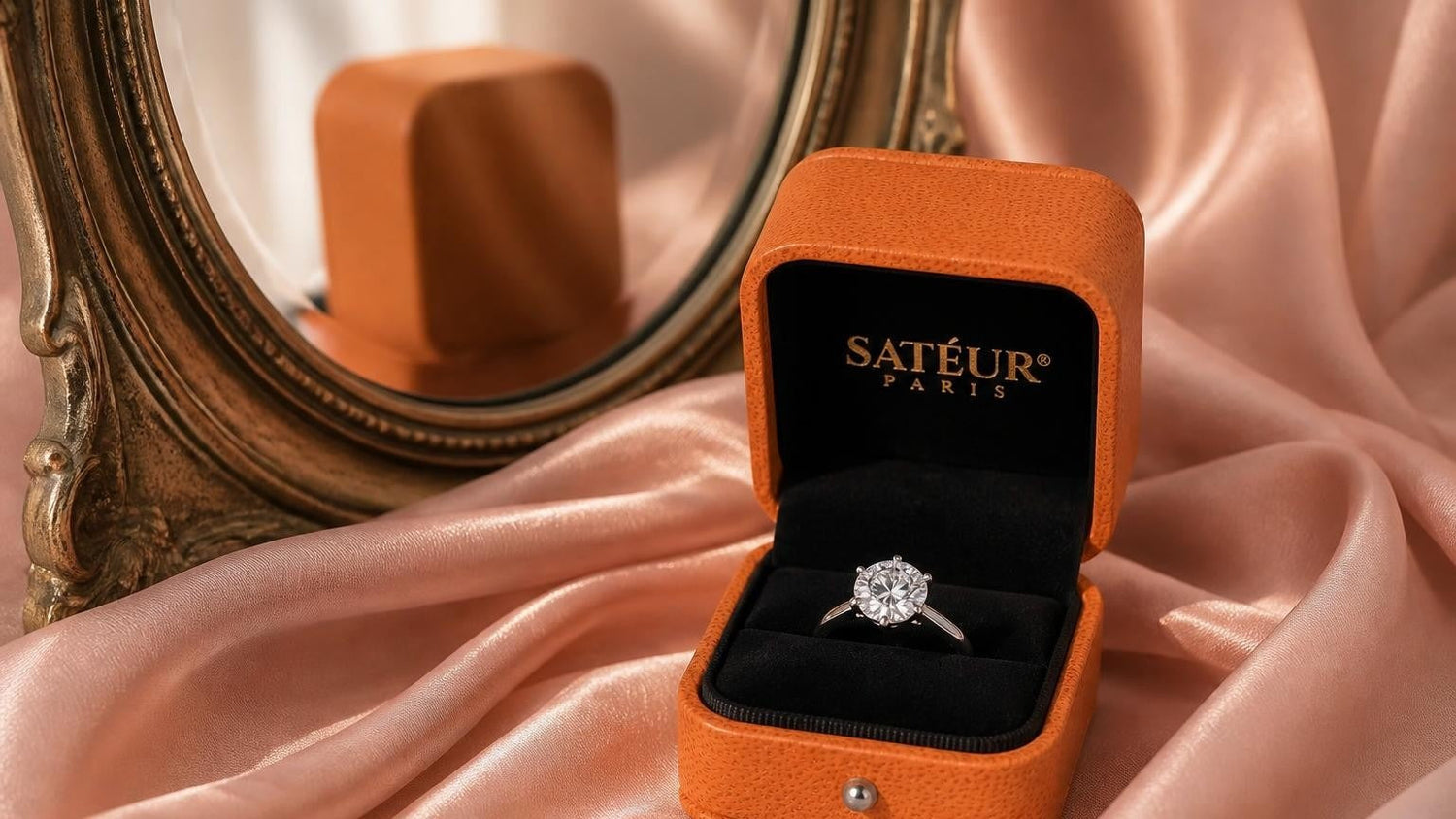
Types of Engagement Rings: A Complete Guide to Settings and Styles
The engagement ring is one of the most considered objects a person ever selects. Every detail — the setting architecture, the centre stone, the metal, the profile — communicates something about who is wearing it and who chose it. Understanding the types of engagement rings available is not a purchasing exercise. It is a process of narrowing infinite possibility down to something singular and right.
This guide covers every major engagement ring setting and style: what distinguishes each one, who it suits, and how the centre stone interacts with the design. Whether the preference runs to the disciplined simplicity of a solitaire or the layered brilliance of a halo, the answer begins with understanding the architecture.
Key Takeaways
- Solitaire settings account for approximately 45% of all engagement ring purchases — the enduring default for a reason.
- Halo settings optically enlarge the centre stone by surrounding it with a ring of smaller gems, creating the appearance of greater size and brilliance.
- Three-stone rings carry the symbolic meaning of past, present, and future, with the centre stone conventionally larger than the flanking pair.
- Emerald and asscher cuts feature step faceting that creates a distinctive hall-of-mirrors effect — the choice for those who favour clarity over fire.
- Pavé and channel settings add continuous sparkle along the band without altering the centre stone's primary presence.
- Satéur Gems® deliver D-E colour, Excellent cut, and the clean white brilliance of a flawless diamond — from approximately $138, at roughly 1% of a comparable mined diamond's price.
Engagement Ring Styles and Setting Types
An engagement ring setting is the structure that holds the centre stone in place. It determines how much light reaches the gem, how the ring looks in profile, how practical it is for everyday wear, and how prominently the stone reads from across a room. The setting and the stone are inseparable — choosing one without considering the other produces a result that works on neither.
The principal engagement ring styles are: solitaire, halo, hidden halo, three-stone, pavé, side-stone, and step-cut designs such as emerald and asscher. Each has a distinct geometry and a distinct visual signature. Below, each is examined in full.
1. Solitaire Engagement Rings
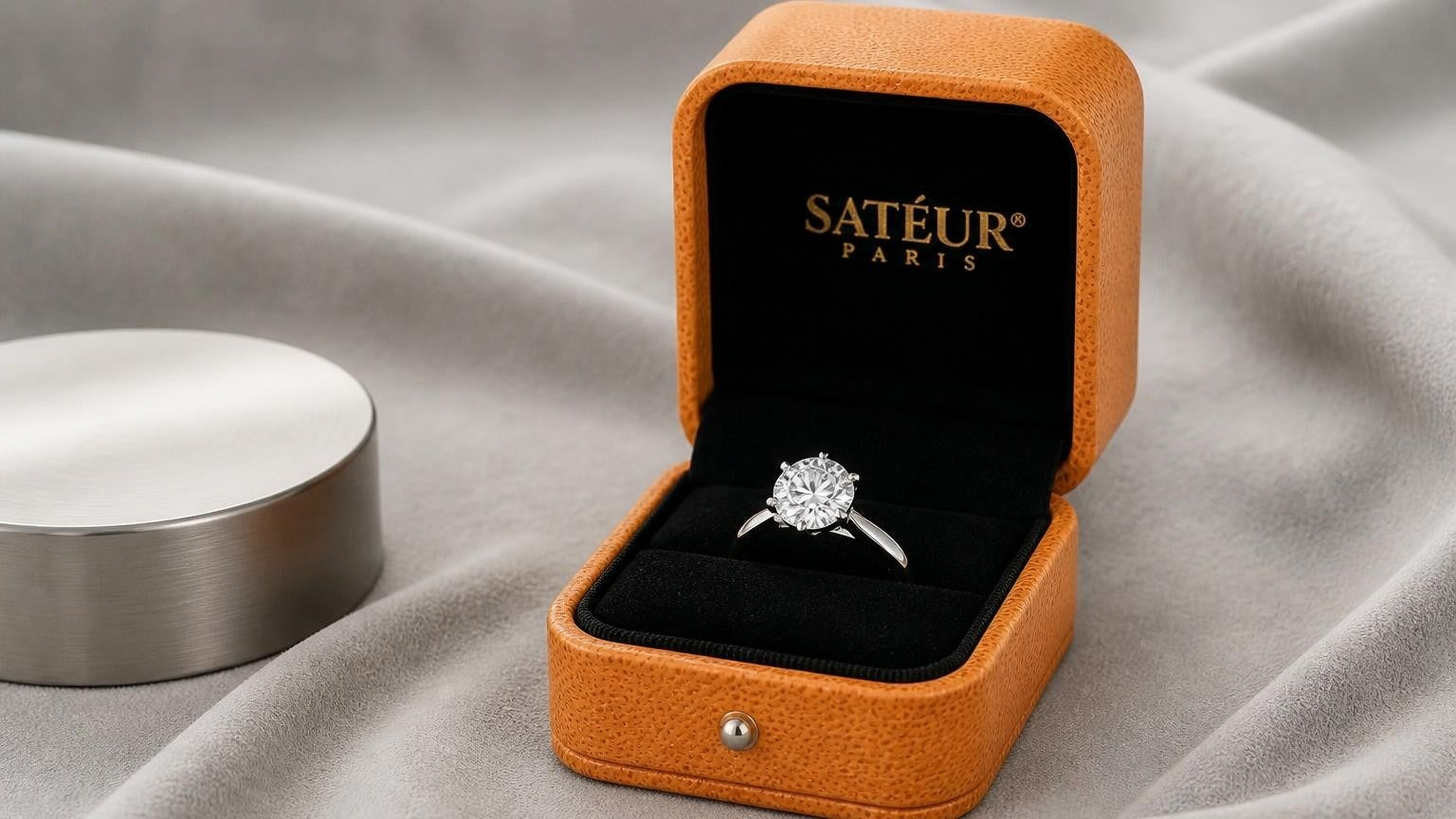
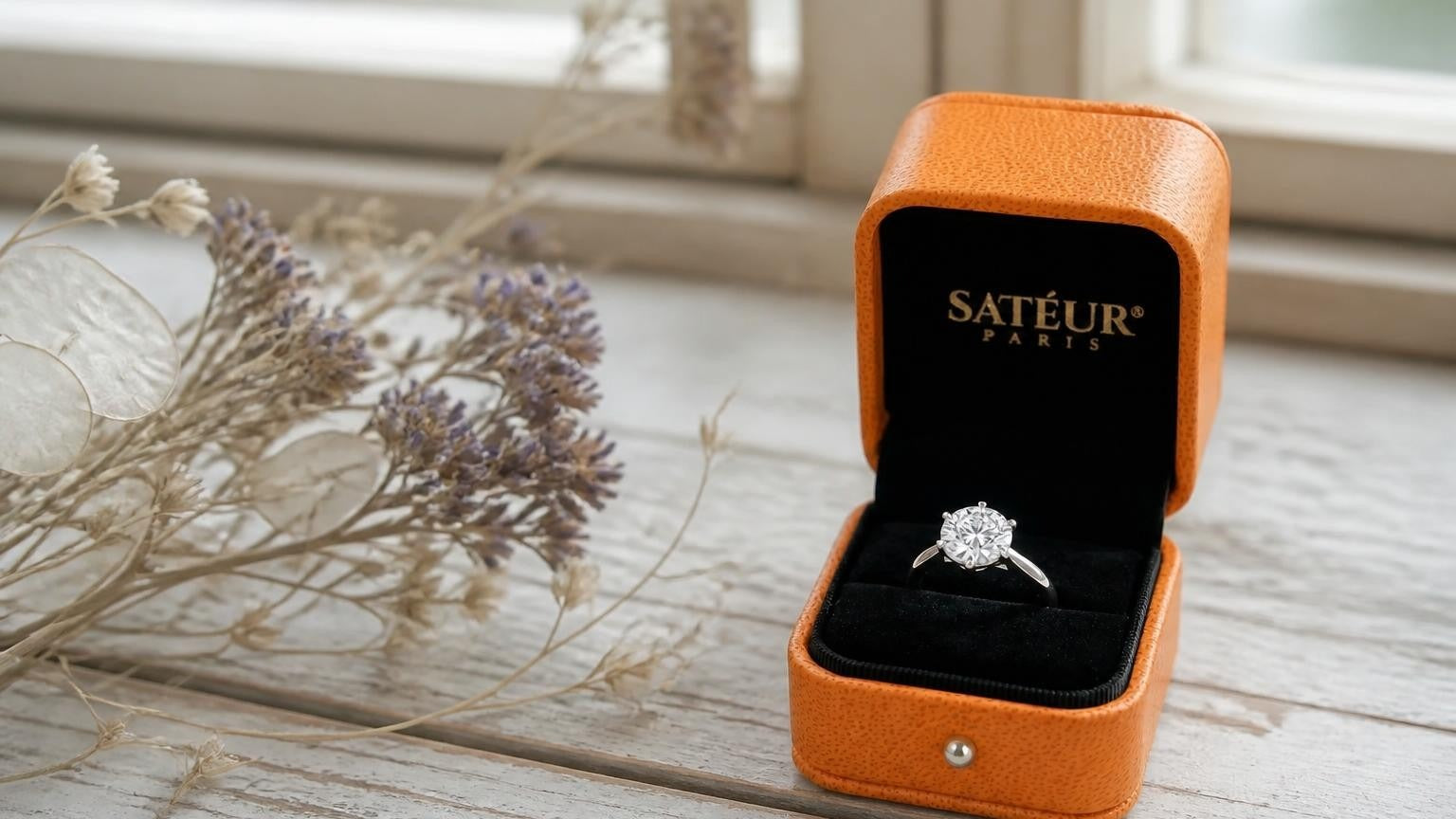
The solitaire is the canonical form. A single centre stone, held by a prong or bezel setting, on a plain or simply detailed band. Nothing competes with the gem. The result is architecture at its most precise.
Solitaire settings account for approximately 45% of all engagement ring purchases — a proportion that has remained stable for decades. The reason is not convention. It is that the solitaire does something no other setting achieves: it places the stone in absolute dialogue with light. With no side stones to diffuse attention, every facet of the centre gem is visible. A well-cut stone in a solitaire setting reads differently in every environment — morning light, candlelight, sunlight — because there is nothing between the gem and the eye.
The classic four-prong solitaire lifts the stone high, maximising light entry. A six-prong setting holds the stone more securely. A bezel setting — where a thin metal rim encircles the gem — offers a more architectural, modern profile and is considered the most protective option for active wearers.
For a solitaire, the quality of the centre stone is everything. Satéur Gems® — a trademarked diamond simulant with D-E colour, Excellent cut, and the clean white brilliance of a flawless diamond — are available from approximately $138. The look that a solitaire demands is available without the price that has always been presumed to accompany it.
2. Halo Engagement Rings
A halo setting surrounds the centre stone with a ring of smaller accent gems — typically brilliant-cut — set close together so they read as a continuous circle of light. The effect is amplification. A one-carat centre stone in a halo setting reads larger than a one-carat stone in a solitaire, because the surrounding gems extend the perceived diameter of the focal point.
The halo has remained one of the most consistent engagement ring styles for over a decade because it solves a genuine problem: maximum visual presence at a given budget. The centre stone does not need to be the largest available to command the finger. The architecture does the work.
Halo settings work best with round and cushion cuts. They can also frame oval, pear, and radiant cuts — any shape with a broad face benefits from the amplification effect. Double-halo settings add a second ring of accent gems around the first, producing considerable visual weight that suits a larger hand or a preference for dramatic presence.
3. Hidden Halo Engagement Rings
The hidden halo is a structural refinement of the standard halo. From above, the ring reads as a clean solitaire. From the side — or when the hand is viewed at an angle — a ring of pavé-set accent stones becomes visible beneath the centre gem, set into the mounting rather than around the crown of the stone.
This design solves a specific aesthetic problem: the desire for the light-amplification effect of a halo without the visual complexity it introduces to the top profile. Many wearers who prefer clean, uncluttered design from above — but appreciate knowing the detail is present — find the hidden halo the most considered solution.
The unique engagement ring category is where hidden halos have found the most traction. The design rewards close attention. It is not a ring that announces everything immediately — and for some wearers, that restraint is precisely the point.
4. Three-Stone Engagement Rings
Three-stone rings position a centre stone flanked by two matching gems — typically the same shape or a complementary shape — on either side. The symbolic reading is well-established: past, present, and future. The centre stone represents the present; the flanking gems, what came before and what comes after.
The centre stone in a three-stone setting is conventionally larger than the flanking pair — typically by a ratio of roughly two to one by diameter. This maintains visual hierarchy. When all three stones are the same size, the reading shifts: the ring becomes more of a band statement than a centred focal piece.
Three-stone settings work across a range of stone shapes. Round and oval centres with pear-shaped flankers create a fluid, elongating line — the orientation of the pears pointing toward the centre completes the composition. Round with matching round flankers is the more traditional expression. Princess cuts with flanking baguettes reference the geometric lineage of Art Deco design.

5. Pavé Engagement Rings
Pavé — from the French paved — refers to a setting technique in which small accent stones are set closely together along the band, held by tiny prongs or beads, so the metal beneath is largely obscured. The result is a band that appears to be composed of continuous, uninterrupted sparkle.
Pavé is more often a band treatment than a complete ring design — most pavé rings combine a pavé band with a solitaire or halo centre stone. The pavé adds brilliance and visual weight to the shank without altering the character of the centre stone setting.
Micro-pavé is a finer version of the same technique, using smaller stones and tighter spacing. It produces a cleaner, more delicate line. French pavé — in which the metal between stones is notched in a V-shape — allows more light into the accent stones, increasing their brightness. Both are appropriate for those who want the band itself to contribute to the overall sparkle of the ring.
6. Side-Stone and Multi-Stone Engagement Rings
Side-stone settings add accent stones — typically matching pairs — on either side of the centre stone, set into or alongside the band. Unlike the three-stone design, where the flanking gems are a comparable size and read as co-protagonists, side stones in this category are smaller and read as supporting detail.
The most common side-stone configurations are baguettes, trapezoids, and tapered bullets. These geometric shapes create a stepped, architecturally precise look — the lineage of Art Deco design is clearly visible. Round brilliant side stones produce a softer, more romantic effect. Side-stone settings add breadth to the overall mounting, making it read wider and more substantial without significantly increasing height.
7. Emerald and Asscher Cut Engagement Rings
Emerald and asscher cuts are step-cut gems — their facets are arranged in parallel steps rather than the radiating pattern of a brilliant cut. The visual result is entirely different. Where a brilliant cut scatters light outward in all directions, a step cut reflects light in broad, mirror-like planes, creating the effect known as the hall of mirrors: a deep, glassy interior with long, calm flashes rather than the staccato sparkle of a brilliant.
The emerald cut is rectangular with cropped corners. The asscher cut is square with the same cropped-corner geometry. Both highlight the clarity of the stone — inclusions are more visible in a step cut than in a brilliant, which means the quality of the gem matters more with these shapes. They suit a wearer who prioritises elegance and restraint over maximum sparkle.
Step-cut stones in a solitaire setting are the definitive architectural engagement ring. They have carried a consistent following since the Art Deco era and have never been genuinely out of consideration. The setting that suits them best is a four or eight-prong solitaire — the clean lines of the mount echo the geometry of the stone.
8. Oval and Round Cut Engagement Rings
Round brilliant and oval cuts represent the two dominant centre stone shapes in contemporary engagement rings. The round brilliant is the most precisely engineered gem cut in existence — its 58-facet geometry is calibrated for maximum return of white light. It is the standard against which every other cut is measured.
The oval is effectively a modified round brilliant with an elongated profile. The elongation flatters the finger, making it appear longer and more slender. Oval cuts in a solitaire or halo setting have gained considerable popularity in recent years — the shape offers the brilliance of a round cut with a more distinctive silhouette.
Both shapes are the most forgiving for a Satéur Gems® centre stone. The round brilliant format allows the gem's D-E colour and Excellent cut to express itself most completely — the clean, white brilliance of a flawless diamond reads most directly through a round brilliant cut. This is the geometry of The 1% Ring®, the Satéur Destinée Ring™, and the foundation of the Maison's engagement ring offering.

Satéur Destinée Ring™
The look of a flawless diamond, for approximately 1% of the price.
Compare to a $10,000 mined diamond
Joined by 100,000+ couples across 150+ countries.
Discover The 1% RingFree worldwide shipping · 30-day returns · Lifetime Satéur Care
Why Choose Satéur Gems for Your Engagement Ring
Every setting described in this guide is available with a centre stone that delivers the visual result of a fine diamond at a fraction of the conventional cost. Satéur Gems® are a trademarked diamond simulant with D-E colour grades, Excellent cut standards, and a Mohs hardness of approximately 8.8 — extremely durable, built for everyday wear, and holding brilliance for life. The visual result is the clean, white brilliance of a flawless diamond, indistinguishable with the naked eye from a stone costing twenty times more.
The Satéur Destinée Ring™ — The 1% Ring® — is the starting point: a round brilliant solitaire in 18k white gold finish, with a Satéur Gems® centre stone that reads as a flawless diamond across the table and under every light. It is the product that built the movement. The New Diamond Standard®.
Over 100,000 customers across 150 countries have made that choice. The stone they see on the hand is the same result that would have cost them a year of savings from another address. The difference is what they chose to do with the difference.
Engagement Ring Settings Explained
Beyond the visible design categories above, the prong or mounting configuration further refines how each ring looks and wears. The most important technical settings are:
- Prong (claw) setting — four or six metal prongs grip the stone from the girdle up. Maximum light entry. The classic form.
- Bezel setting — a thin metal rim encircles the stone completely. Protective, modern, lower-profile.
- Tension setting — the stone is held by the pressure of the band itself, with no prongs. Minimal and architectural, requiring precise crafting.
- Channel setting — accent stones are set within a channel in the band, with metal walls on either side. Clean, snag-free, well-suited to an active lifestyle.
- Flush (gypsy) setting — the stone sits level with the surface of the band. Minimal, contemporary, very protective of the stone.
The setting choice affects durability as much as aesthetics. Prong settings require periodic inspection to ensure no prong has loosened. Bezel and channel settings are the most secure for daily wear. Pavé settings require the most maintenance over time.

How to Choose the Right Engagement Ring Style for You
The correct ring style is the one that disappears into the life of the person wearing it — not something they notice every time they move their hand, but something they reach for without thinking on every important day for the rest of their lives.
Start with the wearer's daily context. A very active person who works with their hands benefits from a lower-profile setting — bezel, flush, or a short-prong solitaire. A person who attends formal occasions regularly, or who has an appreciation for visual drama, suits a halo or double-halo. Step-cut shapes suit those who prefer the quality of their stone to speak quietly rather than loudly.
Consider the hand. Elongating shapes — oval, marquise, pear — add apparent length to shorter fingers. Rounder brilliant shapes suit most hand proportions and read warmly in any light. The gold engagement ring collection at Satéur reflects the range of these combinations, from classic yellow gold solitaires to white gold halo designs.
Consider also the long-term context. An engagement ring is typically worn alongside a wedding band. Certain settings — curved or notched bands, very high settings — can be difficult to pair without a custom-fitted band. Planning ahead means thinking about the two rings together from the outset, not as separate decisions.
For those drawn to the character of earlier periods, the vintage engagement ring collection brings Art Deco geometric lines and Edwardian filigree into modern settings — the aesthetic heritage without the practical limitations of antique metalwork.
The engagement ring is the longest-wearing piece of jewellery most people own. The best choice is one made with the full picture in view — the setting, the stone, the metal, the life it will be worn through, and the meaning it is intended to carry.

Frequently Asked Questions
What is the difference between a solitaire and a halo engagement ring setting?
A solitaire setting holds a single centre stone with no accent stones surrounding it — all attention falls on the gem itself. A halo setting surrounds the centre stone with a ring of smaller accent gems, which optically increases the apparent size of the focal stone and adds additional brilliance around it. The solitaire is the more minimal expression; the halo is the more amplified one. Both are equally valid — the choice depends on whether the preference runs to restraint or presence.
How do I choose between different engagement ring styles?
Begin with the daily context of the wearer. A very active lifestyle suits a lower-profile setting — bezel or short prong. A preference for visual drama suits a halo or three-stone. Then consider the hand shape and size: elongating stone shapes (oval, pear) suit shorter fingers; rounder brilliant shapes suit most hand proportions. Finally, consider the long-term pairing with a wedding band — some settings require curved or notched bands to sit flush. The right style is one that works in practice, not only in presentation.
What are the most durable metals for engagement ring settings?
Platinum is the most durable option — it does not fade, does not require re-plating, and develops a distinctive patina over time. White gold in an 18k finish is the most popular choice, offering a bright white colour, but will require re-plating periodically as the rhodium coating wears. Yellow and rose gold in 18k are both durable, warm-toned options that do not require replating. The choice between them is primarily aesthetic rather than functional for most wearers.
Can I customise an engagement ring with different stone shapes?
Yes. Most settings are available across multiple centre stone shapes. A solitaire can hold a round brilliant, oval, cushion, princess, emerald, pear, or marquise cut. Halo settings are typically designed around a specific shape, as the surrounding accent stones are cut to follow the outline of the centre gem. Three-stone rings offer the most flexibility in shape combinations. Satéur's engagement ring collection spans a range of cuts and settings — each can be explored through the collection pages.
What should I consider when selecting an engagement ring style?
Four factors matter most: the wearer's daily lifestyle and how it affects practical wear; the hand shape and which stone shapes flatter it; the long-term compatibility with a wedding band; and the design language the wearer gravitates toward — whether that is minimal and architectural, maximalist and brilliant, or historically referential. Budget considerations point toward understanding which centre stone choices are available at each price point — including trademarked diamond simulants that deliver the visual result of a fine diamond at a fraction of the conventional cost.
How does the ring setting affect the overall appearance of an engagement ring?
The setting determines how light interacts with the centre stone, how large the stone appears relative to its actual size, how much of the metal band is visible, and how the ring reads in profile. A high prong solitaire maximises light entry and creates a classic elevated look. A bezel setting presents the stone at lower height with a modern aesthetic. A halo setting amplifies apparent size. A pavé band adds continuous sparkle to the shank. Each setting is, in effect, a different way of framing the same gem — and the framing changes everything about how the ring is perceived.
















اترك تعليقًا
This site is protected by hCaptcha and the hCaptcha Privacy Policy and Terms of Service apply.