

Do Lab Grown Diamonds Test as Real
Yes. Lab-grown diamonds test as real diamonds on a standard diamond tester. They register identically to mined diamonds because they are, in every material sense, the same thing: pure carbon arranged in the same cubic crystal lattice structure. The tester returns a result based on what the gem is — not where it came from.
For anyone considering lab grown diamonds, this is the foundational fact. A lab-grown diamond passes the diamond test because it is a diamond. The sections below explain the science, the certification, and what this means in practice.
Key Takeaways
- Lab-grown diamonds are chemically and structurally identical to mined diamonds — pure carbon, cubic crystal lattice.
- Standard diamond testers (thermal and electrical) register lab-grown diamonds as real diamonds, without exception.
- Only specialised laboratory equipment or a laser inscription can distinguish a lab-grown diamond from a mined one.
- Lab-grown diamonds are IGI-certified, with D-E colour grades and Excellent cut standards.
- Type IIa classification — present in fewer than 2% of natural diamonds — is common in laboratory-grown diamonds due to the controlled growth environment.
- IGI-certified lab diamonds are available from approximately $88, at a fraction of comparable mined diamond pricing.

How Diamond Testers Work
A diamond tester measures one of two properties: thermal conductivity or electrical conductivity. Both methods were designed to distinguish genuine diamonds from simulants such as cubic zirconia, which behave very differently at a material level.
Thermal testers — the most widely used type — send a small pulse of heat through the surface of the gem. Diamonds conduct heat at an exceptionally high rate. Cubic zirconia does not. The tester reads the conduction speed and returns a result: diamond or not diamond.
Electrical testers measure conductivity rather than heat. Pure diamond is an electrical insulator. Moissanite is a semiconductor and registers differently — which is why advanced testers include a dedicated moissanite setting. Lab-grown diamonds, being pure diamond, behave identically to mined diamonds on both test types.
Neither method measures the origin of a diamond. They measure its physical and chemical properties. Origin is irrelevant to the instrument.
Lab Grown Diamonds and Thermal Conductivity
Diamond has one of the highest thermal conductivities of any known material — approximately 900–2,320 W/m·K. This is what separates it from every common simulant in a retail testing context.
Lab-grown diamonds share this thermal conductivity with mined diamonds exactly. There is no distinction at this level of measurement because there is no distinction in the material: the same carbon lattice, the same atomic bonding, the same thermal behaviour.
Surface condition matters. Moisture and residue can affect tester accuracy on any gem. A clean, dry surface is necessary for a reliable reading. Thermal testers are more reliable than basic electrical models — less susceptible to trace-element variation and surface interference.

Visual and Optical Properties
The visual character of a lab-grown diamond is indistinguishable from a mined diamond with the naked eye. The refractive index is the same — approximately 2.42. Brilliance, scintillation, and dispersion are identical. A mined diamond and a lab-grown diamond of equivalent cut, colour, and clarity cannot be separated by sight alone under any normal viewing condition.
Cubic zirconia has a lower refractive index and a distinctly different visual weight. Moissanite has a higher refractive index and produces different light behaviour — higher dispersion that separates it from diamond visually. Lab diamonds sit exactly where mined diamonds sit, because they are the same material.
For those considering lab created diamond rings, this optical equivalence is the defining fact of the tier. The light that enters a lab-grown diamond exits it exactly as it would exit a stone drawn from the earth.
Why Lab Diamonds Register on Standard Testers
The answer is structural. A lab-grown diamond is grown from a carbon seed using one of two processes: High Pressure High Temperature (HPHT), which replicates the conditions under which natural diamonds form, or Chemical Vapour Deposition (CVD), which builds the crystal layer by layer from a carbon-rich gas. Both produce the same cubic crystal structure as a mined diamond. The result is not a simulant, not an approximation — it is diamond.
One distinction illuminates this further: Type IIa classification. Fewer than 2% of mined diamonds qualify as Type IIa — indicating extremely low nitrogen impurities and high optical and thermal purity. In laboratory-grown diamonds, Type IIa classification is common, because the controlled growth environment minimises nitrogen incorporation by design.
Standard testers cannot detect this. Laboratory instruments can identify growth patterns and trace element profiles that differentiate lab-grown from mined origin. At the level of a standard retail tester, the result is unambiguous: diamond. This is why a 3 carat lab grown diamond ring tests identically to its mined equivalent.

Satéur Lab Diamond Value
Satéur's lab diamond range begins at approximately $88 for IGI-certified diamonds — roughly 1% of comparable mined diamond pricing at equivalent specifications. Each carries D-E colour grading and Excellent cut certification from the International Gemological Institute.
IGI certification documents the specific characteristics of each diamond: carat weight, colour, clarity, and cut grade. It provides the same independent verification as a mined diamond certificate. A certified lab diamond is a documented diamond — origin noted, quality confirmed.
Laboratory growth eliminates the extraction premium that has historically priced mined diamonds beyond reach. What remains is the diamond itself: the same carbon, the same crystal structure, the same result on a tester, the same light return to the eye.

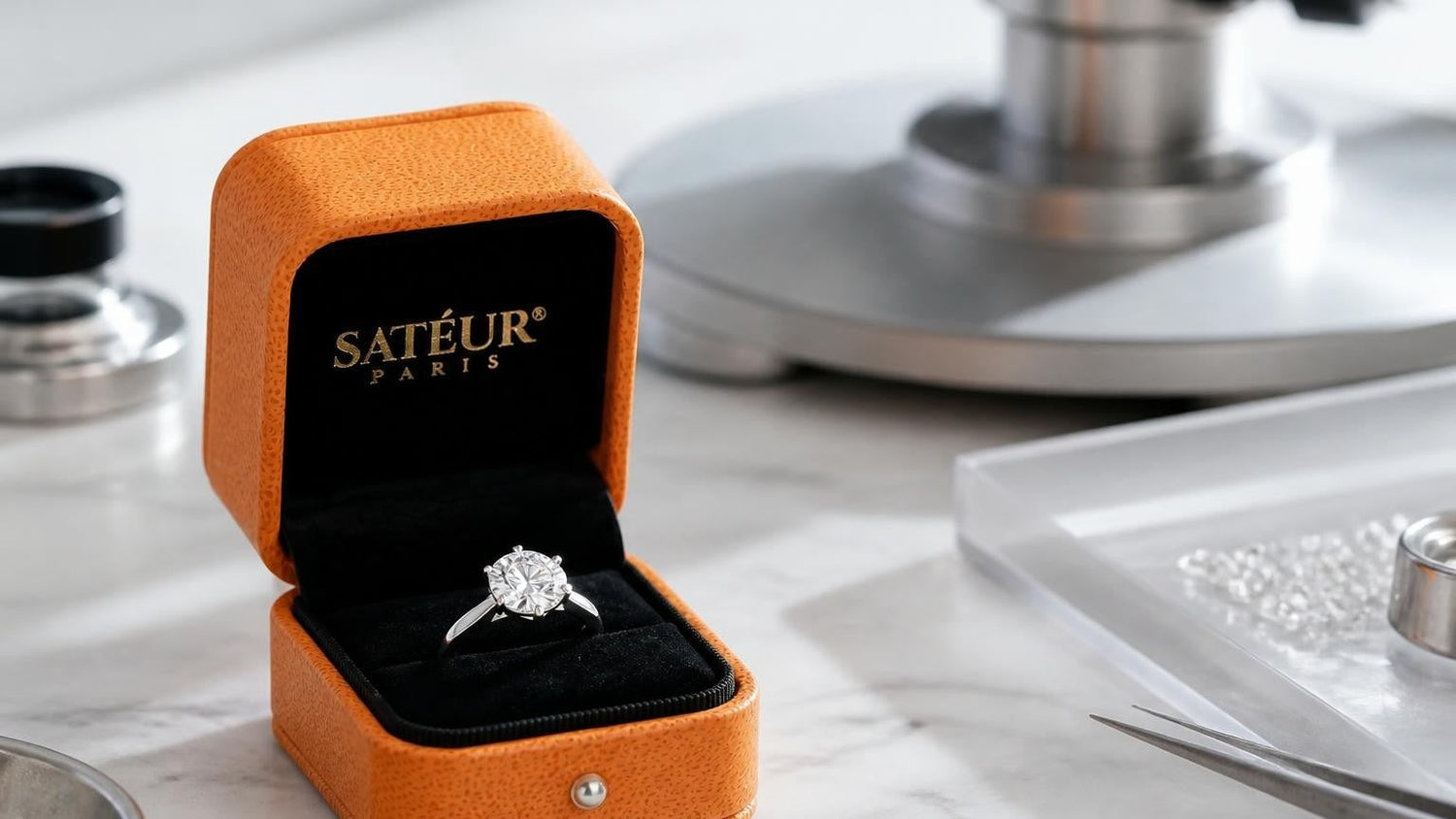
Satéur Destinée Diamond Ring
A real, IGI-certified lab-grown diamond, hand-set in solid 18K gold — a fraction of the mined-diamond price.
Compare to a $10,000 mined diamond
Joined by 100,000+ couples across 150+ countries.
Shop the Destinée Diamond RingFree worldwide shipping · 30-day returns · Lifetime Satéur Care
FAQ: Lab Grown Diamonds and Testing
What is the difference between a lab grown diamond and a mined diamond?
The difference is origin, not composition. A mined diamond forms over billions of years under the earth's surface. A lab-grown diamond is produced in a controlled environment — either by replicating that high-pressure, high-temperature process (HPHT) or by building the crystal layer by layer from carbon gas (CVD). The end result is the same: pure carbon in a cubic crystal lattice. The chemical, optical, and physical properties are identical. Both are diamonds.
Can a jeweler tell if a diamond is lab grown or mined?
Standard testing instruments cannot make this distinction — thermal testers and electrical testers both measure conductivity, not origin, and conductivity is the same in lab-grown and mined diamonds. Distinguishing the two requires specialised laboratory equipment capable of detecting trace element profiles or microscopic growth patterns. The most reliable identifier in practice is the laser inscription on the girdle of a certified lab diamond, which records the IGI certificate number and confirms origin.
Do all lab grown diamonds test the same on a diamond tester?
Yes. All lab-grown diamonds — whether produced by HPHT or CVD — test as diamond on a standard tester. The tester measures thermal or electrical conductivity, which is a function of the carbon crystal structure. Both production methods yield the same cubic crystal structure as mined diamonds and therefore produce the same tester result.
Why do some diamond testers fail on lab grown diamonds?
Failures are typically caused by surface conditions rather than the diamond itself. Moisture, fingerprints, or surface residue can interfere with the tester's conductivity reading. A clean, dry gem tested with properly calibrated equipment returns an accurate result. Basic electrical testers may also have lower sensitivity; thermal testers are more reliable across all diamond types and less susceptible to surface interference.
What does IGI certification mean for a lab diamond?
IGI — the International Gemological Institute — provides independent grading for lab-grown diamonds using the same criteria applied to mined diamonds: carat weight, colour, clarity, and cut grade. An IGI certificate documents the specific properties of a stone and confirms its identity as a diamond, with origin noted. Satéur lab diamonds carry IGI certification with D-E colour grades and Excellent cut standards, providing the same level of independent verification as a certified mined stone.
How can you identify a lab grown diamond by eye?
Under normal viewing conditions, you cannot. A lab-grown diamond and a mined diamond of equivalent specifications are visually indistinguishable with the naked eye. The refractive index, brilliance, and light dispersion are the same — both are diamond, and both behave accordingly. Identification requires specialised laboratory analysis or reference to the laser-inscribed certificate number on the diamond's girdle.

















اترك تعليقًا
This site is protected by hCaptcha and the hCaptcha Privacy Policy and Terms of Service apply.