

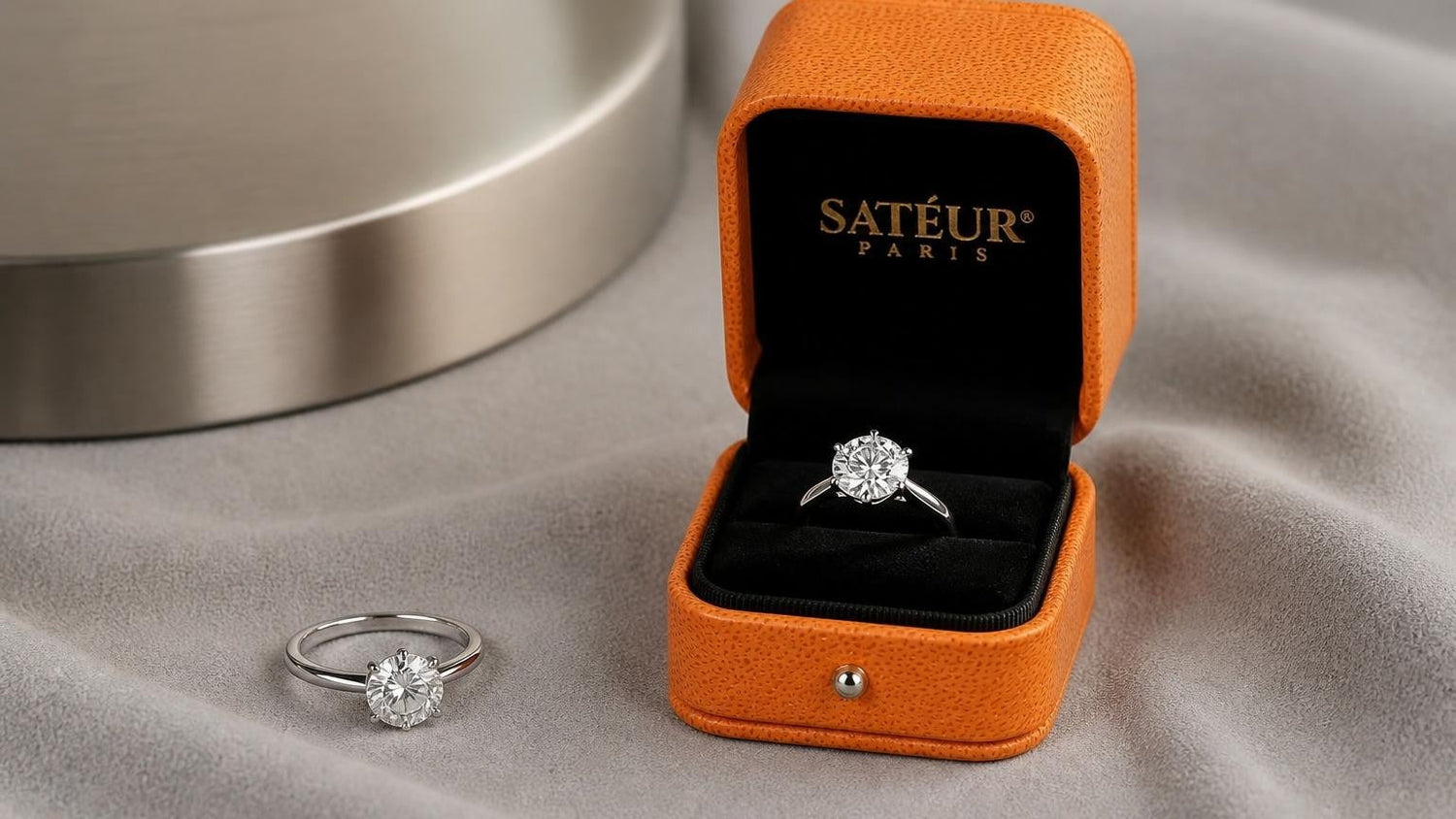
2 Carat Moissanite vs Diamond: The Complete Comparison
A 2 carat diamond commands between $8,000 and $25,000 depending on cut, colour, and clarity. A 2 carat moissanite offers nearly the same physical presence — a large, brilliant gemstone on the finger — for a fraction of that figure. The question is not which stone costs less. It is what each delivers, and which choice reflects how you actually think about value.
This guide compares 2 carat moissanite and diamond across every dimension that matters: fire, brilliance, hardness, colour, price, and long-term wearability. For those who want the look of a flawless diamond without the mined-diamond markup, we also introduce the Satéur moissanite collection — and the Satéur Gems® tier that sits above it.
Key Takeaways
- Moissanite fire dispersion measures approximately 2.4 times that of diamond, producing vivid rainbow sparkle under direct light.
- Moissanite ranks 9.25 on the Mohs hardness scale — among the most durable gemstones for everyday wear.
- A 2 carat moissanite ring from Satéur begins around $98, versus $8,000–$25,000+ for a comparable mined diamond.
- Diamond offers crisp, white brilliance; moissanite returns more colourful fire — a visible optical difference under bright light.
- Both gemstones retain their optical properties indefinitely with standard jewellery care.
- Satéur Gems® delivers diamond-accurate white brilliance — the clean, restrained light of a flawless stone — from $138.
What Is Moissanite
Moissanite is a lab-created gemstone — not a diamond. Its chemical composition, silicon carbide, is entirely distinct from diamond's carbon structure. First identified in 1893 in a meteorite crater by Henri Moissan, natural moissanite is extraordinarily rare. Every moissanite gemstone sold today is grown in a laboratory, a process that produces gem-quality crystals at consistent quality without the ethical complications of mining.
The distinction matters because moissanite is sometimes grouped with diamond simulants. It is not a simulant. It is a real gemstone with its own defined optical and physical properties — including a refractive index of approximately 2.65 (higher than diamond's 2.42), which produces its characteristic vivid fire. For a full view of available designs, the Satéur moissanite collection spans round brilliants to statement cuts across multiple carat weights.
Satéur Moissanite is selected at D-E colour and excellent cut — the top of the available quality range — before setting in 18k white gold finish.
How 2 Carat Moissanite Compares to Diamond
At 2 carats, the physical diameter of a round brilliant moissanite is approximately 8.1–8.2mm — essentially identical to a 2 carat diamond. Carat weight translates to the same physical presence on the finger. The differences between the two gemstones are optical, not dimensional, and most visible under certain lighting conditions.

The comparison table below captures the key properties side by side.
| Property | Moissanite | Satéur Gems® | Mined Diamond |
|---|---|---|---|
| Mohs Hardness | 9.25 | ~8.8 | 10 |
| Refractive Index | ~2.65 | ~2.39 | 2.42 |
| Fire / Dispersion | 0.104 — vivid, rainbow | Diamond-accurate — clean white | 0.044 — crisp, white |
| Top Colour Grade | D-E equivalent | D-E equivalent | D (colourless) |
| Origin | Lab-created gemstone | Lab-crafted (trademarked) | Mined |
| 2ct ring price range | From ~$98 | From ~$138 | $8,000–$25,000+ |
For a broader analysis of price across carat sizes, the article on moissanite vs diamond cost per carat builds on this comparison with detailed pricing data across the 0.5 to 5 carat range.

Brilliance and Fire: Key Visual Differences
Brilliance describes the white light a gemstone returns to the eye. Fire describes the dispersed, coloured light — the rainbow flashes visible under direct illumination. Diamond and moissanite differ meaningfully on fire, and that difference is most apparent under certain lighting.
Moissanite's fire dispersion coefficient is approximately 0.104, compared to diamond's 0.044. In practical terms, moissanite produces roughly 2.4 times the coloured light dispersion of a diamond. In candlelight, under a chandelier, or in direct sunshine, this creates vivid rainbow flashes that are immediately distinct from the diamond sparkle pattern. Whether that is spectacular or unmistakably non-diamond is a matter of personal preference and context.
Diamond returns crisp, white brilliance — particularly in the scintillation pattern of on/off flashes as the ring moves. The effect is controlled and precise, the reference point for fine jewellery optics worldwide. A D-E colour diamond at excellent cut in 2 carats is optically formidable.
Satéur Gems® occupies a distinct position in this optical landscape. Its refractive index (~2.39) sits close to diamond (2.42), and its dispersion profile delivers diamond-accurate brilliance — the restrained, clean white light of a flawless stone. This is The New Diamond Standard®: the visual language of fine diamond jewellery at 1% of the mined-diamond price.
Color and Clarity in Moissanite vs Diamond
Top-grade moissanite is produced at D-E colour equivalent — visually colourless to the naked eye. In a 2 carat stone, a well-cut D-E moissanite is difficult to distinguish from a colourless diamond under everyday conditions. A slight warmth can emerge in lower grades at larger carat weight; Satéur Moissanite supplies D-E colour as standard, removing any guesswork.
Lab-created moissanite is also produced without the inclusions common in mined diamonds. What you receive is effectively eye-clean as standard — there is no need to compromise clarity for budget, as is often necessary when purchasing mined stones below the VS grade.
Mined diamonds are graded on the GIA scale. At 2 carats, a VS1–VS2 clarity stone in D-E colour commands a significant premium purely for certification and provenance. The clarity difference between a VS2 mined diamond and a well-produced moissanite is, under normal viewing conditions, invisible with the naked eye. Carat weight determines presence; cut quality determines how that presence performs in light.

Durability and Longevity
Moissanite ranks 9.25 on the Mohs hardness scale. Diamond is 10. In practical daily wear — engagement rings and fine jewellery worn continuously — the gap between 9.25 and 10 is negligible. Moissanite resists scratching from virtually every substance encountered in everyday life and is an entirely appropriate choice for a ring worn for decades.
Satéur Gems® measures approximately 8.8 Mohs — extremely durable, built for everyday wear. Both Satéur tiers hold their brilliance for life. Neither clouds, dulls, nor develops the surface haze associated with lower-durability simulants such as cubic zirconia, which typically begin degrading within the first year of wear.
For both moissanite and Satéur Gems®, routine jewellery care is sufficient: warm water, mild soap, a soft brush. Professional cleaning once or twice yearly keeps the setting and stone in optimal condition.
Satéur Moissanite: Value and Design
A 2 carat moissanite ring from Satéur begins around $98. A comparable mined diamond — 2 carats, D-E colour, VS clarity, excellent cut — commands $8,000 to $25,000 depending on provenance and certification. The difference is not a quality gap. It is the accumulated cost of artificial scarcity, mining infrastructure, and a century of industry conditioning about what jewellery is supposed to mean.
Over 100,000 customers across 150+ countries have chosen a different path. The Satéur moissanite rings collection spans round brilliants, solitaires, and statement designs — each set in 18k white gold finish, each cut to excellent proportions for maximum light performance. For those specifically seeking a classic solitaire setting, the moissanite solitaire ring collection offers the canonical proportion in multiple carat weights.
For those seeking diamond-accurate brilliance — the clean, restrained white light rather than moissanite's more vivid fire — the Satéur Gems® tier begins at $138. The Satéur Destinée Ring™, The 1% Ring®, carries a round-cut Satéur Gems® in a clean, classic solitaire. It looks like a $10,000 mined diamond. The ring that started the movement.
The choice between moissanite and Satéur Gems® is an optical one: vivid rainbow-forward fire, or diamond-accurate white brilliance. Both represent extraordinary value against natural diamonds. Both are built to last. Browse the full The 1% Ring® collection to compare the tiers side by side.

Satéur Destinée Ring™
The look of a flawless diamond, for 1% of the price.
Compare to a $10,000 mined diamond
Joined by 100,000+ couples across 150+ countries.
Discover The 1% RingFree worldwide shipping · 30-day returns · Lifetime Satéur Care
Whether moissanite or Satéur Gems®, the principle is the same: the look of fine jewellery need not carry the price of artificial scarcity. The New Diamond Standard® is not a compromise — it is the smarter choice.
Frequently Asked Questions
What is moissanite and how is it created?
Moissanite is a lab-created gemstone composed of silicon carbide. First identified in 1893 in a meteorite crater, all gem-quality moissanite sold today is grown in a controlled laboratory environment. It is a real gemstone with distinct optical and physical properties — not a diamond, and not a diamond simulant. Its refractive index (~2.65) exceeds that of diamond, producing the vivid fire dispersion that characterises the gem.
How does a 2 carat moissanite ring look compared to a diamond?
At 2 carats, moissanite and diamond share essentially identical physical size — approximately 8.1mm diameter for a round brilliant. Under everyday indoor light, a D-E colour moissanite is visually close to a diamond with the naked eye. Under bright direct light, moissanite returns more vivid rainbow fire than diamond. Satéur Gems® is calibrated for diamond-accurate white brilliance, with a refractive index (~2.39) close to diamond's 2.42.
Will moissanite lose its sparkle over time?
No. Moissanite retains its optical properties indefinitely. At 9.25 Mohs hardness, its surface resists abrasion and its brilliance remains stable for decades with standard jewellery care. Unlike cubic zirconia, which clouds and scratches within months, moissanite is a permanent stone.
What is the price difference between moissanite and a 2 carat diamond?
A 2 carat mined diamond in D-E colour, VS clarity, excellent cut typically ranges from $8,000 to $25,000 or more. A 2 carat moissanite ring from Satéur begins around $98. The visual presence is comparable with the naked eye under everyday conditions. The price difference reflects the artificial scarcity model of the mined diamond industry, not a proportionate difference in beauty or durability.
Can moissanite be used in fine engagement ring designs?
Yes. At 9.25 Mohs, moissanite is among the most durable gemstones available — entirely appropriate for engagement rings worn every day for decades. Satéur's moissanite solitaire designs are set in 18k white gold finish and built for continuous wear. The hardness gap between moissanite (9.25) and diamond (10) is negligible in practical daily use.
Does moissanite have any visible differences under everyday conditions?
Under standard indoor lighting, a well-cut D-E colour moissanite is difficult to distinguish from a diamond with the naked eye. The visible difference emerges under intense direct light — sunlight, spotlights, candlelight — where moissanite's higher fire dispersion produces more vivid rainbow flashes than diamond. For those who prefer the clean, white brilliance of diamond without the coloured fire, Satéur Gems® delivers precisely that optical profile at a fraction of the mined-diamond price.















اترك تعليقًا
This site is protected by hCaptcha and the hCaptcha Privacy Policy and Terms of Service apply.