

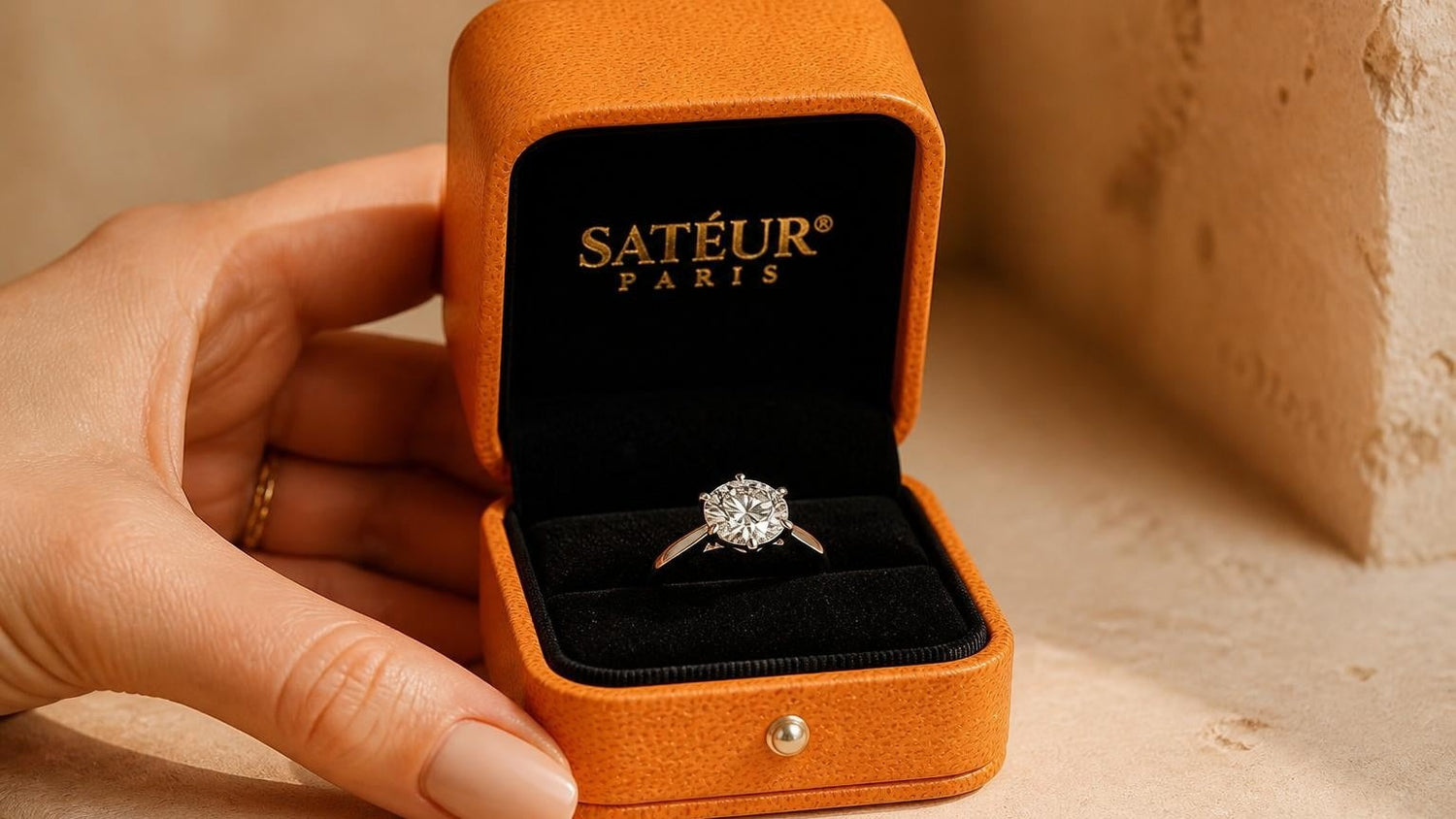
Is Moissanite Real? The Honest Answer
The question surfaces often — and it deserves a direct answer. Moissanite is a real gemstone. It is not fake, not synthetic glass, and not a lesser material dressed up as something it is not. It is a lab-created gemstone composed of silicon carbide, grown under controlled conditions to produce stones of consistent clarity, colour, and optical performance. It simply is not a diamond — and understanding that distinction is how intelligent jewellery choices begin.
If you are exploring moissanite versus diamond for an engagement ring or fine jewellery, this article establishes the facts clearly, without the industry rhetoric that has surrounded both stones for decades.
Key Takeaways
- Moissanite is a genuine lab-created gemstone — silicon carbide, not a diamond alternative.
- It carries a Mohs hardness of approximately 9.25, making it one of the most durable stones in jewellery.
- Moissanite typically achieves D-E colour grade and excellent cut quality.
- Its refractive index produces approximately 2.4 times the fire of a diamond — a vivid, rainbow-forward sparkle.
- Moissanite engagement rings from Satéur begin from approximately $88.
- It will not cloud, yellow, or degrade under normal wear conditions.
What Is Moissanite
Moissanite is silicon carbide — a crystalline compound that occurs naturally in minute quantities, first identified in 1893 by French chemist Henri Moissan in a meteorite crater in Arizona. The amounts found in nature are far too small for jewellery use. All moissanite on the market today is lab-created: grown in controlled environments to produce gem-quality crystals with exceptional clarity and consistent optical properties.
The distinction matters. Lab-created does not mean inferior. It means produced through a precise process rather than extracted from the earth. Silicon carbide in gem form delivers hardness, brilliance, and durability that rival or exceed most natural stones — including diamond in certain optical measures.
Moissanite is not cubic zirconia — cubic zirconia is zirconium oxide, a much softer material that clouds and degrades within years. It is not glass. It is not a "diamond substitute" in the dismissive sense. It is its own category of gemstone, with its own science, its own optical signature, and its own place in fine jewelry and fine jewellery. The moissanite diamond comparison and the diamonds moissanite question are really about understanding two distinct gemstones — not ranking one against the other.

Is Moissanite Real
Yes. A gemstone is classified by its crystal structure, chemical composition, and physical properties — not by its origin. Rubies, sapphires, and emeralds are all produced in laboratories today, and those lab-created versions are recognised as real gemstones by every gemmological body worldwide. The same standard applies to moissanite.
The confusion arises from the jewellery industry's long habit of treating "real" as synonymous with "mined." That framing served commercial interests for decades. It does not hold up to scrutiny. A moissanite gemstone is a real gemstone — it simply is not a diamond. Those are different things, and conflating them produces exactly the kind of misinformation that leads buyers to make poorly informed decisions.
For a deeper exploration of how these two stones compare on every meaningful property, read our guide on are moissanite diamonds real.
Moissanite vs. Diamond: Key Differences
Moissanite and diamond are distinct in composition, optical character, and price. Understanding the differences allows for an honest evaluation rather than a comparison built on marketing language.
Composition. Diamond is carbon, arranged in a cubic crystal lattice. Moissanite is silicon carbide, arranged in a hexagonal lattice. These are different materials with different atomic structures. Moissanite does not share diamond's chemical structure — and claiming otherwise would be false.
Hardness. Diamond registers 10 on the Mohs scale — the hardest known natural material. Moissanite registers approximately 9.25 Mohs, placing it among the most durable gemstones available for jewellery. For daily wear, that distinction is largely negligible. Both stones resist scratching under normal conditions and are suited for rings, earrings, and all fine jewellery applications.
Optical character. This is where moissanite diverges most visibly from diamond. Moissanite has a higher refractive index than diamond, producing approximately 2.4 times the fire — the spectral dispersion that creates rainbow-coloured flashes of light. Under direct lighting, moissanite exhibits a vivid, prismatic brilliance. Diamond, by contrast, returns a crisper, more white-dominant light. Neither is objectively superior. They are different optical signatures, and the preference between them is personal.
Colour. Top-tier moissanite achieves D-E colour grade — the equivalent of the clearest, most colourless diamonds. Near-colourless grades (F-H) are also widely available. In standard lighting conditions, colour differences between D and H are often imperceptible to the naked eye.
Price. This is the factor that reshapes the entire conversation. A one-carat mined diamond in D colour and excellent cut can command $8,000 to $15,000 or more. A moissanite of equivalent visual presence and superior hardness costs a fraction of that. The gap is not a reflection of quality. It is a reflection of supply, marketing history, and a century of carefully managed scarcity. For those researching how moissanite compares to diamond in person, the visual result speaks clearly.

Durability and Longevity
Moissanite's hardness of 9.25 Mohs is not a compromise. It is a credential. On the Mohs scale, only diamond rates higher among gemstones used in jewellery. Moissanite resists scratching, abrasion, and the physical demands of everyday wear with the same resilience expected of a stone intended to last a lifetime.
Its chemical stability is equally solid. Silicon carbide does not react with common acids, does not cloud under normal environmental exposure, and does not degrade in response to heat within the range of everyday use. Moissanite retains its brilliance and clarity indefinitely under normal wear conditions — there is no yellowing, no hazing, no slow deterioration over time.
For jewellery intended to mark a lasting occasion — an engagement, an anniversary, a personal milestone — moissanite's durability profile is not a concern. It is a strength.
Moissanite Colour and Clarity
Moissanite produced today reaches the highest colour grades available — D through E on the GIA colour scale, equivalent to colourless diamonds of exceptional quality. Earlier generations of lab-grown moissanite sometimes exhibited faint yellow or grey tints under certain lighting conditions. That characteristic has been largely eliminated through advances in the growth process. Premium moissanite in 2026 is optically consistent and colourless to the naked eye.
Clarity follows a similar trajectory. Lab growth produces stones with fewer inclusions than their natural counterparts, and moissanite in the market today is typically eye-clean — meaning no inclusions are visible without magnification.
The combination of D-E colour, eye-clean clarity, and the stone's own vivid fire produces a visual presence that is arresting in its own right — not as an imitation of something else, but as a gemstone with a confident, distinct optical identity.

The Satéur Value Proposition
Satéur offers moissanite as part of a considered offering that places an exceptional gemstone within reach of buyers who refuse to pay a premium for historical marketing. The moissanite tier sits alongside moissanite rings and other jewellery pieces, beginning from approximately $88 — a price point that reflects the actual cost of producing a superior gemstone, not a century of manufactured scarcity.
The engagement ring collection includes moissanite in classic and contemporary settings, designed to the standard of Maison jewellery without the traditional Maison markup.

Satéur Destinée Ring™
The look of a flawless diamond, for 1% of the price.
Compare to a $10,000 mined diamond
Joined by 100,000+ couples across 150+ countries.
Shop Moissanite RingsFree worldwide shipping · 30-day returns · Lifetime Satéur Care
Satéur also offers Satéur Gems® — the Maison's flagship tier — for buyers who want the specific, clean white brilliance of a flawless diamond with maximum diamond-accuracy. The diamond moissanite choice within the Satéur range comes down to optical preference: Gems® for the diamond-true look; moissanite for those drawn to vivid, rainbow-forward fire and lab credentials. Both are exceptional gemstones. Neither is a compromise.
FAQ: Moissanite Questions and Answers
Is moissanite a real gemstone?
Yes. Moissanite is a real gemstone composed of silicon carbide. It is lab-created — grown under controlled conditions to produce gem-quality crystals — but that does not make it artificial in the sense of being fake. Lab-created rubies, sapphires, and emeralds are all recognised as real gemstones. Moissanite carries the same classification. It is not a diamond, but it is entirely real.
How does moissanite differ from diamond in appearance?
The most visible difference is fire — the spectral dispersion that produces coloured light flashes. Moissanite exhibits approximately 2.4 times the fire of a diamond, resulting in a vivid, rainbow-forward brilliance. Diamond returns a crisper, more white-dominant light. Both are visually impressive. The preference between them comes down to whether you prefer the diamond's restrained white brilliance or moissanite's more vivid sparkle.
Will moissanite last as long as a diamond?
In practical terms, yes. Moissanite rates 9.25 on the Mohs hardness scale — the second hardest gemstone used in jewellery. It resists scratching, abrasion, and heat under everyday conditions. Moissanite retains its brilliance and clarity indefinitely under normal wear. There is no known degradation process that would diminish its appearance over a lifetime of use.
What is the price difference between moissanite and diamond engagement rings?
Significant. A one-carat mined diamond in D colour and excellent cut typically costs between $8,000 and $15,000. A moissanite of equivalent visual presence and greater fire costs a fraction of that — Satéur moissanite engagement rings begin from approximately $88. The gap reflects the economics of supply and historical marketing, not a meaningful difference in quality or visual impact.
Does moissanite cloud or yellow over time?
No. Moissanite is chemically stable and does not cloud, yellow, or haze under normal wear conditions. Its silicon carbide composition resists the environmental factors that cause some stones to degrade. The brilliance and clarity of a moissanite gemstone remain consistent across decades of everyday use.
Can moissanite be used in any engagement ring setting?
Yes. Moissanite is sufficiently hard and durable for any standard jewellery setting — solitaire, pavé, halo, channel, bezel. Its hardness of 9.25 Mohs makes it suitable for rings intended for daily wear. Standard setting techniques and metals — gold, platinum, silver — are all compatible. No special accommodation is required.















اترك تعليقًا
This site is protected by hCaptcha and the hCaptcha Privacy Policy and Terms of Service apply.