

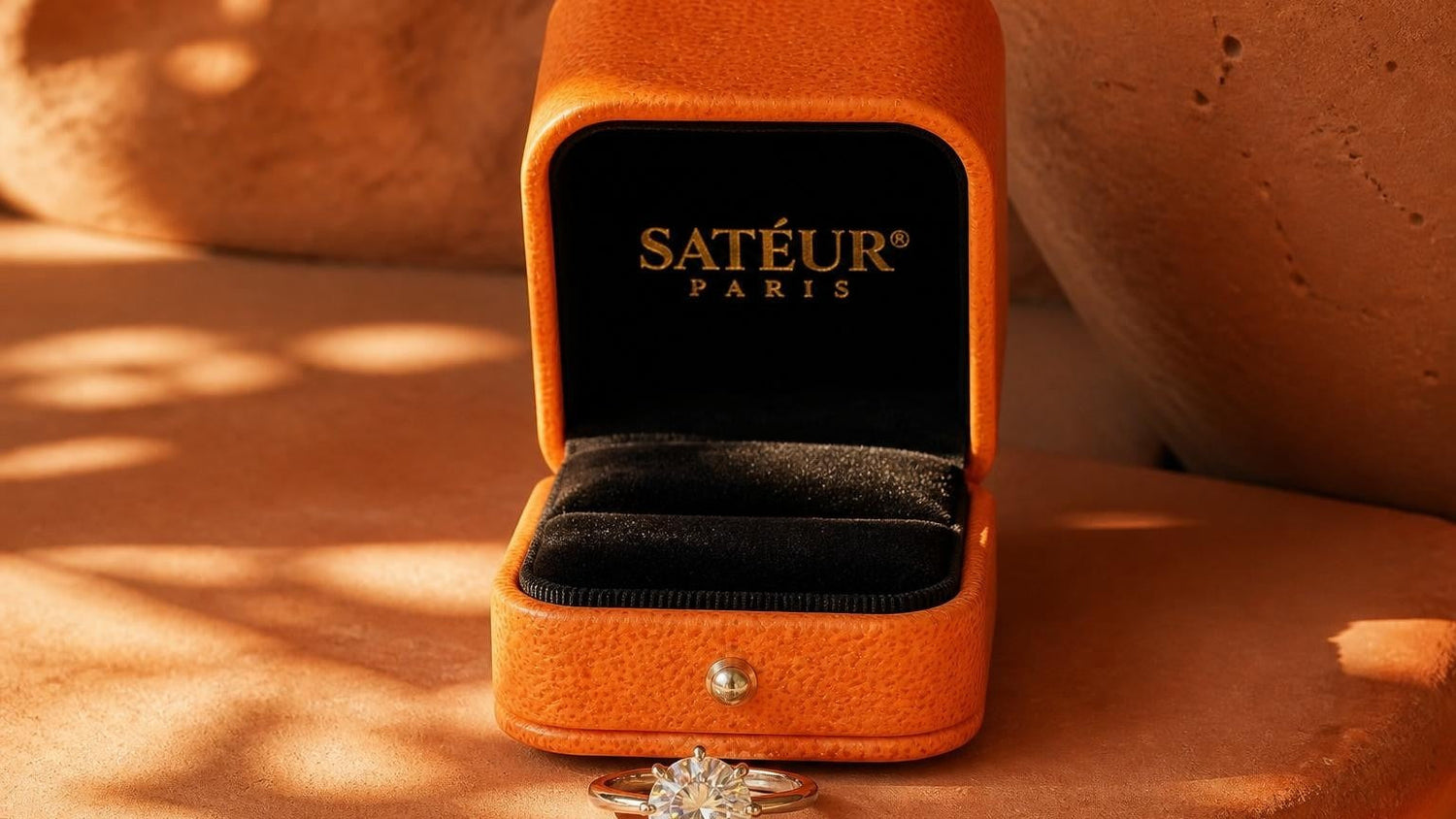
Moissanite Hardness: What 9.25 Mohs Means for Daily Wear
Moissanite hardness is measured at 9.25 on the Mohs scale — harder than sapphire (9), ruby (9), topaz (8), and quartz (7). Only diamond, at 10, sits above it. For anyone considering moissanite jewellery as part of a lifetime commitment, this single number carries significant weight. It tells you, with the precision of mineralogical science, that moissanite resists the scratches and abrasions of ordinary life with exceptional reliability.
This article explains what moissanite hardness means in practice, how it compares to diamond and other popular gemstones, and why the Mohs scale matters more than most buyers realise when choosing an engagement ring built to last.
- Moissanite rates 9.25 on the Mohs hardness scale — second only to diamond (10).
- It is harder than sapphire (9), ruby (9), topaz (8), and every other common gemstone.
- Moissanite will not scratch from everyday contact with keys, metal, or fabric.
- Hardness and toughness are distinct properties — moissanite excels at both.
- Moissanite exhibits approximately 2.4× the refractive fire of a diamond, creating vivid rainbow brilliance distinct from diamond's whiter light.
- Satéur moissanite rings begin from approximately $88, offering lasting beauty at a fraction of diamond cost.
What Is Moissanite Hardness
Hardness, in the context of gemstones, refers to a stone's resistance to surface scratching. The Mohs scale — developed by German geologist Friedrich Mohs in 1812 — ranks minerals from 1 (talc, the softest) to 10 (diamond, the hardest). Each step up represents a meaningful leap in scratch resistance: a mineral can only be scratched by something harder than itself.
Moissanite was first discovered in 1893 by French chemist Henri Moissan in a meteorite crater in Arizona. What he found was a mineral of extraordinary durability — silicon carbide (SiC) — with optical properties unlike almost anything found in nature. Today, moissanite used in jewellery is lab-created, grown to precise standards. Its hardness of 9.25 Mohs is not an approximation; it is a consistent, measured characteristic of the silicon carbide crystal structure.
For a gemstone worn daily on the hand — the most abrasive surface in ordinary life — hardness is the baseline qualification. A ring that scratches from bag linings, kitchen countertops, or metal buckles will cloud and dull within years. A gemstone rated 9.25 does not.

Moissanite on the Mohs Hardness Scale
The Mohs scale is not linear — the distance between diamond (10) and corundum (9, which includes sapphire and ruby) is far greater than the distance between corundum and beryl (7.5–8). Moissanite's 9.25 rating places it in a category with only one peer: diamond itself.
What this means practically is that moissanite resists scratching from virtually every material it will encounter in daily wear. Steel (which rates around 6–7 on the Mohs scale) will not scratch moissanite. Granite countertops (around 6–7) will not scratch moissanite. Even sapphire glass (used in premium watch faces, rated 9) is marginally softer than moissanite.
For context, cubic zirconia — a commonly used diamond simulant — rates only 8 to 8.5 on the Mohs scale. The practical gap between 8.5 and 9.25 is significant: CZ will show scratches from everyday contact that moissanite would not register. This is why moissanite does not yellow or lose brilliance over time with normal wear and care, while lower-hardness alternatives cloud and scratch within years.
Moissanite also has a refractive index of approximately 2.65, generating approximately 2.4× the fire dispersion of diamond. Its sparkle under direct light is vivid — a distinct rainbow-forward brilliance that differs from diamond's crisper, whiter light. Both are optically exceptional; they are simply different in character.
Those comparing moissanite vs diamond rings should understand that this difference in sparkle character is a feature, not a compromise. Moissanite simply returns more colour from its facets than diamond does.
How Moissanite Compares to Diamond in Durability
Diamond measures 10 on the Mohs scale — the upper limit. Moissanite, at 9.25, is 0.75 points below. In the lab, this means diamond can scratch moissanite (and not vice versa). In daily life, this distinction is nearly inconsequential. The surfaces that jewellery actually encounters — counters, handbags, fabrics, metal fixtures — are all well below 9 on the Mohs scale. The 0.75 point difference between moissanite and diamond does not translate into a meaningful difference in real-world durability.
Where the comparison becomes more nuanced is toughness. Hardness measures scratch resistance; toughness measures resistance to breaking or chipping under impact. Diamond, despite its extraordinary hardness, is brittle — it has cleavage planes along which it will fracture under a sharp blow. Moissanite has no such cleavage planes. It is not only hard but also structurally resilient. In drop or impact scenarios, moissanite typically performs at least as well as diamond.
The practical conclusion: for daily-wear engagement rings, moissanite's 9.25 Mohs hardness and high toughness make it a gemstone that does not require special handling. It is built for uninterrupted wear.
For a broader comparison of how moissanite sits alongside diamond in terms of cost and value, see this guide to moissanite vs diamond vs lab diamond.

Moissanite vs. Sapphire and Other Gemstones
Understanding moissanite hardness becomes clearer when set alongside the full spectrum of popular gemstones. Below is a reference comparison using standard Mohs ratings.
| Gemstone | Mohs Hardness | Daily Wear Suitability |
|---|---|---|
| Diamond | 10 | Excellent |
| Moissanite | 9.25 | Excellent |
| Sapphire / Ruby (Corundum) | 9 | Excellent |
| Cubic Zirconia | 8–8.5 | Good, but will show wear |
| Topaz | 8 | Good with care |
| Aquamarine / Emerald | 7.5–8 | Moderate — requires care |
| Quartz / Amethyst / Citrine | 7 | Low — not ideal for rings |
| Pearl / Opal | 2.5–6.5 | Very fragile — occasional wear only |
Sapphire is commonly cited as the second hardest gemstone for jewellery use, and it has a long history in engagement rings. Moissanite, at 9.25, exceeds it. Where sapphire has occasionally been recommended as a slightly softer but durable alternative to diamond, moissanite sits above it on every durability metric.
Gemstones below 7 on the Mohs scale — such as opal, pearl, and many organic stones — are vulnerable to scratching from household dust (which contains quartz particles rated at 7). These require occasional wear and careful storage. Moissanite sits in a category so far above this threshold that the comparison is almost academic.
The gemstones most often compared to moissanite in engagement ring contexts — sapphire, cubic zirconia, and lab-grown diamond — are all softer. Only mined or lab-grown diamond exceeds moissanite in Mohs hardness, and the practical difference in ring-wear durability is minimal.

Why Hardness Matters in Engagement Rings
An engagement ring is worn every day, often without removal. It endures cooking, cleaning, exercise, travel, and the accumulated contact of an ordinary life. A gemstone that scores poorly on hardness will show it — and quickly. Fine scratches accumulate across the table facet, reducing the stone's ability to reflect and refract light. Brilliance dims. The stone appears milky or dull.
A gemstone rated 9.25 does not allow this. Its crystal structure resists the micro-abrasions that accumulate from daily contact. The facets remain sharp. The light path through the stone stays clear. Over ten, twenty, or forty years of continuous wear, the stone looks as it did on the day it was set.
Hardness also directly informs cleaning. Moissanite can be cleaned with an ultrasonic cleaner, a steam cleaner, or warm soapy water — the same methods used for diamond. Lower-hardness gemstones often cannot tolerate ultrasonic cleaning, which vibrates the stone to dislodge debris. Moissanite's structural integrity makes maintenance simple.
This is why hardness is not merely a technical footnote on a gemstone specification sheet. For a ring worn without interruption for decades, it is the foundation on which everything else rests.
For those exploring the full landscape of moissanite vs diamond vs Satéur, hardness is one dimension of a broader durability conversation that also includes brilliance retention, toughness, and long-term maintenance.

Satéur Destinée Ring™
The look of a flawless diamond, for 1% of the price.
Compare to a $10,000 mined diamond
Joined by 100,000+ couples across 150+ countries.
Discover the Destinée RingFree worldwide shipping · 30-day returns · Lifetime Satéur Care
The Satéur Advantage: Exceptional Durability at Transparent Value
Satéur moissanite is sourced from the top tier of lab-created silicon carbide production — stones that meet a consistent hardness of 9.25 Mohs and exhibit the vivid fire dispersion that distinguishes moissanite from all other gemstone alternatives. Set in 18k gold finish, the stones are cut to maximise that distinct rainbow brilliance.
Satéur moissanite rings begin from approximately $88. A comparable diamond — one that approaches moissanite's fire and surpasses it only marginally in hardness — would cost ten to fifty times more. The Satéur moissanite ring collection offers that calibre of durability without the pricing structures that have historically made fine jewellery inaccessible to most.
For those who want the clean, white brilliance of a diamond simulant rather than moissanite's more vivid fire, Satéur Gems® — the Maison's flagship stone — offers diamond-accurate optics at an equally considered price point. For the moissanite buyer, the choice is clear: no other lab-created gemstone combines 9.25 Mohs durability with moissanite's characteristic fire at this price.
Over 100,000 customers across 150+ countries have made that choice. The stone does not diminish with time. Neither does the decision.
The Satéur Destinée Ring™ is The 1% Ring® — a ring that begins a different conversation about what jewellery should cost and what it should mean.
Frequently Asked Questions About Moissanite Hardness
What does moissanite's 9.25 Mohs hardness rating mean for daily wear?
A 9.25 Mohs rating means moissanite resists scratching from virtually every surface it encounters in daily life — steel, granite, concrete, fabric, and most metals all rate below 9 on the Mohs scale. Moissanite can be worn continuously without accumulating the micro-scratches that cloud lower-hardness gemstones over time. It is one of only two gemstones (alongside diamond) considered fully suitable for uninterrupted daily ring wear on a hardness basis.
How does moissanite hardness compare to diamond?
Diamond measures 10 on the Mohs scale; moissanite measures 9.25. Diamond is the only harder gemstone. In laboratory conditions, diamond can scratch moissanite. In daily wear, the practical difference is negligible: the surfaces a ring encounters routinely — countertops, bags, clothing — are all well below 9 Mohs, meaning both diamond and moissanite resist them equally well. Moissanite also differs from diamond in toughness: diamond has cleavage planes that make it susceptible to fracture under a sharp blow; moissanite does not, making it structurally resilient under impact.
Will moissanite scratch or cloud over time?
Moissanite does not scratch from ordinary contact and does not cloud or lose brilliance over time with normal wear and care. Because its hardness (9.25 Mohs) exceeds the hardness of dust particles, household surfaces, and everyday materials, its facets remain sharp and its light performance is preserved. Unlike lower-hardness simulants such as cubic zirconia, which can show surface scratching within months of daily wear, moissanite maintains the same optical clarity for decades. Routine cleaning with warm soapy water or an ultrasonic cleaner keeps it at its best.
Why is hardness important when choosing an engagement ring?
An engagement ring is worn daily, often without removal, across every activity of ordinary life. Gemstones with hardness ratings below 8 on the Mohs scale will accumulate surface scratches from contact with household dust, fabrics, and surfaces — dulling the stone's brilliance over months and years. Hardness directly determines whether a stone's facets remain sharp and reflective across decades of wear. For a ring intended to last a lifetime, a hardness rating of 9 or above is the practical threshold. Moissanite, at 9.25, exceeds this threshold and is matched only by diamond (10) among widely available gemstone options.
What gemstones are harder or softer than moissanite?
Only diamond (Mohs 10) is harder than moissanite (9.25). Sapphire and ruby, both forms of corundum, rate 9 — marginally softer. Cubic zirconia rates 8 to 8.5, topaz rates 8, aquamarine and emerald rate 7.5 to 8, and quartz-family stones (amethyst, citrine) rate 7. Pearl and opal are far softer, at 2.5 to 6.5, and are not suitable for rings worn daily. In the practical spectrum of gemstones considered for engagement rings, moissanite's 9.25 places it in the top tier alongside diamond.
How often does moissanite need cleaning or professional maintenance?
Moissanite benefits from the same cleaning routine as diamond — warm soapy water with a soft brush every few weeks, or occasional use of an ultrasonic cleaner. It does not require professional maintenance at any fixed interval. Because moissanite's 9.25 Mohs hardness means its facets do not scratch or erode from normal wear, professional re-polishing is not typically necessary over the lifetime of the stone. A check of the setting (claws, prongs) every one to two years is good practice for any fine ring, regardless of the gemstone.

















اترك تعليقًا
This site is protected by hCaptcha and the hCaptcha Privacy Policy and Terms of Service apply.