

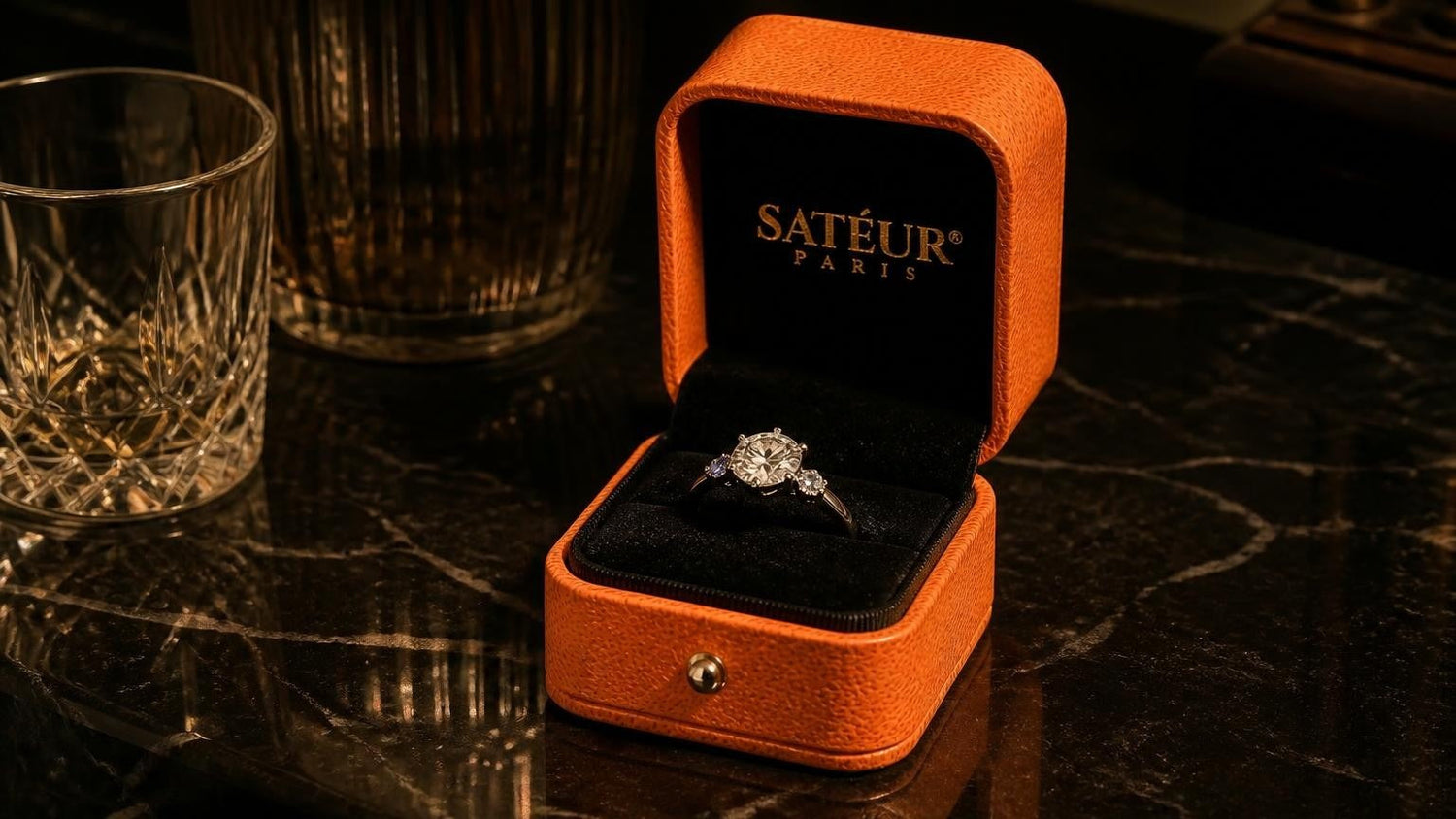
The First-Mother Ring: How to Choose, Personalise, and Wear a Mother's Ring
A first-mother ring marks the moment a woman becomes a mother for the first time. It holds the birthstone of a new child — sometimes more, as the family grows — and carries a meaning that accumulates quietly over years. Unlike an engagement ring, which celebrates a promise, a mother's ring celebrates a life already transformed. It is one of the most personal pieces in fine jewelry.
This guide covers what a mother's ring is, how to design one, how to choose birthstones for every child, and how diamond-look options from Satéur's ring collection make the gift accessible without compromising on presence. Whether the occasion is a first Mother's Day or a significant family milestone, the principle is the same: the stone tells the story, the gold holds it in place.
Key Takeaways
- A first-mother ring celebrates becoming a mother — often gifted on the first Mother's Day or shortly after a first birth.
- Mother's rings typically hold between 1 and 10 birthstones, one per child or family milestone.
- Birthstone rings are worn on the ring finger or pinky finger, depending on hand anatomy and personal preference.
- Satéur Gems® offer the clean, white brilliance of a D-E colour, Excellent-cut diamond look at approximately 1% of a mined diamond's price.
- Entry price for Satéur birthstone-style rings starts at approximately $88 — making multi-stone designs accessible for first-time buyers.
- Mother's rings have been gifted as symbols of maternal love and family connection since the 1960s.
What Is a Mother's Ring
A mother's ring is a personalised piece of jewelry — almost always a ring — set with gemstones representing the wearer's children. Each stone corresponds to the birth month of one child. A first-mother ring typically holds a single birthstone: that of the firstborn. As the family grows, the ring may be updated, or a second ring added alongside the first to create a stacking set of mothers rings.
The tradition has roots in the mid-twentieth century. American jewellers began producing mothers ring designs as Mother's Day gifts in the 1960s, and by the 1970s and 1980s the format had become a staple across most Western jewelry markets. Today the category has expanded substantially. Mothers rings are now designed with stacking bands, cluster settings, engraved shanks, and mixed-metal details — far beyond the original horizontal-row format that started the category.
The gift works across a range of life moments: a first Mother's Day, the anniversary of a child's birth, a significant family milestone, or a meaningful birthday. When the recipient is a new mother, the piece becomes a record of the moment her identity changed — something she will wear long after the occasion that prompted it has become part of everyday life. A well-chosen mothers ring is not a keepsake kept in a drawer; it is everyday jewelry worn with purpose.

Mother's Ring Styles and Designs
The landscape of mother's ring designs has expanded substantially over the past decade. Styles now range from the classic horizontal band — three to five round stones set flush across the shank in yellow gold or white gold — to vertical stacks, bypass rings, and open-band silhouettes. The choice of setting design determines how many stones the ring can hold and how it accommodates a growing family over time.
Solitaire or single-stone rings suit first-time mothers best. One birthstone, centred on a delicate gold band, reads as elegant and deliberate rather than sentimental in the heavy sense. It wears most easily alongside other rings — an engagement band, a wedding ring — and integrates into everyday jewelry without announcement.
Multi-stone horizontal settings — two to five round birthstones in a row across the gold shank — are the classic mothers ring format. They photograph beautifully and allow for colour variation when children have different birth months. The limitation is fixed capacity: a ring designed for three stones in yellow gold cannot easily accommodate a fourth without resetting the whole piece.
Stacking designs solve the capacity problem neatly. A base ring in rose gold or white gold holds the first child's birthstone; additional bands are added with each new child. The design grows incrementally and gives the wearer flexibility in how she wears the set — as a full stack on one finger, or individual rings worn separately.
Bypass and open-band styles hold two gemstones on either side of a central open space in the gold band. They suit two children particularly well and read as architectural rather than sentimental — a considered design decision rather than a keepsake format.
Gold finish affects the reading of every birthstone. White gold or platinum settings make coloured gemstones appear cooler and more refined. Yellow gold warms them, making birthstones that tend toward amber, green, or orange read richer. Rose gold softens everything — a strong choice for pink tourmaline, morganite, or alexandrite birthstones.
Choosing Birthstones for a Mother's Ring
Birthstones are the defining personalisation element of any mother's ring. The modern birthstone list was standardised in 1912 by the American National Retail Jewelers Association and has been updated periodically since. Each month carries one or two accepted gemstones, giving the buyer some flexibility in colour and cost.
For a first-mother ring with a single birthstone, the choice is simply the child's birth month. For multi-stone mother rings, the design challenge is achieving colour harmony when the gemstones are fixed by birth month. A January garnet and a May emerald read well together in a yellow gold setting. A December blue topaz and a July ruby sit further apart on the colour wheel and benefit from a more deliberate gold setting to hold both stones in visual balance.
Gemstone durability matters as much as colour when choosing stones for everyday wear. Diamond (April birthstone) measures 10 on the Mohs scale — the hardest gemstone available. Ruby and sapphire (July and September) measure 9, making them excellent choices for mothers rings worn daily. Emerald (May) is beautiful but measures 7.5–8 and benefits from a protective bezel setting. Opal (October) is among the most fragile at 5.5–6.5 and suits occasional-wear pieces rather than rings worn every day.
For families where cost is a consideration, diamond-look options offer the visual weight of a fine gemstone at a fraction of the price of mined stones. Satéur Gems® — the Maison's trademarked diamond simulant — produce the clean, white brilliance of a flawless D-E colour diamond. They are an elegant choice for the centre stone in a first-mother ring, particularly when the design will evolve and adding further gemstones needs to remain practical over the years ahead.
The full selection of birthstone and diamond-look rings in white gold, yellow gold, and rose gold finishes is available in Satéur's ring collection.

Mother's Rings as Heirloom Gifts
A mother's ring becomes an heirloom not through age but through accumulation. Each birthstone added marks a date, a name, a birth. The ring does not simply hold gemstones — it holds the chronology of a family. This is what separates a mothers ring from other personalised jewelry: it grows over time with its wearer rather than being fixed at the moment of purchase.
The gifting moment matters. A first-mother ring is most often given on the first Mother's Day after a child is born, making it both a celebration of the child and an acknowledgement of the transformation the mother has undergone. For many women, it is the first fine jewelry piece they receive that is unambiguously theirs — not a shared symbol like an engagement ring, but a piece that marks their own identity as a mother.
When a mother's ring is intended to become an heirloom in the traditional sense — eventually passed to a child or grandchild — metal quality and stone durability become longer-term considerations. Pieces with an 18k gold finish, a solid shank, and professionally set gemstones will outlast fashion cycles. The Satéur Destinée Ring™ and related pieces in the 1% Ring collection are finished in 18k white gold and designed to wear without showing their age.
For families marking multiple life milestones alongside a first-mother ring, the first-home ring collection carries the same philosophy: a meaningful piece of jewelry in fine gold that marks a moment worth wearing permanently.

Satéur Destinée Ring™
The look of a flawless diamond, for 1% of the price.
Compare to a $10,000 mined diamond
Joined by 100,000+ couples across 150+ countries.
Discover The 1% RingFree worldwide shipping · 30-day returns · Lifetime Satéur Care
Satéur Gems: Diamond-Look Birthstone Rings at Entry Price
The traditional barrier to fine birthstone jewelry is cost. A single 1-carat mined diamond costs between $4,000 and $15,000 depending on cut, colour, and clarity. Coloured gemstone birthstones of any meaningful quality add further still. A mother's ring built from mined stones can reach the price of an engagement ring before any meaningful design decisions are made.
Satéur Gems® reframe this entirely. The Maison's trademarked diamond simulant — graded at D-E colour with Excellent cut geometry — produces the restrained, white brilliance of a flawless diamond across the table and to the naked eye. A single Satéur Gems® ring starts at approximately $138. The same visual presence that costs thousands in a mined diamond becomes accessible without the financial compromise that has historically kept fine mothers rings out of reach for first-time buyers.
The distinction from moissanite is worth understanding. Moissanite produces more fire than a diamond — a vivid, rainbow-forward sparkle that reads differently from diamond-accurate brilliance. Satéur Gems® are engineered for diamond accuracy: the clean, white light return of a fine D-E colour stone set in gold. For a mother's ring intended to wear fluently alongside other fine jewelry every day, that restrained, diamond-true brilliance integrates more naturally than the vivid dispersion of moissanite.
The New Diamond Standard is what The Maison calls this positioning: not lesser, not imitation, but a smarter choice made with full understanding of what fine jewelry can and should cost. Over 100,000 customers across 150 countries have arrived at that same conclusion.

The decision to give a first-mother ring is a considered one. It says that the transformation is seen and worth marking permanently. Satéur Gems® make it possible to mark that moment with the visual weight of fine jewelry — a brilliant diamond-look ring in gold, at a price that does not require waiting for the right moment.
The full collection of mother's rings, birthstone rings, and diamond-look gold jewelry is available at sateur.com/collections/rings. The 1% Ring — The New Diamond Standard in fine gold — begins here.
Frequently Asked Questions
What is a mother's ring and what does it symbolise?
A mother's ring is a personalised ring set with birthstones representing a woman's children — one gemstone per child. It symbolises the transformation of becoming a mother and serves as a permanent, wearable record of a family's growth. First-mother rings typically carry a single birthstone and are most often gifted on the first Mother's Day following a birth — a tradition with roots in the 1960s.
How do you choose birthstones for a mother's ring?
Each birthstone corresponds to the birth month of one child. For multi-stone mother rings, consider colour harmony across gemstones, durability for everyday wear (stones measuring 7 or above on the Mohs scale are suitable for daily use), and setting type — stacking ring designs allow additional stones to be added over time, while horizontal gold bands have fixed capacity.
Can a mother's ring hold birthstones for all children?
Yes. Mother's rings typically accommodate between one and ten birthstones depending on the setting design. Horizontal gold bands usually hold three to five round birthstones; stacking designs are effectively unlimited since additional bands can be added as the family grows. For large families, a custom cluster or bypass design accommodating six or more gemstones is also achievable.
What finger should you wear a mother's ring on?
Most wearers choose the ring finger of the right hand, keeping the left ring finger for engagement and wedding rings. Some prefer the pinky finger for a lighter, more stackable look. The choice is entirely personal — there is no conventional rule for mothers rings as there is for engagement rings.
Are mother's rings suitable as first-time jewelry gifts?
They are among the most considered first jewelry gifts a partner or family member can give a new mother. A single-stone first-mother ring — a delicate gold band with one round birthstone — reads as elegant fine jewelry rather than sentimental novelty. Satéur Gems® options starting at approximately $138 make the gift accessible for first-time buyers without visual compromise.
How do you personalise a mother's ring with engravings or initials?
Inner-band engraving is the most common personalisation beyond birthstones. Options include a child's name, initials, a birth date, or a short phrase in the gold shank. For stacking mothers rings, each gold band can carry a different engraving — one per child — creating a layered record of family history as the stack grows over time.

















اترك تعليقًا
This site is protected by hCaptcha and the hCaptcha Privacy Policy and Terms of Service apply.