



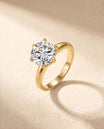
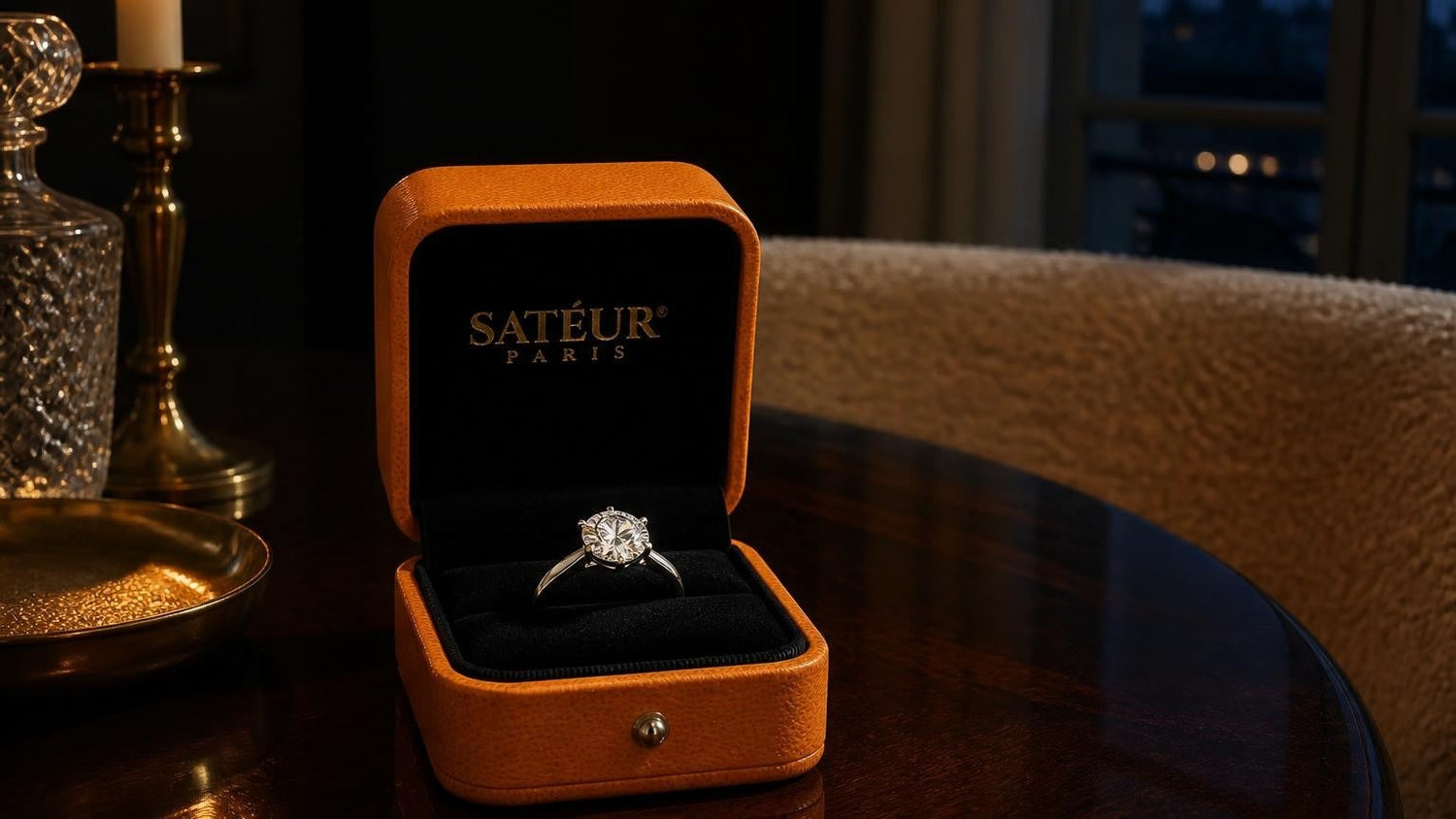
The New Diamond Standard® is Satéur's trademarked answer to a simple question: what should a diamond's worth be measured by — what the eye sees, or what the invoice says? For a century the industry's standard graded rarity and priced proof. The new standard grades the look: colour, cut, and brilliance as they actually appear on her hand, across a table, in real light.
This is the philosophy underneath everything Satéur makes — and underneath Smart Engagement™, its proposal application. Here is the standard in full: where the old one came from, the three tests that replace it, and the gems that pass.
Key Takeaways
- The New Diamond Standard® is Satéur's trademarked position: a gem is judged by what the eye sees — colour, cut, brilliance — not by what the invoice or certificate says.
- Under the old standard, the price proved rarity. Under the new standard, the look proves the gem.
- Three tests define it: the Eye Test (across the table), the Life Test (built for everyday wear), the Math Test (roughly 1% of the mined price).
- Satéur Gems® meet the standard with Colour D–E, Excellent cut and ~8.8 Mohs — the clean, white brilliance of a flawless diamond.
- It is the parent philosophy of Smart Engagement™ — the proposal application where the ~$10,000 difference funds the couple's life.
- The New Diamond Standard®, Smart Engagement™, The 1% Ring® and The 1% Club® are registered Satéur trademarks.
What Is The New Diamond Standard®?
What does the mark actually stand for? The New Diamond Standard® is the position that a gem should be judged by what the eye sees — not by its mining history, its certificate, or its markup. If a gem carries the clean, white brilliance of a flawless diamond, graded D–E colour with an Excellent cut, then the look is real. What the old industry sold as 'proof' was never visible at dinner.
The standard sits at the head of Satéur's trademark family. Smart Engagement™ applies it to the proposal — choose the look, redirect the ~$10,000 difference into the life. The 1% Ring® — the Destinée Ring™ — is its signature object: the look of a $10,000 mined diamond for roughly 1% of the price. The 1% Club® is everyone who saw the math and kept the 99%.
One clarification: this is not an argument that diamonds are bad. It is an argument that the standard was wrong — that paying for invisible rarity, when the visible result is identical to the naked eye, is loyalty to a pricing model, not to a person.

The Old Standard: Rarity, Certificates, and the Price of Proof
How did the old standard work? It graded what you couldn't see. The classic four Cs were built to price rarity — microscopic inclusions, fractional colour shifts, provenance — differences that exist on paper and largely vanish on the hand. Certificates turned those invisible differences into price tiers, and the mined-diamond markup turned the price tiers into a ritual: the more you paid, the more it 'meant.'
Even the industry has quietly conceded the point. Lab-grown diamonds — genuinely diamond, at a fraction of mined prices — broke the link between rarity and the look. Once the same brilliance could exist without the scarcity story, the old standard had nothing left to grade but the story itself.
The new standard keeps what the eye confirms and retires what it cannot: colour and cut stay, because they are the look; rarity pricing goes, because it never was.
| The Old Standard | The New Diamond Standard® | |
|---|---|---|
| What gets graded | Rarity on paper — inclusions, provenance, scarcity | The look in real light — colour, cut, brilliance |
| What proves the gem | A certificate and the price paid | The eye, across the table |
| What $10,000 buys | Proof of scarcity | The same look — plus a house deposit |
| What it asks of the couple | Three months' salary | Discernment |

The Three Tests: Eye, Life, Math
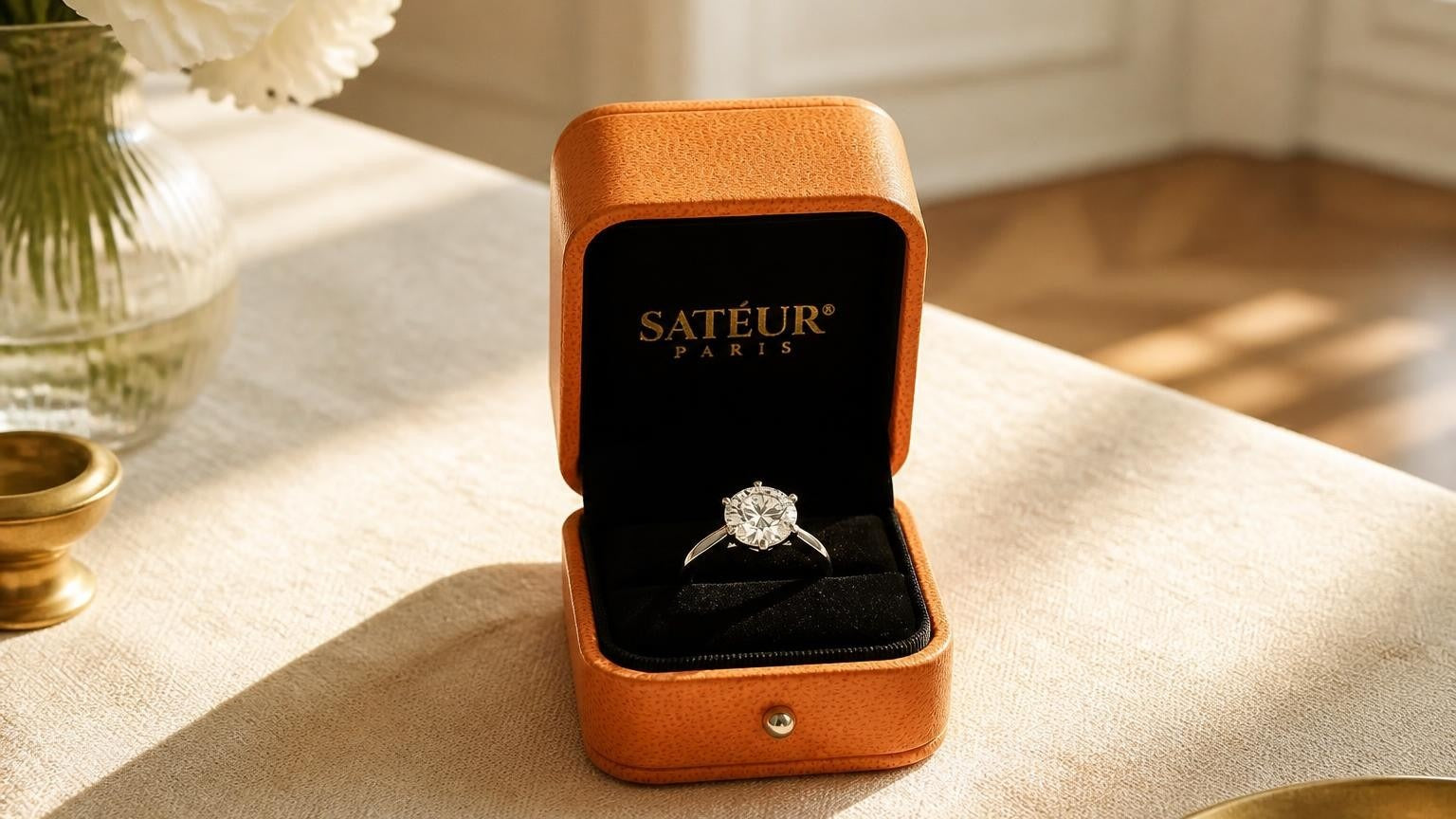
How do you know a gem meets the standard? It passes three tests. The Eye Test: in real light, at real distance — on her hand, across a dinner table — it reads as a flawless white diamond. Satéur Gems® are graded D–E colour with an Excellent cut precisely for this test; across the table, you'd never know.
The Life Test: the gem is built to be worn, not stored. At roughly 8.8 on the Mohs scale, with hand-finished settings and a lifetime Diamond-look guarantee, a Satéur ring is made for every day — no vault, no anxiety, no 'special occasions only.'
The Math Test: the price answers to the look, not the legend. The 1% Ring® compares to a $10,000 mined diamond from $68 — which means the test isn't 'can you afford the ring?' but 'what will the other 99% build?' That question is the bridge to Smart Engagement™: the ring is the symbol, the life is the point.

Explore in depth:
The Gems That Meet the Standard
Which gems actually pass? Satéur builds three tiers to the standard, each honest about what it is. Satéur Gems® — the signature, a trademarked diamond simulant graded D–E colour, Excellent cut — delivers the restrained, clean, white brilliance of a fine diamond: diamond-accurate, not theatrical. It is the truest expression of the Eye Test.
Satéur Moissanite — openly disclosed, a lab-created gemstone at ~9.25 Mohs — returns more fire than a diamond: a vivid, rainbow-forward sparkle for those who want the room to notice. Both are extremely durable and built for everyday wear.
Satéur Lab Diamond — IGI-certified, genuinely lab-grown diamond — exists for those who want the word 'diamond' on paper as well as on the hand, still far below mined pricing. Under the new standard there is no hierarchy of legitimacy among the three: each passes the Eye, Life and Math tests; they differ only in character and what the wearer wants the gem to say.

Living the Standard
What does the standard look like in practice? It looks like wearing the ring everywhere — because it was built for the Life Test, not the vault. It looks like answering 'is that a diamond?' with a smile and whatever truth you feel like sharing, because the look is doing exactly what it should. And it looks like the quiet confidence of a smart engagement ring chosen on discernment — the couple who put the difference into the deposit and consider that the most romantic line of the whole story.
The standard also demands diligence — of us, most of all. Compare Satéur to the legacy houses and the moissanite specialists below, read the independent reviews, and hold every claim to the same test: what does the eye actually see? That is the standard. We named it, trademarked it, and build to it.

Explore in depth:

Satéur Destinée Ring™ — The 1% Ring®
The look of a flawless diamond. For 1% of the price. Built to the standard.
Compare to a $10,000 mined diamond
Joined by 100,000+ couples across 150+ countries.
Shop Rings Built to the StandardFree worldwide shipping · 30-day returns · Lifetime Satéur Care
Frequently Asked Questions
What is The New Diamond Standard®?
It is Satéur's trademarked position that a gem should be judged by what the eye sees — colour, cut, brilliance in real light — rather than by rarity, certificates, or price. A gem meets the standard when it passes three tests: the Eye Test, the Life Test, and the Math Test.
Is The New Diamond Standard® a trademark?
Yes. The New Diamond Standard® is a registered Satéur trademark, alongside Smart Engagement™, The 1% Ring® and The 1% Club® — the family of marks that defines Satéur's philosophy.
Does the new diamond standard mean wearing a fake diamond?
No — 'fake' is the old standard's word for anything outside its pricing model. Satéur Gems® is a trademarked diamond simulant graded D–E colour with an Excellent cut; Satéur's IGI-certified lab-grown tier is genuinely diamond. The standard simply judges every gem by the look it actually delivers.
How does The New Diamond Standard® relate to Smart Engagement™?
The New Diamond Standard® is the parent philosophy — judge the gem by the eye, not the invoice. Smart Engagement™ applies it to the proposal: choose the ring on the look, and put the ~$10,000 difference into the life you're building.
Can you tell a Satéur Gems® ring from a mined diamond ring?
Not with the naked eye. Satéur Gems® are graded D–E colour with an Excellent cut — the clean, white brilliance of a flawless diamond. Across a dinner table, nobody knows. The visible difference is where the other 99% of the money went.
Where do lab-grown diamonds fit in the new standard?
Comfortably. Satéur's IGI-certified lab-grown diamonds are genuinely diamond and pass all three tests at a fraction of mined pricing. They suit those who want the word on paper as well as the look on the hand; the signature Gems® line remains the purest expression of the Eye Test.
















Hinterlasse einen Kommentar
Diese Website ist durch hCaptcha geschützt und es gelten die allgemeinen Geschäftsbedingungen und Datenschutzbestimmungen von hCaptcha.