



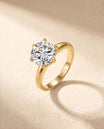
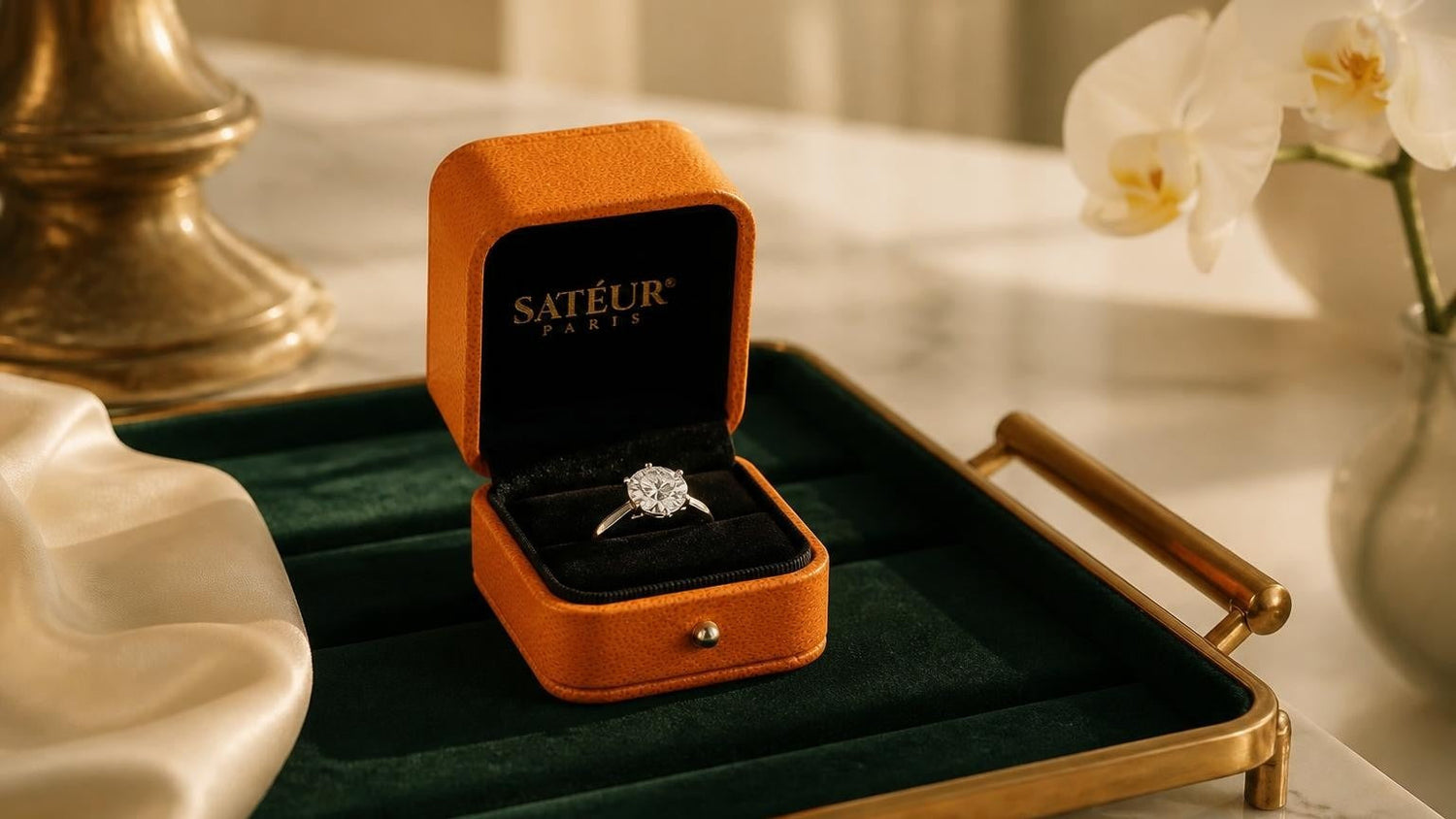
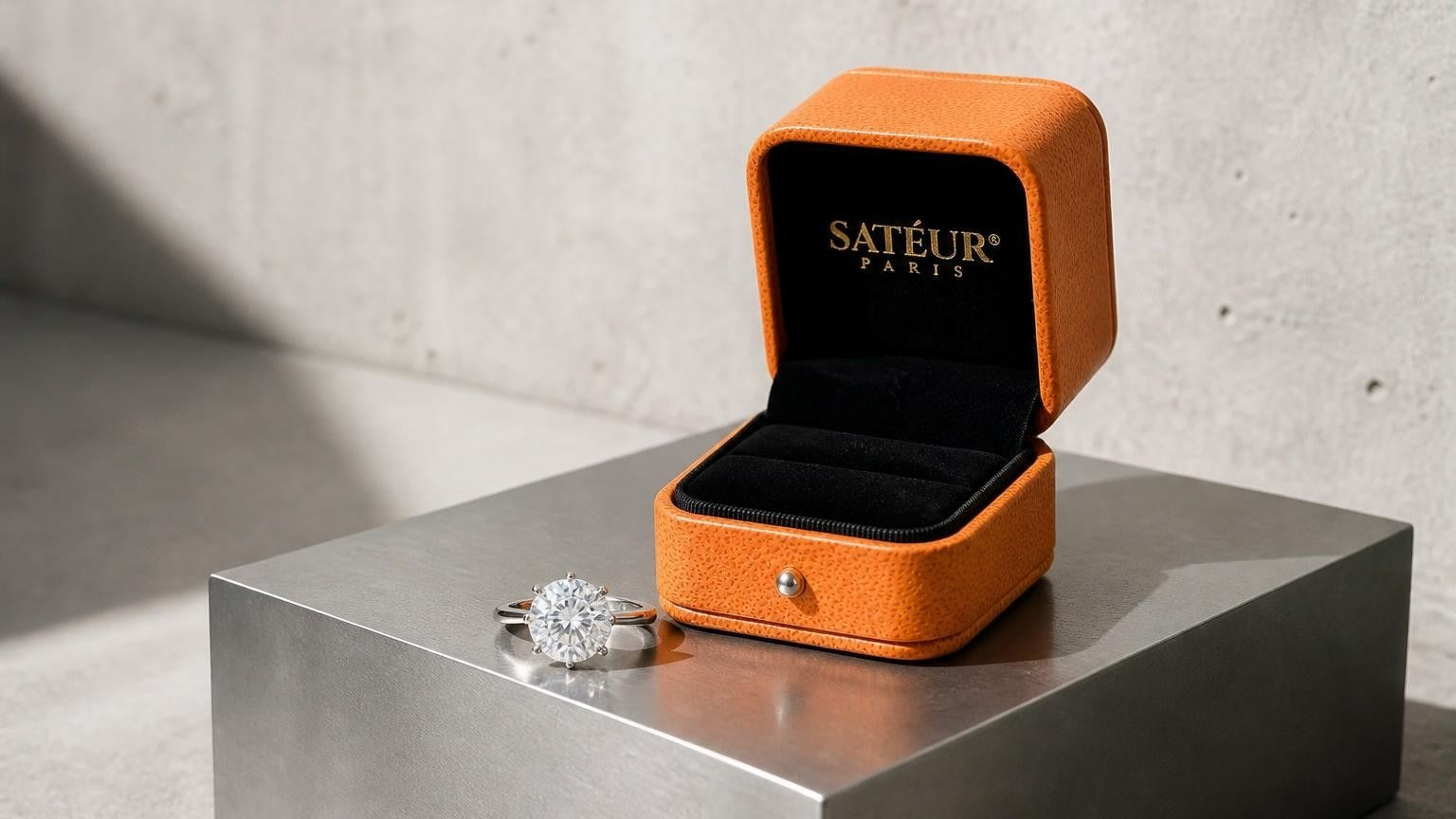
Choosing an engagement ring comes down to four decisions — the gem, the cut, the metal and the setting — and once those are clear, the rest is personal taste. The hardest question used to be how much to spend: a one-carat mined-diamond ring can run past $10,000. A Satéur Destinée Ring™ replicates the look of that flawless diamond for about 1% of the price, set in real 18K gold finishing, from $138. Across a dinner table, you'd never know the difference.
This is the complete guide to choosing an engagement ring the modern way — how the Four Cs actually affect what you see, which metals and settings suit which hands, how to read carat size in the real world, and how a trademarked diamond simulant like Satéur Gems® compares to mined and lab-grown diamonds. Each section links to a deeper guide or collection where one exists.
Key Takeaways
- An engagement ring comes down to four choices: the gem, the cut, the metal and the setting — get those right and the rest is personal taste.
- The Satéur Destinée Ring™ gives the look of a flawless diamond for about 1% of the price — set in 18K gold finishing, from $138.
- Satéur Gems® are graded to a D–E colour equivalent with an Excellent cut, and carry the restrained, white brilliance of a fine diamond rather than a rainbow-forward sparkle.
- Across a dinner table, you'd never know a Satéur Gems® ring from a mined diamond — it replicates the look of a flawless diamond.
- A solitaire flatters every hand; a halo adds visual size; three-stone and vintage styles add story. White-gold finishing maximises brilliance; yellow and rose add warmth.
- Carat reads differently on every hand — match the gem to your finger, your lifestyle and your price range rather than to a number.
Engagement Ring Basics & the Four Cs
What actually determines how an engagement ring looks? Four things, known as the Four Cs — cut, colour, clarity and carat. Cut is the most important and the most misunderstood: it isn't the shape, it's how precisely the gem is faceted, and it controls how much light comes back to your eye. A brilliant cut returns more light than a larger gem cut poorly. Colour grades how near-colourless a white gem is, from D (icy white) down the alphabet toward warm. Clarity measures internal inclusions — most are invisible without magnification. Carat is weight, not size, though the two move together.
The Four Cs were written for mined diamonds, but they're the right lens for any centre gem. Satéur Gems® are engineered to the grades that matter most to the eye: a D–E colour equivalent (the icy, near-colourless end) and an Excellent cut for the restrained, white brilliance of a fine diamond — a true diamond look rather than a rainbow-forward sparkle. Knowing the Four Cs lets you spend on what you can see and skip what you can't.
| The C | What it controls | Where to spend |
|---|---|---|
| Cut | Brilliance & light return | Prioritise — Excellent cut first |
| Colour | How icy-white the gem reads | D–E or G–H both look white set |
| Clarity | Internal inclusions | Eye-clean is enough; skip flawless |
| Carat | Weight (and rough size) | Balance against cut & price |

Explore in depth:
Metals & Settings
Which metal and setting should you choose? Metal sets the mood; the setting sets the silhouette. White-gold finishing is the brightest, most diamond-like backdrop — it lets the gem do all the talking. Yellow gold reads classic and warm against most skin tones; rose gold is romantic and modern; platinum is the heaviest, coolest and most understated. Every Satéur ring is set in 18K gold finishing — the look and feel of fine gold, without the four-figure jump in price.
The setting is where personality enters. A solitaire — one gem, clean band — is the timeless default and flatters every hand. A halo rings the centre gem in smaller accents, adding visual size and brilliance. A three-stone design (past, present, future) carries built-in meaning and suits those who want story. Vintage and art-deco settings add detail and character; dainty and simple bands keep the focus minimal. When in doubt, a solitaire or halo in white-gold finishing is never the wrong answer.
| Setting | Best for | What it does |
|---|---|---|
| Solitaire | Everyone — the safe default | Maximum focus on the gem |
| Halo | Wanting more visual size | Makes the centre read larger |
| Three-stone | Story & symbolism | Past, present, future |
| Vintage / Art Deco | Character & detail | Period romance, fine metalwork |

Explore in depth:
Carat, Shape & Ring Proportions
How big should the gem be? Bigger isn't automatically better — the right carat is the one that suits the hand, the lifestyle and the price range. Carat is weight, so two one-carat gems can look different sizes depending on cut and shape; an elongated cut (oval, marquise, pear, tear-drop) reads larger than a round of the same weight, while a square or cushion shape reads broad and substantial. On a slimmer finger, a one-carat gem looks generous; on a longer hand, you can carry more. The classic engagement sweet spot sits between one and two carats.
Because a Satéur Gems® gem costs a fraction of a mined diamond, carat stops being the price ceiling it usually is — you can choose the size that looks right rather than the size price dictates. If you work with your hands, a lower-profile setting protects the gem; if the ring is for occasions, a higher setting and larger gem catch more light. Match the proportion to the person, and the size takes care of itself.
| Carat (round) | Approx. diameter | Reads as |
|---|---|---|
| 0.5 ct | ~5.2 mm | Dainty, understated, everyday |
| 1.0 ct | ~6.5 mm | Classic engagement sweet spot |
| 2.0 ct | ~8.2 mm | Statement — catches the room |
| 3.0 ct+ | ~9.3 mm+ | Bold, unmistakable presence |

Explore in depth:
Diamond Simulants vs Mined Diamonds — and the Satéur Gems® Value
Can anyone tell a simulant from a mined diamond? Not with the naked eye. Across a table, in a photograph, at dinner, a Satéur Gems® ring replicates the look of a flawless diamond, for about 1% of the price. There are three honest paths to a diamond look. A mined diamond is the traditional, most expensive option. A lab-grown diamond is a real, certified diamond grown in weeks rather than billions of years, typically 60–80% of the mined price. A diamond simulant like Satéur Gems® replicates the look at a fraction of either.
Satéur Gems® are a trademarked diamond simulant engineered for the eye: a D–E colour equivalent, an Excellent cut, and the restrained, white brilliance of a fine diamond — the trait that makes them read as a true diamond rather than a rainbow-forward sparkle. They're extremely durable, built for a lifetime of everyday wear, and graded by abstract spec (colour, cut) rather than the mined-diamond price tag. Satéur Moissanite, an openly-disclosed lab-created gemstone (silicon carbide), is the value option below Gems®, with more fire than a diamond — a vivid, rainbow-forward sparkle — from $98. The result, across the board, is the New Diamond Standard®.
| Option | The look | Relative price | Everyday wear |
|---|---|---|---|
| Satéur Gems® | Restrained, white brilliance of a fine diamond | ~1% of mined · from $138 | Extremely durable |
| Satéur Moissanite | More fire than a diamond — rainbow-forward | ~1% of mined · from $98 | Extremely durable |
| Lab-grown diamond | A real, certified diamond | 60–80% of mined | Extremely durable |
| Mined diamond | Classic white brilliance | 100% | Extremely durable |

Browse Engagement Rings by Style
Where should you start browsing? Begin with the look you're drawn to, then narrow by metal and setting. If you love clean and timeless, look at simple and solitaire styles. If you love detail and history, explore vintage, art-deco and 1920s-inspired designs. Want something unmistakably yours? Unique, custom and non-traditional rings break from the classic template — and there's a full range of men's engagement rings too. Below you'll find every Satéur engagement-ring style, from classic and vintage to modern, dainty and men's designs, each one a step closer to the ring that fits the person.

Explore in depth:
Engagement Ring Care & Maintenance
How do you keep an engagement ring looking new? The whole job takes minutes. A ring worn every day picks up hand cream, soap film and skin oils that dull its brilliance long before any wear shows — so the single best habit is a regular gentle clean. Soak the ring in warm water with a drop of mild dish soap for a few minutes, work a soft brush behind and around the gem where film collects, rinse and pat dry with a lint-free cloth. Done weekly, it keeps both the gem and the 18K gold finish bright.
Beyond cleaning, a few habits protect the ring for life: store it apart from other pieces so harder gems don't scratch the metal, take it off for heavy manual work where knocks do the most damage, and give the setting a once-over now and then to check the gem sits firm. Satéur Gems® are extremely durable and built to shrug off everyday life — treat any fine ring with a little care and it stays looking the way it did on day one.


Satéur Destinée Ring™
The look of a flawless diamond — for about 1% of the price.
Compare to a $10,000 mined diamond
Joined by 100,000+ couples across 150+ countries.
Discover Satéur Engagement RingsFree worldwide shipping · 30-day returns · Lifetime Satéur Care
Frequently Asked Questions
What factors should I prioritize when choosing an engagement ring?
Start with the gem and the cut — cut controls brilliance more than size does. Then choose the metal (white-gold finishing for maximum brilliance, yellow or rose for warmth) and the setting (solitaire for timeless, halo for visual size). With a Satéur Gems® ring, carat stops being the price ceiling, so you can choose the size that looks right rather than the size price dictates.
How do I select the right metal for an engagement ring?
White-gold finishing gives the brightest, most diamond-like backdrop and suits cool skin tones. Yellow gold reads classic and warm; rose gold is romantic and modern; platinum is the coolest and most understated. Every Satéur ring uses 18K gold finishing — the look and feel of fine gold without the four-figure markup.
What are the visual differences between diamond simulants and mined diamonds?
To the naked eye, across a dinner table, a Satéur Gems® ring replicates the look of a flawless diamond — and only a closer look would tell. Satéur Gems® are engineered for the restrained, white brilliance of a fine diamond, so they read as a true diamond rather than a rainbow-forward sparkle — all for about 1% of the mined-diamond price.
How do I determine the appropriate carat weight and stone size?
Match the carat to the hand, the lifestyle and the price range rather than to a number. One to two carats is the classic engagement sweet spot. Elongated cuts (oval, pear, marquise) read larger than rounds of the same weight, and slimmer fingers make any gem look more generous. Because Satéur Gems® cost a fraction of mined diamonds, you can size up without the price penalty.
What setting styles best suit different hand shapes and personal aesthetics?
A solitaire flatters every hand and is the timeless default. A halo adds visual size and works well on slimmer fingers. Three-stone designs carry built-in symbolism; vintage and art-deco settings add detail and history; dainty and simple bands keep the look minimal. When unsure, a solitaire or halo in white-gold finishing is always a safe, elegant choice.
How should I care for and maintain an engagement ring over time?
Clean it weekly in warm water with a drop of mild dish soap and a soft brush, then pat dry — this restores full brilliance in minutes. Store it apart from other jewellery, take it off for heavy manual work, and check the setting periodically. Satéur Gems® are extremely durable and built for everyday wear.
















Hinterlasse einen Kommentar
Diese Website ist durch hCaptcha geschützt und es gelten die allgemeinen Geschäftsbedingungen und Datenschutzbestimmungen von hCaptcha.