



IGI Certified Lab Grown Diamonds: Grading, Reports & Value
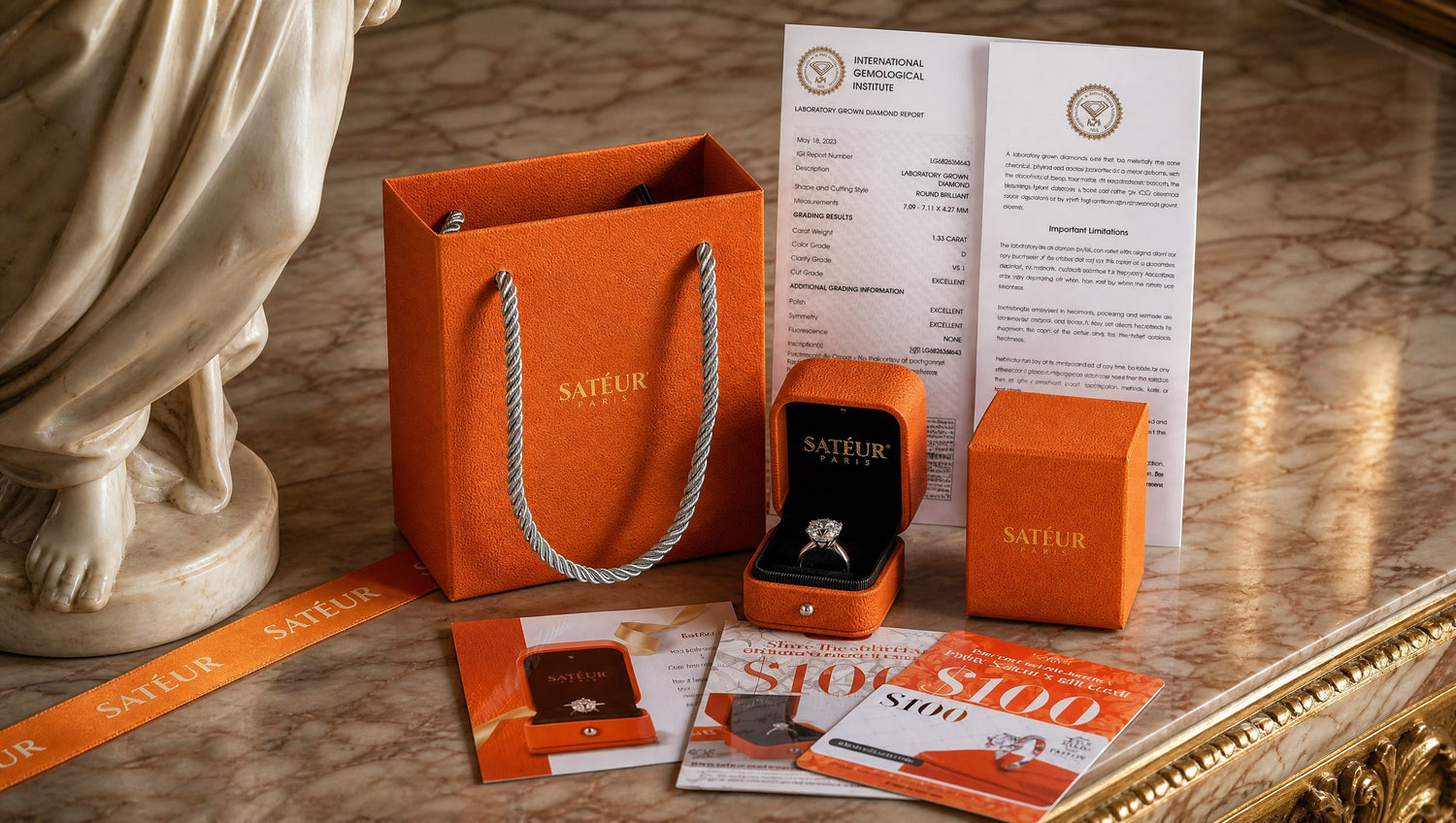
An IGI certified lab grown diamond is a laboratory-grown diamond that has been independently graded by the International Gemological Institute and issued a report documenting its carat weight, colour, clarity and cut. The certificate is what turns a beautiful stone into a verified one — proof, in writing, of exactly what you are buying.
Lab grown diamonds are chemically and optically identical to mined diamonds. Because the two cannot be told apart by the naked eye, certification is the only reliable way to confirm a diamond's origin and quality. IGI grades laboratory-grown diamonds on the same 4C scale used for natural stones, so the language on the report is one you can compare directly against any mined diamond.
This guide explains what IGI certification means, how to read a laboratory-grown diamond report, the colour and clarity ranges you will encounter, and where the value sits. For a wider view, see our overview of lab-grown diamonds and the full range of lab created diamond rings.
Key Takeaways
- IGI grades lab grown diamonds on the same 4C scale (carat, colour, clarity, cut) as mined diamonds.
- Lab grown and mined diamonds are chemically identical — certification is the only way to confirm origin.
- IGI colour grades run D to Z; clarity grades run FL (flawless) to I3 (included).
- Lab grown diamonds typically cost 40–60% less than mined diamonds of equivalent quality.
- A diamond simulant is a separate category — it imitates the look of a diamond rather than being one.
- Satéur gemstones deliver the visual appearance of a D–E colour, excellent-cut diamond for roughly 1% of a mined diamond's cost, from about $88.
What Is an IGI Certified Lab Grown Diamond
The International Gemological Institute is one of the world's largest independent diamond grading laboratories. An IGI certified lab grown diamond is simply a lab-grown diamond that IGI has examined, measured and described in a formal grading report.
The word certified matters. A lab grown diamond is a real diamond grown above ground rather than mined from the earth. It has the same crystal structure and the same hardness — a perfect 10 on the Mohs scale. A certificate does not make a stone real; it documents the qualities the stone already has, so a buyer is not relying on a seller's word.
IGI reports for laboratory-grown diamonds clearly state the diamond's origin as laboratory grown, alongside its full grading. That transparency is the point. Two diamonds can look identical across a table, and only the report tells you which came from a lab and which from the ground.
How to Read an IGI Laboratory Grown Diamond Report
An IGI laboratory-grown diamond report differs from a natural diamond report in one essential way: it states the origin. The header identifies the stone as a lab grown diamond, and many reports carry a small laser inscription on the girdle noting the same. The grading method, however, is shared.
Every report records the 4Cs and the stone's measurements. Read them in this order:
- Carat weight — the diamond's mass, given to two decimal places.
- Colour grade — placed on the D to Z scale.
- Clarity grade — from FL down to I3.
- Cut grade — Excellent through Poor, describing how well the diamond returns light.
- Measurements and proportions — depth, table, symmetry and polish.
Because IGI lab grown diamond reports use the same vocabulary as natural diamond reports, you can compare a lab grown stone and a mined stone line by line. The only field that separates them is origin. For a sense of how weight changes price and presence, our guide to the 3 carat lab grown diamond is a useful reference point.

Lab Grown Diamond Colour Grades: D–Z Scale
Colour in a white diamond is measured by its absence. The IGI colour scale runs from D, the most colourless grade, through to Z, where a faint yellow or brown tint becomes visible. Lab grown diamonds are available across the full D to Z range.
The grades fall into recognisable bands:
- D–F — colourless. The most prized, with no perceptible tint.
- G–J — near colourless. Excellent value, with colour rarely visible once set.
- K–Z — faint to light tint, increasingly noticeable as the scale descends.
For most buyers, a diamond in the D–F or G–J range delivers the clean, white look they imagine when they picture a diamond. Because lab grown diamonds can be produced in high colour grades at lower cost, a colourless lab grown stone is often more attainable than its mined equivalent.

Lab Grown Diamond Clarity Grades Explained
Clarity describes the tiny natural characteristics — called inclusions — formed inside a diamond as it grows. IGI grades clarity from Flawless down to Included, the same scale used for natural diamonds.
| Grade | Meaning |
|---|---|
| FL / IF | Flawless / Internally Flawless — no inclusions visible under magnification. |
| VVS1 / VVS2 | Very, very slightly included — inclusions extremely difficult to detect. |
| VS1 / VS2 | Very slightly included — minor inclusions, not visible to the eye. |
| SI1 / SI2 | Slightly included — inclusions noticeable under magnification. |
| I1 / I2 / I3 | Included — inclusions visible to the naked eye. |
An eye-clean diamond is one whose inclusions cannot be seen without magnification. Many VS and SI graded stones are eye-clean, which is why these grades are a sensible balance of beauty and value. Lab grown diamonds are commonly available in VS+ clarity with D–F colour.

Satéur Destinée Diamond Ring
A real, IGI-certified lab-grown diamond, hand-set in solid 18K gold — a fraction of the mined-diamond price.
Compare to a $10,000 mined diamond
Joined by 100,000+ couples across 150+ countries.
Shop the Destinée Diamond RingFree worldwide shipping · 30-day returns · Lifetime Satéur Care

Carat Weight and Price: Lab Grown vs Mined
Carat weight is the most visible driver of price. As weight rises, price climbs steeply — but the gap between lab grown and mined diamonds means a larger, higher-graded stone is far more reachable in lab grown form.
Lab grown diamonds typically cost 40–60% less than mined diamonds of equivalent carat, colour, clarity and cut. The same report, the same 4Cs, the same brilliance — at a meaningfully lower figure. That is why a couple choosing a lab grown diamond can often move up a colour grade, a clarity grade, or a carat band for the same budget.
Certification protects that value. With an IGI report in hand, a buyer can verify that a lab grown diamond's quality matches its price, rather than paying a premium built on assumption.
The Satéur Alternative: Diamond-Look Gemstones at 1% of the Price
Not every buyer is choosing between mined and lab grown diamonds. Some want the look of a flawless diamond without a diamond budget at all. This is where a diamond simulant earns its place — and where Satéur sits.
A diamond simulant is a gemstone engineered to imitate the visual appearance of a diamond. It is a distinct category: it is not a diamond and is not graded as one. Satéur gemstones are designed to deliver the clean white brilliance and presence of a D–E colour, excellent-cut diamond — indistinguishable from a diamond with the naked eye, across the table.
The numbers tell the story. A Satéur gemstone reaches a Mohs hardness of 9.25 with fire dispersion roughly 2.4 times that of a mined diamond, for approximately 1% of a mined diamond's cost — with pieces starting from around $88. For couples who want a certified diamond, a lab grown diamond is the answer. For those who want the look at an entry price, Satéur is The New Diamond Standard. Begin with The 1% Ring, or browse the full lab diamond tier.
Frequently Asked Questions
What does IGI certification mean for a lab grown diamond?
It means the International Gemological Institute has independently examined the stone and issued a report documenting its carat weight, colour, clarity and cut, and confirming its laboratory-grown origin. The certificate is written proof of the diamond's quality, so a buyer is not relying on the seller's description alone.
How do IGI lab grown diamond reports differ from natural diamond reports?
The grading is the same — both use the 4C scale of carat, colour, clarity and cut. The essential difference is origin: a laboratory-grown report clearly states that the diamond was grown in a lab, and many stones carry a matching laser inscription on the girdle. That single field is what distinguishes the two reports.
What are the colour and clarity grade ranges for IGI certified lab grown diamonds?
Colour runs from D, the most colourless, through to Z, where a faint tint appears. Clarity runs from FL, flawless, down to I3, included. Lab grown diamonds are available across the full range, and are commonly found in D–F colour with VS+ clarity.
Why do lab grown diamonds require independent certification?
Because lab grown and mined diamonds are chemically and optically identical, they cannot be told apart by appearance. An independent IGI report is the only reliable way to confirm a diamond's origin and verify that its quality matches its price.
How much less expensive are lab grown diamonds compared to mined diamonds?
Lab grown diamonds typically cost 40–60% less than mined diamonds of equivalent carat, colour, clarity and cut. The saving often lets a buyer choose a larger or higher-graded stone for the same budget.
What is a diamond simulant, and how does it compare to lab grown diamonds?
A diamond simulant is a gemstone engineered to imitate the look of a diamond — it is not a diamond and is not graded as one. A lab grown diamond is a real diamond grown above ground. Satéur gemstones are simulants designed to deliver the appearance of a flawless diamond, reaching a Mohs hardness of 9.25 with about 2.4 times the fire of a mined diamond, for roughly 1% of the price, from around $88.
A lab grown diamond gives you a certified, real diamond at a far gentler price. A Satéur gemstone gives you the look of one at a fraction more gentle still. Either way, the era of paying a premium on assumption is over — this is The New Diamond Standard, and it begins with The 1% Ring.












Hinterlasse einen Kommentar
Diese Website ist durch hCaptcha geschützt und es gelten die allgemeinen Geschäftsbedingungen und Datenschutzbestimmungen von hCaptcha.