



1 Carat Moissanite vs Diamond Price: What You Actually Pay
A 1 carat moissanite ring starts around $98 at Satéur. The same carat weight in a natural diamond — D colour, VS1 clarity, Excellent cut — typically ranges from $5,000 to $12,000. That is not a marginal difference. It is a category-level decision. This comparison covers exactly what drives those numbers, where moissanite and natural diamond diverge on brilliance and durability, and how Satéur Gems® fits into the picture as a third distinct option. For a broader look at moissanite as a gemstone category, the collection guide is the right starting point.
Key Takeaways
- 1 carat moissanite rings from Satéur start under $100 — versus $5,000–$12,000 for equivalent natural diamonds.
- Moissanite grades D–E colourless with Excellent cut and Mohs hardness 9.25 — built for daily wear.
- Natural 1 carat diamond prices scale exponentially above the 1 carat mark; moissanite scales linearly.
- Moissanite retains its brilliance indefinitely — no sparkle loss documented over decades of wear.
- Satéur Gems®, a trademarked diamond simulant tier, delivers the clean white brilliance of a flawless diamond at a fraction of the price.
- Both moissanite and Satéur Gems® are suitable for engagement rings and daily wear.
How Much Does 1 Carat Moissanite Cost?
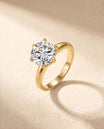
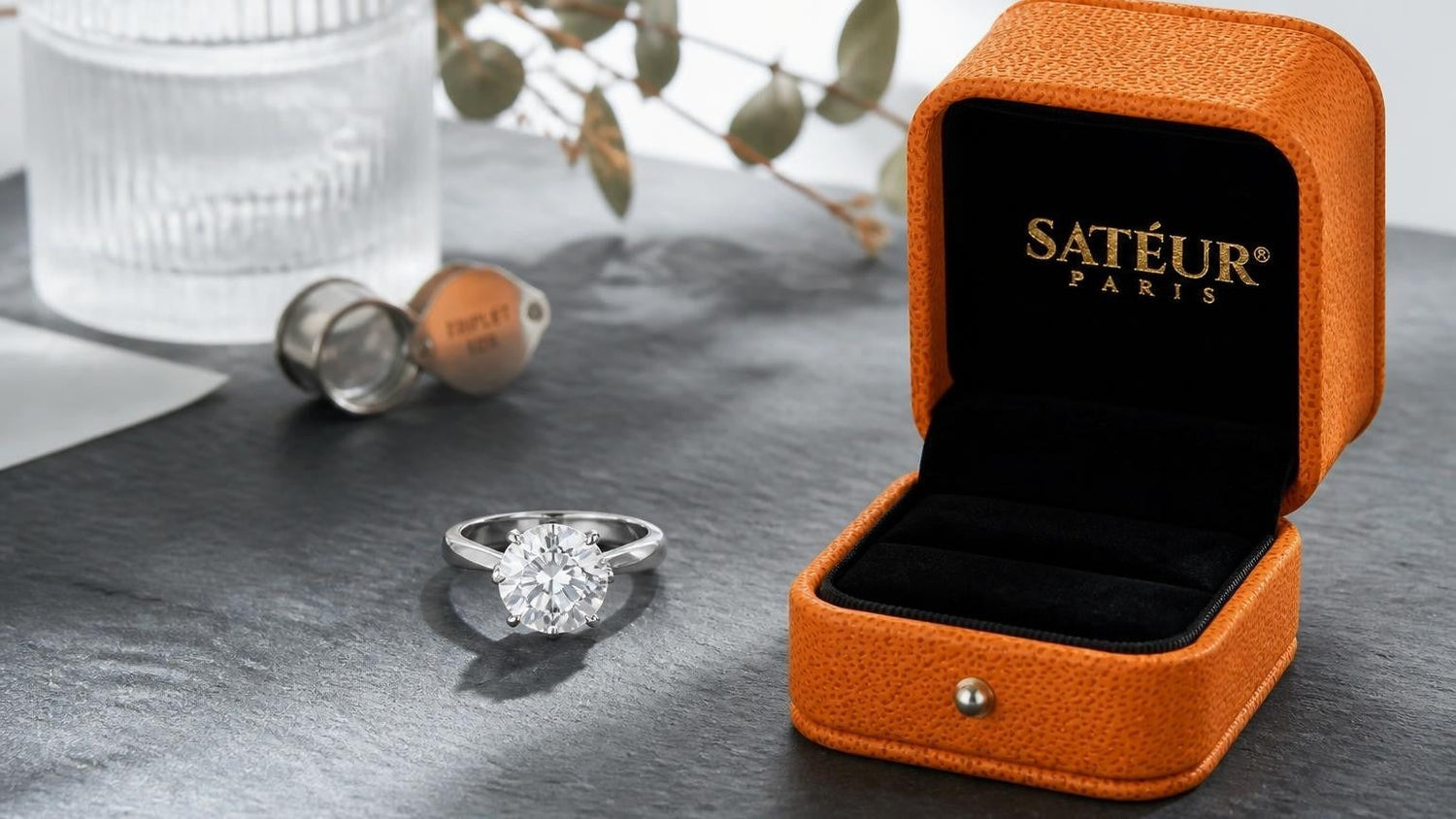
Moissanite is priced by shape, cut grade, and the setting it is mounted in. A round brilliant 1 carat moissanite from a premium brand ranges from approximately $88 to $600 complete — gem plus setting. Satéur's moissanite solitaire starts at $98 in an 18k white gold finish setting. The gemstone itself accounts for a small fraction of that figure; the majority of the retail price reflects metalwork, finish quality, and brand positioning.
Colour grades for moissanite follow the same D–Z scale used by the GIA for natural diamonds. D is perfectly colourless; F is near-colourless but still within the colourless range visible to the naked eye. Lab-created moissanite sold today grades D–F as standard — the controlled lab-growth process produces consistent colourlessness that would cost a premium in a natural diamond. Clarity is almost universally eye-clean for the same reason: lab growth eliminates the inclusions and fractures common in mined stones.
This means the two variables that typically add thousands to a natural diamond — colour and clarity — are effectively non-issues at the 1 carat moissanite level. What remains as a differentiator is cut precision, which governs fire (dispersion of white light into spectral colour) and overall light return. A well-cut 1 carat moissanite delivers exceptional brilliance regardless of price tier. For a broader view of how the cost curve changes across carat weights, the moissanite vs diamond cost per carat breakdown shows how the gap widens significantly above 2 carats.

Moissanite vs Natural Diamond Pricing
The price gap between moissanite and natural diamond is not simply a quality story — it reflects fundamentally different supply structures. Moissanite is a lab-created gemstone; its production cost does not depend on geological scarcity, extraction infrastructure, or a century of marketing that positioned diamonds as irreplaceable. Natural diamond prices embed all of that into every carat.
The gap is most dramatic at exactly 1 carat. Natural diamond pricing has a hard threshold at 1.00 carat: buyers pay a significant premium simply for reaching the round number. A 0.95 carat D/VS1 might retail for $3,800; the same stone at 1.01 carats could cost $6,500 or more. Moissanite has no such cliff. Pricing scales smoothly and linearly with carat weight — which is why the value case for moissanite strengthens above 1 carat. The 2 carat moissanite vs diamond comparison shows how that exponential gap compounds further.
| Property | 1ct Moissanite | Satéur Gems® (~1ct) | 1ct Natural Diamond |
|---|---|---|---|
| Typical price (ring) | $88–$600 | $138–$300 | $4,000–$15,000 |
| Colour grade | D–F (colourless) | D–E equivalent | D–Z (wide range) |
| Mohs hardness | 9.25 | ~8.8 | 10 |
| Brilliance character | Vivid rainbow fire — more dispersion than diamond | Clean white brilliance of a flawless diamond | Crisp white brilliance, high fire |
| Certification | Lab report (colour / cut) | Satéur proprietary standard | GIA or IGI certificate |
| Daily wear suitability | Yes | Yes | Yes |
| Lab-created | Yes | Yes (trademarked simulant) | No (mined) |
Natural diamonds in high clarity grades — VS1 and above — carry a further premium that compounds with colour. A 1 carat D/VVS2 can approach $15,000 at retail from a reputable jeweller. A 1 carat H/SI1 might sit closer to $3,500. Moissanite eliminates this entire axis of pricing complexity: every 1 carat moissanite from a premium brand grades eye-clean D–F as a baseline, without the grading premium.
Why Moissanite Costs Less
Moissanite is silicon carbide — a compound of silicon and carbon that occurs naturally only in meteorites and in microscopic traces near certain mineral deposits. The first gem-quality natural moissanite was identified in 1893 by Henri Moissan in the Canyon Diablo meteorite. Natural deposits have no commercial significance; all gem-quality moissanite sold today is lab-created.
Lab creation removes geological scarcity from the pricing equation entirely. A moissanite grows in controlled conditions over days or weeks, not over billions of years underground. The production cost reflects energy, process quality, and cut labour — not extraction, sorting, transport, and a century of industry-controlled supply management. That is why a D-colour, Excellent-cut 1 carat moissanite can retail for under $150, while a comparable natural diamond sits at $5,000 or more.
Natural diamonds also carry a significant marketing cost embedded in their price. The industry has spent decades positioning diamonds as the singular measure of romantic commitment. That positioning has real commercial value — and buyers pay for it whether they intend to or not. Moissanite does not carry that legacy. For buyers who are purchasing the brilliance and the ring, not the heritage narrative, moissanite represents a materially different value proposition.
Lab diamonds occupy a distinct third position: chemically and optically identical to natural diamonds, IGI-certified, and priced between moissanite and natural. Satéur's lab-grown diamond collection covers that tier for buyers who want the real thing without the old-world markup.
Colour & Clarity Grades: D, E, F
The GIA colour scale runs from D (perfectly colourless) to Z (visibly tinted yellow or brown). The colourless range — D, E, F — represents the top tier of the scale. In natural diamonds, reaching D colour on a 1 carat stone with excellent cut commands a significant premium: expect to add 20–40% over an equivalent H or I colour stone. That premium exists because colourless natural diamonds are genuinely rare.
Lab-created moissanite grades D–F as a production standard. The process that grows moissanite is designed to produce colourless material; variance into tinted ranges is an exception rather than the norm. The practical implication for buyers: a 1 carat D-colour moissanite does not carry the rarity premium a D-colour natural diamond does. You are paying for cut quality and setting craftsmanship — not geological luck.
Clarity follows the same logic. Natural diamonds contain inclusions and fractures formed during crystallisation under extreme pressure. These are graded on a scale from Flawless to I3 (visibly included). VS1 and above is considered eye-clean at 1 carat; clarity premiums compound with colour and carat weight. Lab-created moissanite is produced in controlled conditions that do not produce the same inclusions — eye-clean is the standard, not the exception.
The result is that when comparing a 1 carat moissanite to a natural diamond on paper, the moissanite grades D–F/eye-clean as a baseline. The natural diamond at the same grade level costs many times more. The difference is entirely a function of scarcity and supply chain — not quality of the stone the buyer receives.

Moissanite Durability & Longevity

Moissanite registers 9.25 on the Mohs hardness scale. Diamond is 10. For daily wear — engagement rings, earrings, bracelets worn consistently — the relevant threshold is resistance to scratching in normal conditions. Quartz, the most common mineral in household dust, is 7 on the Mohs scale. At 9.25, moissanite is well above that threshold. It also sits above sapphire (9.0) and corundum, meaning everyday abrasion cannot mark it.
Hardness is one dimension of durability; toughness is another. Moissanite scores well on toughness as well — it does not cleave or fracture easily under normal mechanical stress. The combination of high hardness and strong toughness makes moissanite one of the most durable gemstones available for jewellery settings.
Perhaps more important for long-term value: moissanite retains its brilliance permanently. Cubic zirconia — an earlier diamond simulant — clouds and scratches within a year of regular wear as surface abrasion disrupts the facet quality. Moissanite does not do this. Its fire and light return remain consistent over decades. There is no documented instance of moissanite losing its sparkle from normal use.
Satéur Gems®, at approximately 8.8 Mohs, is also extremely durable and built for everyday wear. The difference between 8.8 and 9.25 is negligible in daily life — both fall well above the threshold for engagement ring suitability and long-term brilliance retention. For engagement ring settings in particular, both tiers are designed to hold their appearance for life.

Satéur Destinée Ring™
The look of a flawless diamond. For 1% of the price.
Compare to a $10,000 mined diamond
Joined by 100,000+ couples across 150+ countries.
Discover The 1% RingFree worldwide shipping · 30-day returns · Lifetime Satéur Care
Satéur Moissanite: Value & Specifications
Satéur's moissanite tier begins at $98 for a 1 carat round brilliant in an 18k white gold finish setting. The gemstone grades D–E colourless, Excellent cut, Mohs hardness 9.25. Moissanite's fire — the dispersion of white light into spectral colour — runs higher than diamond's: the refractive index of moissanite is approximately 2.65, compared to diamond's 2.42. This produces a vivid, rainbow-forward sparkle particularly visible under strong directional or artificial lighting. For buyers who want that vivid character alongside significant price efficiency, moissanite delivers it decisively.
Satéur also offers Satéur Gems®, a trademarked diamond simulant that represents a distinct tier with a different optical character. Where moissanite's higher dispersion creates more rainbow fire, Satéur Gems® is engineered for diamond-accurate brilliance — the restrained, clean white light return of a fine D-colour diamond, not moissanite's vivid spectral display. Satéur Gems® starts at $138 for the Destinée Ring™ and represents the flagship of the Satéur range. Buyers prioritising the closest visual match to a natural diamond choose Gems®; buyers who want vivid fire and maximum brilliance per dollar choose moissanite.
Across either tier, the operating principle is the same: the look of a fine diamond, at a fraction of the price — a position Satéur calls The New Diamond Standard. The moissanite rings collection covers both round brilliant solitaires and more complex settings. The moissanite solitaire ring — unobstructed stone, maximum light return — is the most consistent seller in the range. Over 100,000 customers across 150 countries have chosen a different path to brilliance.
Frequently Asked Questions
How much does a 1 carat moissanite ring cost?
A 1 carat moissanite ring from Satéur starts at $98. Prices vary by setting metal and design complexity — plain solitaire bands sit at the lower end; halo, pavé, and split-shank settings range higher. The gemstone itself is a small fraction of the total; the majority of the price reflects setting craftsmanship and metal quality.
What is the price difference between moissanite and natural diamond?
A 1 carat natural diamond in D colour and VS1 clarity typically costs $5,000–$12,000, depending on cut quality and source. A 1 carat moissanite of equivalent colour grade starts under $150. That is a difference of 97–98% — driven not by optical quality but by the presence or absence of geological scarcity and supply-chain cost in the price.
Does moissanite look different from a diamond to the naked eye?
To the naked eye, moissanite is visually indistinguishable from diamond in most everyday settings. Under strong directional light, moissanite shows more rainbow fire — its higher dispersion produces more spectral colour than diamond. In natural daylight, across a table, or in normal social settings, the difference is not perceptible. Satéur Gems® is engineered specifically for the clean white brilliance of a flawless diamond, minimising that dispersion difference further.
How are moissanite colour and clarity graded?
Moissanite is graded on the same D–Z colour scale used for natural diamonds. Lab-created moissanite from reputable brands grades D–F (colourless) as standard — the controlled lab-growth process produces consistent colourlessness that commands a significant premium in natural diamonds. Clarity is almost universally eye-clean. The result is top-tier colour and clarity grades without the rarity premium those grades carry in natural diamonds.
Will moissanite lose its sparkle over time?
No. Moissanite is chemically stable and does not cloud, discolour, or lose brilliance under normal wear conditions. Unlike cubic zirconia, which degrades with surface abrasion within a year of regular use, moissanite retains its fire and light return indefinitely. Standard care — cleaning with warm water and mild soap — is all that is needed to maintain its appearance.
Is moissanite suitable for engagement rings?
Yes. At Mohs 9.25, moissanite is extremely durable — well within the range recommended for engagement rings intended for daily wear over decades. It holds its setting securely, resists surface scratching under normal conditions, and retains its brilliance for life. Satéur's moissanite and Gems® rings are both designed as engagement-suitable pieces, backed by Satéur's lifetime care policy.
The choice between moissanite and natural diamond is ultimately a decision about what you are paying for. A 1 carat moissanite delivers colourless grading, exceptional fire, proven durability, and decades of brilliance at a fraction of the price of natural diamonds. The New Diamond Standard was built on exactly that premise — that the measure of a fine piece is what it looks like and how long it lasts, not what it cost the earth to produce.















Hinterlasse einen Kommentar
Diese Website ist durch hCaptcha geschützt und es gelten die allgemeinen Geschäftsbedingungen und Datenschutzbestimmungen von hCaptcha.