



3 Carat Moissanite vs Diamond: The Complete Comparison
A 3 carat moissanite ring delivers the visual presence of a natural diamond in the $15,000–$50,000 range — for under $500. The two gemstones share a similar scale and brilliance at a glance, yet differ in sparkle character, hardness, and cost in ways that matter at this size. Understanding those differences leads to a more considered choice. For a broader view of how these economics scale across every carat weight, the moissanite vs diamond cost per carat guide sets the full picture.
Key Takeaways
- A 3 carat natural diamond costs $15,000–$50,000+; a 3 carat moissanite centre stone costs $400–$800.
- Moissanite rates 9.25 on the Mohs hardness scale — second only to diamond at 10 — and is fully suited to daily wear.
- Moissanite displays approximately 2.4× the fire dispersion of diamond, producing more vivid rainbow sparkle under bright light.
- Both are available in D–E colourless grades and remain optically stable over time.
- Satéur Gems® — a trademarked diamond simulant — delivers the restrained white brilliance of a flawless diamond, distinct from moissanite's rainbow-forward sparkle.
- At 3 carats, the optical character of each stone is more pronounced — moissanite's vivid fire becomes visibly distinct from diamond at this scale.
Moissanite vs Diamond: Core Differences
Moissanite and diamond are fundamentally different materials. Diamond is pure carbon — natural or lab-grown. Moissanite is silicon carbide, first discovered in a meteorite crater in 1893 by Henri Moissan and now produced entirely in laboratory conditions. At 3 carats, those material differences manifest most clearly in sparkle character, durability, and price.
| Property | Moissanite | Natural Diamond | Satéur Gems® |
|---|---|---|---|
| Mohs Hardness | 9.25 | 10 | ~8.8 |
| Refractive Index | ~2.65 | ~2.42 | ~2.39 |
| Fire Dispersion | High — ~2.4× diamond | 0.044 (reference) | Diamond-accurate |
| Colour Range | D–E colourless available | D–Z (mined varies) | D–E |
| 3 Carat Price | $400–$800 | $15,000–$50,000+ | $600–$1,100 |
| Origin | Lab-created silicon carbide | Mined or lab-grown carbon | Proprietary lab-crafted gem |
Appearance & Sparkle Breakdown
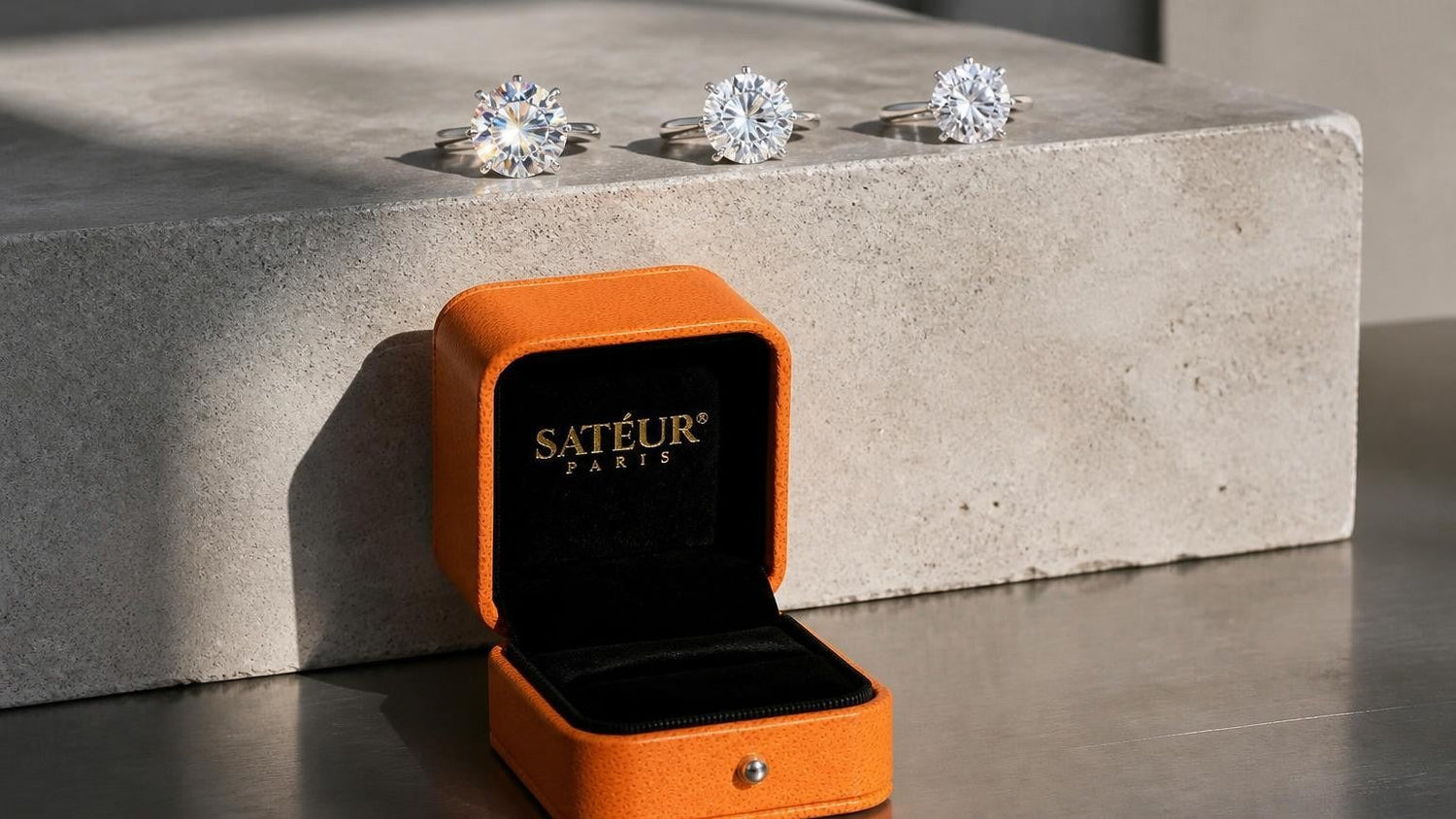
At 3 carats, a well-cut moissanite is a striking presence. Its refractive index of approximately 2.65 — compared to diamond's 2.42 — means light bends more dramatically inside the stone, producing fire dispersion roughly 2.4 times that of diamond. Under bright light or direct sunlight, this translates to vivid rainbow flashes rather than the white-light brilliance a natural diamond returns.
Whether that character is a virtue or a drawback depends entirely on preference. Some buyers specifically want the vivid colour play. Others — seeking the closest visual match to a fine diamond — find the spectral effect more visible at 3 carats than at smaller sizes, where the difference is subtler.
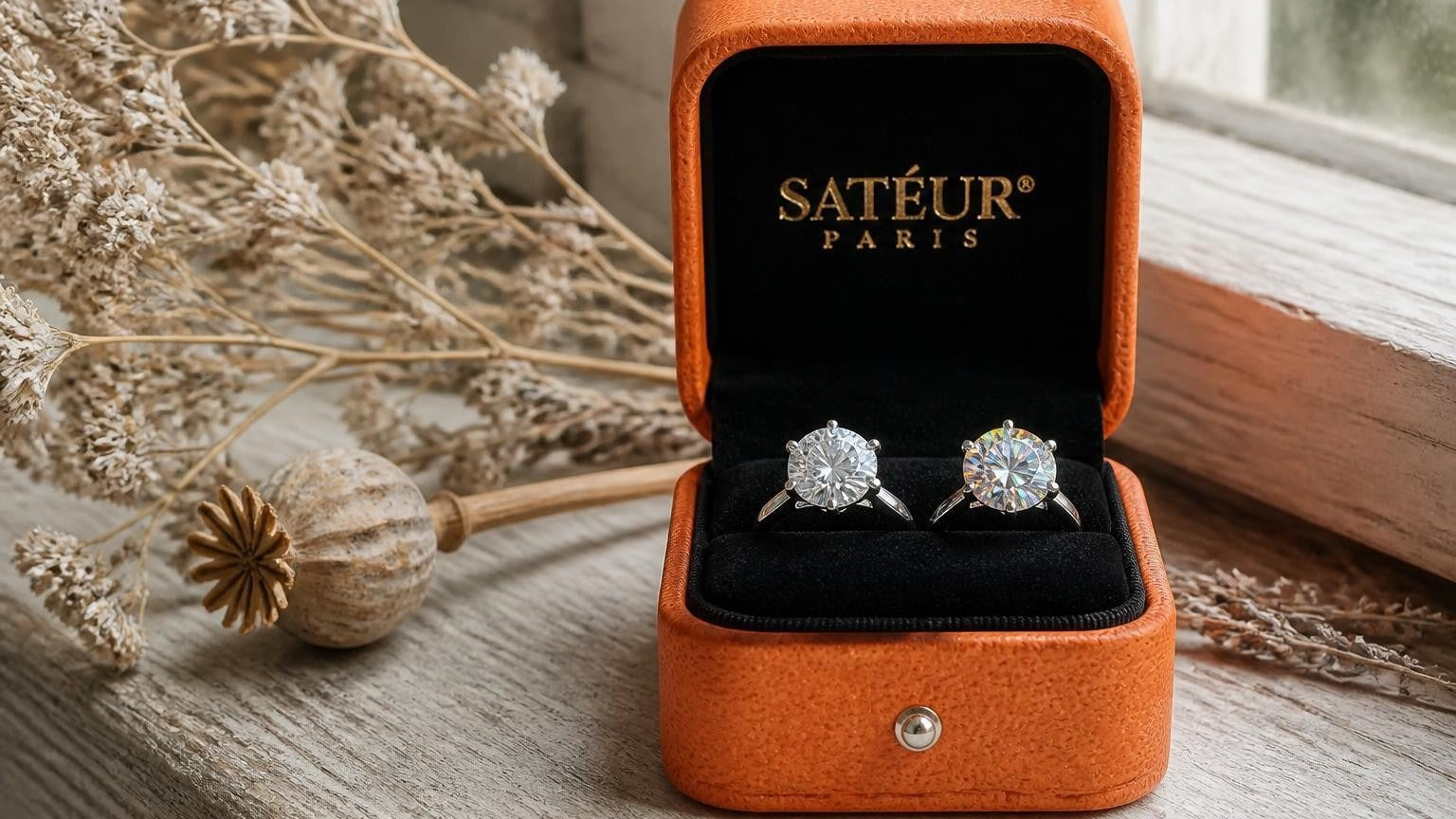
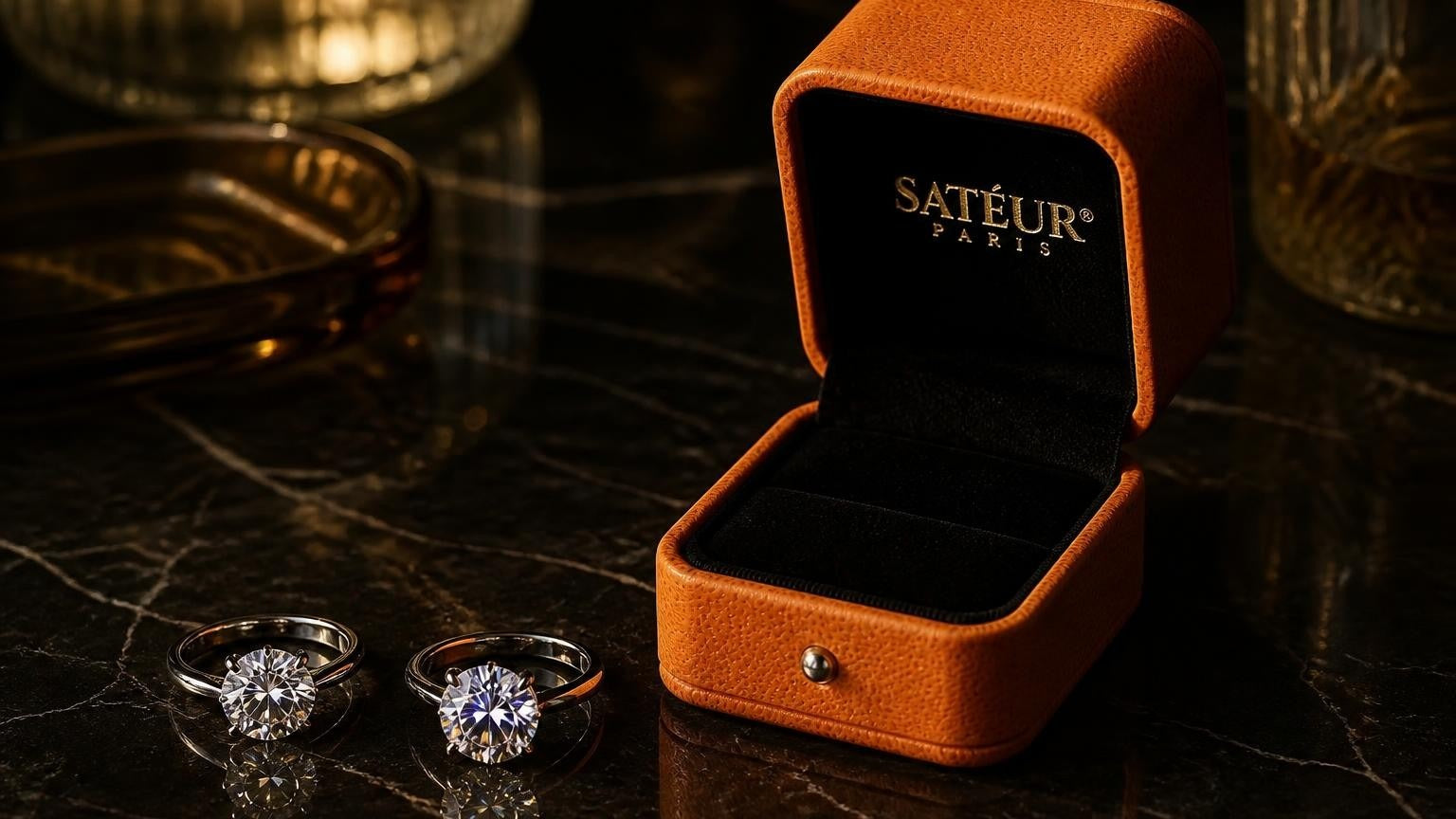
Satéur Gems® occupies a different position in this visual spectrum. With a refractive index of approximately 2.39, closely matching diamond's, it is engineered to return the clean, white brilliance of a flawless diamond rather than moissanite's rainbow-forward sparkle. That diamond-accurate look is its defining advantage — the most faithful visual replica available among diamond simulants. The The 1% Ring® collection demonstrates this character across every setting style.

Durability & Longevity
Moissanite rates 9.25 on the Mohs hardness scale — second only to diamond at 10. This makes it one of the hardest gemstones available and fully suited to daily wear in an engagement ring or any piece intended for a lifetime. At this hardness, it resists scratching from virtually all materials encountered in everyday life.
Satéur Gems® rates approximately 8.8 Mohs — extremely durable and built for everyday wear. In daily practice, the gap between 8.8 and 9.25 is negligible; both options represent a stone that holds its brilliance for life without the handling precautions that softer gemstones require.
Moissanite does not yellow, cloud, or lose its refractive properties over time with proper care. Its optical stability matches diamond's permanence — which is the practical argument for choosing it in an engagement ring intended to last decades rather than years.
Price Comparison: 3 Carat Range
The price difference between a 3 carat moissanite and a 3 carat natural diamond is not incremental — it is structural. A 3 carat natural diamond of VS2 clarity and G colour retails between $15,000 and $50,000 depending on cut quality and grading certification. Stones in D-IF grades at this size reach considerably higher. The rarity premium compounds non-linearly with carat weight.
A 3 carat moissanite centre stone typically ranges from $400 to $800 — the same visual scale, the same D-E colour grade, the same excellent cut, for approximately 1–2% of the natural diamond price. The setting costs are identical; only the centre stone differs.
Lab-grown diamonds sit between the two at roughly $2,000–$5,000 for 3 carats. They carry the same chemical structure as mined diamonds and full IGI certification. For buyers who want the word "diamond" — and its chemistry — Satéur's lab diamond collection offers that without the mined-stone premium. For buyers who simply want the look, moissanite or Satéur Gems® make a more efficient case.
Moissanite Rings from ~$88 — Value Maximisation
The Satéur moissanite rings collection spans accessible price points, making the 9.25-Mohs lab-created gemstone available across a range of settings and styles. For buyers comparing a 3 carat moissanite to a natural diamond, the economics produce a clear result: the same budget that purchases a modest natural diamond could fund a significantly larger moissanite, or a complete jewellery set.
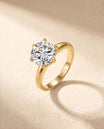
The Satéur Destinée Ring™ — The 1% Ring® — is the central expression of this position. A 1.00 carat round cut Satéur Gems® in 18k white gold finishing that delivers the look of a $10,000 diamond. The argument at 3 carats is the same, scaled.
The New Diamond Standard is not a compromise. It is a better argument — one that 100,000+ customers across 150 countries have made for themselves.

Satéur Destinée Ring™
The look of a flawless diamond, for 1% of the price.
Compare to a $10,000 mined diamond
Joined by 100,000+ couples across 150+ countries.
Discover The 1% RingFree worldwide shipping · 30-day returns · Lifetime Satéur Care
Natural vs Lab-Created vs Moissanite: Which Fits Your Budget
The choice between a natural diamond, a lab-grown diamond, and a moissanite is as much a question of philosophy as budget. Natural diamonds carry provenance, resale history, and the cultural weight of scarcity. Lab-grown diamonds carry identical chemistry and optics with a lower price and no mining footprint. Moissanite is a distinct gemstone: not a diamond, not a pejorative imitation, but a brilliant, durable lab-created gem with its own optical signature.
For buyers seeking the most diamond-accurate look — the restrained white brilliance of a fine stone, rather than vivid spectral fire — Satéur Gems® occupies that position by design. The moissanite solitaire ring collection, by contrast, showcases what moissanite's distinct character looks like in a clean setting at this scale — the format that best reveals its sparkle difference from diamond.

Choosing Between Moissanite and Diamond Engagement Rings
The decision resolves around two questions. First: does the buyer want or need the word "diamond" — for certification, resale, or personal meaning? If yes, a lab-grown diamond is the considered answer. Second: does the buyer prioritise the closest visual similarity to a fine diamond, or are they drawn to moissanite's distinctly vivid fire?
If diamond-accuracy is the priority, Satéur Gems® delivers that look — at a price that makes 3 carats, 5 carats, or a complete jewellery suite a realistic proposition rather than a once-in-a-decade event. The engagement rings collection places both options side by side, so the comparison can be made on one's own terms.

At this scale, the choice is not between quality and compromise. It is between two genuinely different optical characters — and the intelligence to choose the one that reflects your own point of view.
Frequently Asked Questions
How does a 3-carat moissanite ring compare visually to a 3-carat diamond?
At 3 carats, a well-cut moissanite and a well-cut diamond share similar physical dimensions and comparable brilliance under low or ambient light. The visible difference emerges under bright light: moissanite's fire dispersion — approximately 2.4× that of diamond — produces vivid rainbow flashes rather than the predominantly white-light return of a fine diamond. Those who want the closest visual match to a natural diamond will notice the difference; those who prefer vivid colour play will not view it as a drawback.
What is the price difference between a 3-carat moissanite and a 3-carat natural diamond?
A 3 carat natural diamond of good quality (VS2, G colour, excellent cut) retails between $15,000 and $50,000+, depending on certification and provenance. A 3 carat moissanite centre stone typically costs $400–$800 — approximately 1–2% of the natural diamond price. The setting cost is the same for both. Lab-grown diamonds sit in between at roughly $2,000–$5,000 for 3 carats.
Will a moissanite ring scratch or cloud over time?
Moissanite rates 9.25 on the Mohs hardness scale, making it resistant to scratching from virtually all everyday materials. It will not cloud or yellow with proper care — its optical stability is one of its most practical advantages. Regular cleaning with mild soap and a soft brush maintains its brilliance indefinitely.
Can moissanite be used in any engagement ring setting?
Yes. Moissanite is available in all standard cuts — round brilliant, oval, cushion, princess, emerald, pear — and suits any setting type, from solitaire to halo to pavé. Its hardness of 9.25 makes it robust for prong, bezel, or channel settings without additional precautions. The one sizing note: moissanite is slightly less dense than diamond, so a 3 carat moissanite measures slightly larger in diameter than a 3 carat diamond of the same shape.
How is moissanite graded for colour and clarity?
Moissanite is graded using a system parallel to the GIA diamond scale. The highest tier — colourless — maps to the D–F range on the diamond scale. Near-colourless (G–I range) reads marginally warmer under certain lighting. Premium lab-created moissanite is available in the D–E colourless range, matching the colour profile of the finest natural diamonds. Clarity is typically high, as the lab-creation process produces stones with minimal inclusions.
Is moissanite a good choice for a lifetime engagement ring?
Yes. At 9.25 Mohs hardness, moissanite is second only to diamond among gemstones used in fine jewellery, and its optical properties — brilliance, fire, colour — do not degrade over time with proper care. It is lab-created, consistent in quality, and available at a price point that makes premium settings and larger carat weights genuinely accessible. For a buyer who wants a brilliant, durable, ethically produced gemstone without the natural diamond premium, moissanite is a well-founded, lasting choice.












Hinterlasse einen Kommentar
Diese Website ist durch hCaptcha geschützt und es gelten die allgemeinen Geschäftsbedingungen und Datenschutzbestimmungen von hCaptcha.