



Moissanite vs Diamond Price: What You Actually Pay
A 2-carat moissanite engagement ring typically costs under $1,500. An equivalent diamond — same cut grade, same colour category, same carat weight — runs between $12,000 and $18,000. That is not a marginal difference. It is a structural one, built into how each gemstone is formed, certified, and sold. This article examines what drives the moissanite vs diamond price gap, how the two gemstones compare across every meaningful physical property, and what that means when you are choosing an engagement ring that will be worn for decades.
For a deeper look at how these gemstones stack up across the full 1-carat moissanite vs diamond price comparison, including per-carat cost curves, that breakdown covers the maths in detail.
Key Takeaways
- A 2-carat moissanite engagement ring costs under $1,500 versus $12,000–$18,000 for an equivalent diamond.
- Moissanite ranks 9.25 on the Mohs hardness scale — extremely durable for daily-wear rings and long-term use.
- Moissanite exhibits approximately 2.4 times the fire (colour dispersion) of diamond, producing distinct rainbow sparkle under bright light.
- Diamond pricing scales exponentially with carat weight; moissanite pricing remains broadly linear, reducing cost per carat as size increases.
- Satéur moissanite rings start from approximately $88 for minimalist designs, scaling to $3,000 or more for elaborate settings in precious metals.
- Moissanite in D-E colour grades maintains consistent optical clarity across all carat weights, with no yellow or brown tint.
Before comparing prices, it is worth establishing what each gemstone is — because the origin story explains almost everything about the cost.
What Is Moissanite and How Does It Compare to Diamond?
Moissanite is a lab-created gemstone composed of silicon carbide. It was first discovered in a meteor crater in Arizona in 1893 by the French chemist Henri Moissan, who initially believed he had found diamonds. The natural mineral is extraordinarily rare; virtually all moissanite used in jewellery today is produced in controlled laboratory conditions, making it consistent in quality and available at scale.
Diamond is carbon in its crystallised form. Natural diamonds are mined from the earth, a process involving significant capital, labour, and supply-chain infrastructure. That structural cost is embedded in the price of every mined stone. Lab-grown diamonds are chemically identical to mined diamonds and carry their own certification structure, but they are distinct from moissanite — different material, different refractive properties, different price point.
The comparison that matters most to most buyers is straightforward: moissanite gives you a gemstone of extraordinary durability and brilliance, at a fraction of the cost of a mined diamond. What changes is the optical character — and understanding that difference is what makes the choice an informed one rather than a compromise.
The moissanite vs diamond rings debate ultimately comes down to which optical character suits you — rainbow fire or crisp white brilliance — and what you are prepared to spend for either.

Moissanite vs Diamond: Key Physical Differences
The two gemstones differ across several measurable properties. A side-by-side look clarifies what you are actually choosing between.
| Property | Moissanite | Diamond (Natural) |
|---|---|---|
| Composition | Silicon carbide (lab-created) | Carbon (mined or lab-grown) |
| Mohs hardness | 9.25 | 10 |
| Refractive index | ~2.65 | ~2.42 |
| Fire (colour dispersion) | ~2.4× that of diamond — vivid rainbow sparkle | Crisp white brilliance, restrained colour flash |
| Colour grades available | D–E (colourless) consistently | D–Z scale; D–F colourless at premium cost |
| Certification | Lab grading (GIA, GCAL, independent) | GIA, IGI, AGS (mined); IGI, GCAL (lab-grown) |
| Price per carat (1ct) | $300–$700 | $4,000–$8,000+ (mined, D-F VS+) |
| Price scaling | Broadly linear with carat weight | Exponential — doubles or triples per carat jump |
| Availability | Consistent supply, stable price | Supply-constrained, price volatile |
The hardness difference — 9.25 versus 10 on the Mohs scale — is real but practically irrelevant for a ring worn daily. Both materials resist scratching from virtually every substance encountered in ordinary life. The meaningful difference is optical: moissanite's higher refractive index (approximately 2.65 versus diamond's 2.42) produces more fire — vivid rainbow colour flashes under direct light. Diamond returns a crisper, whiter brilliance. Neither is inferior; they are different expressions of brilliance.
Why Moissanite Costs Less Than Diamond
The price gap is not about quality — it is about rarity and infrastructure. Natural diamonds are extracted from mines at enormous cost. The supply chain spans continents: exploration, extraction, rough sorting, cutting, certification, distribution. Each step adds margin. At the retail end, a significant portion of the price of a mined diamond is not the stone itself but the system required to bring it to market.
Moissanite is created in laboratories under controlled conditions. The process is replicable, scalable, and not dependent on geological rarity. Quality is consistent. Price reflects production cost, not artificial scarcity.
Diamond pricing also behaves differently as carat weight increases. A 2-carat diamond does not cost twice as much as a 1-carat stone of equivalent quality — it typically costs three to four times as much, because larger stones of fine quality are rarer and command exponential premiums. Moissanite pricing remains broadly linear: a 2-carat moissanite costs roughly twice what a 1-carat costs. This compression is most visible at larger carat weights, where the savings against a natural diamond become most significant.
A useful framework: a 1-carat moissanite in a solitaire setting costs $300–$700 for the stone. A 1-carat natural diamond in D-F colour, VS+ clarity — the grades required to produce a visibly clean stone — costs $4,000–$8,000 or more, before the setting. By the time you reach 2 carats, the moissanite alternative costs less than 10% of its diamond equivalent.
Moissanite Durability, Hardness and Longevity
Moissanite ranks 9.25 on the Mohs hardness scale, making it the second-hardest gemstone used in jewellery after diamond. In practical terms, this means it will not scratch from contact with everyday materials — keys, surfaces, other metals. The gemstone is suitable for daily-wear rings and will hold its brilliance for life without special maintenance beyond normal cleaning.
The half-point difference between moissanite's 9.25 and diamond's 10 has no meaningful implication for how a ring wears. The only materials harder than moissanite are diamonds themselves. Moissanite does not cloud, dull, or discolour over time. Unlike cubic zirconia — a different material entirely — moissanite retains its optical properties permanently.
For an engagement ring intended to last decades, moissanite's durability is not a trade-off. It is a specification that meets every demand of daily wear.

Brilliance, Fire and Optical Properties Explained
Brilliance refers to the white light returned through the table of a stone. Fire refers to the dispersion of light into spectral colours — the rainbow flashes visible under direct illumination. Both moissanite and diamond return both types of light; the balance between them differs.
Moissanite has a refractive index of approximately 2.65 and a dispersion of 0.104 — roughly 2.4 times the fire of diamond (dispersion 0.044). Under a chandelier, a spotlight, or strong sunlight, moissanite produces vivid, colourful flashes. This is its optical signature: distinctive, abundant, clearly different from diamond's character.
Diamond returns a more restrained play of light — crisp white brilliance with moderate colour flashes. In low or diffuse light, diamond's brilliance reads as clean and classic. In direct light, the colour flashes are present but more controlled than moissanite's.
Neither is objectively superior. They are a matter of preference. Buyers who want abundant, colourful sparkle generally prefer moissanite. Buyers who want the specific look of a diamond — that particular white, crystalline brilliance — may prefer diamond or a gemstone engineered specifically to replicate diamond's optical character.
At Satéur, the moissanite ring collection presents D-E colour moissanite: colourless, with no yellow or brown tint, in cuts engineered to maximise the stone's natural fire. The result reads as a premium gemstone on its own terms — vivid, clean, and genuinely beautiful — without positioning itself as a diamond substitute.
Moissanite vs Diamond: Engagement Ring Price Breakdown
The following figures reflect market rates at time of writing for fine-quality stones in standard engagement ring configurations.
| Carat Weight | Moissanite (D-E, Excellent cut) | Natural Diamond (D-F, VS+, Excellent cut) | Saving |
|---|---|---|---|
| 0.5 ct | $150–$300 | $1,500–$2,500 | ~90% |
| 1.0 ct | $300–$700 | $4,000–$8,000 | ~90–92% |
| 2.0 ct | $600–$1,200 | $12,000–$18,000 | ~93–95% |
| 3.0 ct | $900–$1,800 | $28,000–$45,000 | ~96% |
| 5.0 ct | $1,500–$3,000 | $80,000–$150,000+ | ~97–98% |
These figures are for the gemstone alone. Setting costs apply to both equally — a well-made solitaire in 18k gold finish adds $300–$1,500 regardless of the centre stone. The differential is entirely in the gemstone cost.
The compounding effect at larger carat weights is the clearest expression of moissanite's value proposition. At 1 carat, you save approximately $5,000–$7,000. At 3 carats, you save $30,000 or more. The stone you can afford in moissanite at a $3,000 budget would require $50,000+ in natural diamond form.
Lab-grown diamonds sit between the two on price — typically 60–80% less than their mined counterparts but still significantly more expensive than moissanite, at three to six times the per-carat cost. They offer the chemical and optical properties of diamond with a lower supply-chain overhead. The trade-off against moissanite is cost versus diamond-exact optical character.

Satéur Moissanite: Design, Specs and Value Proposition
Satéur presents moissanite in D-E colour grading — colourless stones selected for consistency of optical performance. The cuts are engineered to maximise moissanite's natural fire: Excellent cut grades that return maximum light through the table. Settings range from minimalist solitaires to elaborate pavé designs, in 18k white, yellow, and rose gold finish.
Entry-level Satéur moissanite rings start from approximately $88 for clean, well-proportioned designs. Mid-range pieces — larger carat weights, more complex settings — fall between $400 and $1,200. The upper tier, for statement pieces in precious metal settings with pavé or halo elements, reaches $3,000 or more.
This is the range that defines what Satéur's moissanite offering does: it makes a genuinely fine gemstone, in designs that would otherwise require five to twenty times the outlay in diamond, available to buyers who allocate their engagement budget on their own terms rather than the terms the traditional diamond industry has set.

Satéur Moissanite Rings
The look of a flawless diamond, for 1% of the price.
Compare to a $10,000 mined diamond
Joined by 100,000+ couples across 150+ countries.
Discover the CollectionFree worldwide shipping · 30-day returns · Lifetime Satéur Care
Over 100,000 customers across 150 countries have chosen a different path — one where the size of the stone is not constrained by the size of the budget, and where the intelligence of the choice is part of what the ring says.
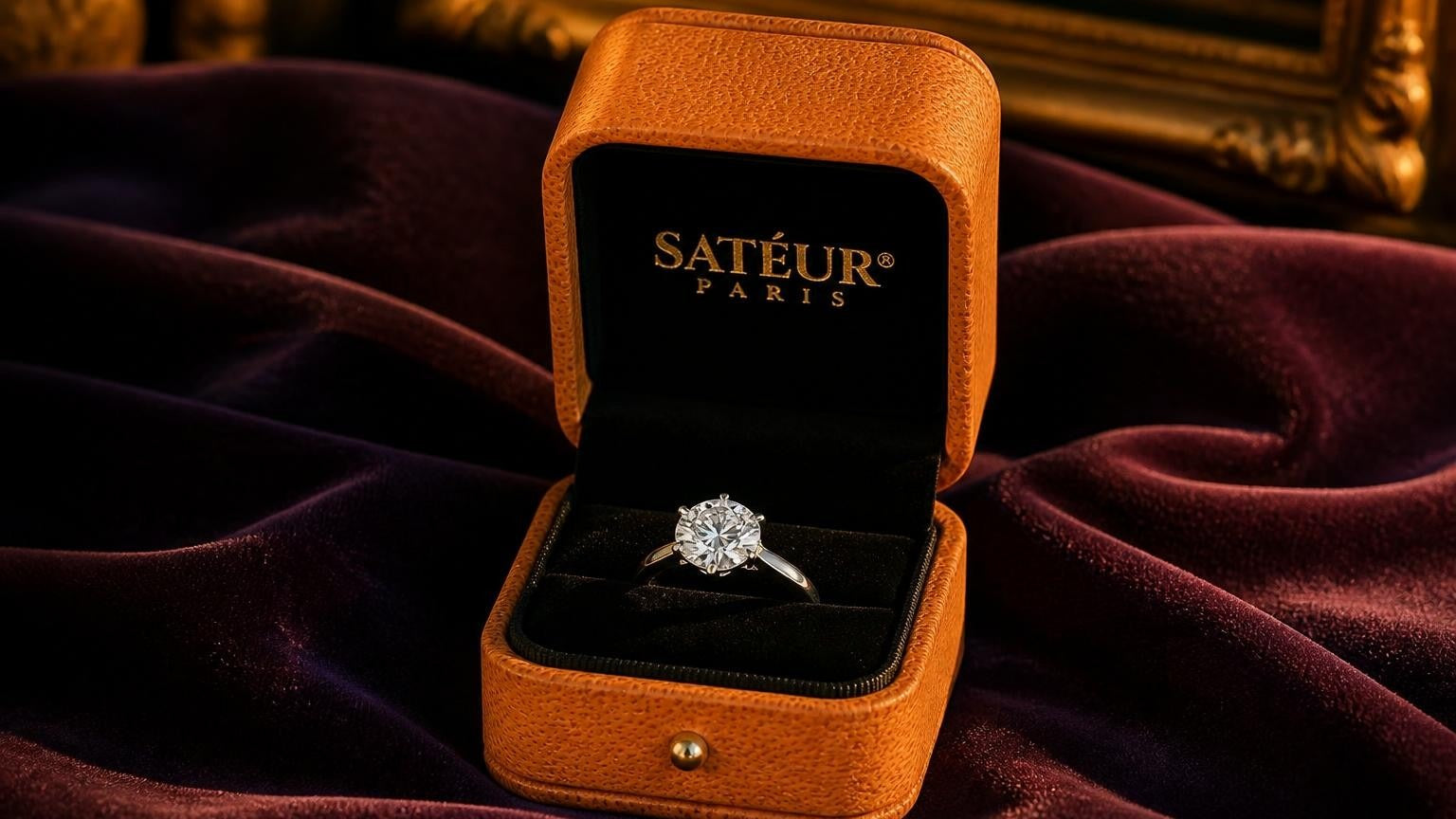
[IMAGE: lifestyle — woman wearing Satéur moissanite ring, champagne silk backdrop, soft gold 3700K ambient light, SMALL OPEN orange Satéur ring box visible with gold SATÉUR PARIS wordmark CLEARLY LEGIBLE on black velvet interior | Satéur moissanite engagement ring lifestyle — The 1% Ring]The Satéur moissanite collection is designed to be chosen, not settled for. The distinction matters. A stone that returns 2.4 times the fire of diamond is not a compromise — it is a different kind of presence. One worth considering on its own merits.
For those interested in how moissanite compares at the specific 1-carat benchmark, the 1-carat moissanite vs diamond price analysis breaks down that comparison in detail, including per-carat cost curves and setting options.
Frequently Asked Questions
What physical properties make moissanite different from diamond?
Moissanite is silicon carbide; diamond is carbon. Moissanite ranks 9.25 on the Mohs hardness scale versus diamond's 10 — both are extremely durable for daily wear. The key optical difference is refractive index: moissanite at approximately 2.65 produces roughly 2.4 times the fire (colour dispersion) of diamond at 2.42. Diamond returns crisper white brilliance; moissanite returns more vivid rainbow colour flashes. Both are colourless in D-E grades and hold their appearance permanently.
Why is moissanite significantly less expensive than diamond?
Moissanite is produced in controlled laboratory conditions. Its supply is not constrained by geological rarity or the infrastructure required to extract, sort, and certify mined stones. Diamond pricing — especially for natural diamonds — reflects both production cost and artificial scarcity built into the supply chain. Lab-grown diamonds reduce that overhead but remain several times more expensive per carat than moissanite because they must replicate the exact chemistry of diamond, which requires more energy-intensive processes. Moissanite's cost is primarily a function of what it costs to produce silicon carbide at gem quality, which is genuinely less than diamond production.
Does moissanite maintain its clarity and appearance over time?
Yes. Moissanite does not cloud, dull, or discolour over time. Its hardness of 9.25 means it resists scratching from virtually all materials encountered in daily life. Unlike cubic zirconia, which degrades within a few years under regular wear, moissanite retains its optical properties permanently. Standard care — occasional cleaning with mild soap and water — is sufficient to maintain brilliance indefinitely.
How does moissanite sparkle compare to diamond in everyday light?
In low or diffuse indoor light, moissanite and diamond both return white brilliance — the difference is subtle and requires direct comparison to notice. In direct or strong light — sunlight, spotlights, candlelight — moissanite's higher fire becomes apparent: the rainbow colour flashes are more vivid and more frequent than diamond's. Some buyers prefer this; others prefer diamond's more restrained optical character. With the naked eye and in ordinary social settings, both read as premium gemstones.
What metal settings does Satéur recommend for moissanite rings?
Satéur moissanite rings are available in 18k white gold, yellow gold, and rose gold finish. White gold settings tend to amplify the colourless appearance of D-E moissanite, reinforcing the clean, bright look. Yellow and rose gold settings create a warmer contrast that suits different aesthetics. The choice depends on personal preference and how the ring will be worn alongside other jewellery. Satéur's design team curates settings to suit each stone's proportions and cut.
Can moissanite be resized or repaired like a diamond ring?
Yes. Moissanite rings can be resized by a qualified jeweller using standard ring-sizing techniques. The stone itself is not removed during a typical resize of one to two sizes. Moissanite is not heat-sensitive in the way some softer gemstones are, making it compatible with the heat processes used in ring repair and resizing. More significant alterations — changing the setting style, replacing prongs, or resizing more than two sizes — should be handled by a jeweller experienced with moissanite, as with any fine gemstone ring.















Hinterlasse einen Kommentar
Diese Website ist durch hCaptcha geschützt und es gelten die allgemeinen Geschäftsbedingungen und Datenschutzbestimmungen von hCaptcha.