

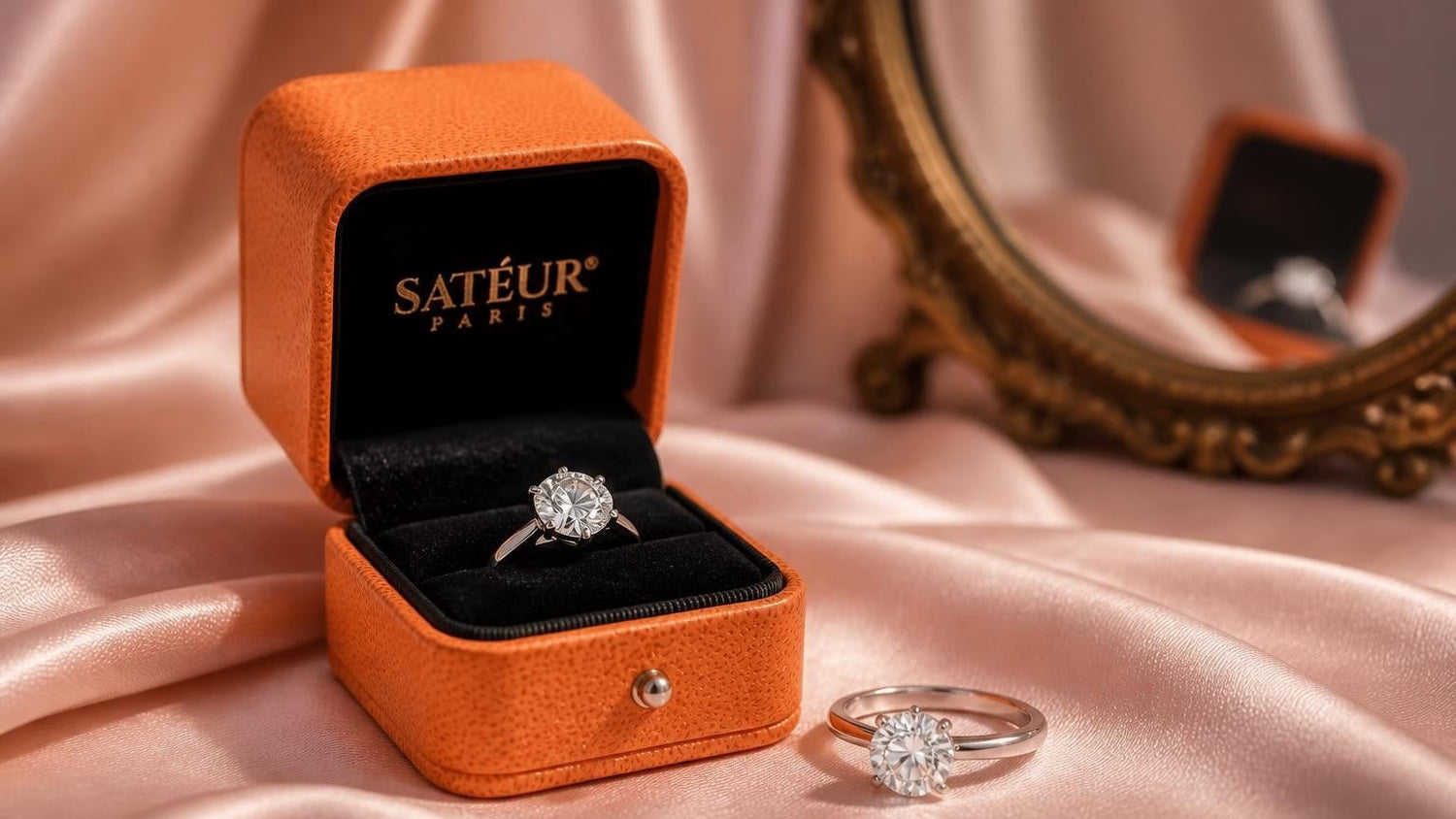
Diamond Simulant Rings: The Essential Guide
A diamond simulant is a gemstone or lab-crafted gem that replicates the look of a mined diamond without sharing its chemical composition. Diamond simulant rings deliver the presence and brilliance of a fine diamond ring — at a fraction of the cost. The category spans cubic zirconia, white sapphire, moissanite, and purpose-engineered simulants like Satéur Gems® — each with its own optical profile, durability, and value proposition.
For anyone who wants the look of a flawless diamond ring without a five-figure commitment, understanding the distinctions between simulant types is the essential first step. Simulants are not a compromise. They are an informed choice — one that reframes where value actually lives.
Key Takeaways
- Diamond simulants look like diamonds but differ in chemical composition and optical properties.
- Satéur Gems® offer D-E colour grading and Excellent cut specifications — the closest visual match to a flawless diamond.
- Moissanite (~9.25 Mohs) produces vivid, rainbow-forward fire — approximately 2.4 times that of a mined diamond.
- Satéur Gems® (~8.8 Mohs) produce restrained white brilliance — diamond-accurate to the naked eye.
- Entry-price diamond simulant rings from Satéur begin at approximately $138.
- Diamond simulant rings cost roughly 1% of comparable mined diamond ring prices.
What Is a Diamond Simulant?
A diamond simulant is any material — natural, lab-created, or engineered — that visually resembles a mined diamond to the naked eye. Simulants are distinct from lab-grown diamonds, which share the identical chemical and crystal structure of mined diamonds. Simulants replicate the look; lab-grown diamonds replicate the substance.
The distinction matters both scientifically and commercially. Lab-grown diamonds are graded by the same IGI and GIA standards as mined stones. Simulated diamonds are assessed on their own terms — brilliance, fire, colour, and durability — rather than against diamond grading scales. The question is not which is more like a diamond. The question is which delivers the look you want, at the durability and price point that reflects how you actually live.
The most common diamond simulants are:
- Cubic zirconia (CZ) — the most widely produced simulant, inexpensive, but prone to clouding and scratching within a year of daily wear.
- White sapphire — a natural gemstone with a cool, milky brilliance; harder than CZ but without diamond's characteristic light return.
- Moissanite — a lab-created gemstone (silicon carbide) with exceptional hardness (~9.25 Mohs) and notably more fire than a mined diamond.
- Satéur Gems® — a trademarked diamond simulant engineered for D-E colour accuracy and Excellent cut specifications, delivering the restrained, white brilliance of a flawless diamond.
Diamond Simulant vs. Lab-Created Gemstones
The terms "simulant" and "lab-created" are frequently conflated. They are not interchangeable. A lab-created gemstone is grown in a controlled environment but shares its chemical and physical structure with its natural counterpart — lab-grown diamonds, lab-created moissanite, and lab-grown sapphires all qualify. A simulant is defined purely by appearance: it looks like a diamond, not because it shares diamond's carbon lattice, but because it has been crafted or selected to produce a comparable visual effect.
Moissanite occupies a useful middle position in this conversation. It is a genuine lab-created gemstone — not a diamond by any measure — but its brilliance and hardness make it one of the most durable simulant choices available. For those exploring the full range of non-diamond engagement rings, understanding this distinction prevents costly mismatches between expectation and result.
Satéur Gems® occupy a different position: a purpose-engineered simulant optimised for diamond-accurate colour and brilliance rather than moissanite's more vivid fire profile. They are not positioned as moissanite — they are positioned as the closest available visual equivalent to a flawless, colourless mined diamond.

Satéur Gems®: Diamond-Look Gemstones at ~1% the Price
Satéur Gems® are the Maison's flagship diamond simulant — trademarked, purpose-engineered, and designed to one standard: the look of a flawless diamond, for approximately 1% of the price. Every Satéur Gems® stone is cut to an Excellent specification across 58 facets and colour-graded to D-E — the same top tier used to describe the finest colourless mined diamonds.
The result is a restrained, white brilliance that reads as a flawless diamond across the table and to the naked eye. Not the vivid, rainbow-forward fire of moissanite. The precise, clean light return of a fine diamond — a distinction that matters most when you place the ring on a hand in natural light and the room does not know what it cost.
The refractive index of Satéur Gems® (~2.39) produces this diamond-accurate optical character. Moissanite's higher index (~2.65) is the source of its celebrated vivid fire. Different optical signatures. Different intended expressions.
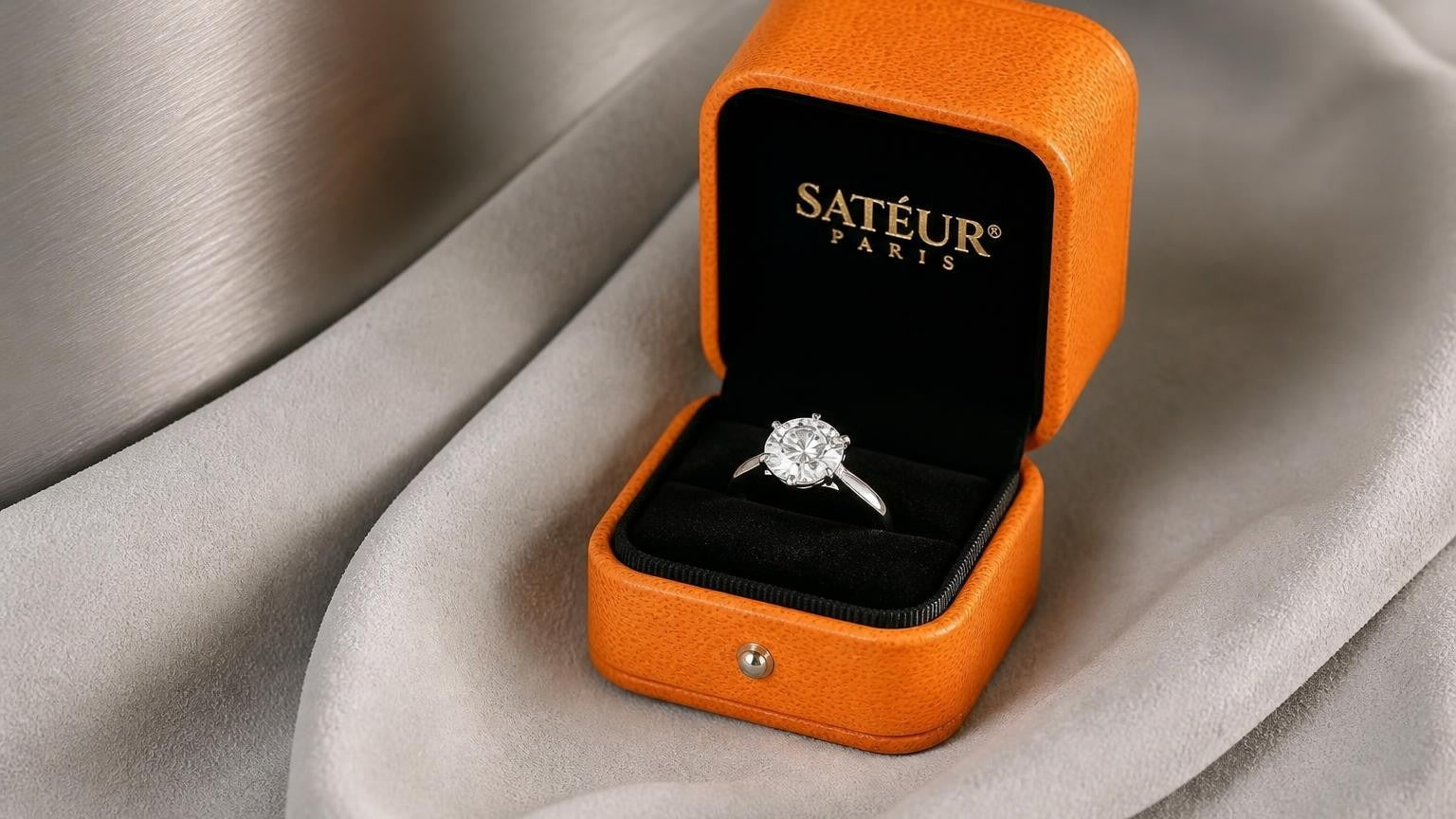
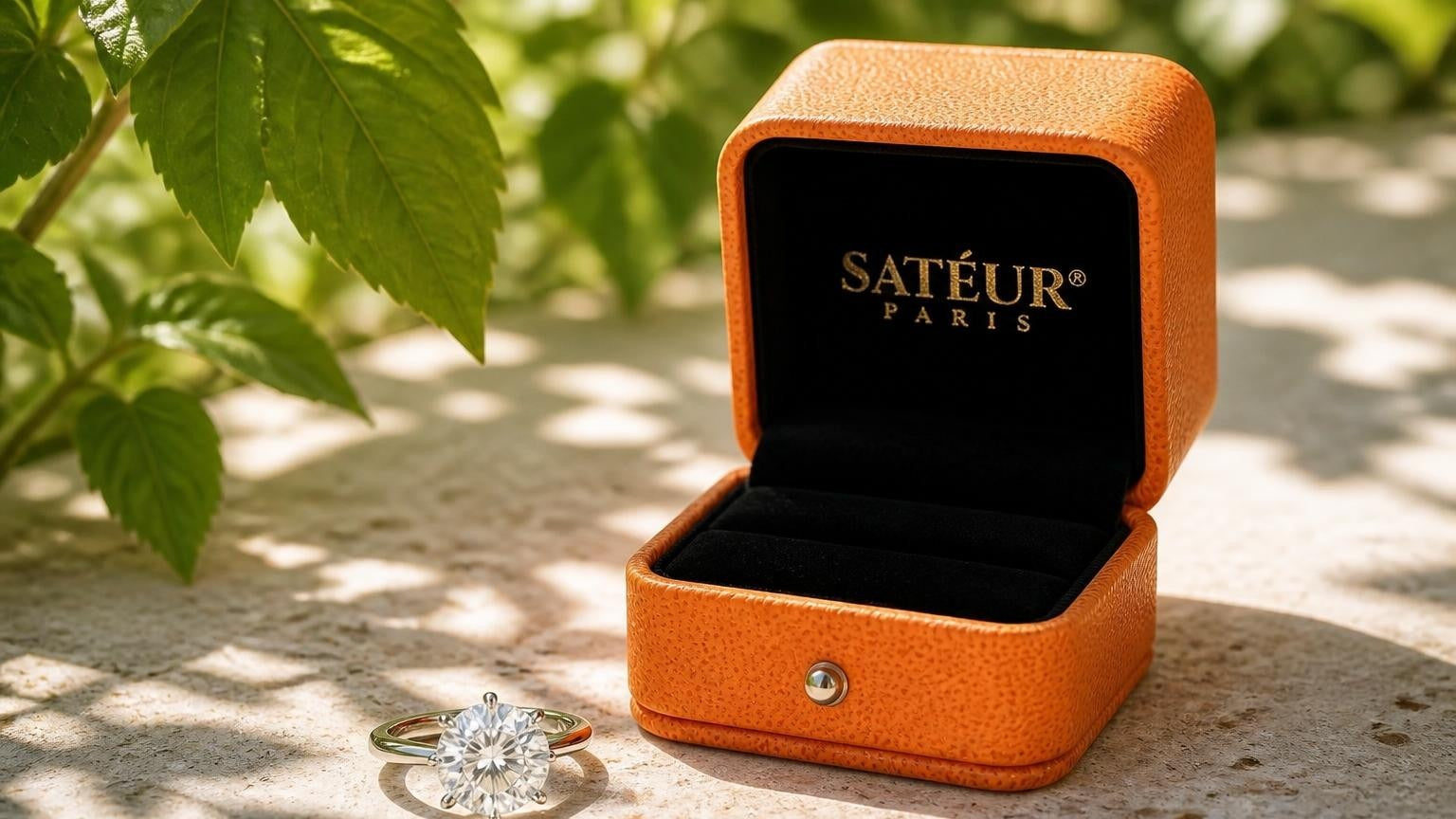
The Satéur Destinée Ring™ — The 1% Ring® — is the Maison's defining expression of this proposition. A 1.00 carat round-cut Satéur Gems® in 18k white gold finishing. The ring that started the movement.
Key Specifications: Colour, Cut and Durability
When evaluating any diamond simulant ring, four properties determine long-term satisfaction: colour, cut, hardness, and optical behaviour.
| Property | Satéur Gems® | Moissanite | Cubic Zirconia | White Sapphire |
|---|---|---|---|---|
| Colour grade | D-E (colourless) | D-F (top grades available) | Variable (yellows over time) | Near-colourless |
| Cut specification | Excellent, 58-facet | Excellent available | Variable | Variable |
| Mohs hardness | ~8.8 | ~9.25 | ~8.0–8.5 | ~9.0 |
| Optical character | White, diamond-accurate brilliance | Vivid rainbow fire (~2.4× diamond) | Flat, low fire | Milky, subdued return |
| Long-term clarity | Holds brilliance for life | Holds brilliance for life | Clouds within 1–2 years | Durable, lower sparkle baseline |
| Entry price (ring) | From ~$138 | From ~$98 | $50+ | Varies widely |
Both Satéur Gems® (~8.8 Mohs) and moissanite (~9.25 Mohs) are extremely durable — built for everyday wear and designed to hold their brilliance for life. The gap between them is negligible in daily life. Cubic zirconia, at ~8.0–8.5, is the simulant most susceptible to surface scratching and internal clouding over time.

Why Choose a Diamond Simulant Ring?
The decision to choose a diamond simulant ring is, increasingly, a position of intelligence rather than compromise. Mined diamond prices are a function of artificial scarcity and a century of marketing — not intrinsic optical superiority. A well-crafted simulant ring delivers the same visual presence in any social context: across the table, in natural light, on the hand.
Over 100,000 customers across 150+ countries have chosen the Satéur path. The driver is not price alone — it is the recognition that a diamond's value is what it communicates, not what it cost to extract.
From a practical standpoint:
- Diamond simulant rings typically cost 1–5% of a comparable mined diamond ring.
- Entry-price Satéur rings begin at approximately $88.
- High-quality simulants (moissanite, Satéur Gems®) hold their brilliance for life with basic care.
- Simulants require no compromise on cut quality or colourlessness — the grading standards are at least as demanding.
Diamond Simulant Engagement Ring Styles
The simulant category covers every engagement ring style that mined diamonds occupy. Solitaire, halo, pavé, three-stone — all are available in high-quality simulant form. The Satéur engagement rings collection spans solitaire to multi-stone designs across all three gem tiers: Gems®, moissanite, and lab diamond.
For those drawn to the solitaire — the most enduring engagement ring format — The 1% Ring® is the definitive expression. A single 1.00 carat round-cut Satéur Gems® in a classic setting. The same proportion. The same colourless presence. The economics of the 21st century, not the 20th.
The The 1% Ring collection extends across carat weights and settings. For couples who want rings that carry the diamond look without the mined diamond price, The New Diamond Standard® begins here.

Care and Maintenance for Long-Lasting Brilliance
Both Satéur Gems® and moissanite require minimal maintenance relative to the durability they offer. Mild soap and warm water, applied with a soft-bristled brush, remove the surface oils that dull any gem over time. A rinse under clean running water and a gentle pat dry with a lint-free cloth restores brilliance in minutes.
Avoid ultrasonic cleaners for pavé settings where small stones are prong-set closely; a solitaire, however, is well suited to periodic ultrasonic care. Cubic zirconia requires more frequent cleaning — its surface energy attracts oils more readily, and its lower hardness makes fine scratching from daily contact accumulative over months rather than years. For long-term engagement ring wear, Satéur Gems® and moissanite are the simulant categories built for life.
Store your ring separately from other jewellery. Even a harder stone can abrade softer metalwork or a CZ centre when pieces are stacked loose. A lined box or soft pouch extends the life of the finish on any ring and preserves the setting's integrity.
Frequently Asked Questions
What is a diamond simulant and how does it differ from a mined diamond?
A diamond simulant is a material — natural, lab-created, or engineered — that visually resembles a mined diamond to the naked eye. It differs in chemical composition and crystal structure. Mined diamonds are pure carbon in a cubic lattice. Simulants such as moissanite (silicon carbide), white sapphire (aluminium oxide), and Satéur Gems® (a trademarked lab-crafted gem) each have distinct compositions. Lab-grown diamonds share identical chemistry with mined diamonds — they are diamonds, not simulants.
Are diamond simulant rings durable enough for everyday engagement wear?
Moissanite (~9.25 Mohs) and Satéur Gems® (~8.8 Mohs) are both extremely durable — built for everyday wear and designed to hold their brilliance for life. The practical difference in hardness is negligible in daily wear. Cubic zirconia (~8.0–8.5 Mohs) is least suited to long-term wear: it scratches more readily and tends to cloud within one to two years. For an engagement ring worn daily, moissanite or Satéur Gems® are the appropriate simulant choices.
How do diamond simulants compare to lab-created gemstone alternatives?
Lab-created gemstones (including lab-grown moissanite and lab-grown sapphires) are grown in controlled environments and share their chemical structure with the natural version of that gem. Simulants are defined by visual resemblance to diamonds rather than composition. Moissanite is both a lab-created gemstone and a diamond simulant. Satéur Gems® are a trademarked, purpose-engineered diamond simulant optimised for the look of a flawless diamond. Lab-grown diamonds are neither simulants nor simply lab-created gems — they are chemically identical to mined diamonds.
What colour and clarity grades do Satéur Gems® diamond simulants offer?
Satéur Gems® are cut and graded to D-E colour — the same top tier of colourlessness used for the finest mined diamonds — with an Excellent cut specification across 58 facets. The refractive index (~2.39) produces clean, white brilliance that reads as a flawless diamond to the naked eye. The specific composition of Satéur Gems® is not disclosed — it is a trademarked diamond simulant and The New Diamond Standard®.
Why is the price of a diamond simulant ring significantly lower?
Mined diamond prices are driven by artificial scarcity, supply chain markups, and a century of diamond industry marketing — not optical superiority. Diamond simulants bypass all of that. Satéur Gems® rings cost approximately 1% of a comparable mined diamond ring because the gem is precision-engineered for the look rather than extracted under controlled scarcity conditions. A mined diamond ring at $10,000 and a Satéur Gems® ring with equivalent visual presence sit in entirely different economic ecosystems. The difference is the supply chain, not what you see across the table.
Can a diamond simulant ring be resized or customised like a traditional ring?
Yes. Diamond simulant rings set in standard metal alloys — sterling silver, 18k gold finish, platinum-fill — are resized by any competent jeweller using standard techniques. The gem type does not complicate the process. For Satéur rings in 18k white gold finishing, standard resizing applies to the band. Seek a jeweller experienced with your specific metal finish to preserve the integrity of the setting.
Start Your Ring Search
Diamond simulant rings represent one of the most considered choices in modern jewellery. The look of a flawless diamond — its colourlessness, its precision cut, its presence — is no longer the exclusive province of a category built on scarcity.
Satéur Gems® sit at the top of the simulant category: D-E colour, Excellent cut, diamond-accurate white brilliance, engineered to The New Diamond Standard®. The price reflects intelligence, not compromise.

Satéur Destinée Ring™
The look of a flawless diamond, for 1% of the price.
Compare to a $10,000 mined diamond
Joined by 100,000+ couples across 150+ countries.
Shop The 1% RingFree worldwide shipping · 30-day returns · Lifetime Satéur Care















Deja un comentario
Este sitio está protegido por hCaptcha y se aplican la Política de privacidad de hCaptcha y los Términos del servicio.