

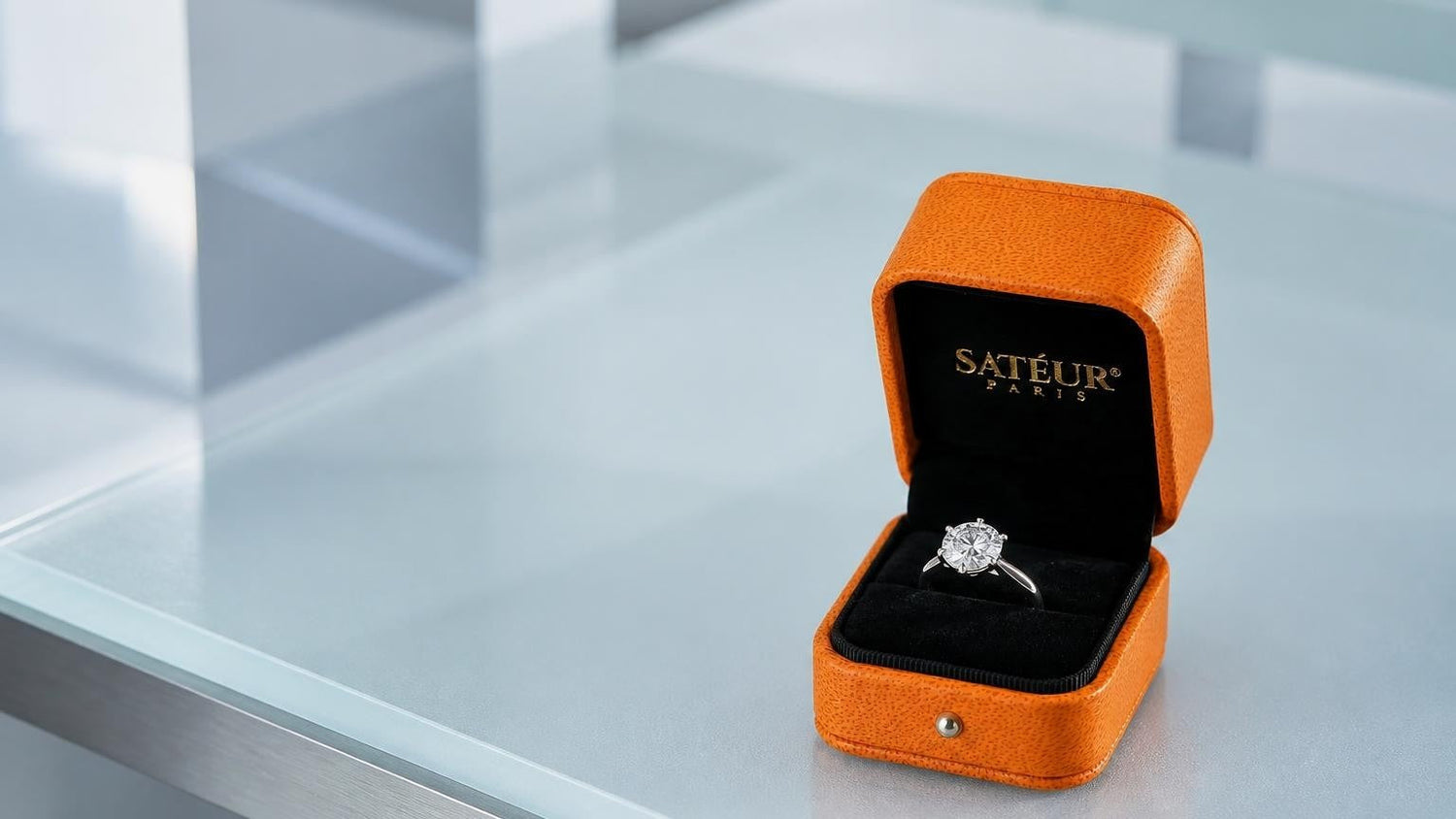
Lab Grown Diamond Color and Clarity Guide
Two numbers define almost everything about how a lab grown diamond looks: its clarity grade and its color grade. Together they determine whether a stone appears brilliant and white or slightly included and warm-tinted. Understanding both scales lets you choose with confidence — and spend precisely where it counts.
Lab grown diamonds carry the same IGI clarity and color grading system used for mined diamonds. Every grade means the same thing. The only difference is price. Browse the full lab diamond collection to see how grades translate into real stones.

Key Takeaways
- IGI grades lab grown diamonds on the same FL-to-I3 clarity scale used for mined diamonds.
- VVS1 and VVS2 inclusions are microscopic and invisible without magnification.
- VS1 and VS2 offer the best value — eye-clean at a fraction of FL pricing.
- The D-Z color scale measures absence of color; D is the purest white.
- Lab grown diamonds achieve identical clarity and chemical structure to mined diamonds.
- Satéur lab diamonds are IGI-certified and start at approximately $88.
What Affects Lab Grown Diamond Clarity?
Clarity measures the presence or absence of internal characteristics called inclusions and surface features called blemishes. Both form during the diamond's growth — whether that growth happens over billions of years underground or in weeks inside a laboratory reactor.
In lab grown diamonds created by HPHT (high pressure, high temperature) and CVD (chemical vapor deposition), inclusions still occur. CVD diamonds sometimes show dark graphitic pinpoints or strain lines from the growth environment. HPHT diamonds can contain metallic flux inclusions. Neither type affects durability, and high-grade stones show nothing visible to the eye.
Three factors determine how much inclusions matter in practice: their size, their position within the stone, and their number. A single pinpoint near the girdle matters far less than a feather at the table center, even if both carry the same clarity grade on paper.
The IGI Clarity Scale Explained
The International Gemological Institute (IGI) grades lab grown diamonds on the same eleven-point clarity scale used for mined diamonds. Grades move from flawless at the top to heavily included at the bottom.
| Grade | Category | What It Means | Visible to Naked Eye? |
|---|---|---|---|
| FL | Flawless | No inclusions or blemishes under 10× magnification | No |
| IF | Internally Flawless | No internal inclusions; minor surface blemishes only | No |
| VVS1 | Very Very Slightly Included | Minute inclusions extremely difficult to see under 10× | No |
| VVS2 | Very Very Slightly Included | Minute inclusions very difficult to see under 10× | No |
| VS1 | Very Slightly Included | Minor inclusions difficult to see under 10× | No |
| VS2 | Very Slightly Included | Minor inclusions somewhat easy to see under 10× | No |
| SI1 | Slightly Included | Inclusions easy to see under 10×; usually invisible to naked eye | Rarely |
| SI2 | Slightly Included | Inclusions very easy to see under 10×; sometimes visible to eye | Sometimes |
| I1 | Included | Inclusions obvious under 10×; visible to naked eye | Yes |
| I2 | Included | Inclusions clearly visible; may affect brilliance | Yes |
| I3 | Included | Prominent inclusions; significantly affects transparency | Yes |

Most buyers find the best value between VS1 and SI1. These grades are consistently eye-clean and cost significantly less than VVS or FL stones.
Types of Inclusions in Lab Grown Diamonds
Not all inclusions behave the same way. Knowing the terminology helps you read an IGI certificate and understand exactly what you are buying.
Pinpoints are tiny crystal inclusions, often so small they resemble a dot under high magnification. They are the most common type in lab grown diamonds and rarely affect appearance even in VS2 stones.
Feathers are small fractures within the crystal. At VS1 and above they are microscopic and structurally irrelevant. At SI2 or below they can occasionally affect light return if positioned at the table.
Clouds are clusters of many pinpoints grouped together. A dense cloud can create a slightly hazy area in the stone. IGI notes cloud presence on the certificate; if the plotted cloud is small and positioned near the girdle, it rarely matters.
Needles are long, thin crystal inclusions. They appear as bright lines under magnification. Like pinpoints, they are grading-relevant but rarely visible in everyday wear at VS grades.
Twinning wisps occur when a diamond crystal changes growth direction. They are more common in mined diamonds but can appear in HPHT lab grown diamonds. They tend to cluster near the girdle and are noted on the certificate plot.
How Clarity Impacts Sparkle and Appearance
A diamond's brilliance — the return of white light — depends primarily on cut, not clarity. A well-cut VS2 will outsparkle a poorly-cut VVS1 every time. Clarity only begins to suppress light return when inclusions are large, dark, or centrally placed in I-grade stones.
For all grades VS1 and higher, clarity has virtually no effect on observable sparkle. Even most SI1 stones remain eye-clean in normal lighting. The practical distinction between an FL and a VS1, viewed without magnification, is undetectable to any observer.
Where clarity matters most is in colorless diamonds with excellent cuts. A perfectly faceted round brilliant amplifies everything inside the stone under lighting. This is why many buyers of lab created diamond rings prioritize cut grade first, then color, then clarity — in that order.
Clarity Grades and Naked-Eye Visibility
The critical threshold for most buyers is eye-clean: no inclusions visible to the unaided eye at roughly 25 cm (10 inches) in normal lighting. Understanding which grades reliably hit that threshold helps avoid overpaying.
FL through VS1: Universally eye-clean. No buyer viewing the stone without magnification will see anything. Premium price for a result indistinguishable from VS2 to the naked eye.
VS2: Eye-clean in the vast majority of stones. Occasional VS2 stones with centrally placed inclusions may show a faint characteristic, but this is uncommon and certificate-readable before purchase.
SI1: Mostly eye-clean. Around 80-85% of SI1 lab grown diamonds are eye-clean. The inclusion plot on the IGI certificate tells you where the inclusions are — a small cluster near the girdle is safer than an inclusion at the table.
SI2: Frequently visible. Some SI2 stones are eye-clean; many are not. Requires individual stone review before purchase.
I1 through I3: Inclusions visible to the unaided eye. These grades affect the appearance and sometimes structural integrity of the stone.

The Diamond Color Scale
The Gemological Institute of America (GIA) established the D-Z color scale, which IGI uses for lab grown diamond grading. The scale measures the presence of yellow or brown tones in the diamond body. D represents total absence of color; Z shows obvious yellow or brown tint.
| Grade Range | Category | Appearance | Practical Note |
|---|---|---|---|
| D, E, F | Colorless | No discernible color; pure white | Highest premium; difference between D and F invisible once set |
| G, H, I, J | Near Colorless | Very slight warmth, invisible when set in white metal | Best value for most buyers; G-H appear colorless in everyday conditions |
| K, L, M | Faint | Faint yellow tint detectable by trained eye | Warm appearance; pairs well with yellow gold settings |
| N–R | Very Light | Visible yellow or brown tint | Intentional warm look; significantly lower price point |
| S–Z | Light | Obvious color visible to the eye | Rarely sold as white diamonds; specialty use |
Lab grown diamonds can be produced in D, E, and F color grades at far higher rates than mined diamonds. The geological process that causes color tinting in mined stones is absent from a controlled laboratory environment. This means colorless lab diamonds are genuinely more available — and more affordable — than their mined equivalents.
Setting metal matters as much as the grade itself. A G or H diamond set in platinum or 18K white gold reads as fully colorless to any observer. The same stone in yellow gold absorbs warmth from the setting and may read slightly warmer still — which many buyers prefer.
Lab Diamond Clarity vs Mined Diamond Clarity
Lab grown diamonds achieve identical crystal clarity structures to mined diamonds. This is not marketing language — it is chemistry. Both are pure carbon arranged in a cubic crystal lattice with identical physical properties. An IGI VS1 lab diamond and an IGI VS1 mined diamond have the same type and density of inclusions for that grade. The grading certificate describes the same reality in both cases.
The difference is origin, not structure. A 3 carat lab grown diamond with a VS1/F grade carries the same optical quality as a mined 3 carat VS1/F — and typically costs 70-90% less.
One meaningful distinction in inclusion type: mined diamonds sometimes contain inclusions from surrounding minerals (garnet crystals, olivine) because they grew inside rock. Lab grown diamonds grow in a controlled environment and show inclusions specific to that process — metallic flux in HPHT, graphitic pinpoints or strain in CVD. Neither type is superior or inferior in quality; they are simply different fingerprints of different growth environments.
For the buyer, this distinction is academic. The IGI grade is what governs appearance and value. Both mined and lab grown diamonds carry the same grading authority under IGI's system.
Clarity's Role in Lab Diamond Value
In mined diamonds, moving from VS2 to VVS1 can add 30-50% to the stone price for no visible difference. In lab grown diamonds, that same step carries a smaller premium — but it still adds cost.
The practical value rule is consistent: buy the lowest clarity grade that is reliably eye-clean for the stone size you want. For rounds under 1 carat, VS2 to SI1 is almost always sufficient. For stones above 1.5 carats, VS1 or VS2 gives more reliable eye-clean results because a larger table exposes more of the stone to direct light.
Color premiums follow similar logic. Moving from G to D adds cost without visible change in a set ring. Most buyers choosing a lab diamond find G-H/VS2 the optimal balance of appearance and value.
Spending saved on clarity and color is often better invested in cut quality. An Excellent or Ideal cut grade has more impact on visible beauty than one step of color or clarity.
Satéur Lab Diamond Value Proposition
Satéur's lab diamond tier offers IGI-certified lab-grown diamonds — the same chemical structure as mined diamonds — starting at approximately $88. That is roughly 1% of the price of a comparable mined diamond.
Every Satéur lab diamond comes with an IGI certificate documenting its exact clarity and color grade. The stone on your finger carries the same physical properties as any other diamond graded at that level, regardless of whether it formed underground or in a laboratory.

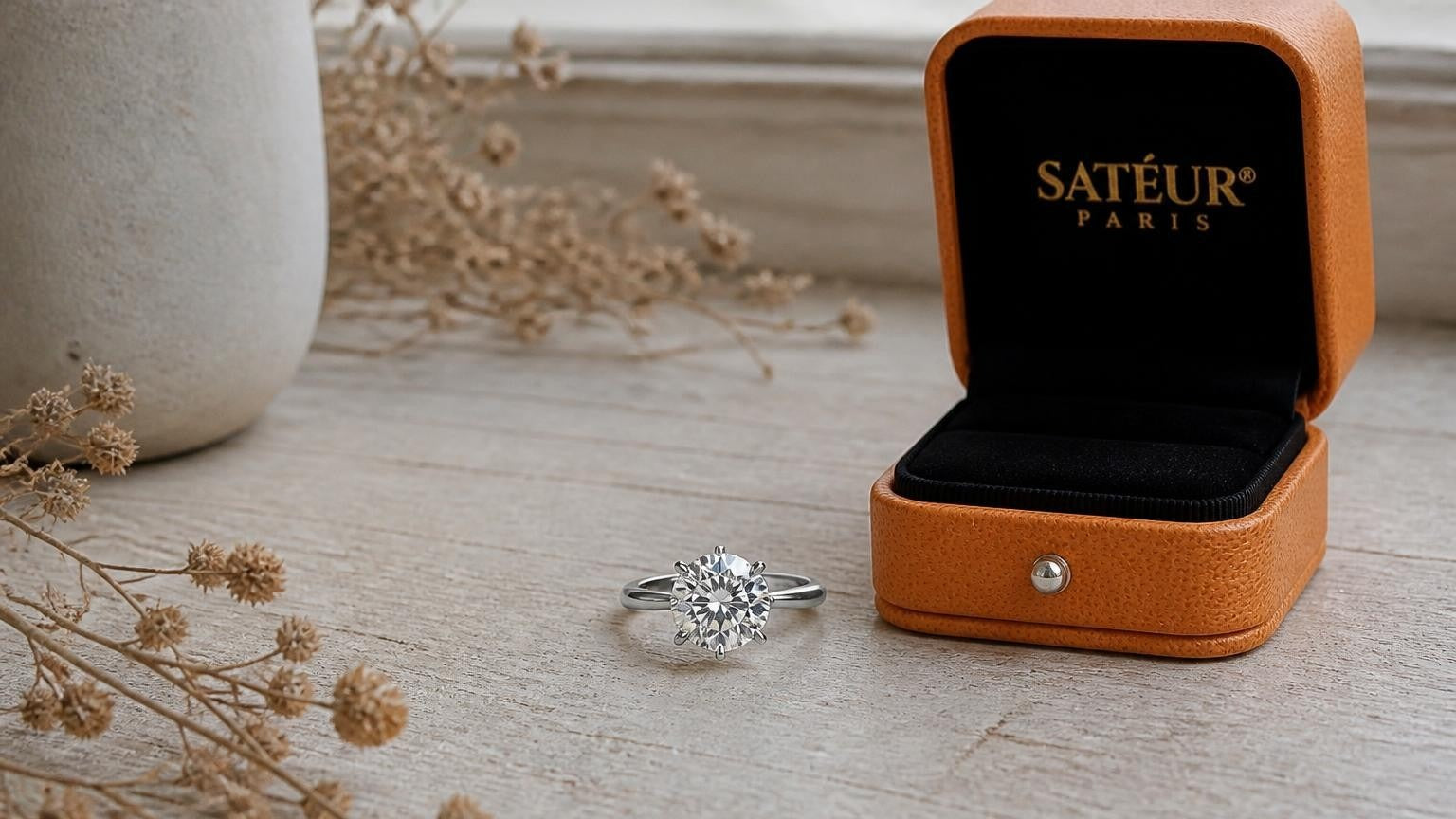
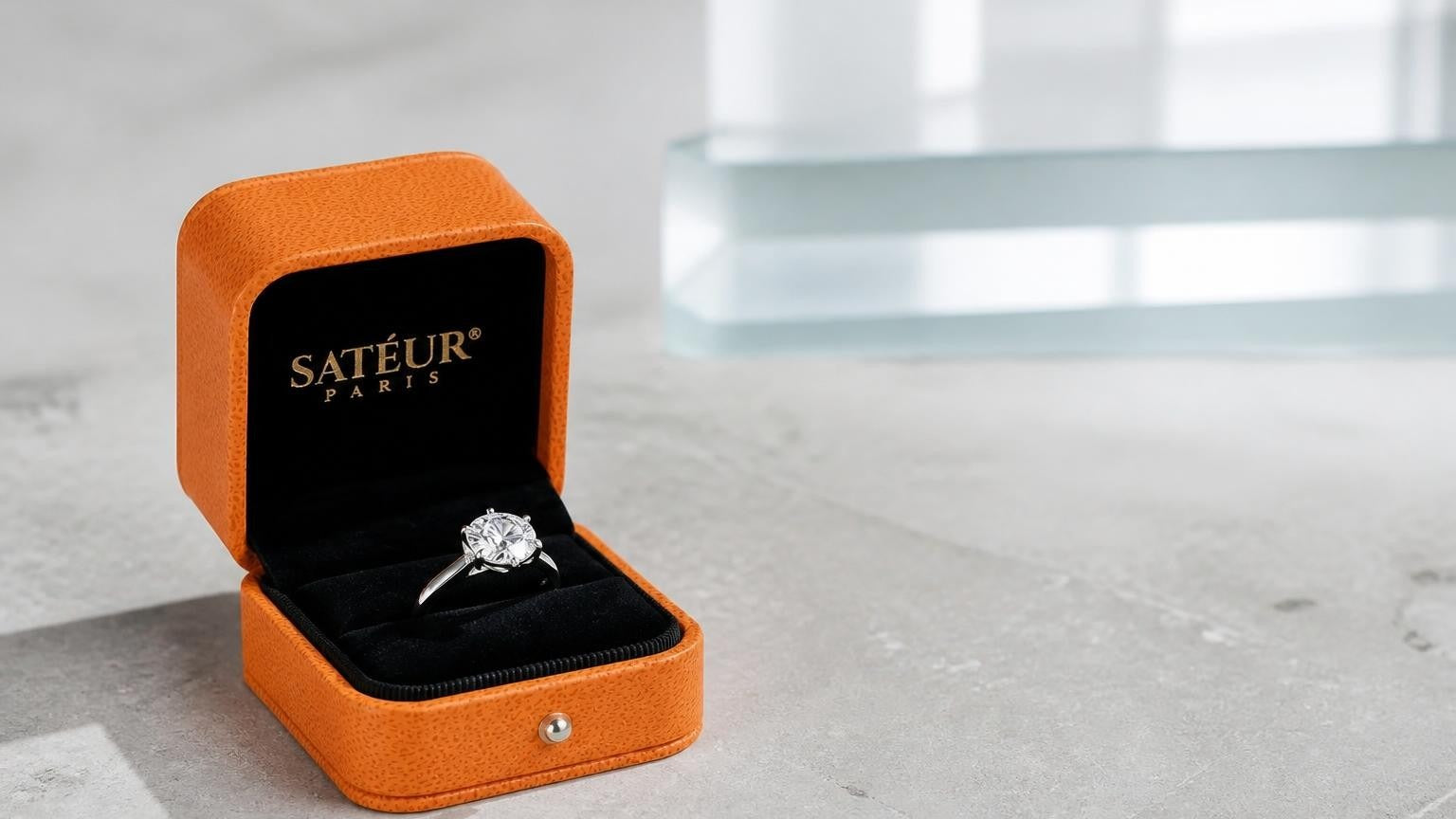
Satéur Destinée Diamond Ring
A real, IGI-certified lab-grown diamond, hand-set in solid 18K gold — a fraction of the mined-diamond price.
Compare to a $10,000 mined diamond
Joined by 100,000+ couples across 150+ countries.
Shop the Destinée Diamond RingFree worldwide shipping · 30-day returns · Lifetime Satéur Care
Frequently Asked Questions
What clarity grade should I choose for a lab grown diamond ring?
VS1 or VS2 is the right starting point for most buyers. Both grades are eye-clean at any normal viewing distance. For stones under 1 carat, SI1 is often eye-clean as well. FL and IF grades offer no visible advantage over VS1 in everyday wear — they cost more for a characteristic only visible under magnification.
Is D color necessary in a lab grown diamond?
No. D, E, and F are all colorless and visually identical once set in white metal. The difference between D and G is undetectable to any observer without a controlled side-by-side comparison. G or H color in an 18K white gold or platinum setting reads as fully colorless in real conditions, at a meaningfully lower cost.
Do lab grown diamond inclusions look different from mined diamond inclusions?
They can look slightly different under magnification. CVD lab diamonds may show graphitic pinpoints or growth strain lines; HPHT diamonds can contain metallic flux. Mined diamonds sometimes show mineral crystal inclusions from surrounding rock. The IGI certificate describes inclusions in detail. For practical purposes, the clarity grade is the relevant indicator — an SI1 lab diamond behaves the same as an SI1 mined diamond in terms of appearance.
Are lab grown diamonds graded the same as mined diamonds?
Yes. IGI uses an identical grading system for both. The same clarity scale (FL through I3), the same color scale (D through Z), and the same cut grades apply. An IGI certificate for a lab grown diamond carries the same technical authority as one for a mined diamond. The certificate will note "Laboratory-Grown" in the description, but the grades themselves use the same standards.
What is the difference between VVS1 and VVS2?
Both VVS1 and VVS2 contain inclusions invisible to the naked eye and extremely difficult to see even under 10× magnification. The distinction between them is technical: VVS1 inclusions are slightly more difficult to locate under magnification than VVS2. In practice, the two grades are visually identical. Both sit well above the eye-clean threshold and carry a premium over VS grades without any observable advantage in everyday wear.
Does clarity affect a diamond's durability?
At VS2 and above, no. Inclusions at these grades are microscopic and have no meaningful effect on structural integrity. At SI grades, most inclusions are still structurally irrelevant — feathers near the girdle are the exception to watch for, since that area takes mechanical stress during setting. At I1 and below, inclusions can occasionally affect durability, particularly large feathers that reach from one facet to another. IGI certificates note the size, position, and type of every significant inclusion.
















Deja un comentario
Este sitio está protegido por hCaptcha y se aplican la Política de privacidad de hCaptcha y los Términos del servicio.