

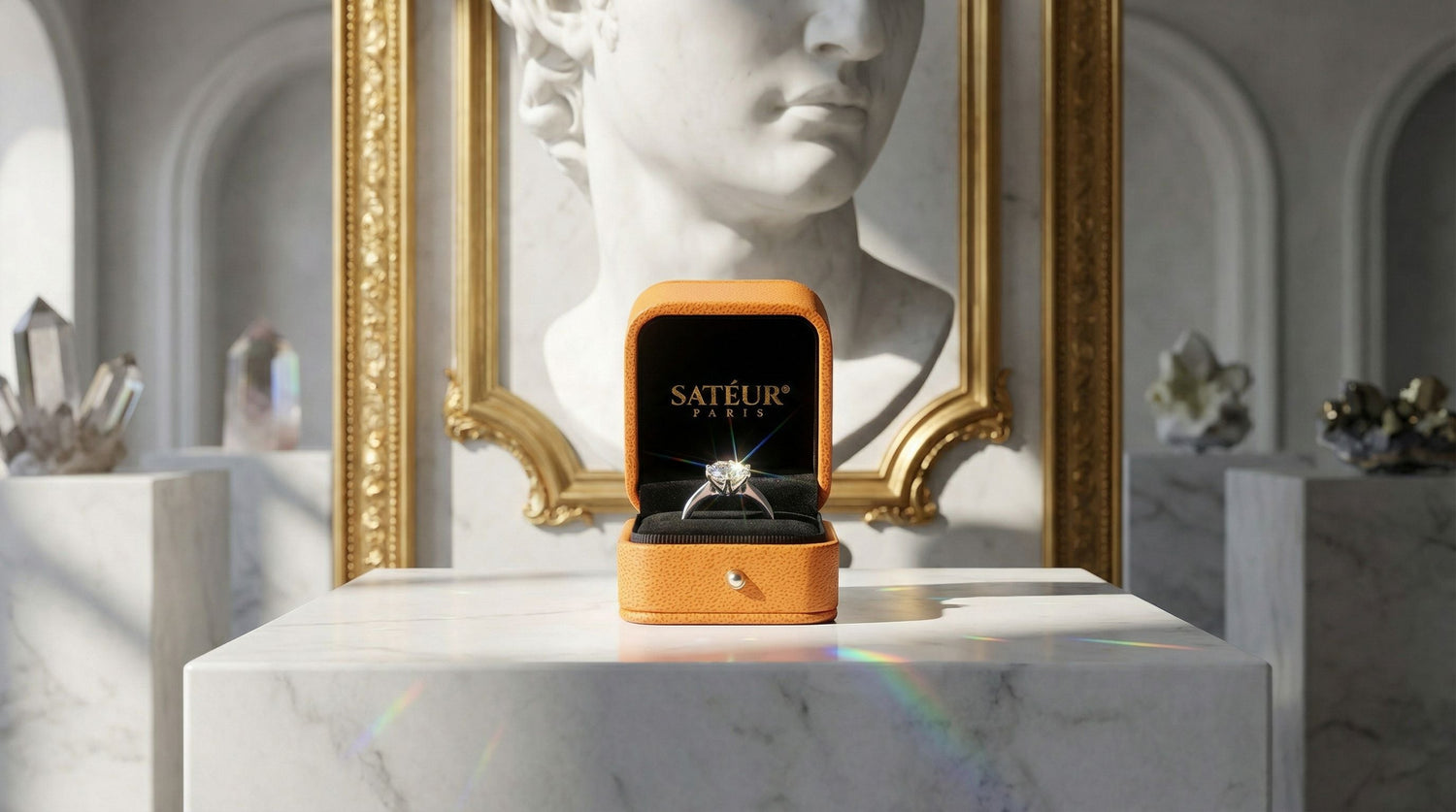
What Is Moissanite? Everything You Need to Know
Quick Answer: Moissanite is a lab-created gemstone composed of silicon carbide (SiC), first discovered in a meteorite in 1893. It ranks 9.25 on the Mohs hardness scale, has a higher refractive index than diamond (2.65–2.69 vs. 2.42), and costs approximately 10% of a comparable diamond. It is not a diamond, but a distinct mineral with its own optical properties.
Moissanite is not a diamond. It is not a substitute. It is a gemstone with its own origin story, its own chemical signature, and its own place in the hierarchy of brilliance.
In 1893, French chemist Henri Moissan — who would later win the Nobel Prize in Chemistry — was examining rock samples from a meteor crater in Canyon Diablo, Arizona. He believed he had found microscopic diamonds. Years of analysis revealed something rarer: a new mineral, formed not in Earth's mantle, but in the extreme conditions of space. For over a century, it remained a scientific curiosity. Today, it is a modern alternative to mined diamonds, engineered in laboratories to rival the finest stones ever pulled from the earth.

This is everything you need to know about what moissanite is, how it compares to diamonds, and why it has become the choice of the discerning modern buyer.
Key Facts About Moissanite
- Chemical Composition: Silicon carbide (SiC) — what moissanite is made of
- Hardness: 9.25 on the Mohs scale (second only to diamond at 10.0)
- Refractive Index: 2.65–2.69 (higher than diamond's 2.42)
- Origin: First discovered in a meteorite; now lab-created
- Fire (Dispersion): 0.104 (more than double a diamond's 0.044)
- Durability: Suitable for daily wear, resistant to scratching and chipping
- Price: Approximately 10% the cost of a comparable diamond
What Is Moissanite? Definition and Origins
Moissanite is a naturally occurring mineral composed of silicon carbide (SiC). Henri Moissan's 1893 discovery at Canyon Diablo was initially mistaken for diamond — understandable, given the crystals' brilliance and hardness. It took years of spectroscopic analysis to confirm they were an entirely new mineral, later named moissanite in his honor.
Natural moissanite is extraordinarily rare. The crystals found in meteorites are microscopic, unsuitable for jewelry. What changed the trajectory of moissanite was the development of lab-grown synthesis in the 1990s. Scientists learned to recreate the extreme heat and pressure conditions that form moissanite in space, producing gem-quality crystals in controlled environments.
Today, all moissanite used in jewelry is lab-created. This is not a limitation — it is precision. Every stone is engineered to exacting standards, free from the inclusions and color variations that plague mined gemstones. For a deeper exploration of moissanite's journey from space mineral to engagement ring, see our analysis of moissanite diamond origins and science.
The Science: What Is Moissanite Made Of?
Moissanite is silicon carbide, a compound of silicon and carbon atoms arranged in a tightly bonded crystalline structure. This atomic arrangement gives moissanite its exceptional hardness and thermal conductivity — properties that rival and, in some measures, exceed those of diamond.
Diamonds, by contrast, are pure carbon arranged in a cubic crystal lattice. The difference in atomic structure explains why moissanite and diamond behave differently under light and testing equipment. Moissanite's crystal structure is hexagonal, which contributes to its higher refractive index and greater dispersion (fire). When light enters a moissanite stone, it bends more sharply than in a diamond, creating flashes of spectral color — the rainbow effect that defines moissanite's signature brilliance.
How Lab-Grown Moissanite Is Created
Modern moissanite is produced using two primary methods: High Pressure High Temperature (HPHT) and Chemical Vapor Deposition (CVD). Both replicate the extreme conditions under which silicon carbide forms naturally in space.
In the CVD process, a silicon carbide seed crystal is placed in a chamber filled with carbon and silicon gases. The chamber is heated to over 1,400°C, causing the gases to bond atom by atom onto the seed crystal. Over weeks, a gem-quality moissanite crystal grows layer by layer. The result is a stone that is chemically, physically, and optically consistent — something nature cannot guarantee.
Moissanite Properties: Hardness, Brilliance, and Durability
Moissanite is not a fragile stone. It is one of the hardest substances on Earth. Understanding what moissanite is made of — silicon carbide — explains its exceptional physical properties.
Moissanite Hardness: 9.25 on the Mohs Scale
The Mohs scale measures a mineral's resistance to scratching, from 1 (talc) to 10 (diamond). Moissanite ranks at 9.25, making it harder than sapphire (9.0) and nearly as hard as diamond (10.0).
This hardness translates to real-world durability. A moissanite engagement ring resists scratching, chipping, and surface degradation under daily wear. It is engineered to outlast the marriage it symbolizes. For a detailed analysis of how moissanite's hardness compares to other gemstones, see our guide to moissanite hardness on the Mohs scale.
Refractive Index: The Science of Brilliance
Brilliance is not subjective. It is measurable. The refractive index (RI) quantifies how much light bends when entering a gemstone.
Moissanite's RI ranges from 2.65 to 2.69. Diamond's RI is 2.42. The higher the refractive index, the more light is reflected back to the observer's eye. This is why moissanite often appears more brilliant than a diamond of the same cut quality.
Fire (Dispersion): The Rainbow Effect
Fire refers to a gemstone's ability to split white light into spectral colors. It is measured by dispersion value.
Moissanite's dispersion is 0.104 — more than double that of diamond (0.044). This creates the characteristic "rainbow flashes" that distinguish moissanite from diamond under direct light. Some buyers prefer this enhanced sparkle. Others find it excessive. This is not a flaw. It is a difference in optical personality.
Thermal Conductivity
Moissanite conducts heat even more efficiently than diamond. This property is why some diamond testers mistakenly identify moissanite as diamond — both conduct heat rapidly, unlike cubic zirconia or glass.
Modern gemological equipment can distinguish between the two, but the thermal similarity is a testament to moissanite's physical rigor. To understand how testing works, read our analysis of whether moissanite passes a diamond tester.

Is Moissanite a Real Diamond?
No. Moissanite is not a diamond. It is not a diamond simulant. It is not a fake diamond. It is a distinct gemstone with its own classification.
Diamonds are carbon. Moissanite is silicon carbide. The two minerals have different chemical compositions, different crystal structures, and different optical properties. Calling moissanite a "diamond alternative" is accurate. Calling it a "fake diamond" is not.
The confusion arises because moissanite rivals diamond in the qualities that matter most to jewelry buyers: brilliance, hardness, and durability. But similarity in performance does not equal identity. For those questioning whether moissanite is real, the answer is unequivocal: it is a real gemstone, with real properties, and real value.
For a detailed breakdown of this distinction, see our expert analysis on whether moissanite is a real diamond.
Moissanite vs. Diamond: A Direct Comparison
| Property | Moissanite | Diamond |
|---|---|---|
| Chemical Composition | Silicon Carbide (SiC) | Pure Carbon (C) |
| Mohs Hardness | 9.25 | 10.0 |
| Refractive Index | 2.65–2.69 | 2.42 |
| Dispersion (Fire) | 0.104 | 0.044 |
| Color Grade | Near-colorless to colorless (premium grades) | D–Z scale (D = colorless) |
| Price per Carat (1ct) | $400–$600 | $4,000–$10,000+ |
| Durability | Excellent for daily wear | Excellent for daily wear |
| Origin | Lab-created | Mined or lab-grown |
The performance gap between moissanite and diamond is narrower than the price gap. For buyers prioritizing brilliance and durability over tradition, moissanite delivers comparable results at a fraction of the cost.
Moissanite Stone Meaning: What the Gem Represents
Gemstones carry meaning beyond their molecular structure. The moissanite stone meaning is rooted in its origin story — a mineral born in the stars and brought to Earth by meteorites. This cosmic provenance lends it a narrative of rarity and wonder that no marketing campaign could manufacture.
In modern symbolism, moissanite represents clarity, resilience, and the courage to choose intelligence over tradition. It is the gemstone of the informed buyer, the couple who values substance over status. Moissanite does not inherit its meaning from centuries of marketing. It earns it through performance.
For a deeper exploration of the cultural and emotional significance of this gemstone, read our guide to moissanite meaning and symbolism.
Types of Moissanite: Grading and Quality Tiers
Not all moissanite is created equal. The gemstone industry has developed quality tiers based on color, clarity, and cut precision. Understanding what moissanite stone quality means requires examining these distinctions.
Color Grades
The moissanite market is stratified by color grade, but most retailers conflate "colorless" with "acceptable." At the Maison, we define colorless as D-F equivalent under gemological grading — the same standard applied to investment-grade diamonds. This is not the industry norm. It is the Sateur standard.
- Colorless (D-E-F equivalent): Premium moissanite with no detectable color. Comparable to the finest diamonds.
- Near-Colorless (G-H-I equivalent): Slight warmth under magnification, undetectable to the naked eye in most settings.
- Faint Color (J-K equivalent): Vintage or budget-tier moissanite with visible warmth under direct light.
Premium Moissanite Brands
Several brands have developed proprietary moissanite formulations with enhanced optical properties. Forever One, created by Charles & Colvard, is the most recognized premium-grade moissanite, engineered for maximum colorlessness and brilliance.
Unlike diamonds, moissanite is not graded by the Gemological Institute of America (GIA) or other traditional gemological labs. Moissanite quality is assessed by the manufacturer using diamond-equivalent color scales (D-F, G-I, etc.), but these are internal standards, not third-party certifications.
At the Maison, we offer ultra-premium moissanite selected from the top 0.1% of lab-grown batches — stones that meet the same clarity and color standards as D-F diamonds.
What Is Moissanite Jewelry? Applications Beyond Engagement Rings
Moissanite is not limited to engagement rings. Its hardness and brilliance make it suitable for any jewelry application where durability and visual impact matter. For a comprehensive overview of moissanite applications across jewelry categories, visit our guide to moissanite jewelry.
Engagement Rings
Moissanite engagement rings have surged in popularity among couples seeking an alternative to traditional diamond rings. The stones offer comparable brilliance, superior fire, and a price point that allows for larger carat sizes or higher-quality settings.
A 2-carat moissanite engagement ring costs approximately $800–$1,200. A 2-carat diamond engagement ring of similar quality costs $15,000–$25,000. The visual difference is negligible. The financial difference is transformative.
Earrings and Necklaces
Moissanite's fire makes it particularly striking in earrings, where movement amplifies its rainbow flashes. Studs, drops, and hoops set with moissanite offer the presence of diamond jewelry without the corresponding price.
Necklaces and pendants benefit from moissanite's durability. Unlike softer gemstones, moissanite will not scratch from chain friction or accidental contact.
Does Moissanite Get Cloudy Over Time?
No. Moissanite does not cloud, fade, or lose brilliance with age.
This misconception stems from confusion with cubic zirconia, which can develop surface scratches and lose polish over time. Moissanite's hardness (9.25) prevents this degradation. Moissanite may accumulate oils, lotions, and debris on its surface — as any gemstone will — but this is surface buildup, not structural clouding. A simple cleaning with warm water and mild soap restores full brilliance.
For long-term performance data and care instructions, read our analysis of whether moissanite gets cloudy over time.
Moissanite Price: What to Expect
Moissanite costs approximately 10% of a comparable diamond. This is not a discount. It is a recalibration of value based on production cost rather than artificial scarcity.
| Carat Size | Moissanite Price Range | Diamond Price Range |
|---|---|---|
| 0.5 ct | $200–$350 | $1,500–$3,000 |
| 1.0 ct | $400–$600 | $4,000–$10,000 |
| 2.0 ct | $800–$1,200 | $15,000–$25,000 |
| 3.0 ct | $1,200–$1,800 | $30,000–$50,000+ |
The price of moissanite is determined by size, color grade, and cut quality — not by market manipulation or mining costs. For a detailed breakdown of pricing across carat sizes and quality tiers, see our comprehensive moissanite price guide.
Is Moissanite the Same as a Lab-Grown Diamond?
No. Moissanite and lab-grown diamonds are both created in laboratories, but they are chemically and structurally different gemstones.
Lab-grown diamonds are pure carbon, identical in every measurable way to mined diamonds. They are graded by the same gemological institutes (GIA, IGI) using the same 4Cs criteria. Moissanite is silicon carbide. It has a different refractive index, different dispersion, and different hardness. The two stones behave differently under light and testing equipment.
Both are lab-created. Both are ethical alternatives to mined diamonds. But they are not interchangeable. For a detailed comparison of these two lab-created options, visit our guide to understanding the difference between moissanite and lab-grown diamonds.
Caring for Moissanite: Maintenance and Longevity
Moissanite requires minimal maintenance. Its hardness prevents scratching. Its chemical stability prevents discoloration.
Cleaning
Clean moissanite jewelry every 2-4 weeks using warm water, mild dish soap, and a soft brush. Rinse thoroughly and dry with a lint-free cloth. Ultrasonic cleaners and steam cleaners are safe for moissanite, though hand cleaning is sufficient for most buildup.
Storage
Store moissanite jewelry separately from softer gemstones to prevent accidental scratching. A fabric-lined jewelry box or individual pouches work well.
Professional Inspection
Have moissanite rings inspected annually by a jeweler to ensure prong security and setting integrity. The stone itself will not degrade, but settings can loosen over time.
Why Moissanite Matters: The Shift in Modern Jewelry
Moissanite represents a recalibration of value. For a century, the diamond industry equated scarcity with worth. Moissanite inverts that logic: it is abundant by design, engineered to exacting standards, and priced according to production cost rather than artificial constraint. This is not disruption. It is precision.
It is not about choosing "less." It is about choosing differently. Moissanite offers brilliance, durability, and beauty without the artificial scarcity model. It is the gemstone of the informed buyer — the couple who values substance over tradition.
At the Maison, moissanite is one expression of modern luxury — engineered for brilliance, selected for precision, built to last. This is The New Diamond Standard.

Frequently Asked Questions
What is moissanite made of?
Moissanite is made of silicon carbide (SiC), a compound of silicon and carbon atoms arranged in a hexagonal crystal structure. This differs from diamond, which is pure carbon in a cubic crystal lattice. The silicon carbide composition gives moissanite its exceptional hardness (9.25 on the Mohs scale) and thermal conductivity.
Is moissanite natural or lab-created?
All moissanite used in jewelry is lab-created. Natural moissanite exists but is extraordinarily rare — only microscopic crystals have been found in meteorites. Lab-grown moissanite replicates the extreme heat and pressure conditions of space to produce gem-quality stones through processes like Chemical Vapor Deposition (CVD).
Is moissanite a fake diamond?
No. Moissanite is not a fake diamond. It is a distinct gemstone with its own chemical composition (silicon carbide) and optical properties. It is not a diamond simulant — it is a diamond alternative with measurably different characteristics, including higher brilliance and fire.
Will moissanite last forever?
Yes. Moissanite is one of the hardest substances on Earth (9.25 on the Mohs scale). It will not scratch, chip, or cloud under normal wear. With proper care, moissanite jewelry lasts generations without losing brilliance or structural integrity.
Can jewelers tell the difference between moissanite and diamond?
Yes. Trained gemologists can distinguish moissanite from diamond using specialized equipment that measures refractive index and thermal conductivity. Moissanite has a higher refractive index (2.65–2.69 vs. 2.42) and different dispersion properties. However, to the naked eye, the two stones are nearly indistinguishable.
Does moissanite look as good as a diamond?
Moissanite has more brilliance and fire than diamond due to its higher refractive index and dispersion. Some buyers prefer this enhanced sparkle. Others prefer diamond's subtler light return. "Better" is subjective. "Different" is measurable.
Why is moissanite so much cheaper than diamond?
Moissanite is lab-created, eliminating mining costs and supply chain markups. Its price reflects production cost, not artificial scarcity. Diamonds are expensive due to controlled supply and century-long marketing, not inherent rarity. The performance gap between moissanite and diamond is narrower than the price gap.
What does moissanite mean?
The moissanite stone meaning is rooted in its cosmic origin — a mineral first discovered in meteorites and named after Nobel Prize-winning chemist Henri Moissan. In modern symbolism, moissanite represents clarity, resilience, and the courage to choose intelligence over tradition. It is the gemstone of the informed buyer.
Moissanite is not a compromise. It is a choice. A choice to prioritize brilliance over tradition. Intelligence over inherited narratives. Substance over status.
At the Maison, moissanite is one expression of modern luxury — engineered for brilliance, selected for precision, built to last. Each stone represents a different path to the same destination: jewelry that honors commitment without compromise.
Explore the collection.















Deja un comentario
Este sitio está protegido por hCaptcha y se aplican la Política de privacidad de hCaptcha y los Términos del servicio.