

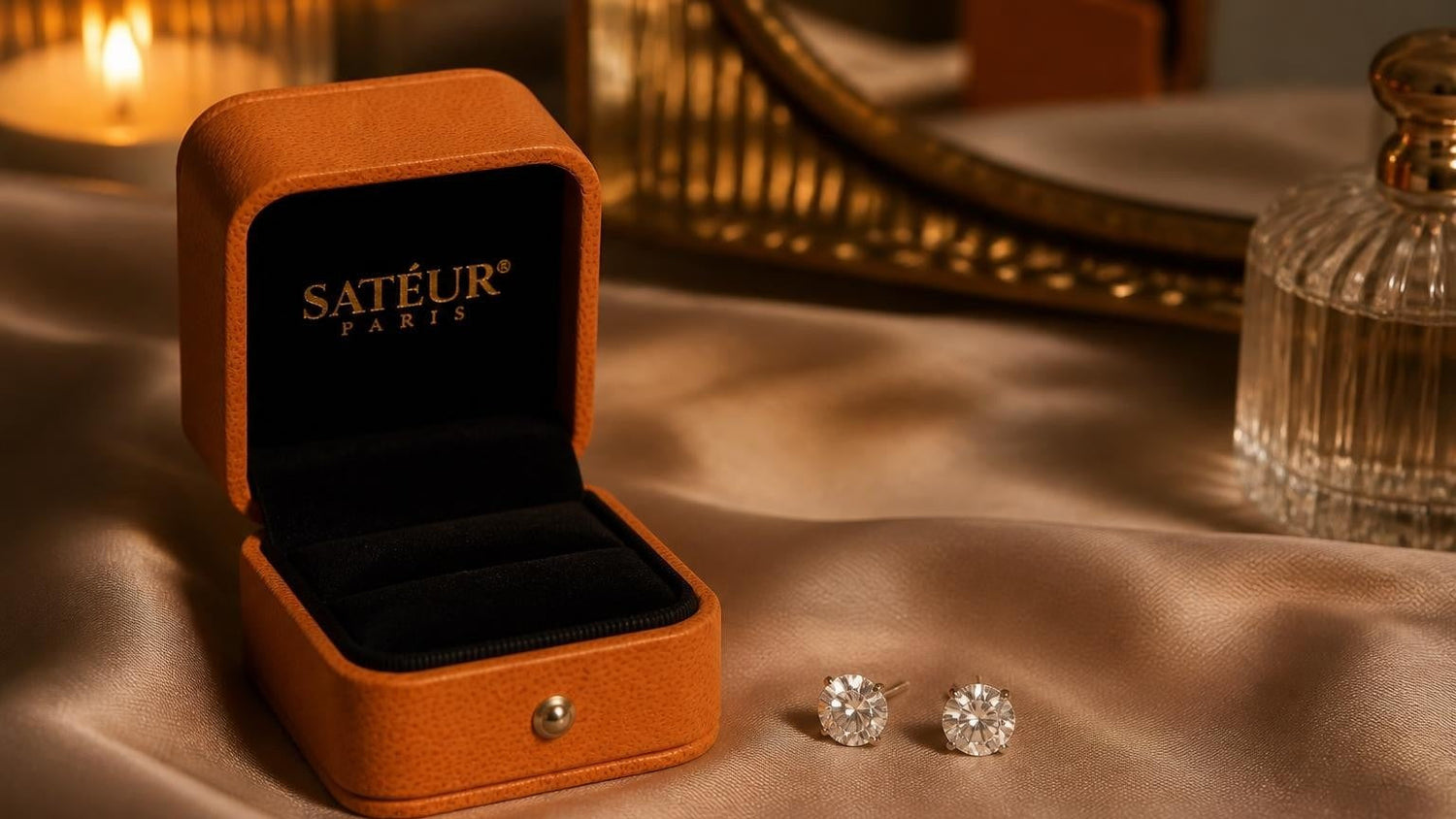
Best Fake Diamond Earrings That Look Real
The best fake diamond earrings deliver the look of a flawless diamond without the diamond price — and the most convincing of them are not really “fake” at all. They are diamond simulants: gems engineered to mirror the brilliance, white color and fire of a fine diamond. The term most shoppers type is fake diamond earrings, but what they are actually looking for is the diamond look, done well, at a fraction of the cost.
This guide separates the realistic options from the disappointing ones. We compare the three things people mean when they say “fake” — cubic zirconia, moissanite and lab-grown diamonds — then show what actually makes a faux diamond earring read as real on the ear. If you want the short version: a top-tier simulant set in proper metal, in a clean round cut, is indistinguishable from a diamond with the naked eye. Shop fake diamond earrings that look real if you already know that is what you want.
Key Takeaways
- “Fake diamond” usually means a diamond simulant — cubic zirconia, moissanite or glass that mimics a diamond’s appearance.
- Lab-grown diamonds are not fakes — they are real diamonds with the same optical and physical properties as mined ones.
- Moissanite (Mohs 9.25, refractive index ~2.65) is the most diamond-convincing simulant and lasts a lifetime; cubic zirconia (~8.5 Mohs) is cheaper but can cloud and scratch over time.
- Satéur Gems® studs grade Color D–E, Cut Excellent — the look of a flawless diamond from $88, about 1% of a comparable mined stone.
- The most realistic pairs are set in nickel-free 925 sterling silver with an 18k gold finish, in a symmetrical round brilliant cut.
What “Fake Diamond” Really Means: CZ, Moissanite & Lab-Grown
“Fake” is a blunt word for a precise category. In the trade, a stone that imitates a diamond’s appearance but has a different makeup is called a diamond simulant. Cubic zirconia and moissanite are the two simulants worth your attention. Glass and rhinestones belong to costume jewelry and are not in the conversation for earrings you intend to keep.
There is one important exception. A lab-grown diamond is not a fake at all. It is a genuine diamond, grown rather than mined, with the same optical, physical and chemical properties as a natural stone — and it is certified as such. So if a listing calls a lab-grown diamond “fake,” that is a misunderstanding, not a description. It simply costs far less than a mined diamond of equal grade.
That gives you three honest routes to the diamond look: a brilliant simulant like moissanite or a refined cubic zirconia, a trademarked diamond simulant such as Satéur Gems®, or a real lab-grown diamond. The right one depends on how close to “real” you need to be, and how much you want to spend. For most people shopping fake diamond earrings, a top simulant answers the brief completely.
Moissanite vs Cubic Zirconia vs Lab Diamond
Here is the quick comparison most shoppers want before anything else. It maps the realistic options against the qualities that actually decide whether a pair looks real and lasts.
| Property | Cubic Zirconia | Moissanite | Satéur Gems® | Lab-Grown Diamond |
|---|---|---|---|---|
| What it is | Diamond simulant | Lab-created gemstone | Trademarked diamond simulant | Real diamond, grown not mined |
| Look vs a diamond | Convincing when new; can read glassy | Brilliant, with extra rainbow fire | The look of a flawless diamond | Identical — it is a diamond |
| Hardness (Mohs) | ~8–8.5 | 9.25 | High, built for daily wear | 10 |
| Fire / dispersion | Moderate | Higher than a diamond | Diamond-like brilliance | Classic crisp white brilliance |
| Longevity | Can cloud or scratch over time | Lasts a lifetime | Made for everyday wear | Permanent |
| Price posture | Lowest cost | From $88 at Satéur | About 1% of a mined diamond | Well below mined diamonds |

Cubic zirconia is the budget answer. A well-cut CZ looks good on day one, but it sits softer on the Mohs scale and tends to abrade and cloud with months to a few years of daily wear. For a costume pair or a short-term piece, it is fine. For earrings you want to keep, it is the weakest of the realistic options.
Moissanite is the most diamond-convincing simulant. Its refractive index actually exceeds a diamond’s, so it returns more visible fire — that flash of rainbow you see when the light moves. At Mohs 9.25 it shrugs off daily wear, and it is openly disclosed as a lab-created gemstone, which many buyers prefer. The only thing to know is that its extra dispersion can read as “more sparkle than a diamond” under bright light, which is a feature for some and a tell for purists.
Satéur Gems® is our trademarked diamond simulant — engineered for the look of a flawless diamond and graded Color D–E, Cut Excellent. It is the gem that built the Maison, and it is what sits in our signature studs. It gives the diamond look without the diamond price, from $88.
A lab-grown diamond is the route for anyone who wants a real diamond on the ear. It is certified, identical to mined in every measurable way, and far less expensive than the mined equivalent. It is the most you can spend here and still beat a traditional jeweler’s markup.
What Makes a Faux Diamond Look Real
The stone is only half the story. Two pairs with the same simulant can look a tier apart depending on cut, setting and metal. These are the details that decide whether a faux diamond earring reads as the real thing.
Cut and symmetry. A diamond looks like a diamond because of how precisely it is cut to return light. The round brilliant is the most forgiving and the most convincing — its symmetry is what the eye expects. Excellent-cut simulants catch and throw light the way a fine diamond does; a lazy cut looks dull or glassy no matter the material.
Color. The most realistic stones grade in the colorless range, around D–E. A faintly yellow or grey tint is one of the fastest tells. Satéur Gems® and our moissanite are selected to read clean and white.
Setting and metal. A four- or six-prong setting lifts the gem into the light the way a real solitaire is set. Cheap, heavy bezels and thin plating give a piece away instantly. The realistic pairs are set in nickel-free 925 sterling silver with an 18k gold finish, not raw base metal.

Satéur Destinée Earrings™
The look of a flawless diamond — hand-set in 18k gold finishing, from $88.
Compare to a $10,000 mined diamond
Joined by 100,000+ couples across 150+ countries.
Shop Destinée EarringsFree worldwide shipping · 30-day returns · Lifetime Satéur Care

Best Settings & Metals for an Authentic Look
If you remember one thing about metal, make it this: the realistic pairs are built in proper precious metal, not plated pot-metal. Look for nickel-free 925 sterling silver, often finished in rhodium for a bright white-gold look, or an 18k gold finish for warmth. Nickel-free matters for sensitive ears, and it signals a piece made to last.
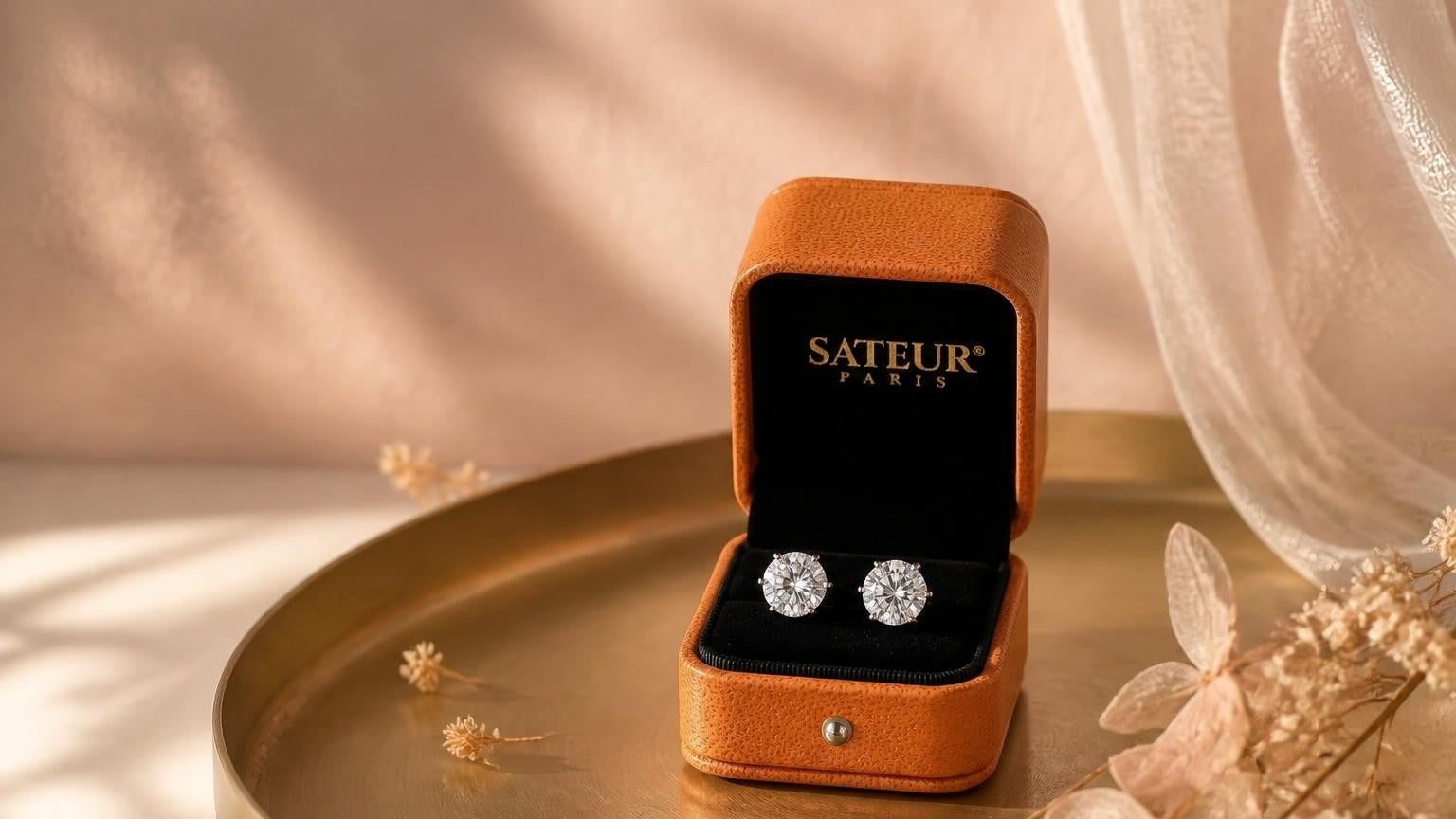
For the stud itself, a classic four-prong “martini” or six-prong basket sits the gem up where light can reach it — the single biggest factor in looking real. For fake diamond stud earrings, that lifted, symmetrical setting is what separates a convincing pair from a flat one. Browse our full earrings collection to see the settings in context.
Carat, Cut & Clarity in Simulated Stones
Simulant earrings borrow the same language as diamonds — carat, cut and clarity. Carat is scale: a 1.00 ct round per ear reads as a confident everyday stud. Cut does the most work, as covered above. Clarity in a fine simulant is effectively flawless — there are no natural inclusions to hide, which is part of why a top simulant can look cleaner than a mid-grade mined diamond.
Across the realistic options you will see specs in the colorless D–E range with excellent cut grades. That combination — colorless, excellent cut, clean clarity — is exactly the profile that makes a pair indistinguishable from a diamond with the naked eye. Explore our moissanite if extra fire appeals to you, or our Gems® studs for the cleanest diamond look.

The Diamond Look for Round, Stud & Drop Styles
The same principles scale across styles. A round brilliant stud is the most versatile and the most convincing — it is the shape the eye reads as “diamond” by default, and it suits every face and every day. A drop or dangle adds movement, which makes a brilliant simulant flash more as it catches the light. A halo surrounds a center gem with smaller ones to amplify size and sparkle.
Whatever the silhouette, the rules hold: colorless gem, excellent cut, lifted setting, nickel-free precious metal. Get those right and the style is a matter of taste, not authenticity.
How to Choose Your Pair
Match the gem to how you will wear it. For an everyday pair, choose a hard, brilliant simulant in a clean round — moissanite or Satéur Gems® in a lifted setting. For maximum fire, moissanite wins. For the truest diamond look at the lowest entry price, our Gems® studs start at $88 — the look of a flawless diamond for about 1% of a comparable mined stone. And for a real diamond on the ear without the old-school markup, the IGI-certified lab-grown route is genuine and far cheaper than mined.
Over 100,000 customers across 150+ countries have chosen this path — the look, the longevity, and the discernment of choosing wisely over spending blindly. That is the heart of The New Diamond Standard®, and the reason the diamond look no longer has to mean a diamond price.
If you already know you want the most realistic pair, start with the pieces chosen for exactly that: fake diamond earrings that look real. The look of a flawless diamond, set properly, from $88.
Frequently Asked Questions
What are the best fake diamond earrings?
The most realistic are top-tier diamond simulants — moissanite or a trademarked simulant like Satéur Gems® — in an excellent round-brilliant cut, set in nickel-free 925 sterling silver or an 18k gold finish. Satéur Gems® studs grade Color D–E, Cut Excellent and start at $88, giving the look of a flawless diamond for about 1% of a comparable mined stone. For a real diamond at a lower price, an IGI-certified lab-grown diamond is genuine, not a simulant.
What looks most like a real diamond?
Among simulants, a top-quality moissanite or Satéur Gems® gem in a colorless grade and excellent cut looks most like a fine diamond — indistinguishable from one with the naked eye. Moissanite shows slightly more rainbow fire; Satéur Gems® reads as the cleanest classic diamond look. If you want something that literally is a diamond, choose a certified lab-grown diamond.
Is moissanite or cubic zirconia more realistic?
Moissanite is more realistic and far more durable. It rates 9.25 on the Mohs scale versus about 8–8.5 for cubic zirconia, so it resists scratching and clouding and keeps its brilliance for life. Cubic zirconia looks good when new but can dull over months to a few years of daily wear. For earrings you intend to keep, moissanite is the stronger choice.
Can people tell fake diamond earrings apart?
Not in normal wear. A top simulant in a proper setting is indistinguishable from a diamond with the naked eye across a room or at dinner. The usual tells are a poor cut, a yellow or grey tint, or cheap plated metal — all of which the realistic pairs avoid with colorless excellent-cut gems and nickel-free precious metal.
Are lab-grown diamonds considered fake?
No. A lab-grown diamond is a real diamond — it has the same optical, physical and chemical properties as a mined diamond and is certified as such. It is grown rather than dug up, which is why it costs far less than mined for the same grade. Simulants like cubic zirconia and moissanite imitate a diamond’s look; a lab-grown diamond is the genuine article.















コメントを残す
このサイトはhCaptchaによって保護されており、hCaptchaプライバシーポリシーおよび利用規約が適用されます。