

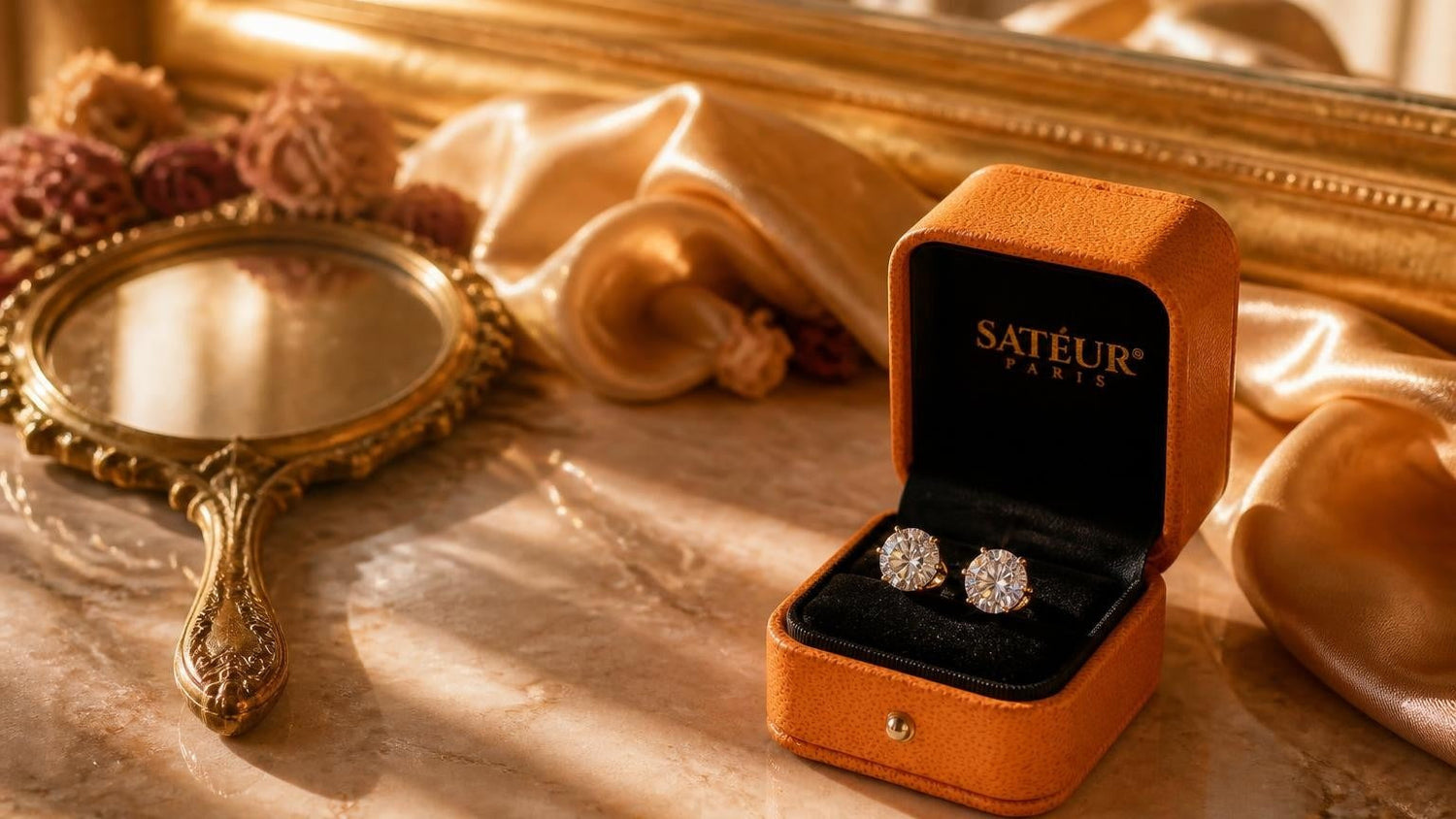
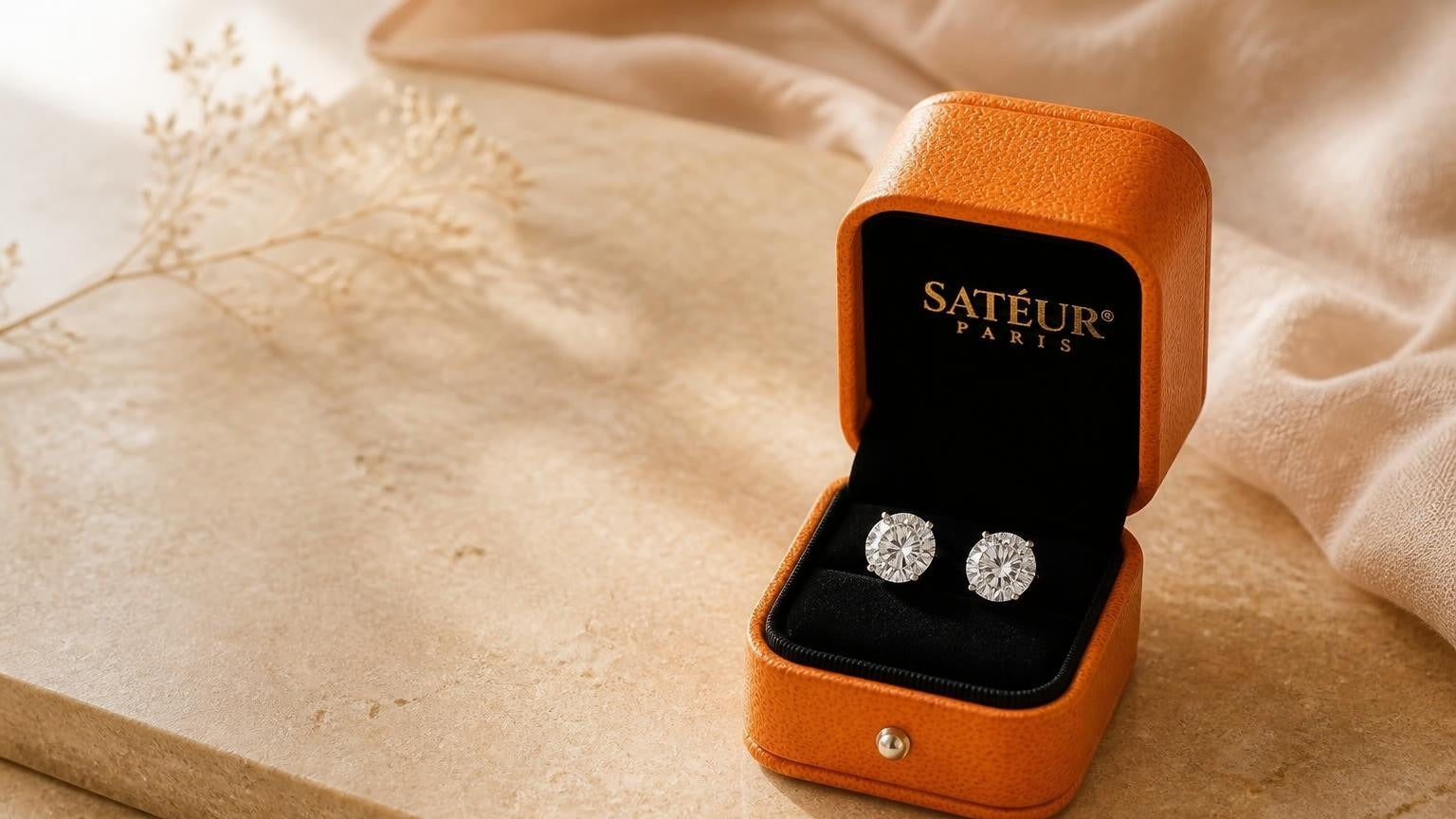
Moissanite earrings give you the brilliance, fire and hardness of a fine diamond pair for roughly 1% of the price. Set in 18K gold finishing, a moissanite stud sits beside your face and returns more rainbow light than a diamond of the same size — and across a dinner table, no one can tell the difference. Because the stone is worn every day and seen up close, earrings are the smartest first step into fine jewellery: low commitment, high impact, and no ring size to guess.
This is the complete guide to Satéur moissanite earrings — every style we make, how to choose a carat size, how moissanite compares to diamonds and other alternatives, the right pair for sensitive ears, and how to match earrings to your face and the occasion. Each section links to a deeper guide where one exists.
Key Takeaways
- Moissanite earrings give you the diamond look for roughly 1% of the price — set in real 18K gold finishing.
- Moissanite scores 9.25 on the Mohs hardness scale (diamond is 10) and never clouds, unlike cubic zirconia.
- Its refractive index (~2.65) is higher than a diamond's (2.42), so it returns more rainbow fire.
- To the naked eye, across a dinner table, no one can tell moissanite from a diamond.
- 1 carat per ear is the everyday sweet spot; earrings sit beside the face, so size up one step from a ring.
- Every Satéur pair uses a hypoallergenic, nickel-safe 18K-gold-finish post — gentle enough to sleep in.
Types of Moissanite Earrings
Which style should you start with? The stud is the foundation of any earring wardrobe: a single round-brilliant moissanite that sits flush to the lobe, catches light from every angle, and never dates. From there the family opens up — hoops for everyday movement, drops for evening, halo studs that ring the centre stone in smaller accents for extra scale, and shaped silhouettes like hearts and emerald-cut stones for character. Bridal and bridesmaid sets lean classic and matched.
Metal sets the mood. Satéur earrings come in 18K white-gold finishing (the brightest, most diamond-like backdrop), warm yellow gold, and rose gold. White gold maximises the stone's sparkle; yellow and rose add warmth against the skin. Whatever the silhouette, the rule is the same — let the stone lead, and let the metal flatter it rather than compete.

Explore in depth:
Earrings by Carat & Size
What carat size should you choose? Carat is the single biggest lever on how an earring reads, and earrings follow a different rule than rings: because the stone sits beside your face rather than on a hand held at a distance, a given carat looks larger — so most people size up one step from what they'd choose for a ring. A half-carat pair is the quiet, dainty option, perfect for stacking or a first piercing. One carat each is the everyday sweet spot — clearly present, refined, never loud. Two carats reads as occasion jewellery, the pair you wear when you want the light to find you across a room.
| Carat (per ear) | Approx. diameter | Reads as |
|---|---|---|
| 0.5 ct | ~5.0 mm | Dainty, stackable, first piercing |
| 1.0 ct | ~6.5 mm | Everyday sweet spot — refined, present |
| 2.0 ct | ~8.0 mm | Occasion jewellery — catches the room |

Explore in depth:
Moissanite vs Diamonds & Other Alternatives
Can anyone tell the difference? Not with the naked eye — across a table, in a photo, at dinner, a moissanite earring is indistinguishable from a diamond, for about 1% of the price. Moissanite (a lab-created gemstone, silicon carbide) actually throws more rainbow fire than a diamond because its refractive index (~2.65) is higher than a diamond's (2.42). It scores 9.25 on the Mohs hardness scale versus a diamond's 10 — hard enough to stay sharp and clear through a lifetime of daily wear. The other alternatives sit at different points on the price-durability curve: lab-grown diamonds cost more and look identical to mined; cubic zirconia is cheaper but softer (Mohs 8.5) and clouds within a year or two. For earrings — worn daily, seen up close — moissanite is the value sweet spot.
| Stone | Hardness (Mohs) | Fire (RI) | Relative price | Holds up? |
|---|---|---|---|---|
| Moissanite | 9.25 | 2.65 — most fire | ~1% of diamond | Lifetime, won't cloud |
| Mined diamond | 10 | 2.42 | 100% | Lifetime |
| Cubic zirconia | 8.5 | 2.16 | <1% | Clouds in 1-2 yrs |

Explore in depth:
Earrings for Sensitive Ears
Why do earrings make your ears sore? The cause is almost always nickel in the post and butterfly back — the most common metal allergy in jewellery. Every Satéur pair uses a hypoallergenic 18K-gold-finish post, so they're nickel-safe and gentle enough to sleep in. That matters most for a few groups: anyone who has reacted to costume or fashion jewellery before; people with newly pierced or healing ears; and anyone with stretched or heavier lobes who needs a lightweight stone that won't drag. A moissanite stud is naturally light for its size, which keeps weight off a sensitive lobe. If you've given up on earrings because they always hurt, start with a hypoallergenic stud and build from there.

Explore in depth:
Earrings as Gifts
Why are earrings the safest jewellery gift? There's no ring size to guess, no commitment anxiety, and a pair of moissanite studs suits virtually everyone — which is why they land equally well as a wedding-party thank-you, a Christmas-morning surprise, an anniversary, or a "just because." For gifting, default to a 1-carat round stud in white-gold finishing: the most universally flattering, the most timeless, and it reads as generous without being a guess. Every pair arrives in the Satéur box, ready to give — and because moissanite costs a fraction of diamond, you can give the look of a serious diamond gift at a price that doesn't require a serious conversation first.

Explore in depth:
How to Choose: Face Shape & Occasion
Which earrings suit your face? Part stone, part you. Studs flatter every face shape — the safe default. Beyond studs: longer drops lengthen and slim a rounder face; a defined, angular silhouette softens a square jaw; softer, rounded shapes balance a heart-shaped face. If you wear glasses, keep studs or short drops so frames and earrings don't compete. For occasion, scale to the dress code: black-tie and weddings are where you size up the carat and let a single brilliant stone do all the work — understated but unmissable when the light hits. For a wedding guest, a 1-2 carat stud reads polished without upstaging the couple. When in doubt, a larger stud is never wrong.

Explore in depth:

Satéur Destinée Earrings™
The brilliance of fine diamond studs — for about 1% of the price.
Compare to a $10,000 mined diamond
Joined by 100,000+ couples across 150+ countries.
Discover Satéur EarringsFree worldwide shipping · 30-day returns · Lifetime Satéur Care
Frequently Asked Questions
Are moissanite earrings worth it?
Yes — you get the brilliance, fire and hardness of a fine diamond earring for roughly 1% of the price, set in real 18K gold finishing. For a piece worn daily and seen up close, that value is very hard to beat.
Can people tell moissanite from a diamond?
Not with the naked eye, and not across a dinner table — moissanite actually returns more rainbow fire than a diamond. The difference only shows under magnification.
Do moissanite earrings get cloudy?
No. Moissanite does not cloud, dull or lose brilliance over time — unlike cubic zirconia, which can cloud within a year or two. A quick clean restores full sparkle.
Are Satéur earrings safe for sensitive ears?
Yes. Every pair uses a hypoallergenic 18K-gold-finish post that is nickel-safe and light enough to sleep in — suitable for healing piercings and sensitive lobes.
What carat size should I choose for earrings?
One carat per ear is the everyday sweet spot. Size up to two carats for occasion wear, or down to a half carat for a dainty, stackable look. Earrings sit beside the face, so size up one step from what you'd pick for a ring.
How do I clean moissanite earrings?
Warm water, a drop of mild dish soap, and a soft brush, then pat dry. Avoid harsh chemicals. This keeps the stone and the 18K gold finish bright.
Which metal is best for moissanite earrings?
18K white-gold finishing gives the brightest, most diamond-like sparkle. Yellow and rose gold add warmth against the skin — choose by the tones you already wear.
















コメントを残す
このサイトはhCaptchaによって保護されており、hCaptchaプライバシーポリシーおよび利用規約が適用されます。