

Moissanite Clarity vs Diamond: What Every Buyer Should Know
When it comes to moissanite clarity vs diamond clarity, the headline is straightforward: premium moissanite is almost universally eye-clean. That makes it a fundamentally different buying decision from a mined diamond, where clarity grading is one of the most consequential — and most expensive — variables on the certificate. Understanding how each gemstone is graded, and what that actually means at arm's length, is the starting point for an intelligent choice.
This guide covers the full comparison — from the GIA FL-to-I diamond scale to how moissanite is graded, the role of colour, fire, and the Mohs hardness scale, and where Satéur's near-colourless, eye-clean gems sit in that picture. For a broader look at how these gemstones compare across every dimension, see the moissanite vs diamond rings complete debate. If you are weighing an engagement ring decision and want facts rather than industry folklore, read on.
Key Takeaways
- Diamond clarity runs from FL (flawless) to I (included) on the GIA scale; most buyers choose VS1–SI2.
- Premium moissanite is graded near-colourless D–E–F and is typically eye-clean — inclusions rarely visible without magnification.
- Moissanite scores 9.25 on the Mohs scale; diamond is 10. Both are everyday-durable gemstones built for lifelong wear.
- Moissanite's fire (dispersion) is about 2.4× that of a diamond, producing vivid coloured sparkle under light.
- Under 1 carat, clarity and colour differences are nearly invisible to the naked eye; cut drives the sparkle you actually see.
- Satéur stones are graded D–E colour, Excellent cut — the flawless-diamond look for about 1% of the price.
Moissanite Clarity vs Diamond Clarity at a Glance
The fastest way to understand the difference is a direct comparison of the four properties that matter most to buyers. Cut, colour, clarity, and hardness tell most of the story — but price per carat tells the rest.
| Property | Diamond | Moissanite | Satéur Gems® |
|---|---|---|---|
| Clarity range | FL to I3 (GIA scale) | Eye-clean at premium tier | Eye-clean, D–E colour graded |
| Colour grade | D (colourless) to Z (light yellow) | D–E–F near-colourless (top tier) | D–E, colourless |
| Mohs hardness | 10 | 9.25 | ~8.8 |
| Fire (dispersion) | 0.044 | 0.104 — about 2.4× diamond | Diamond-accurate white brilliance |
| Price (1 ct equivalent) | $3,000–$15,000+ | From ~$98 | From ~$138 |

How Diamond Clarity Is Graded (FL to I)
The Gemological Institute of America grades diamond clarity on eleven grades across six categories. At the top sits FL (Flawless) — no inclusions or blemishes visible under 10× magnification. Below that come IF (Internally Flawless), VVS1/VVS2 (Very Very Slightly Included), VS1/VS2 (Very Slightly Included), SI1/SI2 (Slightly Included), and I1/I2/I3 (Included, visible to the naked eye).
In practice, most buyers land between VS2 and SI1. An SI1 diamond can be eye-clean — the inclusions exist under magnification but do not affect the visual experience at arm's length. The meaningful premium for FL or IF grades often reflects collector or investment value rather than a visible difference in daily wear. For a ring that will be seen across a table, VS2 and SI1 represent the practical sweet spot on the diamond clarity scale.
The critical point: clarity grade adds substantial cost to a diamond. Moving from SI2 to VVS2 can double or triple the price for a stone that looks identical in the hand. This is the trade-off the diamond industry rarely makes explicit.
How Moissanite Clarity Is Graded
Moissanite — a lab-created gemstone — is not graded on the GIA diamond scale. Manufacturers and grading labs use descriptive tiers that map broadly to the VS–SI range, but the key commercial fact is this: top-tier moissanite is produced to be eye-clean as a baseline, not as an exception.
Where a diamond buyer must navigate a wide clarity spectrum and pay a premium for higher grades, a moissanite ring buyer at the premium tier starts from an eye-clean baseline. Inclusions exist in moissanite — inherent to lab-grown crystal formation — but at the commercial quality level used in fine jewellery, they are not visible without magnification.
This changes the economics of the comparison materially. With a diamond, clarity is a major price driver. With moissanite, it largely is not. Buyers pay for carat size, cut quality, and colour grade — not for hunting an inclusion-free stone within a broad grading range.
Why Most Moissanite Is Eye-Clean
The manufacturing process for lab-created moissanite gives growers significantly more control over crystal formation than exists in nature. Mined diamonds form over billions of years under conditions that introduce nitrogen, hydrogen, and structural irregularities — the source of most natural inclusions. Moissanite grown in a controlled lab environment minimises these variables from the start.
The result: commercially available premium moissanite is reliably eye-clean. Buyers do not need to trade up a clarity tier to avoid visible inclusions. This is one of the most practical — and underappreciated — advantages of moissanite over a natural diamond at equivalent visual impact.
For those weighing a moissanite vs diamond vs Satéur comparison for an engagement ring, this single fact reshapes the budget calculation entirely. The money that would have gone to buying up a clarity grade goes instead toward carat size, setting quality, or — if the goal is the diamond look at a fraction of the cost — toward Satéur's Gems® tier.
Colour: D–E–F Near-Colourless in Both
Diamond colour grades run from D (colourless) to Z (light yellow or brown). The D–F range is near-colourless and commands the highest premiums. In the G–J range, colour is faint but visible under controlled lighting. Below J, warmth becomes visible to the naked eye in most settings.
Top-tier moissanite is produced to fall in the D–E–F colour range — near-colourless and visually comparable to the finest diamonds. The practical implication is the same as with clarity: moissanite buyers at the premium tier are not navigating a wide colour spectrum and paying extra to reach the top. Near-colourless is the standard, not the exception.
One nuance worth noting: under certain lighting, older or lower-grade moissanite can show a faint greenish or greyish tint. Premium D–E–F moissanite does not exhibit this. Verify colour grade when purchasing from any jeweller — it is the most visible variable after cut.
The 4Cs Applied to Moissanite
The diamond industry's 4Cs framework — cut, colour, clarity, carat — applies to moissanite in a modified form. Cut and colour work much the same way. Clarity, as discussed, operates differently because premium moissanite is eye-clean by default. Carat weight is measured differently: moissanite is less dense than diamond, so a stone labelled "1 carat equivalent" is sized to the same diameter as a 1-carat diamond, but its actual weight in carats is lower.
For a buyer focused on visual impact — how the ring looks at normal viewing distance — the 4Cs framework still provides a useful checklist. Prioritise cut (the primary driver of brilliance and fire) and colour (the most visible variable in a colourless stone). Clarity, for premium moissanite, can be taken as given at D–E–F grade. That simplification is itself a meaningful advantage over the diamond buying process.
Fire & Brilliance: Where Moissanite Pulls Ahead
Moissanite's refractive index of approximately 2.65 exceeds that of a diamond (~2.42). Its dispersion — the property that splits white light into coloured fire — is about 0.104, roughly 2.4× the 0.044 of a diamond. Under direct light, moissanite produces vivid rainbow flashes that are visibly more intense than a diamond's sparkle.
Whether this is desirable depends entirely on preference. Those who want the classic, understated white brilliance of a fine mined diamond will find moissanite's fire slightly different — more coloured, more pronounced in direct sunlight or spotlight. Those who want the maximum sparkle from a gemstone will find moissanite compelling precisely for this reason.
This is where Satéur Gems® occupies a distinct position in the comparison. While moissanite is openly disclosed and celebrated for its vivid fire, Satéur Gems® is engineered for diamond-accurate brilliance — the restrained, clean white sparkle of a flawless diamond. Two different gemstones, two different optical characters, two different appeals. The comparison matters when choosing which is right for you.
Hardness: Moissanite 9.25 on the Mohs Scale
Diamond rates 10 on the Mohs hardness scale — the hardest natural mineral known. Moissanite rates 9.25, the second-hardest gemstone commonly used in fine jewellery. Both are everyday-durable. A moissanite ring worn as an engagement ring will not scratch or chip under normal conditions; the gap between 9.25 and 10 is negligible in daily life.
For context, sapphire and ruby — traditional fine jewellery stones — rate 9. Moissanite's hardness surpasses both. It is a gemstone built for lifelong wear, not a compromise on durability.
Satéur Gems® rate approximately 8.8 on the Mohs scale — above sapphire, and more than sufficient for daily wear in rings or earrings. The difference between ~8.8 and 9.25 does not translate to a practical distinction in durability for everyday jewellery. Both Satéur gemstone tiers hold their brilliance and their form for life.
Clarity, Carat & What Actually Shows
One of the most useful facts about diamond and moissanite clarity: below 1 carat, inclusions and colour differences become increasingly difficult to detect with the naked eye, regardless of grading tier. Under 0.5 carats, the visual difference between VS1 and SI1 in a diamond is negligible without magnification. The same holds for subtle colour differences in the D–J range when viewed in normal lighting conditions.
This is the pragmatic argument that buyers often discover only after extensive research. For stones under 1 carat, cut quality — which determines how light enters and exits the gemstone — has more impact on visible sparkle than clarity or colour. A well-cut SI1 diamond outsparkles a poorly cut VVS2. A well-cut premium moissanite at D–E colour, eye-clean, delivers more visual brilliance than its price would suggest by any mined-diamond comparison.
Carat and what shows is also a function of setting geometry. A prong setting showcases the gem from multiple angles; a bezel setting contains it. Understanding how setting design affects visible diameter helps calibrate whether a particular carat size delivers the intended visual presence in the finished ring.

Satéur's Near-Colourless, Eye-Clean Gems
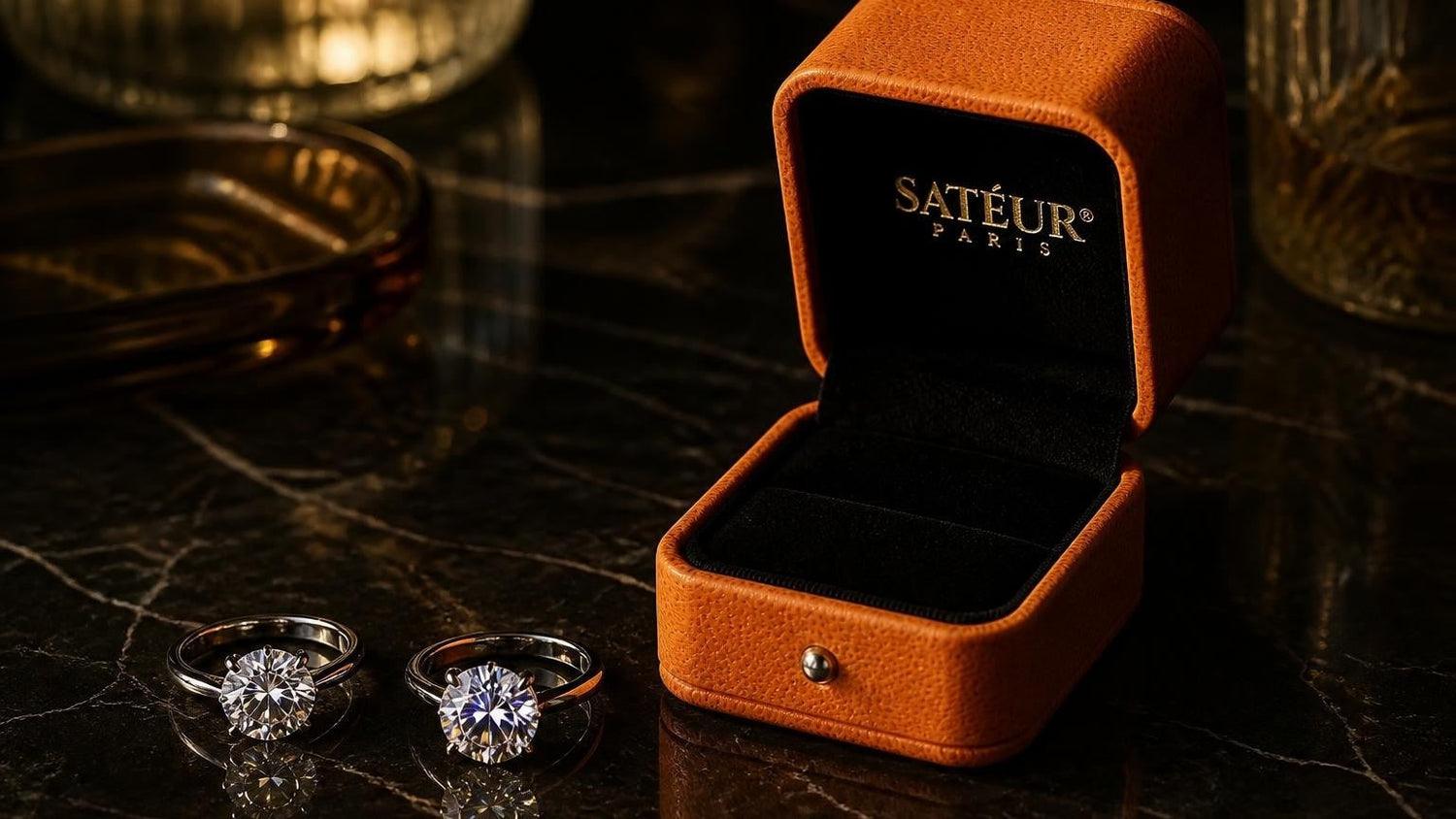
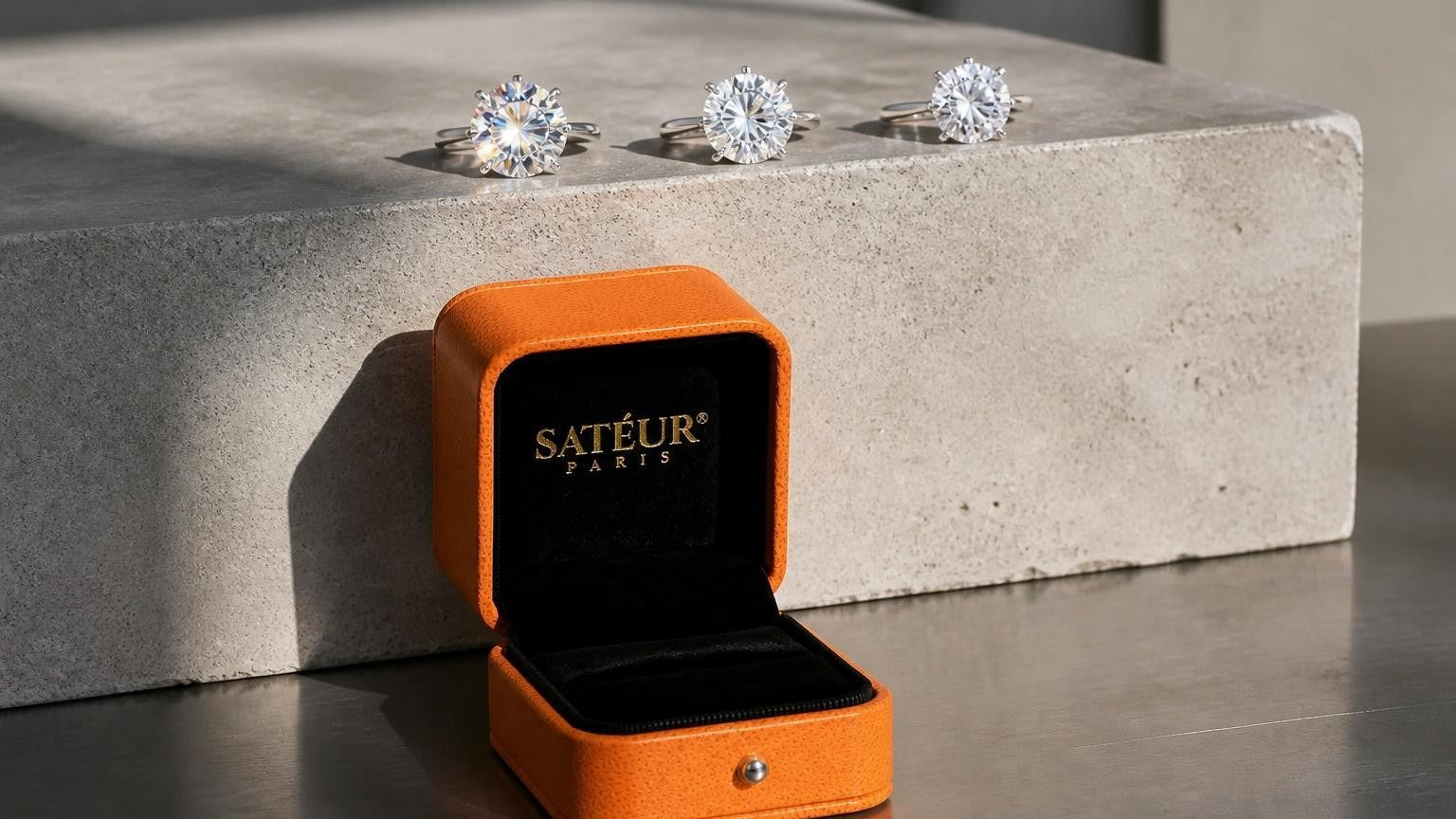
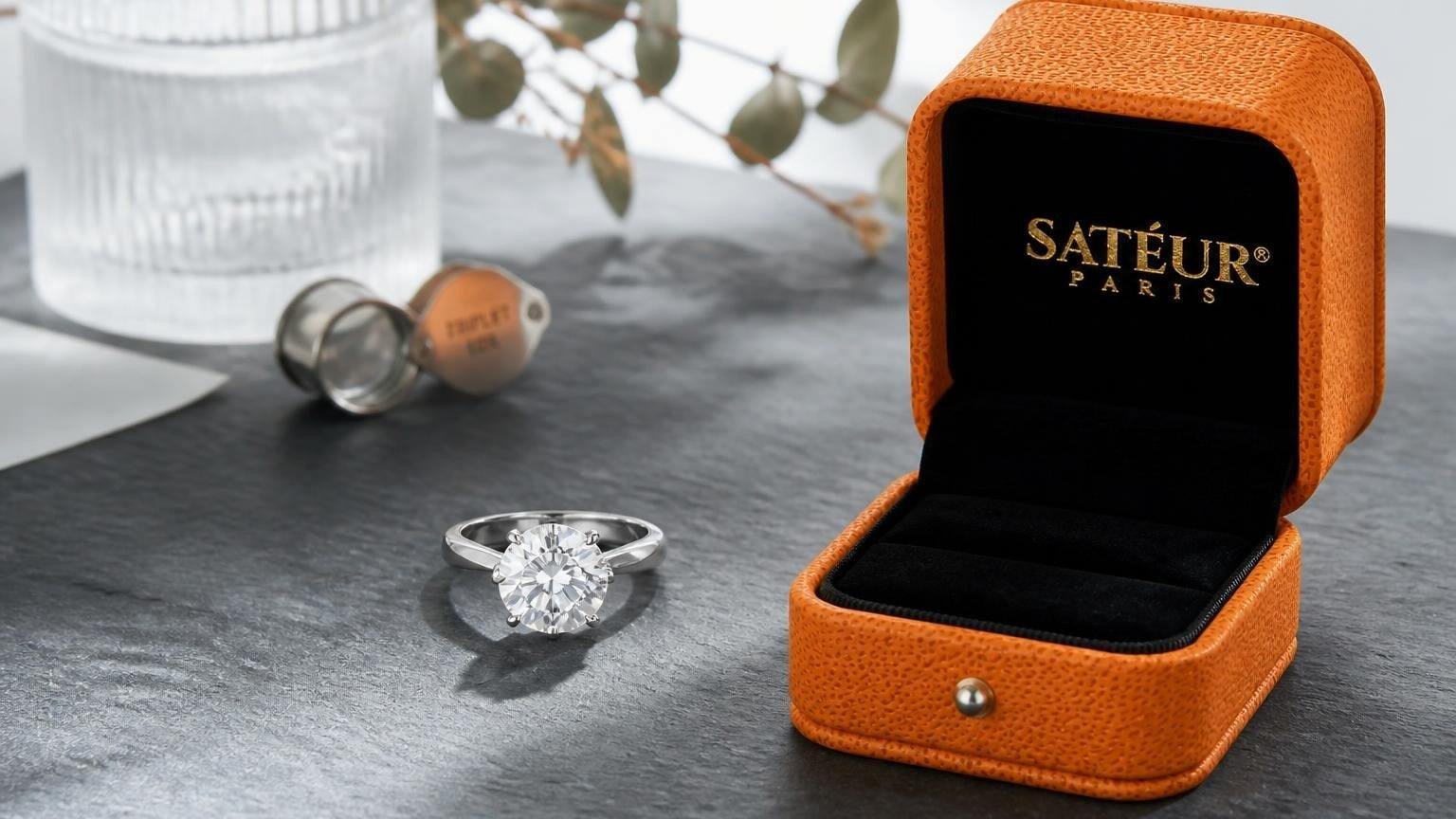
Satéur produces two distinct gem tiers. Moissanite — a lab-created gemstone with higher dispersion and 9.25 Mohs hardness, openly disclosed and chosen for its vivid fire. And Satéur Gems® — the Maison's trademarked diamond simulant, engineered to deliver the clean white brilliance of a flawless diamond. Both are graded D–E colour and cut to Excellent proportions. Both deliver eye-clean clarity as a baseline — not as a premium tier requiring extra spend.
The distinction is optical: moissanite for vivid coloured fire; Satéur Gems® for the restrained, diamond-accurate white brilliance that reads as a flawless diamond to the naked eye. The choice is a matter of preference, not compromise on quality.
Where a comparable lab diamond or mined diamond in the VS2–SI1 clarity range would cost thousands, Satéur's gems deliver the flawless-diamond look at roughly 1% of that figure — the practical expression of The New Diamond Standard. Over 100,000 customers across 150 countries have made that choice. The Satéur Destinée Ring™ — The 1% Ring® — begins the comparison with a $10,000 mined diamond and ends it at a fraction of that price, with clarity that needs no apology.
For those still weighing the decision between gemstone families, the full moissanite vs diamond vs Satéur guide covers every dimension in detail.

Clarity is one dimension. Cut is another. At the level where premium moissanite and Satéur gems operate — D–E colour, Excellent cut, eye-clean — the question is not which is clearer. It is which optical character suits the wearer. That is the decision worth making with care.
Moissanite Clarity vs Diamond FAQ
What is moissanite clarity?
Moissanite clarity refers to the absence of inclusions — internal characteristics formed during crystal growth. Premium moissanite is produced to be eye-clean, meaning inclusions are not visible without magnification under standard viewing conditions. Unlike diamonds, which span a wide clarity spectrum from Flawless to Included, top-tier moissanite is eye-clean as a baseline standard rather than a premium tier.
Is moissanite clarity better than a diamond's?
At the premium tier, moissanite is reliably eye-clean — comparable to VS1–SI1 on the diamond scale. A mined diamond at the same price point may sit in the SI range or lower, requiring careful selection to avoid visible inclusions. In that sense, premium moissanite delivers consistent eye-clean clarity that a similarly priced diamond does not always match. Moissanite's clarity is a manufacturing baseline; a diamond's clarity grade is a variable you pay to optimise.
Does moissanite have inclusions?
Yes — moissanite is a real gemstone (lab-created), and all gemstones form with some degree of internal characteristics. In premium commercial moissanite, these inclusions exist at the microscopic level but are not visible to the naked eye. They do not affect the brilliance, fire, or visual appearance of the stone at normal viewing distance.
What clarity grade is Satéur moissanite?
Satéur's moissanite gemstones are sourced at D–E–F near-colourless grade, eye-clean as standard, and set in Excellent cut proportions. Buyers receive a near-colourless, eye-clean gemstone without navigating a grading tier upgrade — the eye-clean baseline is the product, not a premium option.
Does clarity matter more in moissanite or diamond?
Clarity matters significantly more in diamond purchasing. Because mined diamonds span a wide range (FL to I3) with meaningful price differences at each tier, selecting the right clarity grade is a key part of the buying process. For premium moissanite, eye-clean is the standard — buyers focus on colour grade, cut quality, and carat size rather than navigating a clarity spectrum. The buying decision is simpler and the visual result more consistent.
Can you see moissanite inclusions with the naked eye?
In premium D–E–F moissanite at the quality used in fine jewellery, inclusions are not visible to the naked eye under normal conditions. They exist at the microscopic level, visible under 10× magnification, but they do not affect the visual appearance of the stone when worn. The practical experience is of a clean, brilliant gemstone — consistent with what the grading tier promises.

Satéur Destinée Ring™
The look of a flawless diamond — for a fraction of the price.
Compare to a $10,000 mined diamond
Joined by 100,000+ couples across 150+ countries.
Shop Satéur Destinée RingFree worldwide shipping · 30-day returns · Lifetime Satéur Care
















コメントを残す
このサイトはhCaptchaによって保護されており、hCaptchaプライバシーポリシーおよび利用規約が適用されます。