

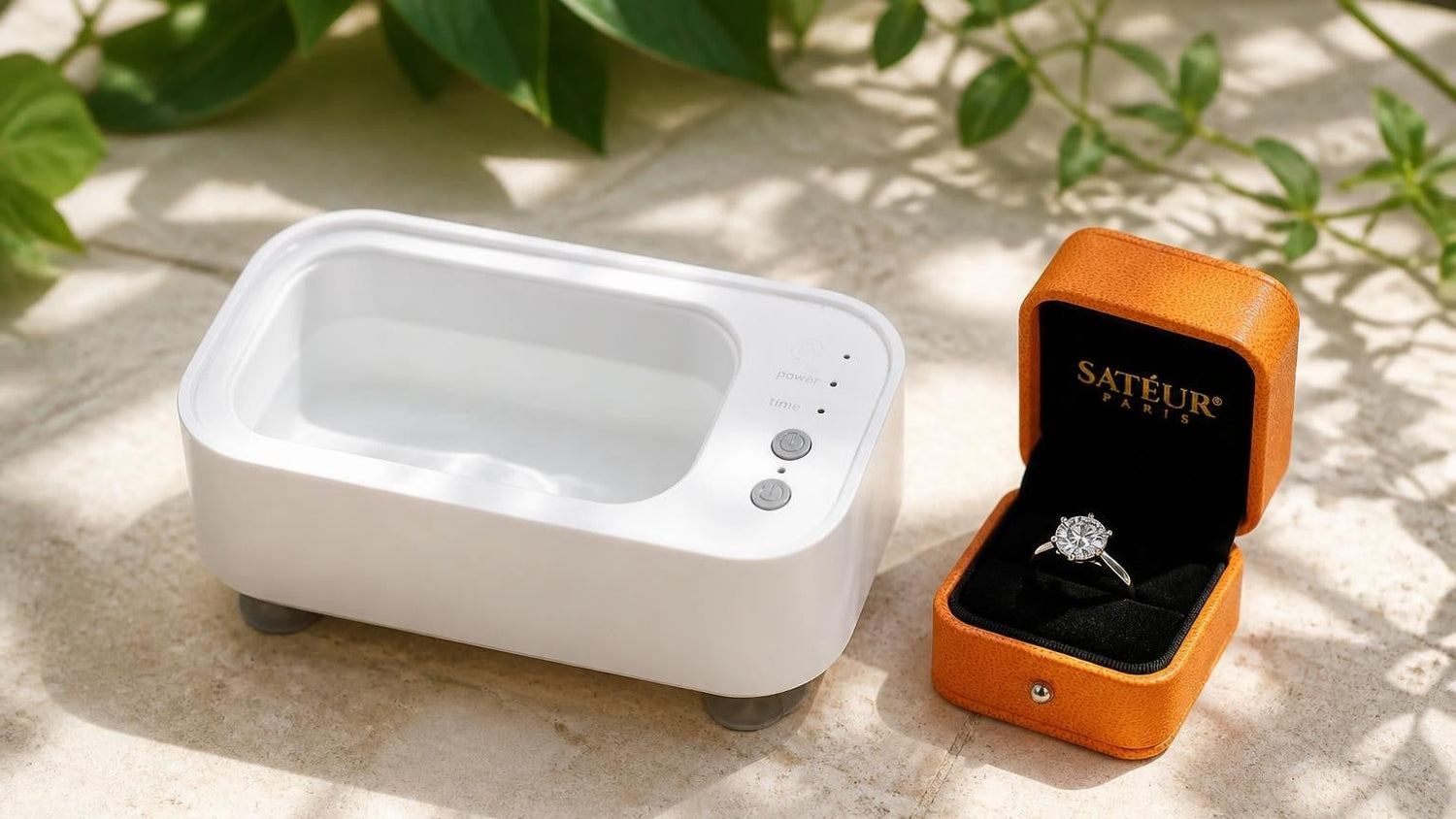
Ring Cleaner: The Complete Guide to Fine Jewelry Care
The right ring cleaner restores brilliance in minutes. The wrong one — or the wrong technique — quietly degrades the setting, dulls the finish, and shortens the life of a piece you intend to keep for decades. This guide covers every method: ultrasonic, brush-and-solution, cloth, and professional — calibrated by metal type, gemstone tier, and how often you actually wear the rings in your collection.
Whether you own a Satéur Gems® solitaire, a moissanite ring, or a classic gold band, the principles are the same. Clean often. Clean gently. Use the right tool for the right material. Satéur Gems® and moissanite are both extremely durable, built for everyday wear — but brilliance is maintained through consistent, appropriate care, not neglect. The piece you wear daily deserves a weekly routine. The piece you wear occasionally deserves a proper clean before and after each time.
Key Takeaways
- Ultrasonic cleaners are safe for most gemstones — including Satéur Gems® and moissanite — when used with an appropriate gentle solution.
- Both Satéur Gems® and moissanite are extremely durable and built for everyday wear; consistent cleaning preserves their brilliance for life.
- 18k gold finish settings clean best with warm water, a drop of mild dish soap, and a soft-bristle brush — never abrasive cloths or harsh solvents.
- Micro-scratches accumulate on any gemstone over time; weekly gentle brushing significantly reduces the need for deep cleaning sessions.
- Professional cleaning every 6–12 months catches prong wear and setting shifts that home care cannot detect.
- Entry-level Satéur fine jewellery begins at approximately $88 — making regular professional care economically viable as a standing habit.

Jewelry Cleaning Essentials
Every ring cleaner method sits on a spectrum from daily habit to periodic deep clean. Understanding the spectrum prevents over-cleaning — which stresses metal joints and solder points — and under-cleaning, which lets oils, soaps, and lotion residue cloud the gem's crown and table facets over time. The goal is a consistent routine, not an occasional rescue operation.
The four categories every fine jewellery owner should know:
- Soft-bristle brush and warm soapy water. The universal baseline. Works on every metal and most gemstones. A child's toothbrush, a dedicated jewellery brush, or a clean cosmetic brush all serve the function equally well. Use a small drop of pH-neutral dish soap in warm — not hot — water. Brush gently under and around the setting, where oils and hand-cream residue accumulate most heavily. A 2–3 minute soak followed by brushing removes the majority of daily build-up on most rings.
- Ultrasonic cleaners. Use high-frequency sound waves to agitate a water-and-solution bath, dislodging debris that manual brushing misses. Safe for most gemstones with a Mohs hardness above 7 — including diamonds, lab diamonds, moissanite, and Satéur Gems®. Not suitable for emeralds, opals, pearls, or heat-treated stones. A 3–5 minute cycle with the appropriate cleaning solution is the overall standard for home use.
- Polishing cloth. A jewellery-specific microfibre cloth with an embedded polishing compound removes surface oxidation from silver settings and restores mild lustre to gold. Not a substitute for solution cleaning — it addresses the metal surface only, not the gem or the setting's recesses. Use it as a quick refresh between proper wet cleans, not as a replacement for them.
- Professional ultrasonic and steam. What a jeweller's workshop offers: commercial-grade ultrasonic at higher frequencies, followed by a steam jet that reaches inside the setting at angles a home unit cannot. Reserved for annual or biannual maintenance, or when rings have been neglected for an extended period. The overall value lies as much in the inspection as in the cleaning itself.
For a detailed step-by-step on the ultrasonic method, see four easy steps to sparkling jewellery with an ultrasonic cleaner. For a broader comparison of the best jewellery cleaners available, the best jewellery cleaner guide covers the full landscape of solutions and units. Browse the complete Satéur jewellery cleaner collection for a practical starting point.
Why Fine Jewelry Needs Proper Care
A gemstone does not lose its optical properties through wear. What changes is the surface environment around it. Skin oils, hand creams, hairsprays, and household soaps create a thin film on the crown and pavilion facets — the surfaces responsible for light entry and reflection. A clouded crown scatters light before it reaches the gem's interior, dimming brilliance without touching the gem itself. Clean the surface, and the full optical performance returns immediately.
The same physics apply to the metal setting. 18k gold finish accumulates micro-abrasions from daily contact with surfaces, clothing, and other pieces stored together. Silver oxidises when exposed to humidity and the trace sulphur compounds present in the atmosphere. Neither of these is a defect — they are the natural behaviour of metal in daily use. The maintenance protocol exists to stay ahead of build-up, not to recover from years of neglect.
Micro-scratches on any gemstone accumulate over time. Weekly gentle brushing with soft bristles removes loose surface debris before it has the opportunity to grind against facets during normal wear — significantly reducing the frequency of deeper cleaning required. Think of it like wiping a camera lens: you do not wait until you cannot see through it. Ten minutes a week saves hours of remediation later.
For anyone building a fine jewellery collection — whether starting with The 1% Ring® or adding pieces over years — a consistent cleaning habit is the single highest-return maintenance practice available.
Cleaners Safe for Diamond Simulants
The term ring cleaner covers a wide range of products — from professional ultrasonic units to spray-and-wipe solutions sold at department stores and grocery chains. Not all are safe for diamond simulants, and the distinction matters for anyone who owns a Satéur piece.
Satéur Gems® carry D–E colour grading — the same range as the finest mined diamonds. Maintaining that colour appearance requires care protocols that protect the gem's surface integrity. Ammonia-based cleaners, common in many commercial jewellery cleaners and glass cleaners, can attack certain surface treatments on metals and compromise joint integrity over time. Alcohol-based solutions dry out the micro-joints in prong settings. Bleach and chlorine — including residual chlorine in swimming pools and some household cleaning sprays — degrade prong settings faster than most other household substances.
What is safe for Satéur Gems® and moissanite rings:
- Warm water with a small amount of pH-neutral dish soap — no citrus-enzyme or antibacterial formulas
- Dedicated jewellery cleaning solutions with a verified neutral pH
- Ultrasonic cleaners used with a mild solution — not plain tap water, which lacks the surfactant action to break down surface oils effectively
- Dry polishing cloths for the metal band, used gently and not drawn directly across the gem's table facet
What is not safe, and what many owners use without realising: toothpaste (silica abrasive), baking soda in water (mildly abrasive, unpredictable pH), commercial spray cleaners with ammonia, and acetone. The damage is cumulative — a single use rarely produces visible harm, but the habit over months produces results that can look permanent.
Satéur's moissanite tier is worth a note here. Moissanite carries a Mohs hardness of approximately 9.25 and is known for its vivid fire — it returns more rainbow-dispersed brilliance than a diamond, at approximately 2.4 times the fire dispersion, visible at specific light angles to the naked eye. This fire is a function of moissanite's distinct optical properties and is unaffected by cleaning; it simply needs the same consistent care protocol as any hard gemstone to remain visible through an unobstructed surface.
Metal-Specific Cleaning Methods
The gemstone and the metal setting often require slightly different approaches within the same overall cleaning session. Treating them as a single unit leads to under-care for one or over-care for the other. Knowing what the metal can and cannot tolerate is the key to protecting the piece as a whole.
18k Gold Finish
Satéur pieces are set in 18k gold finish — a layer of genuine 18k gold applied over a sturdy base metal. The cleaning protocol is identical to solid gold: warm water, a small drop of mild dish soap, a soft brush, and gentle drying with a lint-free cloth. Avoid abrasive cloths or polishing compounds, which accelerate surface wear on the finish. A standard ultrasonic cycle of 3–5 minutes at normal intensity is appropriate; extended high-power cycles add no cleaning benefit for gold-finish rings.
Silver and White Gold
Sterling silver oxidises more rapidly than gold. A polishing cloth with a mild silver-specific compound removes the oxidation from the surface in minutes. For deeper cleaning of the setting's recesses, a warm soapy soak followed by a soft brush works well. Run a heavily oxidised silver piece through ultrasonic only after removing the oxidation manually — the cavitation distributes residue into recesses rather than extracting it if the surface tarnish is still present.
Rose Gold Finish
Rose gold's copper content makes it marginally more reactive than yellow gold alloys. The warm-soapy-water protocol applies equally here. Avoid extended soaking beyond 10 minutes, as prolonged water exposure can affect certain solder joints on fine rings. Dry immediately after cleaning and store in a soft pouch or in the original Satéur box, which prevents contact with other pieces between wears.
A useful overall rule across all metals: the gentler the cleaning method, the more frequently it can be applied. Reserve the ultrasonic for a deeper weekly or monthly clean. Use the brush and soapy water as many times as the week requires without hesitation.
Satéur Gems Care and Maintenance
Satéur Gems® is the Maison's trademarked flagship gemstone — a lab-crafted gem engineered for the clean, white brilliance of a flawless diamond. It carries D–E colour grading and is extremely durable, built for everyday wear. The care protocol is straightforward and requires no specialist knowledge beyond the principles outlined in this guide.
Weekly care: a 2–3 minute soak in warm soapy water, followed by gentle brushing with a soft jewellery brush under the setting — paying particular attention to the area beneath the gem where oils collect — then a rinse under clean water and immediate drying with a soft lint-free cloth. This is sufficient to maintain full brilliance between deeper cleaning sessions for rings worn daily.
Monthly care: a 3–5 minute ultrasonic cycle with a mild solution in the Satéur® Ultrasonic Jewelry Cleaner (2nd Generation). The ultrasonic wave reaches the setting's recesses — the prong seats, the basket channel, and the girdle area — where a manual brush cannot. After the cycle, rinse in clean water and dry thoroughly before storing.
What to avoid: abrasive compounds, toothpaste, acetone, bleach, and any solution containing chlorine. Apply perfume and hairspray before putting on the ring, never after. Store the piece in the original Satéur orange box when not in use — the velvet interior prevents contact with other pieces, and the snug fit limits humidity exposure between wears.
Satéur Gems® display the diamond-accurate brilliance that defines The New Diamond Standard® — a clean white light return that reads as a flawless diamond across the table and to the naked eye. Maintaining this appearance is a matter of keeping the crown and table facets free of the bio-film that daily wear deposits. The gem itself requires no chemical treatment and no specialist restoration. The protocol above is the complete picture.

How Often Should You Clean Fine Jewelry?
The appropriate cleaning frequency depends directly on how the piece is worn. A ring worn daily — hands in water, contact with lotions and soaps throughout the day — accumulates surface film significantly faster than rings worn occasionally for evenings or events. Calibrate the routine to the use pattern, not to a generic schedule.
A practical framework for rings at different levels of use:
- Daily-wear rings: a quick brush in warm soapy water once a week; a full ultrasonic cycle once a month. This combination keeps brilliance at its peak and prevents cumulative build-up that requires more aggressive cleaning to reverse.
- Occasional-wear pieces: brush before each wear; full ultrasonic cycle every 2–3 months. The pre-wear clean removes any storage dust; the periodic cycle handles use accumulation across all rings in the occasional rotation.
- Stored pieces: clean before extended storage; clean again when returning to rotation. A piece stored dirty can develop surface deposits that are harder to remove after months in a box.
- Professional cleaning: every 6–12 months for daily-wear rings. The overall purpose of the professional visit is the structural inspection — not to achieve a cleanliness standard the home routine cannot reach.
The most common mistake is waiting until brilliance is visibly diminished before cleaning. By that point, the oil-and-residue layer has consolidated into a composite film that requires more time, more solution, and more physical effort to dissolve. Weekly light cleaning is always the lower-effort option over time — not the higher one. Ten minutes each week is a better use of time and money than a quarterly restoration session.
Can You Use Ultrasonic Cleaners on All Gemstones?
No — and this is the single most important safety distinction in at-home jewellery care. Using an ultrasonic cleaner on the wrong gem type can cause damage that is not immediately visible but is permanent.
Ultrasonic cleaners work through cavitation: the rapid formation and collapse of microscopic bubbles in a liquid bath, creating pressure waves that dislodge debris from surfaces and recesses. For hard, structurally stable gemstones, this process is entirely safe and effective. For softer, porous, or fracture-filled gemstones, the same pressure waves can propagate through internal fractures and cause internal cracking or expand existing inclusions.
Safe in ultrasonic cleaners (Mohs 7 or above, structurally stable): diamonds, lab diamonds, moissanite, Satéur Gems®, sapphire, ruby, amethyst, topaz, aquamarine, and most standard-cut clear gemstones.
Not safe in ultrasonic cleaners: emeralds (routinely fracture-filled with resin), opals (water-sensitive and thermally fragile), pearls (organic and porous), turquoise, coral, amber, tanzanite (thermal sensitivity under cavitation heat), and any gemstone described as treated, enhanced, or oil-filled.
Satéur Gems® and moissanite are both comfortably in the safe category for ultrasonic cleaning. Both are extremely durable, built for everyday wear and standard cleaning methods, and withstand repeated ultrasonic cycles without degradation to surface quality or optical properties.
The key variable beyond the gemstone itself is the solution used in the cleaning bath. Plain water is a poor medium for this use — its surface tension prevents effective penetration into the micro-spaces around prongs and settings. Use a jewellery-specific cleaning solution at the manufacturer's recommended concentration. More solution does not clean better; it increases the risk of residue deposits on the pieces being cleaned.
What Happens if You Use the Wrong Cleaner?
The effects are gradual and often invisible until a meaningful amount of damage has accumulated. This is precisely why cleaning protocols matter before a problem is apparent — not after it is visible.

Ammonia on gold-finish settings: repeated exposure over time can thin the gold-finish layer prematurely and weaken the solder at prong joints. Small prongs on fine-stone rings are particularly vulnerable — the cross-section is thin by design. A loose prong is not a cosmetic issue; it risks losing the gem from the setting entirely, and it is the kind of damage a professional inspection catches before failure rather than after.
Abrasive compounds on gem surfaces: toothpaste, baking soda, and household scouring powders all contain abrasives fine enough to produce micro-scratches on gem facets. On a flat crown facet, this creates a diffusion layer — light scatters at the surface rather than entering the gem cleanly, and the gem appears permanently cloudy even when otherwise clean. The scratch cannot be reversed at home; it requires professional polishing of the facet surface.
Bleach and chlorine on prong settings: chlorine attacks the alloys used in gold settings. White gold, which typically contains palladium or silver in the alloy, is particularly susceptible. The metal weakens at the prong tips where the cross-section is thinnest. This risk is not limited to swimming pools — certain household sprays contain bleach, and rinsing rings at a kitchen sink immediately after using a chlorine-based cleaner provides sufficient repeated exposure to weaken prong tips over time.
Ultrasonic at inappropriate intensity on the wrong gemstone: as described above, emeralds, opals, and treated stones can fracture under cavitation pressure. When there is any uncertainty about a gem's identity or treatment status, use the brush-and-soak method. It is always safe across all gem categories, regardless of what the collection contains.
Does Professional Cleaning Differ from At-Home Care?
The cleaning result from a professional jeweller's service is not categorically superior to what a quality home ultrasonic unit achieves. What differs significantly is the assessment component — and that distinction makes the professional visit worthwhile on a regular basis regardless of how diligently the home routine is maintained.
A jeweller's cleaning appointment includes a visual inspection under magnification: prong check, setting security, surface condition of the metal, and any structural concerns across all pieces presented. None of these are visible to the naked eye. A prong that has worn thin over two years of daily contact with surfaces looks identical to a new prong without magnification. A hairline crack in a solder joint is invisible at normal viewing distance until the joint fails.
The practical recommendation: clean at home consistently with a quality ultrasonic unit, and schedule a professional inspection every 6–12 months. The cleaning itself can be done at home to the same optical standard as a professional session. The inspection cannot — and the inspection is the more valuable of the two services a professional appointment provides.
Entry-level Satéur fine jewellery begins at approximately $88. At this price point, the economics of professional care make it a straightforward standing habit rather than an occasional consideration. A piece cleaned and professionally inspected annually will maintain its condition for as long as the wearer intends to keep it.
Should Fine Jewelry Be Insured?
Insurance sits in a different category from cleaning — but the two connect through documentation and demonstrated care. Any insurance claim for fine jewellery requires proof of value and condition. A piece that has been consistently maintained, cleaned on a regular schedule, and photographed at intervals has a significantly stronger claim basis than one presented without a care record.
For rings valued above a few hundred pounds, a standalone jewellery rider on a home insurance policy is typically the most cost-effective coverage. General home contents policies often cap jewellery claims at a relatively low figure that may not reflect replacement cost. A dedicated rider, based on a current written valuation, covers the specific piece at full replacement value.
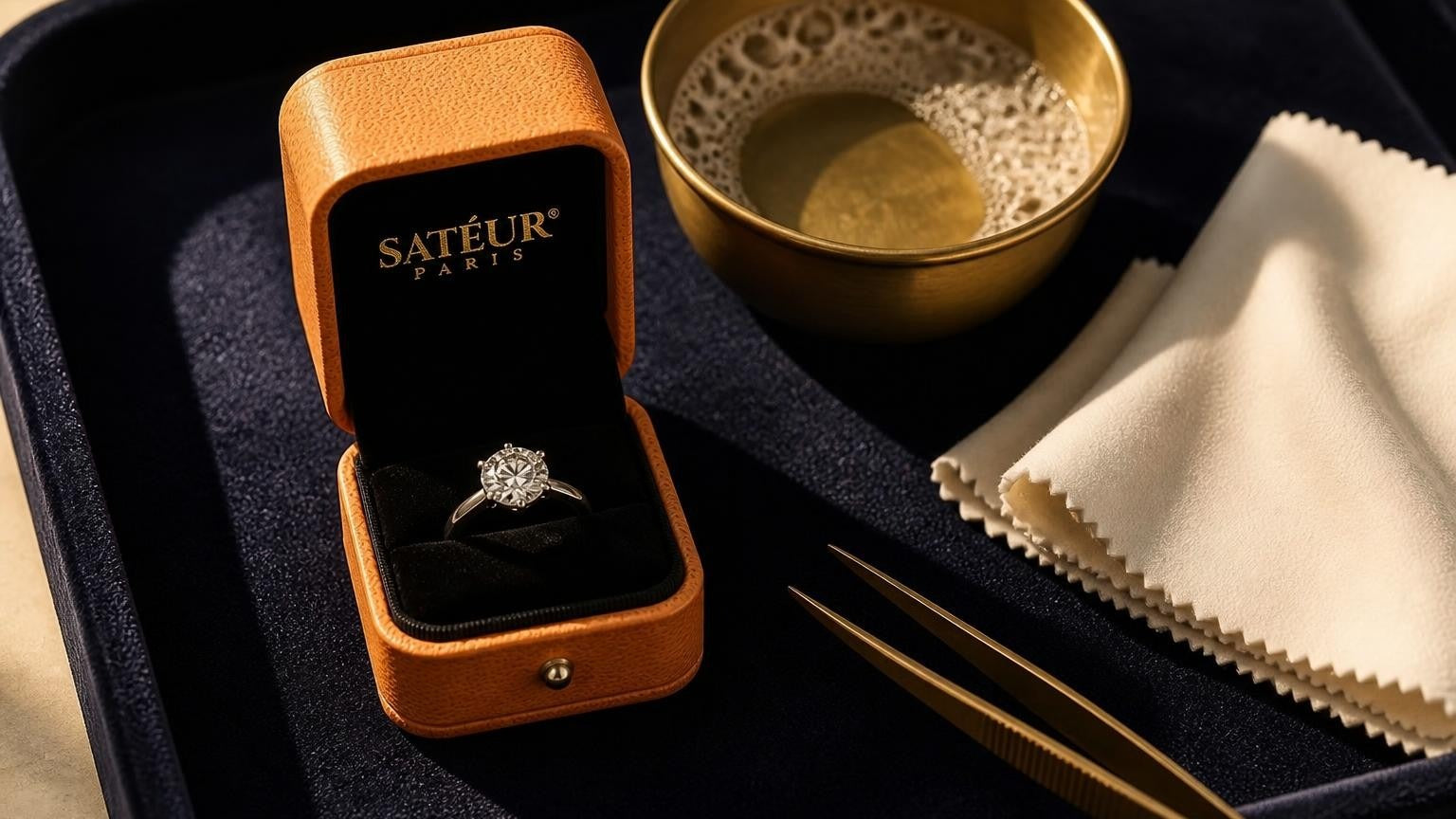
The Satéur orange box functions as part of this documentation. A ring returned to its original box after each wear, cleaned and maintained to its original condition, is demonstrably cared for — a fact that matters to insurers and, more practically, to the long-term condition of the piece itself. The box is not packaging. The habit of returning to it is the practice that compounds over time.
Fine jewellery does not lose its character through use when it is properly maintained. The pieces from the Satéur engagement ring collection and the moissanite ring collection are designed to be worn and kept — not stored. The cleaning routine is what makes that intention possible over years rather than months.
Frequently Asked Questions
How do I clean Satéur Gems at home without damage?
Soak the ring in warm water with a small drop of pH-neutral dish soap for 2–3 minutes. Gently brush the setting and the gem's crown and pavilion facets with a soft-bristle jewellery brush. Rinse under clean running water and dry immediately with a soft lint-free cloth. For a deeper monthly clean, use the Satéur® Ultrasonic Jewelry Cleaner (2nd Generation) for a 3–5 minute cycle with the appropriate solution, then rinse and dry. Avoid abrasive compounds, toothpaste, bleach, and ammonia-based cleaners — all of which cause cumulative damage to gold-finish settings and gem surfaces over time.
Which cleaning method works best for gold and silver settings?
For 18k gold finish settings, warm soapy water and a soft brush is the standard weekly routine. A dedicated polishing cloth addresses surface lustre between wet cleans. For silver settings, a polishing cloth removes surface oxidation in minutes; a warm soapy soak and brush removes deeper build-up in the setting's recesses. Avoid ultrasonic cleaning for heavily oxidised silver — remove the oxidation manually first, then use the ultrasonic for regular maintenance cleaning going forward.
Can I use the same cleaner for all gemstones in my collection?
No. A mild soapy solution is safe for most hard gemstones — diamonds, moissanite, Satéur Gems®, sapphires, rubies — but not for emeralds, opals, pearls, or treated stones. Ultrasonic cleaners are similarly selective: safe for Mohs-7-and-above stable gemstones, potentially damaging for softer or fracture-filled gems. If your collection spans multiple gem types, clean pieces separately using the appropriate method for each. When there is any doubt about a gemstone's identity or treatment status, the warm-water brush method is always safe across all categories.
How often should fine jewelry be professionally cleaned?
For daily-wear rings, a professional inspection every 6–12 months is a sound practice. The primary value of a professional appointment is the structural assessment — prong check, setting security, surface condition — not the cleaning result itself. Home cleaning with a quality ultrasonic cleaner achieves an equivalent optical result. The professional visit catches wear and structural issues that home inspection cannot identify without magnification: worn prong tips, hairline solder cracks, and setting shift.
What household items should I avoid when cleaning fine jewelry?
Avoid toothpaste (silica abrasives scratch gem surfaces and gold-finish metals), baking soda (abrasive and unpredictable pH), bleach and chlorine-based household cleaners (degrade gold alloys and weaken prong joints over time), acetone and nail-polish remover (attack adhesives used in certain settings), and perfume or hairspray applied while the ring is worn. These are the items most commonly used without an awareness of the cumulative damage they produce across months of regular use.
Does regular cleaning affect the longevity of gemstones or metal settings?
Regular gentle cleaning prolongs both. It prevents the accumulation of abrasive film that, when dragged across facets during normal wear, creates micro-scratches over time. It also prevents the gradual build-up of oils in prong seats, which can cause metal to shift slightly under the gem over extended periods. The materials that pose a genuine risk to longevity are the wrong chemicals — not the act of cleaning itself, carried out consistently with appropriate tools and appropriate solutions.
The intelligence of a fine ring begins with its design. It compounds through how you maintain it. Consistent, appropriate cleaning — matched to the metal, the gemstone tier, and the frequency of wear — is the quiet habit that keeps a piece in the condition it was made for.

Satéur® Ultrasonic Jewelry Cleaner (2nd Generation)
Restore your ring's full brilliance at home in minutes.
Compare to a $10,000 mined diamond
Joined by 100,000+ couples across 150+ countries.
Shop the Ultrasonic CleanerFree worldwide shipping · 30-day returns · Lifetime Satéur Care

















コメントを残す
このサイトはhCaptchaによって保護されており、hCaptchaプライバシーポリシーおよび利用規約が適用されます。