

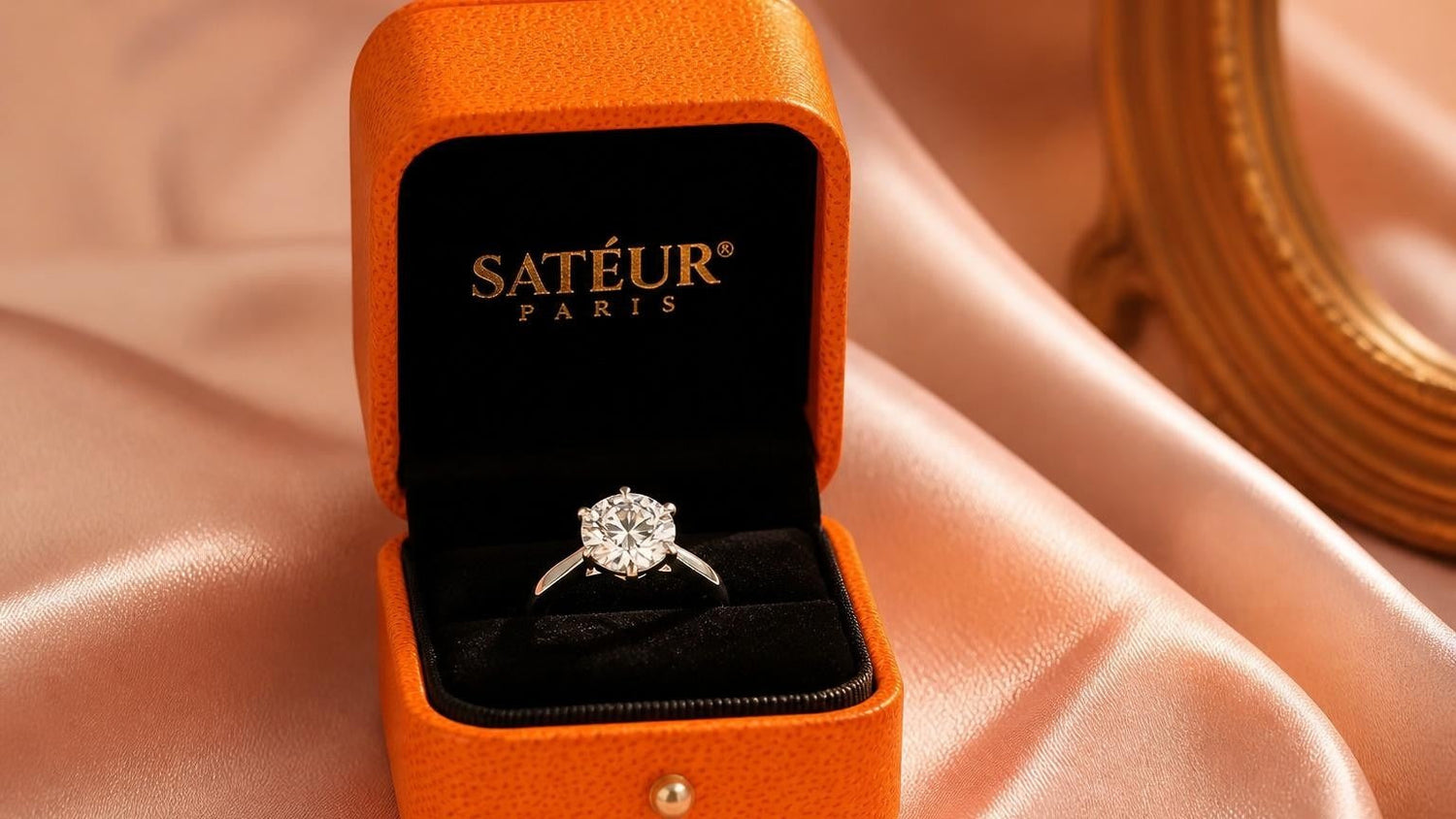
Engagement Ring Budget: How Much Should You Really Spend?
The average engagement ring budget in the United States is approximately $5,200 — a figure that covers a vast range of real spending, from under $500 to well above $50,000. What you spend is less a financial rule and more a personal decision, shaped by income, values, and what the ring is meant to represent. This guide gives you the framework to decide for yourself: data on average costs, stone choices, and how selecting the right gemstone can unlock the diamond look at a fraction of traditional pricing. For the full market picture, our average engagement ring cost guide covers category-wide spending data.
Key Takeaways
- The average engagement ring cost in the USA is approximately $5,200 in 2024, down from $5,500 in 2023.
- The "two months' salary" rule is a marketing invention from the 1980s, not a financial guideline.
- Stone choice — mined diamond, lab diamond, or diamond simulant — can reduce ring cost by 50–90%.
- Satéur engagement rings begin at approximately $138; Gems® delivers D-E colour, diamond-accurate brilliance at roughly 1% of mined diamond pricing.
- A practical budget targets 1–3% of annual household income, adjusted for existing financial commitments.
How Much Should You Spend on an Engagement Ring?
There is no universal answer. The question depends on three variables: your household income, your current financial commitments, and what both partners actually value in a ring.
The most honest framework is this: spend an amount that does not create financial strain entering a marriage. A ring purchased on credit at high interest, or at the cost of an emergency fund, is not a symbol of love — it is a liability. The ring matters. The debt that follows it should not define your first year together.
A reasonable starting point is 1–3% of annual household income. On a $70,000 income, that is $700–$2,100. On $120,000, it is $1,200–$3,600. These are ranges that allow for a genuinely beautiful ring without financial compromise. They also recognise that ring budget is only one of many financial decisions a couple makes in the year surrounding an engagement.
Two-Month Salary Method
The "two months' salary" guideline is the most cited engagement ring budget benchmark — and the most misunderstood. It was popularised by De Beers in a 1980s advertising campaign designed to increase diamond sales, not by financial planners or jewellers.
In 2026, the median individual salary in the US is approximately $56,000, making "two months" roughly $9,300. Most couples spend considerably less. The benchmark persists because it served the industry, not because it reflects what partners want or what is financially sound.
Use it as a data point, not a directive. Some couples spend far less and prioritise a home deposit or financial security. Others spend more because a particular ring carries deep personal significance. Both choices are entirely valid. The rule was never yours to follow.
Average Engagement Ring Cost in 2026
Average engagement ring costs vary by region, culture, and stone choice:
| Region | Average Spend (2024) | Average Diamond Carat |
|---|---|---|
| United States | ~$5,200 | ~1.10 ct |
| United Kingdom | ~£2,800 | ~0.70 ct |
| Australia | ~AU$5,500 | ~0.80 ct |
| Canada | ~CA$5,800 | ~0.85 ct |
US shoppers seek approximately 1.10 carats on average; Commonwealth shoppers lean closer to 0.70 carats. The difference is cultural rather than purely economic — American engagement culture evolved under heavier diamond industry marketing pressure during the mid-twentieth century.
Averages also obscure the distribution. A small number of very expensive rings pull the mean upward. The median spend in the US is typically lower — closer to $3,500–$4,000. Half of all US couples spend below that threshold.

Diamond Size and Price Breakdown
Carat weight is the most significant driver of mined diamond pricing. The relationship is not linear — prices increase sharply at psychological thresholds (1.00 ct, 1.50 ct, 2.00 ct) because demand clusters at round numbers.
| Carat Weight | Mined Diamond (D-F, VS) | Lab Diamond (D-F, VS) | Satéur Gems® Simulant |
|---|---|---|---|
| 0.50 ct | $1,800–$3,500 | $300–$600 | from $138 |
| 1.00 ct | $5,000–$12,000 | $800–$2,000 | from $138 |
| 1.50 ct | $10,000–$22,000 | $1,500–$3,500 | from $188 |
| 2.00 ct | $18,000–$40,000 | $2,500–$5,500 | from $248 |
Cut quality matters as much as carat weight for how a ring actually performs. A well-cut 0.80 ct stone outperforms a poorly cut 1.20 ct stone in everyday brilliance. When evaluating your ring budget against visual outcome, prioritise cut grade over chasing a carat threshold.
Metal choice also contributes to total cost. Platinum adds $300–$800 over 18k white gold finishing for the same setting silhouette. For most wearers, 18k white gold delivers an indistinguishable look in daily wear at a meaningfully lower price.
Why Stone Choice Impacts Your Budget
Stone choice is the single largest lever available in engagement ring budgeting. Choosing between a mined diamond, a lab-created diamond, or a diamond simulant can shift total ring cost by 50–90% while maintaining the same visual presence and durability in everyday wear.
Three categories define the current market:
- Mined diamonds — extracted from the earth, priced at a premium that reflects rarity, supply chain, and decades of marketing. GIA or AGS certified. Resale value exists but is consistently lower than retail suggests.
- Lab-created diamonds — chemically and optically identical to mined diamonds, IGI-certified, grown in a controlled environment. Prices have fallen dramatically over the past five years and continue to decline as supply increases. Satéur's lab-grown diamond collection offers IGI-certified stones for couples who want the real thing without the mined markup.
- Diamond simulants — engineered gemstones designed to replicate the look of a flawless diamond. Not chemically diamonds, but visually compelling and extremely durable. The category includes moissanite and trademarked simulants such as Satéur Gems®.
For couples working within a defined engagement ring budget, lab-created diamonds and high-quality simulants open the full design range — solitaire, halo, three-stone — at a fraction of traditional mined diamond pricing. The comprehensive engagement ring cost guide covers how each stone tier affects total spend across setting styles.

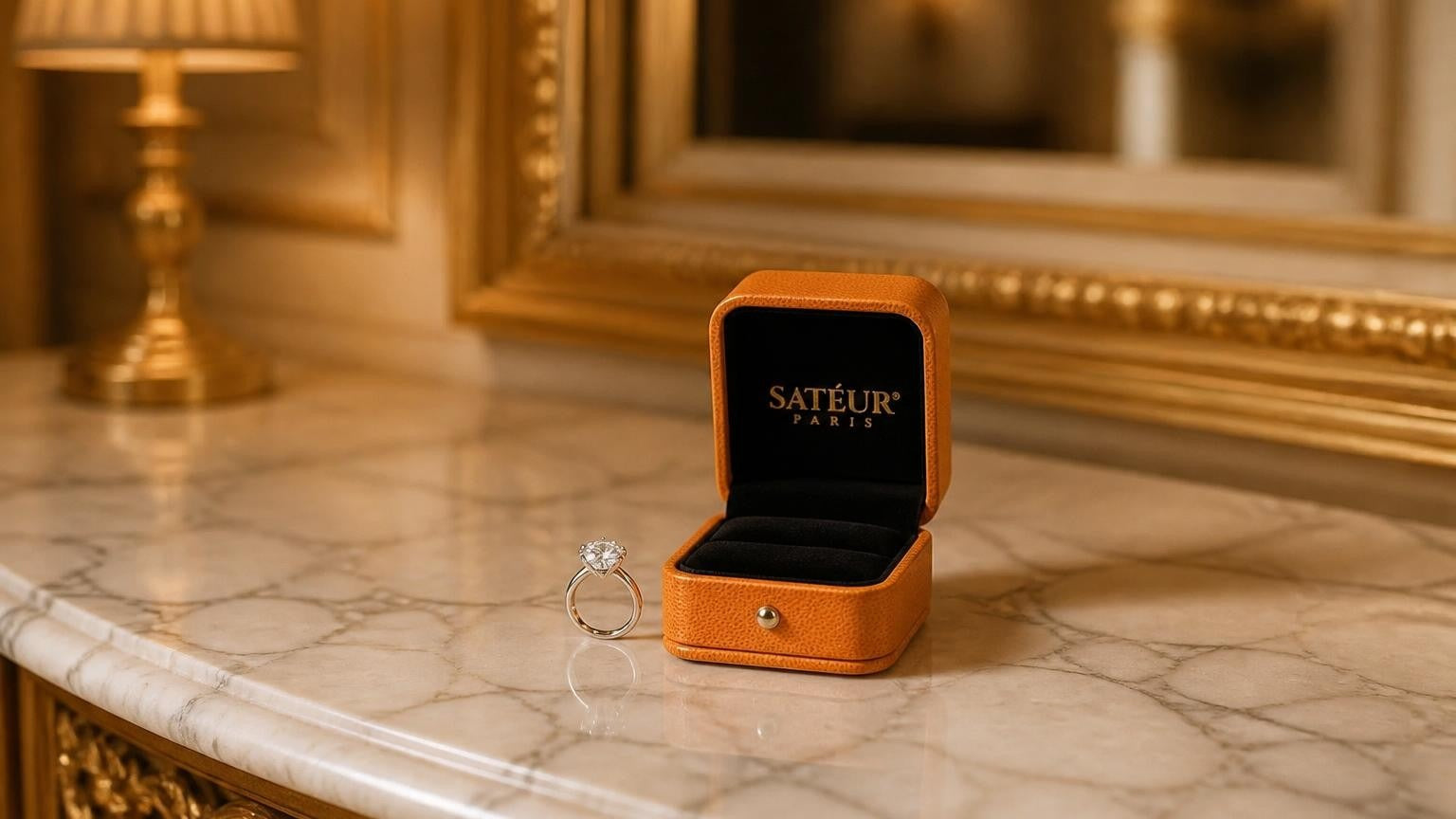
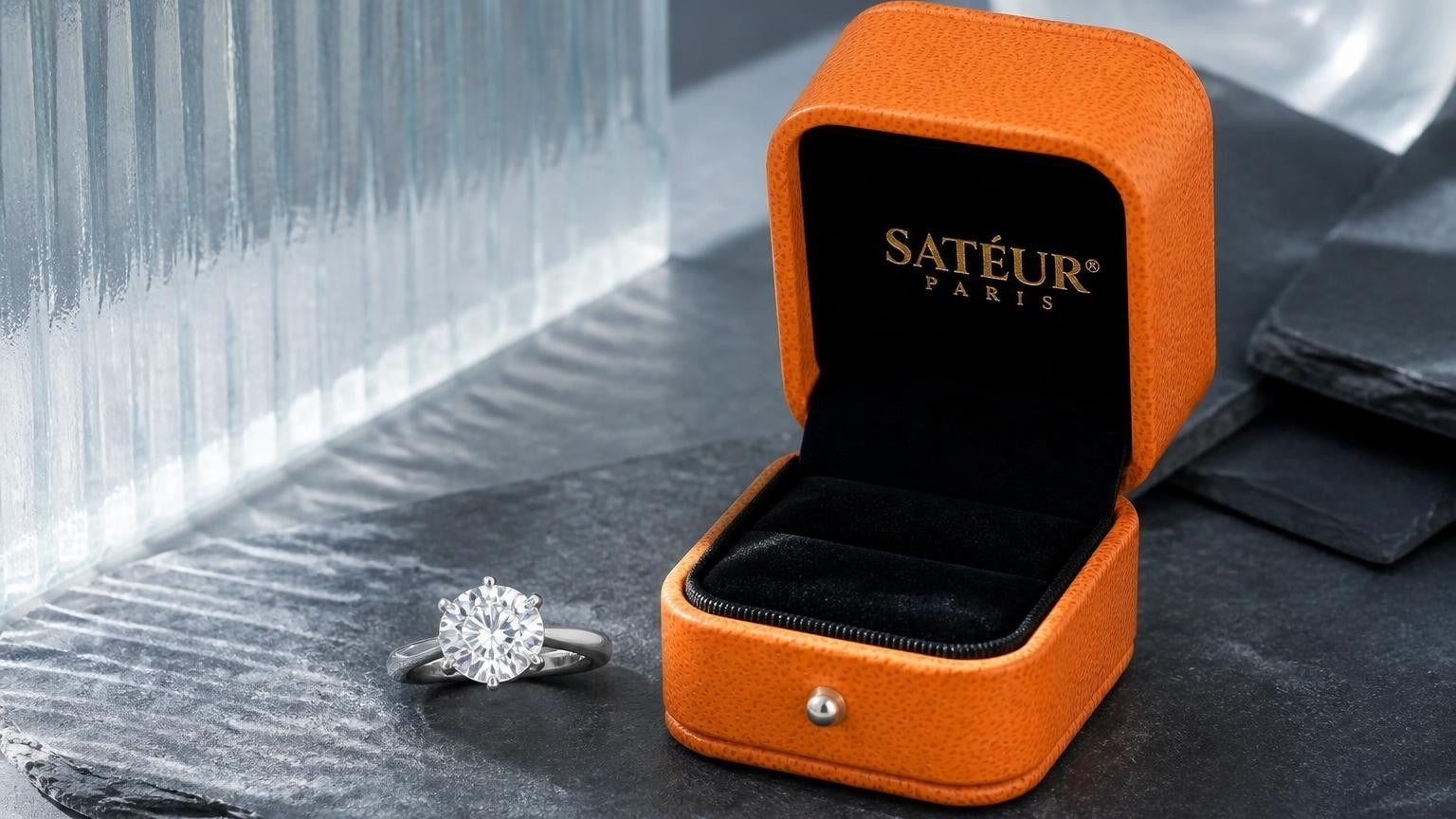
Satéur Destinée Ring™
The look of a flawless diamond, for approximately 1% of the price.
Compare to a $10,000 mined diamond
Joined by 100,000+ couples across 150+ countries.
Discover The 1% RingFree worldwide shipping · 30-day returns · Lifetime Satéur Care
Satéur Gems: Diamond-Look Value at 1% Cost
Satéur Gems® is a trademarked diamond simulant engineered to replicate the clean, white brilliance of a flawless diamond. The gemstone composition is proprietary and not publicly disclosed — what matters for the ring-buyer is what it delivers: D-E colour appearance, a 58-facet precision cut, and a Mohs hardness of approximately 8.8, making it extremely durable and built for everyday wear across a lifetime.
The visual result is diamond-accurate: the restrained, white brilliance of a fine diamond — not the vivid rainbow fire of moissanite, which has higher dispersion. Across the table and to the naked eye, Satéur Gems® reads as a flawless diamond. The 1.00 carat Destinée Ring™ — The 1% Ring® — begins at $138. The equivalent mined diamond solitaire in the same D-E, VS quality range would cost $8,000–$12,000.
That is the engagement ring budget unlock. The same presence. The same look across the table. A fraction of the financial commitment at the start of a marriage. Satéur engagement rings span from $88 at entry point to statement pieces well above $1,000 — the full engagement rings collection and The 1% Ring collection show the complete range.

Engagement Ring Budget Calculator
No online tool replaces a direct conversation between partners, but the framework below offers a practical starting point at any household income level:
| Annual Household Income | Conservative (1%) | Moderate (2%) | Generous (3%) |
|---|---|---|---|
| $40,000 | $400 | $800 | $1,200 |
| $60,000 | $600 | $1,200 | $1,800 |
| $80,000 | $800 | $1,600 | $2,400 |
| $100,000 | $1,000 | $2,000 | $3,000 |
| $150,000 | $1,500 | $3,000 | $4,500 |
| $200,000+ | $2,000+ | $4,000+ | $6,000+ |
These ranges assume no significant existing debt, a funded emergency reserve, and no upcoming large purchases such as a home deposit. If any of those apply, adjust toward the conservative end — and consider stone alternatives that deliver the same visual result at a lower price point.
The conversation matters as much as the number. Couples who discuss ring budget openly and early tend to arrive at a decision that reflects both partners' values, rather than responding to cultural pressure that was never designed with their financial wellbeing in mind.

Frequently Asked Questions About Ring Budgets
How much should I realistically spend on an engagement ring?
A realistic engagement ring budget is 1–3% of annual household income, adjusted for existing financial commitments. On a $70,000 income that is $700–$2,100. The "two months' salary" guideline is a legacy advertising benchmark from De Beers, not a financial standard. The right number is the one that does not create financial strain at the start of a marriage.
What is the average engagement ring cost in 2026?
The average engagement ring cost in the US is approximately $5,200 in 2024, down from $5,500 in 2023. The median spend is lower — closer to $3,500–$4,000 — as averages are pulled upward by a small number of high-value purchases. Commonwealth countries average closer to £2,800–AU$5,500 with smaller average carat weights.
Does an engagement ring have to feature a mined diamond?
No. Mined diamonds are one option among several. Lab-created diamonds offer the same chemical and optical properties at 60–80% lower cost. Diamond simulants such as Satéur Gems® deliver the look of a flawless diamond to the naked eye at approximately 1% of mined diamond pricing. The ring's meaning comes from the relationship, not the geological origin of its stone.
How do diamond simulants compare to mined diamonds in appearance and durability?
High-quality diamond simulants such as Satéur Gems® deliver diamond-accurate brilliance — the clean, white light return of a fine diamond — visually indistinguishable with the naked eye. Satéur Gems® measures approximately 8.8 on the Mohs hardness scale: extremely durable for everyday wear across a lifetime. Moissanite, a distinct simulant category, measures approximately 9.25 Mohs and displays more vivid, rainbow-forward fire than a mined diamond — a different aesthetic signature.
What stone options exist within a tight engagement ring budget?
Within a budget of $500–$1,500, the most practical options are: a quality moissanite solitaire from the moissanite rings collection (an openly disclosed lab-created gemstone with vivid fire), a Satéur Gems® diamond simulant ring from $138, or a smaller lab-created diamond in a classic setting. Satéur engagement rings begin from $88 for earrings and from $138 for the full solitaire ring.
How can I maximise visual impact while minimising stone cost?
Prioritise cut quality over carat weight — a well-cut 0.80 ct stone outperforms a poorly cut 1.20 ct stone in brilliance. Choose 18k white gold finishing over platinum, which looks identical in daily wear and costs $300–$800 less. Consider a diamond simulant or lab-created gemstone: Satéur Gems® delivers D-E colour, diamond-accurate appearance at approximately 1% of mined diamond cost, in a 58-facet precision cut that maximises brilliance at any ring budget.
Setting Your Ring Budget: A Practical Approach
The engagement ring is a symbol. Its value is not denominated in dollars. What it communicates is care, intention, and knowledge of the person who will wear it — not the size of the financial commitment used to acquire it.
Set your engagement ring budget in three steps. First, establish your household financial picture: income, savings, debt, and upcoming commitments. Second, decide the visual outcome you want: the carat appearance, the metal, the setting style. Third, match stone choice to that visual outcome at the budget that makes genuine financial sense — not the one a century of advertising suggests you should spend.
The modern market gives couples more choices than any previous generation. Lab diamonds, moissanite, and trademarked simulants such as Satéur Gems® have made the diamond look genuinely accessible at any budget level. For many couples, the smarter choice is a ring that looks exactly right, costs a fraction of tradition, and leaves financial room for the life that follows the proposal. That is The New Diamond Standard.
















コメントを残す
このサイトはhCaptchaによって保護されており、hCaptchaプライバシーポリシーおよび利用規約が適用されます。