

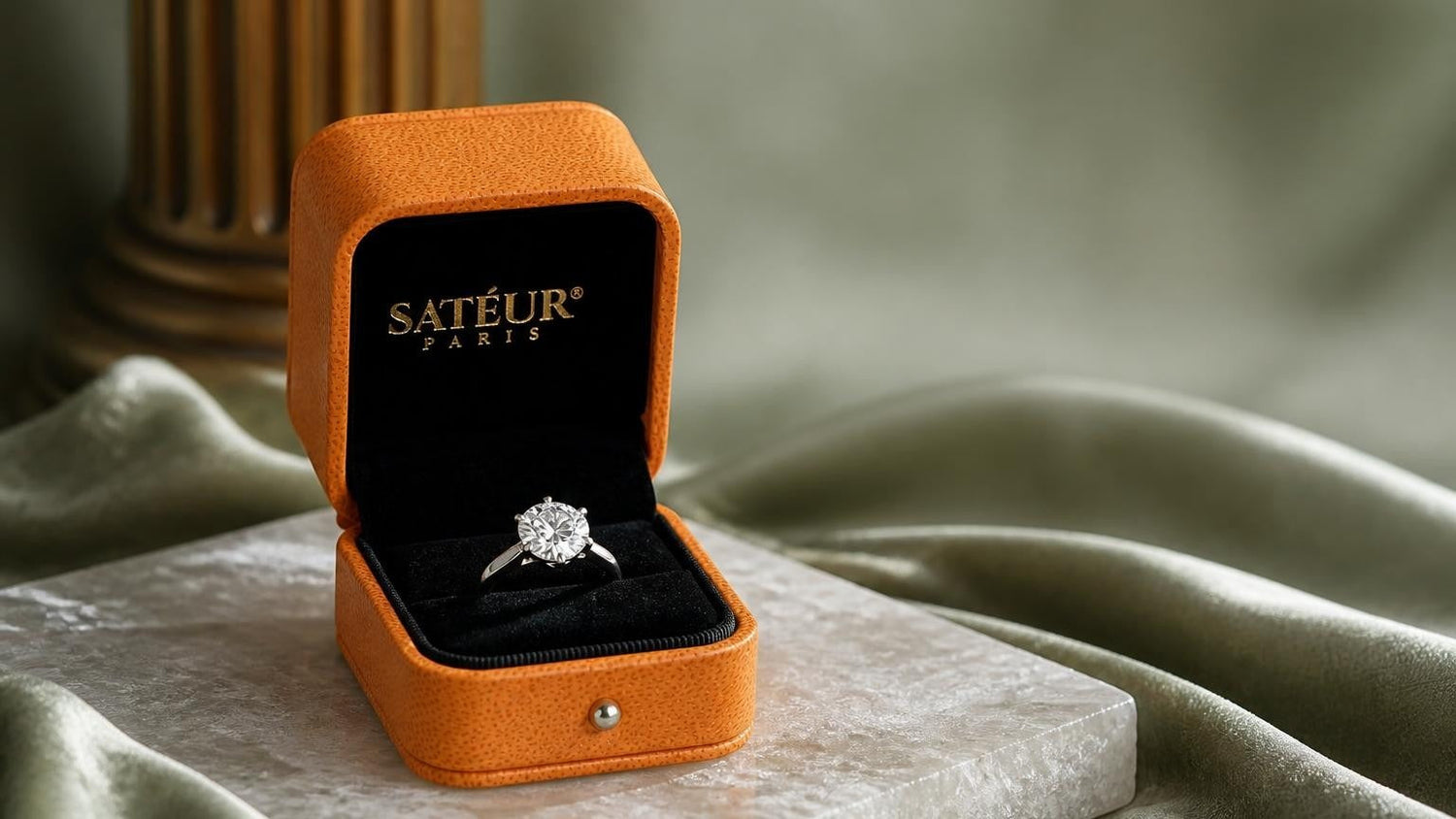
Lab Grown Diamond vs Moissanite: Key Differences and Value
The choice between a lab grown diamond and moissanite shapes the entire character of a ring — its brilliance, its feel, and its long-term story. Both stones are created in a laboratory. Both are durable. Yet they differ in chemistry, optical behaviour, and price in ways that matter.
This guide covers what separates a lab grown diamond from moissanite — and where a third option, the Satéur Gems® diamond simulant, sits for those who want the clean white look of a flawless diamond at a fraction of the cost.

Key Takeaways
- Lab grown diamonds are chemically identical to mined diamonds — rated Mohs 10, graded by IGI or GIA on the same 4C scale.
- Moissanite is a lab-created silicon carbide gemstone, Mohs 9.25, with 2.4× the fire of diamond — producing visible rainbow dispersion under direct light.
- Diamond is harder than moissanite (Mohs 10 vs 9.25), though both are exceptionally durable for everyday wear.
- Lab grown diamonds typically cost 50–70% less than mined diamonds of equivalent specs; moissanite costs less still.
- Satéur Gems® delivers the look of a flawless D-E colour diamond — clean white brilliance — from $88.
Lab Grown Diamond vs Moissanite: Key Differences
At the broadest level, a lab grown diamond is a real diamond made in a controlled environment. Moissanite is a distinct gemstone — composed of silicon carbide — that resembles a diamond but is not one.
The difference begins at the molecular level and expresses itself in the way each stone handles light, how hard each one is, and what each one costs. Understanding those three axes makes the decision straightforward.
| Property | Lab Grown Diamond | Moissanite |
|---|---|---|
| Composition | Pure carbon — identical to mined diamond | Silicon carbide (SiC) |
| Mohs Hardness | 10 (hardest known mineral) | 9.25 |
| Refractive Index | 2.42 | 2.65–2.69 |
| Fire (Dispersion) | 0.044 | 0.104 — roughly 2.4× diamond |
| Brilliance (white light) | High — clean white return | High — with rainbow colour flashes |
| Grading | IGI / GIA — full 4C certificate | Not graded on standard diamond scale |
| Typical Price (1ct equivalent) | $800–$2,500 | $250–$600 |

What Is a Lab Grown Diamond
A lab grown diamond is a genuine diamond produced in a laboratory rather than extracted from the earth. The chemical composition is pure carbon arranged in the same crystal structure as a mined diamond. There is no material difference between the two.
Lab grown diamonds are graded by IGI and GIA using the same 4C scale — cut, colour, clarity, and carat weight — applied to mined stones. A certified lab grown diamond carries a full grading report. It registers Mohs 10, the highest score on the hardness scale. It reflects white light with the clarity and precision diamond is known for.
The primary distinction from mined diamonds is cost and origin. Lab grown diamonds typically cost 50–70% less than mined diamonds of equivalent specifications. The look, durability, and grading are the same.
Browse lab created diamond rings or explore the full range of lab grown diamonds at Satéur.
What Is Moissanite
Moissanite is a lab-created gemstone composed of silicon carbide. It was first discovered naturally in meteorite fragments in 1893 by Henri Moissan. Natural moissanite is extraordinarily rare — the version sold in jewellery is grown in controlled laboratory conditions.
Moissanite is not a diamond. It does not share diamond's carbon composition or crystal structure. It is a distinct material with its own optical and physical properties — some of which are exceptional in their own right.
Its refractive index (2.65–2.69) exceeds that of diamond (2.42), which contributes to high brilliance. Its fire — measured by light dispersion — is approximately 2.4 times that of diamond. This means moissanite throws more rainbow colour under certain lighting conditions, particularly in direct sunlight or under spotlights. Whether that effect is a feature or a drawback comes down to personal preference.
Moissanite sits at 9.25 on the Mohs hardness scale. Diamond sits at 10. Both are highly resistant to scratching in everyday wear. Diamond is the harder of the two.
See Satéur's moissanite collection for current ring and earring options.
Optical and Physical Properties Compared
The most noticeable difference between a lab grown diamond and moissanite is how each stone handles light in real-world conditions.
Diamonds — lab grown or mined — return white light with high precision. The brilliance is clean. The sparkle reads as recognisably diamond-like: bright, measured, and consistent across different lighting environments.
Moissanite's higher dispersion means it splits white light into its spectral components more aggressively. Under direct or artificial lighting, moissanite produces visible rainbow flashes — fire — that diamonds do not. In diffused or ambient light, the two stones appear more similar. In direct sunlight or under spotlights, the difference becomes apparent.
For those who want a stone that reads precisely as diamond, a lab grown diamond is the closer match. For those drawn to intense fire and are comfortable with the rainbow effect, moissanite offers a compelling look.
Both stones retain their brilliance indefinitely. Neither fades, clouds, or degrades over time.

Color and Clarity in Lab Diamonds vs Moissanite
Lab grown diamonds are graded on the standard GIA colour scale, from D (colourless) to Z (noticeable yellow or brown). A well-cut lab grown diamond in the D-F range is optically colourless. IGI-certified lab grown diamonds carry the same colour designations as mined stones.
Moissanite is not graded on the same scale. Earlier generations of moissanite sometimes showed a faint yellow or grey tint, particularly in larger stones or under incandescent light. Modern moissanite is produced to near-colourless standards, marketed as DEF (colourless) or GHI (near-colourless). The grading language is not standardised in the same way as diamond grading.
Clarity follows a similar pattern. Lab grown diamonds carry formal clarity grades — from Flawless to Included — under IGI or GIA standards. Moissanite is sold as eye-clean but without a formal diamond-equivalent clarity report.
For buyers who want documented, third-party grading to a known international standard, the lab grown diamond provides that assurance. A 3 carat lab grown diamond ring, for instance, carries an IGI certificate specifying cut, colour, clarity, and carat to a precise grade.
Durability: Hardness and Longevity
Diamond — including lab grown diamond — is the hardest known natural material, rated Mohs 10. No naturally occurring mineral scratches a diamond; only another diamond can.
Moissanite sits at Mohs 9.25. It is the second-hardest gemstone used in jewellery, harder than sapphire (Mohs 9) and significantly harder than most other stones. In daily wear — exposure to surfaces, cosmetics, and minor impact — moissanite holds up exceptionally well. Visible scratching from typical activity is uncommon.
The practical difference in hardness between a lab grown diamond (Mohs 10) and moissanite (Mohs 9.25) is minimal for most wearers. Both will retain their polish and clarity over decades. Neither requires special care beyond the routine cleaning recommended for fine jewellery.
Both lab grown diamonds and moissanite retain their brilliance indefinitely. There is no degradation in optical performance with age.
Price Comparison and Long-Term Value
Lab grown diamonds cost significantly less than mined diamonds — typically 50–70% less for equivalent specifications. A 1-carat lab grown diamond might be priced between $800 and $2,500 depending on cut, colour, and clarity grade. A mined diamond of the same grade would cost $3,000 to $8,000 or more.
Moissanite is less expensive still. A 1-carat moissanite equivalent (by visual diameter) typically ranges from $250 to $600. For buyers whose primary concern is the size of the stone at the lowest possible price point, moissanite offers considerable value.
Lab grown diamonds carry the same grading infrastructure as mined diamonds. Their resale market is smaller than mined diamonds, but the certification and grading retain meaning. Moissanite has no formal resale market to speak of.
A third option — the Satéur Gems® diamond simulant — begins at $88 and delivers the look of a flawless D-E colour diamond for approximately 1% of a mined diamond's price. It occupies a different category from both lab grown diamonds and moissanite, designed not for grading credentials but for the visual result: clean white brilliance that reads as diamond at any social distance.
Explore engagement rings across all three Satéur tiers.
Satéur Gems: Diamond-Look Alternative
Satéur Gems® is a trademarked diamond simulant engineered to replicate the look of a flawless diamond. It is not a lab grown diamond. It is not moissanite. It occupies its own category — one defined by the visual outcome rather than laboratory origin.
The optical performance of Satéur Gems® prioritises clean white brilliance — the characteristic of a D-E colour diamond — rather than rainbow fire. Compared to moissanite's 2.4× dispersion, Satéur Gems® is calibrated to the white-light return that reads as diamond in normal conditions.
Satéur Gems® rings are available with an 18K gold finish across a range of designs. The Satéur Destinée Ring™ — The 1% Ring® — begins at $68. Other pieces begin at $88. The brand's positioning is straightforward: the look of a flawless diamond, for 1% of the price. This is The New Diamond Standard®.
No inspection-tool comparison is required or implied. The value is in the visual result — what the stone looks like worn at dinner, across a table, in photographs.

Satéur Destinée Diamond Ring
A real, IGI-certified lab-grown diamond, hand-set in solid 18K gold — a fraction of the mined-diamond price.
Compare to a $10,000 mined diamond
Joined by 100,000+ couples across 150+ countries.
Shop the Destinée Diamond RingFree worldwide shipping · 30-day returns · Lifetime Satéur Care
Frequently Asked Questions
What is the main difference between lab grown diamonds and moissanite?
A lab grown diamond is a real diamond — pure carbon, Mohs 10, graded by IGI or GIA on the same 4C scale used for mined diamonds. Moissanite is a separate gemstone composed of silicon carbide (Mohs 9.25) that is not a diamond. The two stones differ in chemistry, optical behaviour, and grading infrastructure. Moissanite produces more rainbow fire (2.4× the dispersion of diamond); lab grown diamonds return cleaner white brilliance that reads precisely as diamond.
Will moissanite look obviously different from a lab diamond in an engagement ring?
In ambient or diffused light, the two stones appear similar. Under direct light — sunlight, spotlights, candlelight — moissanite's higher fire produces rainbow colour flashes that are more pronounced than the white sparkle of a diamond. Whether this is noticeable depends on lighting conditions and the observer. For most social settings, both stones appear brilliant and attractive. If a clean diamond-white appearance is the priority, a lab grown diamond is the closer match.
Do lab diamonds and moissanite have the same hardness?
No. Lab grown diamonds rate Mohs 10 — the highest score on the hardness scale, the same as mined diamonds. Moissanite rates Mohs 9.25. Diamond is the harder material. Both are highly scratch-resistant and durable for everyday wear; the practical difference for most wearers is minimal. In long-term wear, however, diamond's greater hardness means it is technically more resistant to surface abrasion.
Which costs less: lab diamond or moissanite?
Moissanite costs less. A 1-carat moissanite equivalent typically ranges from $250 to $600. A 1-carat lab grown diamond in the D-F colour, VS clarity range typically falls between $800 and $2,500 — still 50–70% less than an equivalent mined diamond. For buyers whose primary goal is visual size at the lowest price, moissanite is the least expensive option among diamond-adjacent stones. Satéur Gems® diamond simulants begin at $88 and offer a different value proposition: diamond-accurate white brilliance without the grading cost.
Can a jeweler tell the difference between lab diamond and moissanite?
With the naked eye, at typical social distances, both lab grown diamonds and moissanite appear virtually indistinguishable to most observers — including most jewellers. The differences in fire and light behaviour become visible under close inspection or specific lighting. With professional gemological instruments, a trained gemologist can distinguish the two stones based on their different optical and physical properties. For everyday wear and social settings, both stones present as brilliant, high-quality alternatives to mined diamonds.
Is a lab grown diamond considered a real diamond?
Yes. A lab grown diamond is a real, genuine diamond. It shares the same carbon crystal structure, the same Mohs 10 hardness, and the same optical properties as a mined diamond. The only difference is its origin — grown in a controlled laboratory environment rather than formed underground over geological time. IGI and GIA grade lab grown diamonds on exactly the same 4C scale applied to mined stones. The Federal Trade Commission (FTC) recognises lab grown diamonds as diamonds.
Choosing Between Lab Diamond and Diamond Simulant
The decision ultimately comes down to what the stone needs to do.
A lab grown diamond is the right choice when grading credentials matter — when the buyer wants an IGI or GIA certificate specifying cut, colour, and clarity, and when resale or appraisal may be relevant. Lab grown diamonds are genuine diamonds. They carry the weight of that designation in every formal sense.
Moissanite is the right choice when maximum visual size at minimum cost is the priority, and when the distinctive fire of silicon carbide is a welcome feature rather than a concern. It is not a diamond and does not come with diamond grading, but as a standalone gemstone it is durable, brilliant, and far less expensive than any diamond tier.
Satéur Gems® occupies a distinct position. It is a diamond simulant — a stone engineered to look like a flawless diamond — sold transparently at approximately 1% of a mined diamond's price. It does not carry diamond grading because it is not a diamond. What it offers is the visual result: clean white brilliance, diamond-accurate colour in the D-E range, in settings designed for the look of fine jewellery.
For those beginning to explore, the full range of lab grown diamonds at Satéur spans multiple stone sizes and ring settings.















댓글을 남기세요
이 사이트는 hCaptcha에 의해 보호되며, hCaptcha의 개인 정보 보호 정책 과 서비스 약관 이 적용됩니다.