

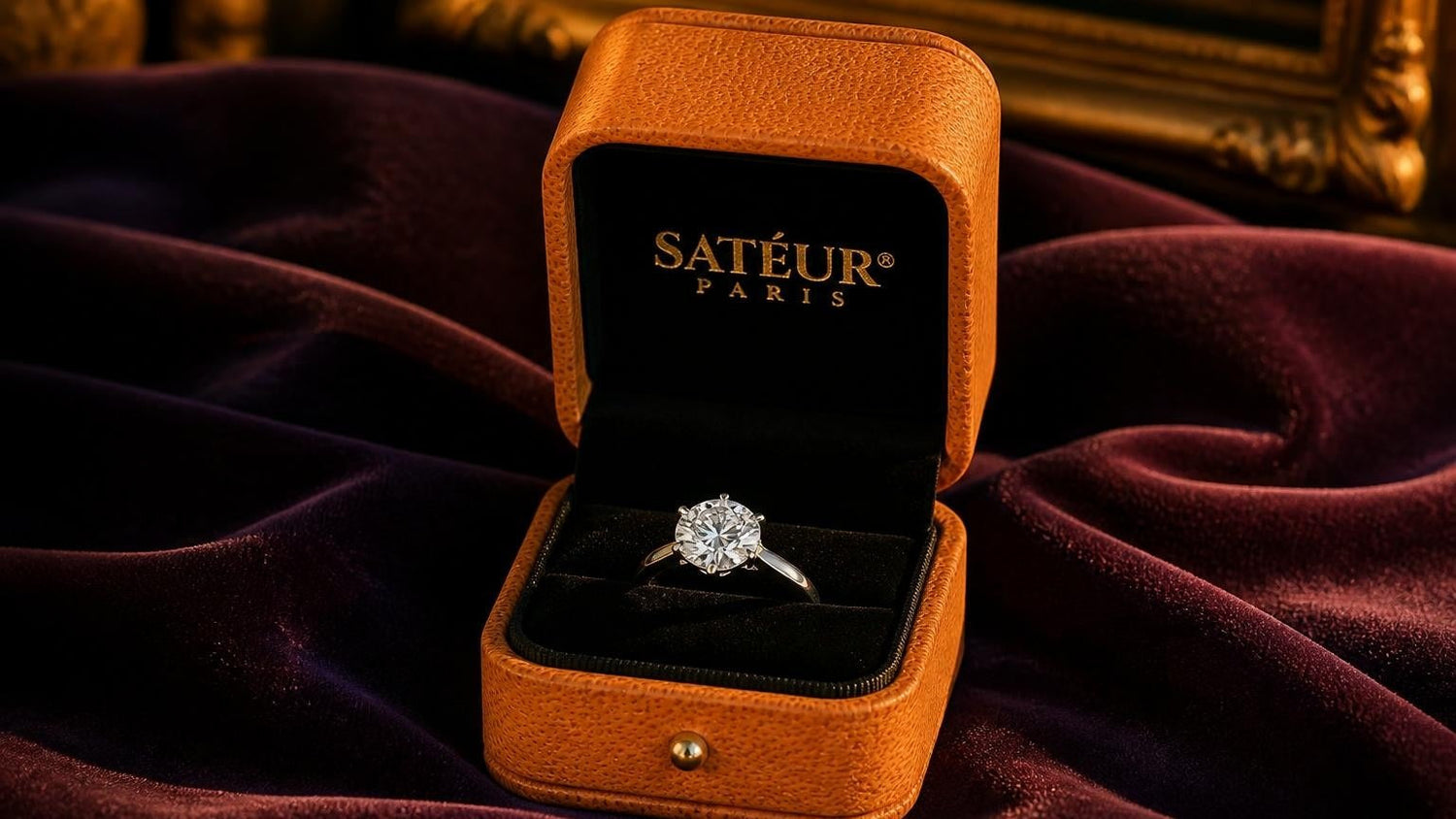
Moissanite Meaning: The Gemstone Born from the Stars
Moissanite is a lab-created silicon carbide gemstone — and one of the most optically brilliant stones in jewellery today. Understanding moissanite meaning goes beyond the technical: discovered in a meteorite crater in 1893 and synthesised for jewellery in the 1990s, it carries both scientific origin and genuine emotional weight. For those choosing it for an engagement ring, moissanite meaning is inseparable from the decision itself — a deliberate, eyes-open choice of brilliance over convention.
This article covers what moissanite is, where it comes from, what it symbolises, how durable it is, how it compares to a diamond, and what caring for it looks like over a lifetime. For a deeper comparative analysis, our guide on moissanite vs. diamond rings explores the full spectrum of differences.
- Moissanite is a real gemstone — lab-created silicon carbide, not a diamond.
- It ranks 9.25 on the Mohs hardness scale, suitable for daily-wear engagement rings.
- Moissanite displays roughly 2.4× the fire of a diamond — a vivid, rainbow-forward sparkle.
- Satéur's moissanite is produced to D-E colour and available from approximately $98 — around 1% of a comparable mined diamond.
- First discovered in 1893; refined for jewellery from the 1990s onward.
The Meaning of Moissanite
The word moissanite carries a double meaning. Scientifically, it refers to silicon carbide in crystalline gem form — a compound of silicon and carbon that occurs naturally only in trace quantities near meteorite impact sites. Culturally, moissanite has come to mean something more: a gemstone chosen with full knowledge of what it is, and why. That transparency is part of its appeal.
When someone chooses moissanite for an engagement ring, the choice is rarely incidental. It reflects an understanding of the gemstone market, and a decision to prioritise brilliance, durability, and considered value over the inherited conventions of mined diamond pricing. In that sense, moissanite meaning is about intelligence as much as aesthetics — a ring that carries an argument about what luxury actually requires.

What is Moissanite?
Moissanite is a lab-created gemstone composed of silicon carbide (SiC). It was first identified in 1893 by the French chemist Henri Moissan, who discovered microscopic crystals in a meteorite crater in Canyon Diablo, Arizona. He initially believed the crystals were diamonds. Analysis revealed they were something entirely different — and the stone was named moissanite in his honour.
Natural moissanite is extraordinarily rare, found only in minute quantities in certain meteorites and geological formations. The moissanite used in jewellery today is entirely lab-created — grown through a controlled thermal process that produces large, gem-quality crystals to precise colour and clarity specifications. The result is a gemstone that is fully disclosed, consistently produced, and available at a fraction of the price of a comparable mined diamond.
Satéur discloses its moissanite composition openly. Each stone is produced to D-E colour specifications — near-colourless quality at the top of the standard grading scale. For those weighing their options, the guide on buying moissanite vs. diamond vs. lab diamond provides a thorough purchasing framework from first principles.
Symbolism and Significance
Every gemstone carries symbolic weight, and moissanite is no exception. Its origin in a meteorite crater — born from cosmic impact — lends it a mythology that diamonds, mined from the earth under industrial pressure, do not possess. For some, that extraterrestrial origin carries a quiet romance. A stone that arrived from outside our world.
More practically, the choice of moissanite for an engagement ring has come to symbolise a particular kind of discernment. It is the choice of someone who researched the gemstone market, understood the artificial scarcity embedded in diamond moissanite pricing debates, and chose with clarity. The ring on the finger means the same — commitment, intention, beauty. The stone beneath that meaning was simply chosen with sharper eyes.
In some cultural traditions, the fire and brilliance of a gemstone carries specific significance. Moissanite, with its dispersion roughly 2.4 times that of a diamond, produces a distinctly vivid sparkle — rainbow fire that catches the light from every angle. For those who associate a gemstone's brilliance with vitality, joy, or presence, moissanite's extraordinary fire carries its own symbolic charge.

Durability and Longevity
Moissanite ranks 9.25 on the Mohs hardness scale — the standard measure of a gemstone's scratch resistance. Diamond sits at 10, the maximum. The gap between 9.25 and 10 is negligible in everyday wear. Moissanite is one of the hardest materials used in jewellery, and the durability difference between moissanite and diamond is not meaningfully felt in a ring worn through normal daily life.
What this means practically: a moissanite stone will not scratch under ordinary conditions, will not cloud, and will not lose its fire over time. A well-set moissanite engagement ring retains its brilliance for decades. This is a gemstone built for daily wear — for the office, travel, and the full texture of a life lived. It does not need to be treated as a delicate object.
Moissanite's stability is also chemical. It is resistant to heat, to most cleaning agents, and to the kinds of physical impacts that would damage a softer stone. For a ring intended to be worn every day, for life, that structural resilience is a genuine advantage rather than a specification on paper.

Moissanite vs. Diamond: Key Differences
The moissanite diamond comparison rewards precision. They are not the same gemstone, and understanding how they differ is the foundation of a considered purchasing decision. A full breakdown is available in our guide to moissanite vs. diamond vs. Satéur.
Composition. Diamond is pure carbon. Moissanite is silicon carbide. They are chemically distinct gemstones with different optical properties.
Fire. Moissanite displays a dispersion rate roughly 2.4 times that of a diamond. Dispersion produces the coloured flashes — fire — when light passes through a stone. In moissanite, this creates a vivid, rainbow-forward brilliance. Diamond returns crisper, whiter light. Both are exceptional optical experiences; they are simply different ones.
Hardness. Moissanite: 9.25 Mohs. Diamond: 10 Mohs. Both are extremely durable gemstones. In daily wear, the difference is not perceptible.
Price. A one-carat round mined diamond in D-E colour runs $8,000–$12,000 or more. Satéur's moissanite in the same colour specifications is available from approximately $98. That difference reflects production economics and supply chain structure — not a proportionate gap in beauty.
Origin. Moissanite is lab-created. It is not mined. Its production involves no land disruption and no supply chain opacity. For buyers for whom ethical sourcing matters, that origin is not incidental — it is a structural advantage.

Satéur Destinée Ring™
The look of a brilliant gemstone, for around 1% of the price of a mined diamond.
Compare to a $10,000 mined diamond
Joined by 100,000+ couples across 150+ countries.
Explore Moissanite RingsFree worldwide shipping · 30-day returns · Lifetime Satéur Care
Satéur's Moissanite Value Proposition
Satéur offers moissanite as one of three openly disclosed gem tiers — each with its own optical signature. The moissanite tier is the vivid option: more fire than a diamond, fully lab-created, produced to D-E colour. It is the choice for buyers who want maximum brilliance and complete transparency about what they are wearing.
At approximately 1% of the price of a comparable mined diamond, the value proposition is direct. The moissanite rings at Satéur begin at $98. A traditional D-E colour mined diamond ring of equivalent size would cost $8,000–$15,000. The optical difference is real — moissanite has its own vivid fire — but that difference in beauty is not proportionate to the difference in cost.
This is the position Satéur holds: not that moissanite is "as good as" diamond, but that it is its own remarkable gemstone, with extraordinary properties, at a price that reflects what the stone actually costs to produce. That is The New Diamond Standard — jewellery chosen for what it is, not for what it costs.
Caring for Your Moissanite Ring
Moissanite requires little specialist care. Its hardness and chemical stability mean it tolerates daily life without degrading. A few straightforward practices keep a moissanite ring looking its best across decades.
Cleaning. Warm water, mild dish soap, and a soft-bristled brush remove the everyday oils and residue that accumulate on any ring. Rinse thoroughly. Dry with a soft cloth. Monthly cleaning, or whenever the stone appears less brilliant, is sufficient.
Ultrasonic cleaning. Moissanite is compatible with ultrasonic cleaners for stones set in metal that is in good condition. If the setting shows wear or the stone feels loose, take the ring to a jeweller before ultrasonic cleaning.
Storage. Keep moissanite rings in a separate pouch or compartment. At 9.25 Mohs, a moissanite stone can scratch softer gemstones stored in contact with it.
Professional maintenance. Most jewellers work with moissanite for resizing, setting adjustments, and prong re-tipping. The stone's hardness is not an obstacle to standard jewellery repair. Inform your jeweller of the stone type before any heat-intensive work — standard practice for any precious gemstone.
Frequently Asked Questions
What does moissanite symbolize in an engagement ring?
Moissanite in an engagement ring symbolises a conscious choice: brilliance, durability, and considered value over inherited convention. Its origin in a meteorite crater carries a quiet mythology for some. Its lab-created nature means no mining and no supply chain opacity. For most who choose it, the meaning is practical and romantic at once — a beautiful stone, selected with full knowledge of what it is and what it represents.
How durable is moissanite compared to diamond?
Moissanite ranks 9.25 on the Mohs scale; diamond sits at 10. Both are among the hardest materials used in jewellery. In daily wear, the difference is not perceptible. Moissanite will not scratch under ordinary conditions, holds its brilliance for decades, and is resistant to the chemical and physical demands of everyday life. It is a genuinely durable stone for lifelong wear.
Will moissanite cloud or lose its sparkle over time?
No. Moissanite does not cloud or lose its fire. Its silicon carbide structure is chemically stable and optically permanent. Unlike cubic zirconia, which degrades with time, moissanite retains the same vivid brilliance in twenty years as on the day it was set. Standard cleaning maintains that appearance without specialist products.
What is the price difference between moissanite and diamond?
A one-carat D-E colour mined diamond typically costs $8,000–$12,000. Satéur's moissanite in equivalent colour specifications starts at approximately $98 — roughly 1% of the mined diamond price. The optical signatures differ: moissanite carries more coloured fire; diamond returns crisper white brilliance. The cost difference, however, reflects production economics rather than any proportionate gap in beauty.
How do I care for a moissanite engagement ring?
Clean monthly with warm water, mild soap, and a soft brush. Rinse thoroughly and dry with a soft cloth. Moissanite is compatible with ultrasonic cleaners for rings in good condition. Store separately from softer gemstones. Any jeweller familiar with hard stones can resize or service a moissanite ring — its hardness at 9.25 Mohs is an asset, not an obstacle.
Can moissanite be resized or repaired by any jeweler?
Yes. Most jewellers work with moissanite without issue. Its 9.25 Mohs hardness makes it durable enough for standard resizing, prong re-tipping, and setting adjustments. Inform your jeweller of the stone type before any heat-intensive work — standard practice for any hard gemstone, and not a limitation unique to moissanite.
The moissanite collection at Satéur is built for those who understand what they are choosing and why. Every stone is lab-created, D-E colour, and produced to a consistent standard. The collection begins at $98. The 1% Ring® philosophy applies equally here: the look of a brilliant gemstone, for around 1% of the price the traditional market demands. Begin here.















댓글을 남기세요
이 사이트는 hCaptcha에 의해 보호되며, hCaptcha의 개인 정보 보호 정책 과 서비스 약관 이 적용됩니다.