

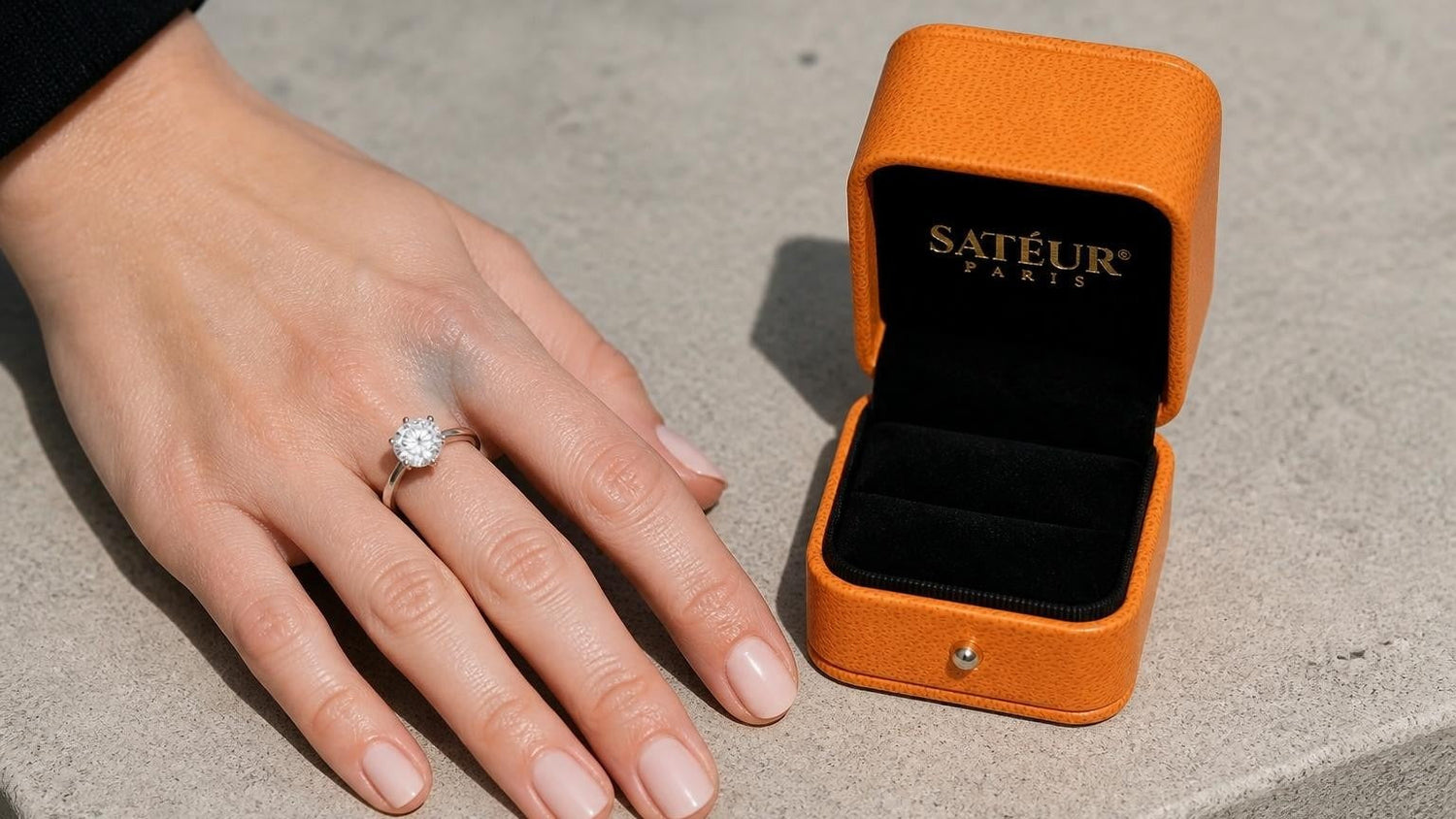
Engagement Ring Finger for Women: Which Finger and What It Means
The engagement ring finger for female tradition is one of the most recognised customs in fine jewellery — and one of the most rarely explained. Most women in Western cultures wear their engagement ring on the fourth finger of the left hand, sitting above the wedding band. But the reasoning behind this choice, and the regional customs that diverge from it, are worth understanding before deciding how to wear your own ring.
This guide covers which finger the engagement ring goes on, the history behind that convention, how customs differ across cultures, and how to wear an engagement ring alongside a wedding band. For the related question of which hand is correct, see the companion guide on engagement ring hand traditions.
Key Takeaways
- The engagement ring traditionally goes on the fourth finger (ring finger) of the left hand in Western cultures, positioned above the wedding band.
- The left-hand tradition descends from the Roman vena amoris — the belief that a vein connected that finger directly to the heart.
- In Germany, Norway, Russia, India, Brazil, and several other countries, the right-hand ring finger is the convention.
- Wedding bands are typically stacked below the engagement ring on the same finger, closest to the palm.
- Engagement rings account for approximately 45% of all fine jewellery purchases, reflecting their lasting cultural significance.
- There is no universal rule — women wear engagement rings on whichever finger suits their cultural context and personal preference.
Which Finger Does an Engagement Ring for Women Go On?
In most Western countries, the engagement ring finger for female tradition points to the fourth finger of the left hand — the finger between the middle finger and the little finger, counting inward from the thumb. This finger is referred to simply as the ring finger in everyday language, a name it earned from this specific custom.
The ring sits in a naturally visible position on the hand. It frames the outer part without drawing attention away from other fingers and pairs visually with the wedding band that follows at marriage. When both rings are worn together, the wedding band typically sits closest to the palm, with the engagement ring above it — a configuration that, in romantic tradition, places the first ring given nearest to the heart.
Knowing which finger to use is the starting point. Whether to wear engagement rings on the left or right hand varies considerably by country and cultural background, which the section below addresses directly.
Engagement Ring Finger Tradition and Meaning
The association of the left-hand fourth finger with betrothal originates in ancient Rome. Roman physicians held that a nerve or vessel — the vena amoris, the vein of love — ran from that finger directly to the heart. Modern anatomy does not support this; every finger shares the same circulatory structure. But the symbolism embedded itself so completely in Western culture that it has never required factual basis to persist.
Medieval European custom reinforced the choice through Church ritual. During marriage ceremonies, a priest would touch successive fingers of the left hand while reciting the Trinity — Father, Son, Holy Spirit — before resting the ring on the fourth finger as the prayer concluded. The rite fused the romantic and the sacred into a single gesture.
By the time European trade networks spread these customs, the left ring finger had become a broadly shared reference point. The De Beers "A Diamond is Forever" campaign of 1947 further institutionalised the engagement ring as a cultural given — and the left ring finger as its natural home. Engagement rings now account for approximately 45% of all fine jewellery purchases globally, a figure that reflects how deeply the tradition has held. The wider context of engagement ring customs shows just how central this symbolism remains.

Left Hand vs. Right Hand: Regional Customs
The left-hand convention is not universal. Across significant parts of Europe, the Middle East, and South America, both the engagement ring and the wedding ring are worn on the right hand — and wearing a ring there is entirely conventional in those contexts. Understanding regional customs matters for personal decisions and when choosing a ring as a gift.
Countries where the right hand is conventional:
- Germany and Austria: Both engagement and wedding rings are worn on the right-hand ring finger.
- Norway and Denmark: The right hand is standard for engagement rings; some couples move to the left at marriage.
- Russia and Ukraine: Right-hand wear reflects the Eastern Orthodox tradition for both rings.
- Spain and Portugal: Right-hand tradition is historical, though urban practices vary.
- India (Hindu tradition): The right hand is considered auspicious; engagement and wedding jewellery appears here.
- Greece: Engagement ring on the left hand before the ceremony; moved to the right at the wedding.
- Brazil and Colombia: Right hand for engagement, sometimes switched to left at marriage.
Countries where the left hand is conventional: The United States, Canada, United Kingdom, Ireland, Australia, New Zealand, France, Italy, and most of sub-Saharan Africa follow left-hand wear.
Multicultural couples increasingly blend both traditions. The right answer is the one that reflects your background and feels correct for your relationship.
Wearing Your Ring with Confidence
Tradition is a starting point, not a constraint. Many women choose to wear engagement rings on the right hand by preference — because it suits their dominant hand, because a ring fits better on a specific finger, or because it reflects a personal aesthetic decision. Others wear their ring on a different finger entirely if sizing or comfort requires it. The convention exists to carry the symbolism, not override personal choice.
When choosing to wear an engagement ring and wedding band together on the ring finger, the bands should sit flush. A curved or contoured wedding band shaped to follow the engagement ring's base creates a seamless bridal set. A flat band beside a ring with a raised setting will leave a visible gap — a matter of aesthetics, not propriety. Many couples choose both rings together for this reason, assessing profile compatibility before purchasing the second band.
During the wedding ceremony itself, many women briefly move their engagement ring to the right hand so the wedding band can be placed first on the left ring finger — then return the engagement ring above it afterwards. Both this move-and-return method and simply wearing rings in final order from the start are common across Western weddings.
Men's engagement ring customs follow different conventions by culture and personal choice. Those exploring engagement rings for men will find that the same traditions apply with their own variations.

Satéur Destinée Ring™
The look of a flawless diamond, for 1% of the price.
Compare to a $10,000 mined diamond
Joined by 100,000+ couples across 150+ countries.
Discover The 1% RingFree worldwide shipping · 30-day returns · Lifetime Satéur Care
Satéur Gems® Engagement Rings: The Look, the Value
Knowing which finger to wear your engagement ring on is one decision. Knowing which ring belongs there is another — and it is here that the landscape has shifted considerably.
Satéur Gems® is a trademarked diamond simulant engineered to replicate the clean, white brilliance of a flawless diamond. A 1.00 carat Satéur Gems® ring — D–E colour, Excellent cut — delivers the visual presence of a diamond engagement ring comparable to one priced at $10,000 or more. The Satéur Destinée Ring™, The 1% Ring®, is the entry point: the same look, starting at approximately 1% of that price.
The gem carries a refractive index of approximately 2.39, producing diamond-accurate white light return — the restrained, clear brilliance that reads as a fine diamond across the table and to the naked eye. Where moissanite offers vivid rainbow fire and a higher dispersion, Satéur Gems® reads diamond-true. For women who want the ring finger to carry a stone with presence and clarity, The New Diamond Standard offers a considered alternative to traditional mined diamond.
Both Satéur Gems® and our moissanite tier are extremely durable and built for everyday wear. Settings use 18K gold finish across designs intended to hold their character for years. To see the full range, the The 1% Ring collection presents every available configuration.

Stacking: Wearing an Engagement Ring with a Wedding Band
Stacking an engagement ring with a wedding band on the ring finger is the predominant configuration in Western tradition. The order is a matter of convention and practicality.
The wedding band closest to the palm — the conventional arrangement — means placing the band first, which most couples achieve by temporarily moving the engagement ring to the right hand during the ceremony. After the vows, the engagement ring is returned to sit above the band. The visual result is a unified bridal set in which the wedding band anchors the look and the engagement ring draws the eye upward.
When selecting a wedding band to sit beside an existing engagement ring, profile compatibility matters. A low-profile band sits flush against most settings. A curved eternity band follows the engagement ring's outline naturally and works particularly well with oval or pear-shaped centre stones. For guidance on presenting either ring, the guide to choosing the best engagement ring box covers presentation and storage options that protect both rings between wears.

The engagement ring finger has carried meaning for over two thousand years across cultures that share almost nothing else. The specific finger, the specific hand, the specific stone — each is a choice. What remains constant is the intention the ring carries when it is placed there.
FAQ: Engagement Ring Finger and Styling
Which finger does a woman wear an engagement ring on?
In most Western cultures — including the United States, United Kingdom, Australia, and Western Europe — a woman wears her engagement ring on the fourth finger of the left hand, commonly called the ring finger. In Germany, Norway, Russia, India, Brazil, and several other countries, the right-hand ring finger is conventional. The correct engagement ring finger is the one that reflects a woman's cultural background and personal preference.
Should an engagement ring go on the left or right hand?
Left-hand wear is conventional in North America, the United Kingdom, Ireland, Australia, and most of Western Europe. Right-hand wear is standard in Germany, Norway, Russia, Spain, India, and Brazil, among others. The choice of hand is largely determined by cultural tradition, and women may choose either without it being incorrect — particularly in multicultural relationships where both traditions have a presence.
What is the meaning behind the engagement ring finger?
The left-hand ring finger tradition derives from the Roman belief in the vena amoris — the vein of love — said to connect that finger directly to the heart. Medieval Church ceremony reinforced the custom by placing the ring on the fourth finger as the concluding gesture of a blessing. The anatomical premise is not supported by modern science, but the symbolism has persisted for over two thousand years and remains central to Western engagement ritual.
Can you wear an engagement ring on a different finger?
Yes. The ring finger is conventional, not obligatory. Some women choose to wear their engagement ring on the right hand by preference, or on a different finger if sizing or comfort requires it. The convention exists to carry the symbolism — it does not override personal choice or practical necessity.
How do you wear an engagement ring with a wedding band?
The most common Western convention places both rings on the left ring finger, with the wedding band closest to the palm and the engagement ring above it. To achieve this order, many women move their engagement ring to the right hand during the wedding ceremony so the band can be placed first on the left ring finger. After the ceremony, the engagement ring is returned above the band. A curved wedding band shaped to follow the engagement ring's base sits flush and creates a cohesive bridal set.
What are current trends in engagement ring styling and wear?
Contemporary trends include stacking multiple slim bands alongside the engagement ring on the ring finger; wearing an engagement ring on the right hand as a personal-choice piece; and choosing non-round centre stones — oval, pear, and emerald cuts have grown significantly through the 2020s. The shift toward value-intelligent choices has also accelerated: rings that deliver the visual presence of a fine diamond without the traditional price premium now represent a growing share of engagement ring purchases, reflecting a broader reappraisal of what The New Diamond Standard means in practice.

















댓글을 남기세요
이 사이트는 hCaptcha에 의해 보호되며, hCaptcha의 개인 정보 보호 정책 과 서비스 약관 이 적용됩니다.