


How to Tell If Moissanite Is Real: A Guide to Genuine Gemstone Quality
Moissanite is a real gemstone. Lab-created silicon carbide, grown under controlled conditions and cut to Excellent precision — it is not a fake, not a counterfeit stone, and not a diamond. The question of whether moissanite is "real" is best reframed as a quality question: is this a genuine, high-grade moissanite gemstone, properly documented, with the optical and physical properties of premium-grade material? That is what this guide addresses.
The broader topic belongs to the moissanite collection at Satéur — understanding the gem's origin, properties, and how it compares. Here, we focus specifically on what distinguishes authentic, premium moissanite from lower-grade alternatives or impostors: the visual fire, the hardness, the colour grade, the refractive index, and the documentation that confirms lab origin.
Key Takeaways
- Moissanite is a real lab-created gemstone (silicon carbide) — genuinely real, not a fake stone.
- Authentic moissanite carries a Mohs hardness of 9.25, among the hardest gemstones available.
- Refractive index 2.65–2.69 produces moissanite's signature high-fire, rainbow-forward sparkle — approximately 2.4× the chromatic dispersion of diamond.
- Genuine premium moissanite is graded D–F (colourless) or G–H (near-colourless) — visually bright and clean.
- Reputable moissanite comes with documentation confirming lab origin, colour grade, and Excellent cut quality.
- Satéur moissanite diamond-look rings begin from approximately $98, delivering vivid brilliance at a fraction of diamond pricing.
Moissanite: The Openly-Disclosed Lab-Created Gemstone
Moissanite was first identified in 1893 by Henri Moissan, in fragments of a meteorite crater in Arizona. Natural moissanite is extraordinarily rare — all commercially available moissanite today is lab-created silicon carbide (SiC), grown through a controlled thermal process that produces crystals of consistent purity and optical quality.
Unlike materials that merely approximate the look of a gemstone, moissanite has a defined physical identity: a measured refractive index, a documented Mohs hardness, a specific crystal structure, and a dispersion rate that has been measured and verified across thousands of specimens. It is not a fake diamond. It is not a fake anything. It is its own gemstone, openly disclosed, with properties that on several dimensions rival or exceed diamond's.
This distinction matters for understanding what the "real moissanite" question actually means. The question is not "does it pass for something else" — it is "is this genuine, quality moissanite?" That is a question about specs, sourcing, and certification. It is a question with practical, verifiable answers.

Visual Characteristics of Authentic Moissanite
The most immediately recognisable trait of genuine, premium moissanite is its fire. Chromatic dispersion — the way a stone breaks white light into colour — measures approximately 0.104 for moissanite, versus 0.044 for diamond. In practice, this means moissanite returns more vivid, rainbow-forward flashes, particularly under direct sunlight or strong artificial lighting.
This visual signature is the fingerprint of the gem. A real moissanite diamond-look ring should appear brilliantly alive in a range of lighting conditions. Under candlelight, the distinction from diamond is minimal. Under direct sun or spotlights, moissanite's greater fire becomes clearly visible as more spectral colour — more vivid, more chromatic. Neither is inferior to the other; they are different optical expressions.
A stone sold as moissanite that appears dull, grey, or flat — lacking the characteristic fire — is a quality concern. Genuine D–E colourless moissanite should be bright and vivid on first sight. If it is not, the material identity is worth investigating through documentation and grade verification, not through visual comparison to a diamond.
Glass and cubic zirconia cannot replicate moissanite's refractive index or hardness. A moissanite diamond-equivalent ring from a reputable supplier will perform visually in a way no inexpensive simulant achieves over time. The combination of optical performance, hardness, and longevity is the real marker of quality moissanite.
Colour Grade and Clarity Standards
Moissanite is colour-graded on the same D-to-Z scale applied to diamonds. Premium-grade moissanite occupies the D–F range (colourless) or G–H (near-colourless). Earlier generations of lab-grown moissanite sometimes carried a slight yellow or green tint under certain lighting conditions; modern premium moissanite, properly graded, eliminates this entirely.
When assessing a moissanite's quality, colour grade is the primary practical indicator. A D–E colourless stone will appear clean and bright under any light source. A stone that reads noticeably warm, yellow, or greenish-grey is either lower-grade moissanite or not moissanite at all. This is one of the clearest visual markers of authentic, premium material.
Clarity in premium moissanite is consistently high. The lab-growth process produces minimal inclusions — most reputable moissanite is VS or better in clarity, meaning no inclusions are visible to the naked eye. A stone with visible internal cloudiness or particulate matter warrants examination of its documentation and grade.
Satéur's moissanite gemstones are graded D–E colourless, Excellent cut — the same cut standard applied across our gemstone tiers. The result is immediate and visual: clean white brilliance with vivid moissanite fire. For a detailed comparison of how moissanite diamonds compare to mined diamonds across all grade points, the moissanite vs. diamond guide covers the full picture.
Refractive Index and Light Behaviour
The refractive index (RI) is the physical reason moissanite looks the way it does. Moissanite's RI of 2.65–2.69 exceeds diamond's 2.42. This higher RI bends and disperses light more intensely, generating the chromatic fire that characterises genuine moissanite.
In practical terms: diamond returns more of its light as white brilliance — crisp, restrained, mirror-like. Moissanite returns more colourful flashes alongside its white light return. Both are visually striking. The difference is measurable and consistent — and it is what distinguishes premium moissanite from lower-RI simulants that try to approximate the look.
A genuine moissanite ring, properly cut to Excellent grade, will display this optical behaviour visibly. The RI is also part of what makes moissanite unsuitable as a material for cutting corners: the physical constants of silicon carbide produce a specific, reproducible optical outcome. A stone that behaves visually unlike described moissanite may be a different material entirely.
Moissanite vs. Diamond: Key Physical Differences
| Property | Moissanite | Diamond |
|---|---|---|
| Hardness (Mohs) | 9.25 | 10 |
| Refractive Index | 2.65–2.69 | 2.42 |
| Chromatic Dispersion | 0.104 (~2.4× diamond) | 0.044 |
| Composition | Silicon carbide (SiC) | Carbon |
| Origin | Lab-created | Mined or lab-created |
| Visual character | Rainbow-forward fire, vivid | Clean white brilliance |
| Colourless grade | D–F available | D–F available |
| Price (1ct equivalent) | From ~$98 | $5,000–$10,000+ |
These physical properties are measurable and consistent. Any stone diverging significantly from moissanite's RI or hardness values is not genuine moissanite. The table also makes clear that moissanite is not an inferior diamond: it is a different gemstone, openly disclosed, with properties that on several metrics — fire, refractive index, price per carat — are arguably superior.
Thermal conductivity testers, which measure how quickly a stone disperses heat, are sometimes used in the jewellery trade to distinguish gems. Moissanite conducts heat similarly to diamond on these instruments — which is why moissanite diamond-look stones require a dedicated moissanite-specific tester to differentiate from diamond, not a standard thermal probe. This is a characteristic of the material's density and structure, not a deficiency. The relevant question for buyers is not "what does a tester read" but "does this stone have the documented colour grade, cut quality, and lab origin that premium moissanite requires." Specs and certification are the markers of genuine quality.

Certification and Documentation
Genuine, premium moissanite comes with documentation. Reputable suppliers provide a certificate or card confirming the stone's lab origin, colour grade, and cut quality. Satéur moissanite is sourced with full documentation of origin and grade accompanying each gemstone.
What to look for in moissanite documentation:
- Lab origin confirmation: The certificate should state the stone is laboratory-created silicon carbide.
- Colour grade: D–F (colourless) or G–H (near-colourless) for premium grades.
- Cut quality: Excellent cut is the standard for premium moissanite — it is the primary determinant of fire and light return.
- Size specification: Moissanite is specified by millimetre diameter and carat-equivalent weight. Both should be present.
Documentation does not require a major gemological institute certificate the way a mined diamond might. What matters is that the supplier is reputable, the grade is accurate, and the stone's visual performance matches its described specification. A D–E colourless, Excellent cut moissanite should look unmistakably bright and vivid — documentation and appearance should agree.
For more on how moissanite authenticity differs from the question of whether moissanite is "a real diamond," the moissanite diamonds guide addresses both questions directly.
How Moissanite Performs in Daily Wear
One of the strongest indicators of genuine, quality moissanite is long-term performance. Moissanite at 9.25 Mohs is one of the hardest gemstones commercially available. It resists scratching from everyday contact, retains its surface polish, and does not chip under normal conditions. This makes it a genuine, long-term choice for engagement rings worn daily.
Genuine moissanite does not cloud, yellow, or dull with time. Cloudiness over time is associated with lower-quality simulants, porous stones, or coatings — not with silicon carbide moissanite. A stone that loses its brilliance within months of wear is not performing as authentic moissanite should. This is one of the longer-term markers of material quality: genuine moissanite maintains its fire and colour for life.
Regular cleaning with warm soapy water and a soft cloth restores and maintains brilliance reliably. The hardness and chemical stability of moissanite make it appropriate for standard jewellery cleaning. Ultrasonic cleaners are also generally safe for moissanite settings, unlike softer stones.
This durability is part of what defines moissanite's value proposition. A moissanite engagement ring is not a temporary stand-in — it is a stone built for the same daily wear context as diamond, at a significantly different price point. The moissanite real gemstone guide covers the full context of moissanite's permanence and physical standing as a gem.

Why Satéur Moissanite Offers Exceptional Value
The value proposition of a moissanite diamond-look ring is straightforward. A comparable mined diamond — 1 carat, D–F colourless, Excellent cut — retails between $5,000 and $10,000 at standard market pricing. Satéur's moissanite solitaire rings, built to the same colour and cut specification, begin from approximately $98. That is the New Diamond Standard — the insight that the brilliance of a stone has nothing to do with its price tag.
This is not a compromise in quality or craftsmanship. The moissanite gemstone itself is genuinely different from diamond — openly disclosed, with greater fire and a slightly lower hardness — but those differences do not translate to inferior daily wear performance or inferior beauty. They are the characteristics of a distinct gemstone, not flaws in a replica.
For those who prefer the diamond-accurate look — restrained white brilliance, less chromatic fire, maximum proximity to the visual of a mined diamond — Satéur also offers The 1% Ring®, built around Satéur Gems®. That gem is engineered specifically for diamond-accurate brilliance: clean, white, and visually indistinguishable from a flawless diamond with the naked eye. It is a different gem than moissanite, optimised for a different visual result.
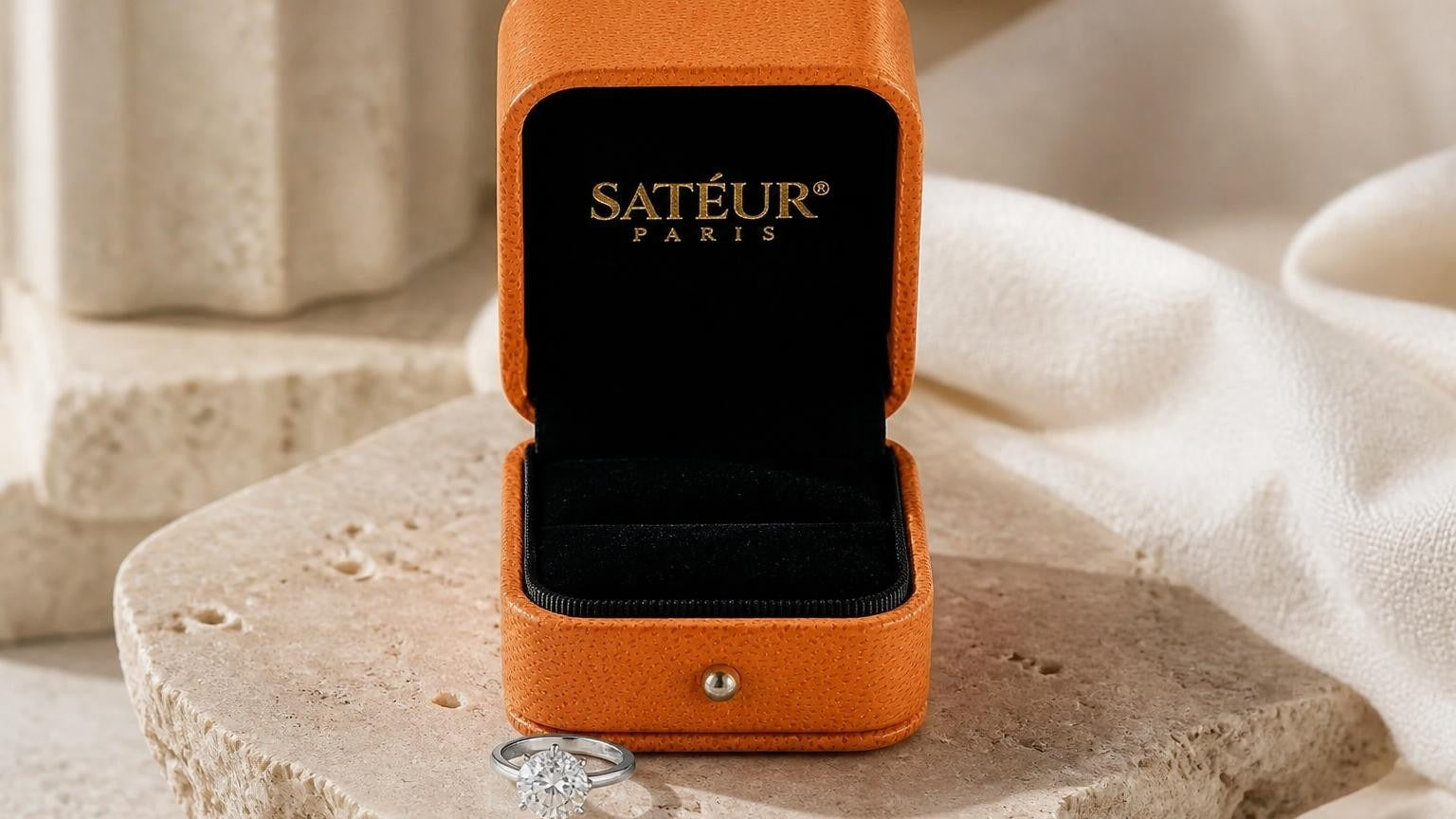
For moissanite specifically — vivid, high-fire, openly lab-created, with the full specs and documentation of a premium gemstone — the Satéur moissanite ring collection and moissanite solitaire ring carry the full range from classic solitaire settings to more contemporary cuts, at pricing that reflects the intelligence of the choice.
Over 100,000 customers across 150 countries have chosen a different path — premium gemstones at a fraction of the price of mined stones, without compromising on quality, beauty, or craftsmanship.

Satéur Destinée Ring™
The look of a flawless diamond, for 1% of the price.
Compare to a $10,000 mined diamond
Joined by 100,000+ couples across 150+ countries.
Explore the Destinée RingFree worldwide shipping · 30-day returns · Lifetime Satéur Care
FAQ: Your Moissanite Questions Answered
What is moissanite and how is it made?
Moissanite is lab-created silicon carbide — a genuine gemstone grown in controlled laboratory conditions that replicate the intense heat and pressure under which natural moissanite (an extraordinarily rare mineral) originally formed. The result is a crystal of consistent purity, cut to Excellent precision, available in D–F colourless grades. It is not a diamond, not a diamond copy, and not a synthetic version of another gem. It is its own gemstone category with its own physical identity.
Can moissanite be distinguished from diamond with the naked eye?
With the naked eye, in everyday settings, the distinction is subtle and context-dependent. Moissanite's greater fire — rainbow-forward chromatic sparkle from its higher refractive index — is more vivid than diamond's clean white brilliance, particularly under direct sunlight or strong artificial lighting. Side-by-side, the two stones read differently to an attentive observer. Worn normally, on the hand, across a table, moissanite is visually indistinguishable from diamond with the naked eye.
What certifications should authentic moissanite carry?
Premium moissanite should come with documentation confirming its lab origin as silicon carbide, its colour grade (D–F for colourless), and its cut quality (Excellent). This documentation typically comes from the supplier or a specialist moissanite grading service. The key indicators are confirmed lab-created silicon carbide identity and a colour grade consistent with the stone's visual appearance. Satéur moissanite is fully documented with origin and grade certification.
How does moissanite's durability compare to diamond for engagement rings?
Moissanite rates 9.25 on the Mohs hardness scale — the second hardest gemstone commercially available, behind diamond at 10. In practical daily wear, the difference is negligible. Moissanite resists everyday scratching, holds its surface polish for decades, and does not chip under normal conditions. A moissanite engagement ring is built for daily wear and will maintain its brilliance for life.
Will moissanite change colour or cloud over time with daily wear?
Genuine, quality moissanite does not cloud or change colour with wear. Its silicon carbide composition is chemically stable and resistant to the surface degradation that affects lower-grade simulants or softer stones. Maintained with regular gentle cleaning, a quality moissanite retains its fire and colour for life. Any stone that clouds quickly after purchase warrants assessment of its documentation and grade.
What is the price difference between moissanite and diamond for comparable sizes?
A 1-carat D–F colourless, Excellent cut mined diamond retails between $5,000 and $10,000 depending on clarity and provenance. A comparable moissanite — same colour grade, same cut quality, visually comparable diameter — is available from Satéur from approximately $98. The price difference reflects material composition and origin, not craftsmanship, daily wear performance, or visual quality.















留下评论
此站点受 hCaptcha 保护,并且 hCaptcha 隐私政策和服务条款适用。