

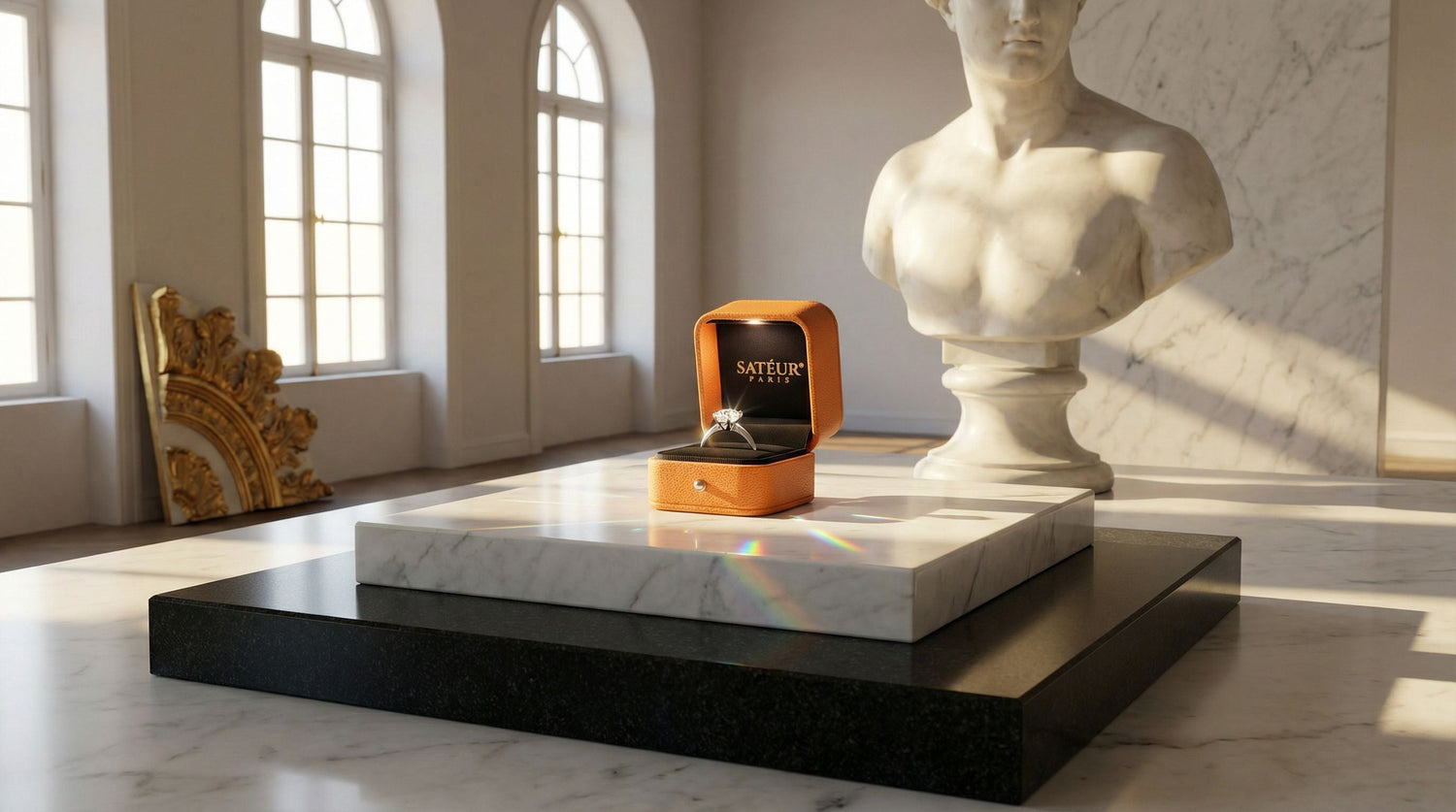
Moissanite vs Diamond: The Complete Comparison Guide
The question is not which stone costs more. It is which stone makes sense. For a century, the diamond industry built its empire on a single premise: rarity equals value. But brilliance has nothing to do with scarcity. It has everything to do with light, structure, and discernment.
This is the complete moissanite vs diamond comparison. Not a sales pitch. Not a shortcut. A clear-eyed analysis of two stones that have more in common than the industry wants you to believe — and critical differences that matter far more than price. A 2-carat moissanite delivers the presence of a $20,000 diamond for under $1,000. The question is what you are paying for — and why.

Quick Comparison: Moissanite vs Diamond
| Property | Moissanite | Diamond |
|---|---|---|
| Brilliance (Refractive Index) | 2.65–2.69 (higher fire) | 2.42 |
| Hardness (Mohs Scale) | 9.25+ | 10 |
| Durability for Daily Wear | Excellent | Excellent |
| Price (1-carat equivalent) | $400–$600 | $4,000–$12,000+ |
| Origin | Lab-created | Mined or lab-created |
| Certification | GIA, IGI (premium only) | GIA, AGS, IGI |
| Color Tint | Slight warmth in larger sizes | D-Z scale (colorless to tinted) |
| Fire (Dispersion) | 0.104 (more rainbow flashes) | 0.044 |
The numbers tell part of the story. The rest is about what you value — and why.
What Moissanite and Diamond Actually Are
A diamond is crystallized carbon — formed over billions of years or replicated in a lab over weeks. The process is different. The result is identical: a 10 on the Mohs hardness scale, a refractive index of 2.42, and the most recognized gemstone in modern history. The industry spent a century convincing you the former is worth 10x the latter. It is not.
Moissanite is silicon carbide. First discovered in a meteor crater in 1893 by Henri Moissan, natural moissanite is extraordinarily rare. Every moissanite in jewelry today is lab-created. It ranks 9.25+ on the Mohs scale — harder than sapphire, softer than diamond by a margin most will never notice. Its refractive index is higher. Its fire is double. It costs a fraction.
The question is not whether one is "real" and the other is not. Both are real. Both are durable. Both refract light into brilliance. The question is what brilliance means to you — and whether you are paying for the stone or the story.
Is Moissanite as Good as Diamond
The question assumes hierarchy. Moissanite is not "as good as" diamond — it is different. It is harder than sapphire, more brilliant in fire, and costs a fraction. For durability, daily wear, and visual presence, moissanite performs at the same level. For cultural symbolism and resale value, diamond still holds traditional weight. Neither is objectively superior.
The question is what you value — and whether that value aligns with the cost. A diamond vs moissanite decision is not about quality. It is about priority.
Brilliance and Fire: How Light Behaves
Brilliance is the white light a stone reflects. Fire is the colored light it disperses into rainbow flashes. A diamond prioritizes brilliance. A moissanite prioritizes fire. This is not subjective. It is optical physics.
Moissanite has a refractive index of 2.65–2.69 compared to diamond's 2.42. That means light bends more sharply inside the stone, creating more internal reflections before exiting. The result: more sparkle per facet. More fire per angle. In smaller stones (under 1 carat), the difference is subtle. In larger stones (2+ carats), moissanite produces noticeably more rainbow flashes — especially in sunlight.
For some, this is a feature. For others, it is too much. A diamond's fire is restrained. A moissanite's fire is expressive. Neither is better. Both are intentional. The choice depends on whether you want your stone to whisper or announce.
Moissanite produces more rainbow flashes in direct sunlight — a phenomenon explored in our diamond vs moissanite in sunlight comparison. The moissanite vs diamond sparkle debate is not about which is more brilliant. It is about which type of brilliance you prefer.

Moissanite vs Diamond Durability: Daily Wear Over Decades
A gemstone for an engagement ring must survive decades of wear. Showers. Gym sessions. Accidental countertop impacts. Sleep. Cooking. Cleaning. This is where hardness matters — and where the gap between 9.25 and 10 becomes irrelevant.
| Durability Factor | Moissanite | Diamond |
|---|---|---|
| Scratch Resistance | Excellent (only diamond can scratch it) | Excellent (hardest natural material) |
| Chip Resistance | Very high | High (can chip along cleavage planes) |
| Heat Resistance | Up to 2,000°F | Up to 1,650°F |
| Chemical Resistance | Inert to household chemicals | Inert to household chemicals |
| Cloudiness Over Time | No (does not cloud) | No (does not cloud) |
Both stones are built for permanence. The myth that moissanite "clouds over time" is false. High-quality moissanite retains its clarity indefinitely. So does a diamond. The only real difference: a diamond can chip if struck at the wrong angle along its cleavage plane. Moissanite has no cleavage planes. It is technically more resistant to impact damage.
For daily wear, both perform identically. The 0.75-point hardness difference will never affect your ring's longevity. This is a non-issue disguised as a decision point.
Moissanite vs Diamond Price: The Comparison That Changes Everything
This is where the conversation shifts. Not because price is the only factor — but because the gap is so extreme it reframes the entire decision.
| Carat Weight | Moissanite (Premium) | Mined Diamond (VS2, G color) | Lab Diamond (VS2, G color) |
|---|---|---|---|
| 1 carat | $400–$600 | $4,000–$7,000 | $800–$1,500 |
| 2 carats | $800–$1,200 | $15,000–$30,000 | $2,500–$4,500 |
| 3 carats | $1,200–$1,800 | $40,000–$80,000 | $5,000–$9,000 |
A 2-carat moissanite costs what a 0.3-carat diamond costs. A 3-carat moissanite costs less than a 0.5-carat diamond. The visual impact is not proportional to the price. The brilliance is not proportional to the cost. The meaning is not proportional to the invoice.
For a deeper breakdown: moissanite vs diamond price analysis.
The 1% Ring
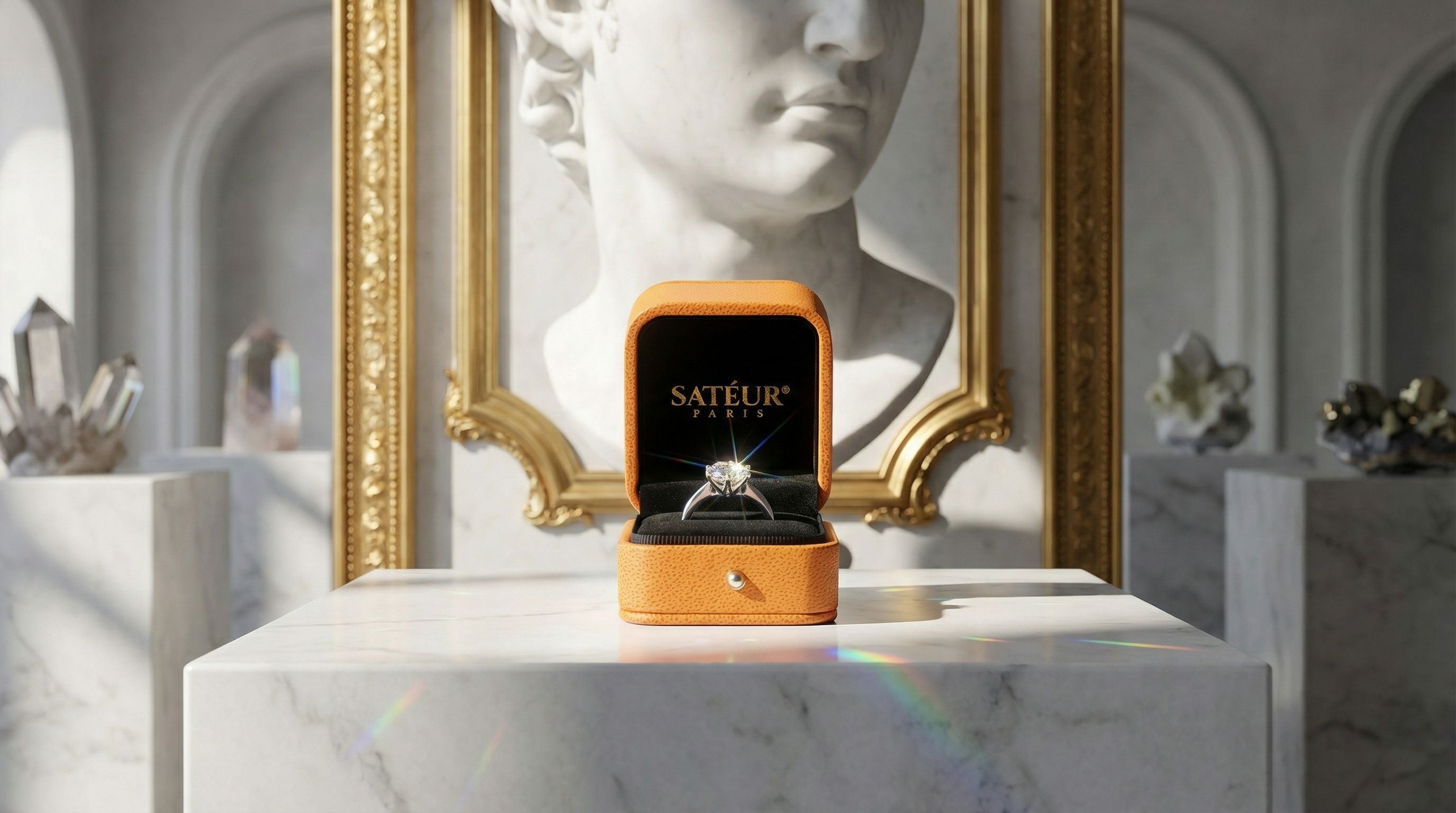
Six-prong classic design. Premium moissanite up to 5 carats. The New Diamond Standard — chosen by over 100,000 customers who prioritize intelligence over inheritance.
Begin hereColor and Clarity: What You See vs What You Are Told
The diamond industry created the D-Z color scale to manufacture scarcity within abundance. D is colorless. Z is yellow. Most buyers choose D-H — a range where color differences are invisible to the naked eye. You are paying for a letter grade no one can see. Moissanite does not play this game.
Premium moissanite is graded as "colorless" or "near-colorless." In sizes under 1 carat, colorless moissanite rivals a D-F diamond. In sizes above 2 carats, some moissanite exhibits a faint yellow or gray tint under certain lighting — particularly older silicon carbide formulas. Modern premium moissanite has largely solved this. But the tint exists in lower-grade material.
Clarity in moissanite is rarely an issue. Lab-created stones can be engineered to near-flawless standards. Inclusions are uncommon. When present, they are microscopic needle-like structures invisible to the eye.
The practical takeaway: In smaller sizes, color and clarity differences are imperceptible. In larger sizes, premium moissanite still performs at a level indistinguishable to most observers. If you are comparing a 2-carat colorless moissanite to a 2-carat G-color diamond, the moissanite will likely appear whiter — and cost 90% less.
Moissanite vs Lab Diamond: The Third Option
Lab diamonds complicate the conversation. They are chemically identical to mined diamonds. They cost 40-60% less than mined stones. They are certified by the same institutions (GIA, IGI). For buyers who want "a real diamond" without the mined diamond price tag, lab diamonds are the obvious middle ground.
But they are still more expensive than moissanite — often 3-5x the cost for the same visual presence. A 2-carat lab diamond costs $2,500-$4,500. A 2-carat premium moissanite costs $800-$1,200. Both look nearly identical to the untrained eye. Both are lab-created. The difference is branding and molecular structure.
The question becomes: Are you paying for the word "diamond" — or for the stone itself? For detailed comparisons: moissanite vs lab diamond analysis, lab grown diamond vs moissanite breakdown, moissanite vs lab grown diamond guide, and lab diamond vs moissanite comparison.
Moissanite vs Diamond Side by Side: Can You Actually Tell the Difference
Place a 1-carat round brilliant moissanite next to a 1-carat round brilliant diamond. Ask someone to identify which is which. Most cannot. Even jewelers need a loupe or a thermal conductivity tester to distinguish them with certainty.
The differences are real but require specific conditions to observe:
- Fire: Moissanite produces more rainbow flashes in direct sunlight. Noticeable in stones above 1.5 carats.
- Doubling: Moissanite is doubly refractive. Under a loupe, facet edges may appear slightly doubled. Invisible to the naked eye.
- Color: In larger stones (2+ carats), some moissanite shows faint warmth. Premium grades eliminate this.
- Weight: Moissanite is 10-15% lighter than diamond by volume. You would need a scale to notice.
In real-world scenarios — across a dinner table, in an office, at a wedding — the stones are indistinguishable. The difference exists under magnification and controlled lighting. It does not exist in lived experience.
For a visual deep dive: moissanite vs diamond side by side comparison.
Certification and Resale Value: The Uncomfortable Truth
The diamond industry built its resale value narrative on a lie. Most diamonds resell for 25-50% of retail. A $10,000 ring fetches $2,500-$5,000 on the secondary market. Moissanite has negligible resale value — but so does most diamond jewelry. The difference: moissanite is honest about it.
Diamonds are certified by GIA, IGI, or AGS. These reports verify the stone's 4Cs (cut, color, clarity, carat) and provide a permanent record. Premium moissanite is also certified by IGI or independent gemological labs — though not by GIA, which does not grade lab-created gemstones other than lab diamonds.
The "investment" argument for diamonds is a myth. Unless you are buying rare, high-grade stones at auction, a diamond is not an asset. It is a purchase. Moissanite is honest about this. Diamonds are not.
If resale value matters to you, neither stone is a financial instrument. If meaning matters, both deliver it equally.
Moissanite vs Diamond for Engagement Rings: The Real Question
The diamond engagement ring is not an ancient tradition. It is a 20th-century marketing invention. Before 1938, only 10% of engagement rings featured diamonds. De Beers' "A Diamond Is Forever" campaign manufactured the tradition we now call timeless. Moissanite does not have that inherited narrative. It has optical science, durability, and intelligence. The question is whether you are buying a symbol or a story.
An engagement ring is not a gemstone. It is a symbol. The question is not whether moissanite is "as good as" diamond. The question is whether the symbol requires a specific material — or whether the meaning is independent of the stone.
For some, the word "diamond" carries irreplaceable cultural weight. It is the expected choice. The inherited choice. The choice that requires no explanation. For others, that expectation is precisely what makes moissanite appealing. It is the intelligent choice. The considered choice. The choice that prioritizes presence over price.
Neither is wrong. But only one is honest about what you are actually buying.
For ring-specific guidance: moissanite rings vs diamond rings comparison.
What Moissanite Is Not
Moissanite is not cubic zirconia. CZ is softer (8-8.5 on Mohs scale), clouds over time, and costs $20-$50 per carat. Moissanite is a premium gemstone with durability and optical properties that rival diamond. The comparison is false equivalence.
For clarity: moissanite vs cubic zirconia distinction, cubic zirconia vs moissanite comparison, and moissanite vs diamond vs CZ three-way analysis.
Moissanite is not a "fake diamond." It is a distinct gemstone with its own properties, its own history, and its own optical signature. Calling it fake is like calling a sapphire fake because it is not a ruby. It is not a simulated diamond — it is an alternative with superior fire and comparable durability.
Moissanite is also not white sapphire. While both are diamond alternatives, moissanite has significantly higher brilliance and fire. For that comparison: moissanite vs white sapphire analysis.
The New Diamond Standard
The Maison was founded on a single premise: brilliance should not require debt. The diamond industry built its empire on artificial scarcity and inherited narratives. We built ours on optical science and intelligent design.
Our moissanite collection features only the top 0.1% of lab-created moissanite — hand-selected for colorlessness, cut precision, and fire. Every stone is inspected under 10x magnification. Every setting is crafted to museum standards. This is not a compromise. It is a recalibration.
How to Decide: A Framework
Choose diamond if:
- The word "diamond" carries personal or cultural significance you cannot separate from the symbol
- You prefer restrained fire and classic brilliance over expressive sparkle
- You want GIA certification and the institutional validation that comes with it
- Budget is not a primary concern
Choose moissanite if:
- You value optical performance and durability over material tradition
- You want maximum visual presence without proportional cost
- You appreciate fire and expressive brilliance
- You prioritize intelligence over inherited narratives
Choose lab diamond if:
- You want the molecular structure of a diamond without the mined diamond price
- You want certification identical to mined diamonds
- You are willing to pay 3-5x more than moissanite for the word "diamond"
There is no wrong answer. Only the answer that aligns with what you value — and why.

FAQ: Moissanite vs Diamond
Is moissanite as good as a diamond?
Moissanite is not "as good as" diamond — it is different. It is harder than sapphire, more brilliant than diamond in terms of fire, and costs a fraction. "As good as" implies hierarchy. The question is whether the differences matter to you. For durability, daily wear, and visual presence, moissanite performs at the same level. For cultural symbolism and resale value, diamond still holds traditional weight. Neither is objectively superior. Read our full diamond vs moissanite analysis for deeper context.
Can you tell the difference between moissanite and diamond?
In sizes under 1 carat, most people cannot distinguish moissanite from diamond without magnification or specialized testing. In sizes above 2 carats, moissanite's higher fire becomes more noticeable — producing more rainbow flashes in sunlight. Jewelers can identify moissanite using a loupe (to detect doubling) or a thermal tester. To the untrained eye in everyday conditions, the stones are visually identical. See our side-by-side comparison for visual evidence.
Does moissanite lose its sparkle over time?
No. High-quality moissanite retains its brilliance and fire indefinitely. It does not cloud, dull, or degrade with age. This myth originated from early moissanite formulas in the 1990s, which had quality inconsistencies. Modern premium moissanite is optically stable and requires only routine cleaning — the same maintenance as a diamond. Learn more about moissanite sparkle longevity.
Why is moissanite so much cheaper than diamond?
Moissanite is lab-created and abundant. Diamonds — whether mined or lab-grown — benefit from a century of brand-building, artificial scarcity, and cultural entrenchment. The price gap is not about quality. It is about market positioning. Moissanite performs optically at diamond-level standards. It simply was not marketed as a luxury product until recently. See the full price breakdown.
Is moissanite worth buying for an engagement ring?
If you prioritize brilliance, durability, and intelligent value, yes. If the word "diamond" carries personal or cultural significance you cannot separate from the symbol, a diamond may be the better choice. Moissanite is not a compromise. It is an alternative with its own advantages. Over 100,000 Sateur customers have chosen moissanite for their engagement rings — not because it is cheaper, but because it makes sense. Explore moissanite rings vs diamond rings for ring-specific guidance.
The Final Word
The question was never which stone is better. It was always what you are willing to pay for — and why. A diamond is a tradition. A moissanite is a decision. Both are brilliant. Only one requires you to believe brilliance has a price.
The comparison is not about which stone is better. It is about which choice reflects your values. Both are beautiful. Both are durable. Both refract light into brilliance. The difference is what you are paying for — and whether that cost aligns with what you believe luxury should mean.
At Sateur, we believe luxury is not what you pay. It is what you choose. The New Diamond Standard.















留下評論
此網站已受到 hCaptcha 保護,且適用 hCaptcha 隱私政策以及服務條款。