

How Much Should a Man Spend on an Engagement Ring?
The most loaded question in jewellery. And also the most unnecessary. How much should a man spend on an engagement ring has a clean, undramatic answer: whatever reflects the relationship, not the mythology. The two-months-salary rule is advertising copy, not counsel. It was introduced by De Beers in the 1980s to move more product. It has no basis in tradition, psychology, or any credible measure of commitment.
This guide is built around your actual circumstances — your income, your priorities, your shared future — not a formula invented by a corporation to increase its margins. The engagement ring budget that serves you is the one that leaves your life intact.
Key Takeaways
- The two-months-salary rule was a marketing invention by De Beers in the 1980s; it carries no financial or cultural authority.
- The average engagement ring diamond in the USA is slightly over 1.10 carats; in Commonwealth countries, closer to 0.70 carats.
- Average engagement ring cost in the USA is approximately $5,500–$7,500 for a mined diamond ring.
- Satéur Gems® deliver D-E colour, Excellent cut, and the restrained white brilliance of a flawless diamond at approximately 1% of a mined diamond's price, starting from $88.
- The right budget is the one that does not compromise your financial foundations — your deposit, your emergency fund, your shared life ahead.
How Much Should You Spend on an Engagement Ring?
There is no single correct amount. Engagement ring budgets span from a few hundred pounds to several hundred thousand dollars, and the figure a man chooses reflects his income, his values, and the expectations inside his specific relationship — not a number produced by a salary formula.
What the data does show: in the United States, the average diamond size purchased for engagement rings is slightly over 1.10 carats. In Commonwealth countries — the United Kingdom, Australia, New Zealand, Canada — the average is closer to 0.70 carats. Smaller stones are not evidence of lesser love. They reflect different cultural norms, different financial realities, and often sharper priorities about what actually matters.
The meaningful question is not "how much should I spend" but "what does this purchase do to my financial life for the next twelve months?" If the ring requires high-interest debt, a depletion of emergency savings, or a delay to a shared deposit, those consequences are real. They do not become romantic simply because the trigger is an engagement.
For a broader view of what buyers actually pay across categories and tiers, the average engagement ring cost guide on this blog maps the full price landscape — from mined diamonds to lab gemstones.

Engagement Ring Budget: Common Approaches
Couples today apply a range of frameworks to their engagement ring budget. None is universally correct. The most rational approach begins with a ceiling — a number your finances can absorb cleanly — and works backward to the best ring within that ceiling.
Common budget bands and what they access:
- Under $1,500: Fine gold and platinum settings with quality gemstones — moissanite, Satéur Gems®, or smaller mined diamonds in Excellent cut. Full presence on the hand. Zero visual compromise for a discerning eye.
- $1,500–$3,500: The range where design quality and gemstone size both become meaningful. A Satéur Gems® solitaire in this band can mirror the look of a $20,000–$30,000 mined diamond ring.
- $3,500–$7,500: Approaching the industry average for a mined diamond ring. Within reach of a 0.70–1.00 carat diamond in G-H colour, VS2 clarity, Excellent cut.
- $7,500+: Premium mined diamonds, bespoke design, or larger stones above 1.00 carat in D-F colour. The price curve steepens sharply above 1 carat.
A framework worth noting: spend on what is visible. Cut quality is more visible than carat weight. Setting craftsmanship is more visible than clarity grade. Every dollar directed at a property invisible to the naked eye is a dollar spent on a certificate, not a ring.
The Two-Month Salary Rule
In 1982, De Beers ran a campaign recommending men spend two months' salary on a diamond ring. A later iteration raised it to three. The rule had no basis in custom, etiquette, or cultural precedent. It was written to establish a price expectation that benefited a single industry.
It succeeded spectacularly. Entire generations internalized the rule as a social norm. Men who spent less felt inadequate. Men who spent more felt validated. Neither feeling was grounded in anything real.
Today, the average engagement ring cost in the USA sits at approximately $5,500–$7,500 for a mined diamond — a figure shaped, in part, by that same psychological conditioning. The ring cost itself is not wrong. The framing that derives it from a salary formula is.
The rule has no authority over you. What you spend on an engagement ring is a financial decision, informed by your circumstances and your partner's expectations — not a mandate from an organisation that profits from the higher number.

Average Engagement Ring Cost
Industry surveys consistently place the average engagement ring cost at $5,500–$7,500 in the United States for a mined diamond ring. The figure varies significantly by geography, age group, and cultural context. Buyers in their late twenties and early thirties tend to spend closer to the lower bound; established earners in their late thirties and forties often spend above the average.
What the average obscures: it is heavily weighted toward mined diamonds, which carry costs extending well beyond the stone itself — mining infrastructure, supply chain margins, retail markups, and what economists call Veblen pricing: the deliberate inflation of price to signal desirability. A meaningful portion of a mined diamond's cost is the mythology, not the mineral.
For precise comparison: a 1-carat mined diamond in D-E colour with Excellent cut typically retails between $8,000 and $15,000, depending on fluorescence, certification, and setting. The average American buyer at 1.10 carats is paying a significant premium for the scarcity story attached to a carbon crystal. The Satéur Gems® 1% Ring delivers the same visual grade — D-E colour, Excellent cut, the clean white brilliance of a flawless diamond — for a fraction of that figure.
That comparison is not a compromise. It is a recalibration of what the word "value" means when applied to something worn every day for a lifetime.
Choosing by Diamond Size and Quality
For those purchasing mined diamonds, the relationship between price and diamond size is non-linear. A 1-carat stone does not cost twice what a 0.50-carat stone costs — it typically costs three to four times as much, because above certain weight thresholds, rarity pricing compounds sharply. The jump from 0.99 carats to 1.00 carat can represent a 15–20% price increase for an entirely invisible visual difference.
The four properties that determine both quality and cost:
- Cut: The most visible property, and the most important. Excellent cut maximises brilliance at any carat weight. A well-cut 0.80-carat diamond outperforms a poorly-cut 1.20-carat stone in every observable way.
- Colour: D-F (colourless) commands a premium. G-H stones are near-identical to the eye in a white gold or platinum setting, and meaningfully less expensive. I-J stones show a faint warmth.
- Clarity: VS1-VS2 or SI1 with no eye-visible inclusions is the value sweet spot. Flawless or Internally Flawless clarity grades add considerable cost for differences undetectable without magnification.
- Carat weight: The largest price driver, and the most visible target for the salary-rule mentality. The average USA buyer at 1.10 carats is often paying a carat-threshold premium that serves the market more than the ring.
Metal matters too: 18k gold finish settings balance durability and price. Platinum adds cost and weight. White gold offers a comparable appearance to platinum at lower initial cost.

Satéur Gems®: The Sustainable Alternative
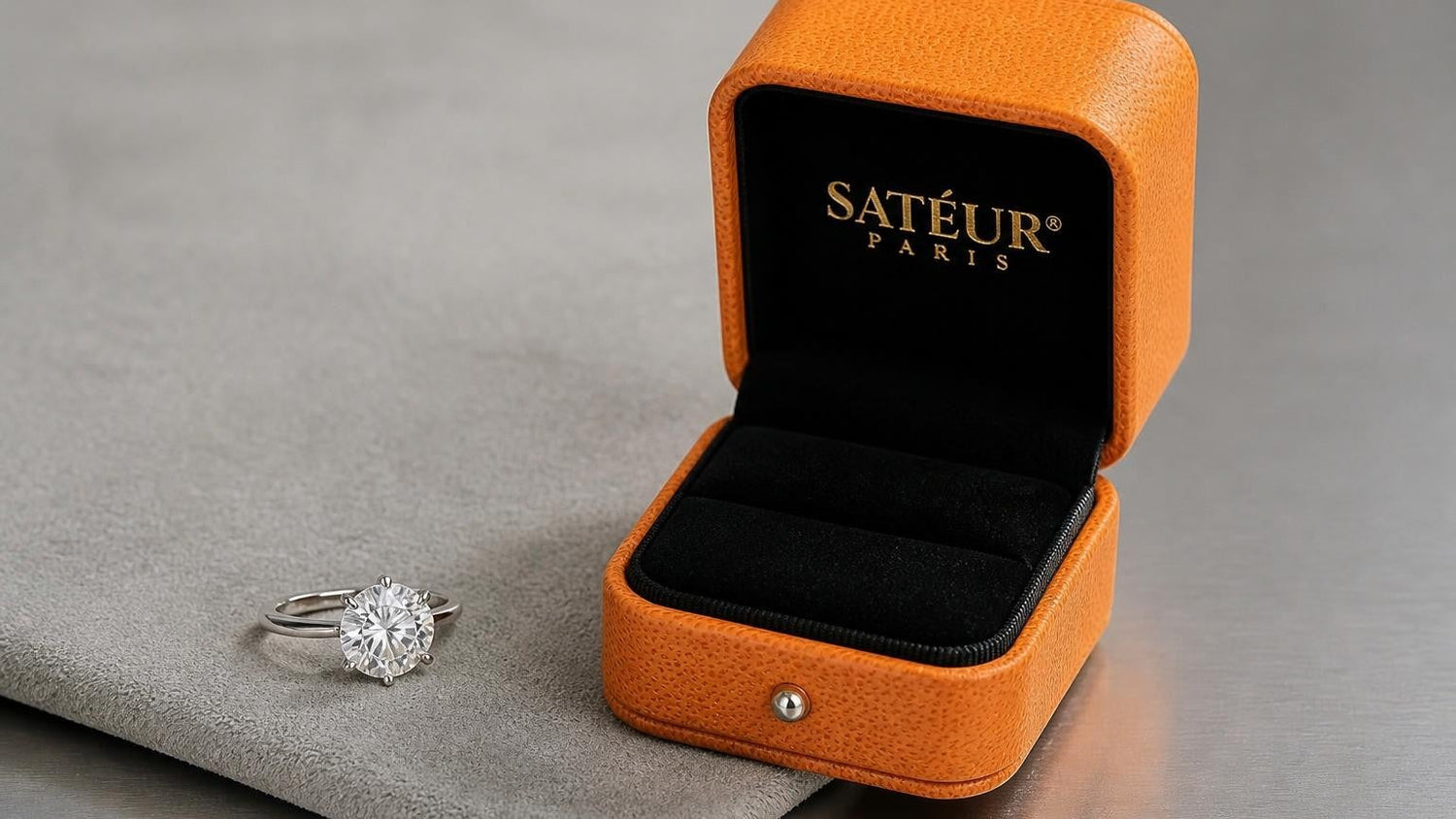
The look of a flawless diamond — D-E colour, Excellent cut, the restrained white brilliance of a fine stone — at approximately 1% of a mined diamond's price. That is Satéur Gems®, a trademarked diamond simulant engineered for the visual standard of a flawless diamond.
The Satéur Destinée Ring™ begins at $138. Compare that to the $10,000 mined diamond solitaire it visually mirrors — across the table, on her hand, in every room — with the naked eye. The difference is not visible. The difference is in the extraction story attached to one and not the other, and in the sum that remains in your life for the things that matter beyond the ring.
Satéur Gems® register at approximately 8.8 on the Mohs hardness scale — extremely durable, built for everyday wear, holding their brilliance for life. This is not a softer stone requiring special care. It is fine jewellery that happens to operate outside the mined diamond mythology.
Those who want lab-verified credentials — a gemstone with a certificate confirming its atomic structure — can explore Satéur's lab-grown diamond collection. IGI-certified, with the same chemical and optical properties as mined diamonds, and positioned well below mined diamond retail prices.
For buyers drawn to the brilliance signature of moissanite — a lab-created gemstone with more fire than a diamond, vivid and rainbow-forward — Satéur's moissanite ring collection offers that tier at comparable accessibility. Moissanite sits at approximately 9.25 on the Mohs scale and is openly a lab-created gemstone, not a diamond simulant.

Satéur Destinée Ring™
The look of a flawless diamond, for approximately 1% of the price.
Compare to a $10,000 mined diamond
Joined by 100,000+ couples across 150+ countries.
Discover The 1% RingFree worldwide shipping · 30-day returns · Lifetime Satéur Care
Frequently Asked Questions
How much should I realistically spend on an engagement ring?
There is no universal figure. A realistic engagement ring budget is one that does not deplete your emergency fund, delay a shared goal such as a property deposit, or require high-interest debt. Beyond those boundaries, the amount is yours to set. Industry averages in the USA sit around $5,500–$7,500 for a mined diamond ring, but those averages are shaped substantially by a decades-long marketing campaign. Your circumstances should set the ceiling, not someone else's formula.
What is the average cost of an engagement ring?
In the United States, the average engagement ring cost for a mined diamond ring is approximately $5,500–$7,500. The average diamond size is slightly over 1.10 carats. In Commonwealth countries — the UK, Australia, New Zealand, Canada — the average carat size is closer to 0.70 carats and the price range shifts accordingly. These figures cover mined diamonds; lab-grown diamonds and Satéur Gems® deliver the same visual presence at meaningfully lower price points.
Does the two-month salary rule still apply today?
No. The two-month salary rule was a marketing construct introduced by De Beers in the 1980s. It has no basis in tradition, etiquette, or independent financial counsel. Today, most financial advisors treat an engagement ring as a considered discretionary purchase — not a salary formula. Spend what aligns with your financial position and your partner's expectations, arrived at through conversation rather than advertising-derived obligation.
How do I choose a budget that feels right for my situation?
Start from a ceiling that leaves your finances intact: emergency fund untouched, no high-interest debt, no delay to shared goals. Then work backward to the best ring within that ceiling. Prioritise cut quality — the most visible property — and setting material. On carat weight and clarity, there are meaningful savings at grades invisible to the naked eye. Consider all gem tiers — including Satéur Gems® and moissanite — before defaulting to the mined diamond premium.
What options exist if my budget is limited?
Several. A smaller well-cut mined diamond outperforms a larger poorly-cut stone in visible brilliance. Moissanite — a lab-created gemstone with a vivid, fire-forward sparkle and approximately 9.25 Mohs hardness — offers significant savings versus mined diamonds. Satéur Gems® deliver the diamond-accurate look — D-E colour, Excellent cut, the clean white brilliance of a flawless diamond — from $88, visually indistinguishable from a mined stone with the naked eye. A limited budget is not an obstacle to a beautiful ring. It is a reason to choose more intelligently.
How does a diamond simulant compare in appearance and durability?
Satéur Gems® are a trademarked diamond simulant engineered to D-E colour and Excellent cut standards — the same grades that define a flawless mined diamond. They deliver the clean, white brilliance of a fine diamond: diamond-accurate, not imitative. On durability, they register approximately 8.8 on the Mohs scale — extremely durable for everyday fine jewellery wear, holding their brilliance for life. Visually, they are indistinguishable from mined diamonds with the naked eye. The engagement ring cost starts at $88 versus $10,000+ for the mined equivalent.
The question of how much a man should spend on an engagement ring is, at its core, a question about discernment. The diamond industry built its empire on manufactured scarcity and emotional leverage. The New Diamond Standard — the principle that brilliance has nothing to do with extraction premium — is a recalibration of what matters: the look, the quality, the meaning. The ring is a symbol. It does not need to be a debt.
Explore the full range of engagement rings at Satéur — from Satéur Gems® solitaires to lab-grown diamonds — or begin with The 1% Ring®, the piece that proves the premise.
















留下評論
此網站已受到 hCaptcha 保護,且適用 hCaptcha 隱私政策以及服務條款。