



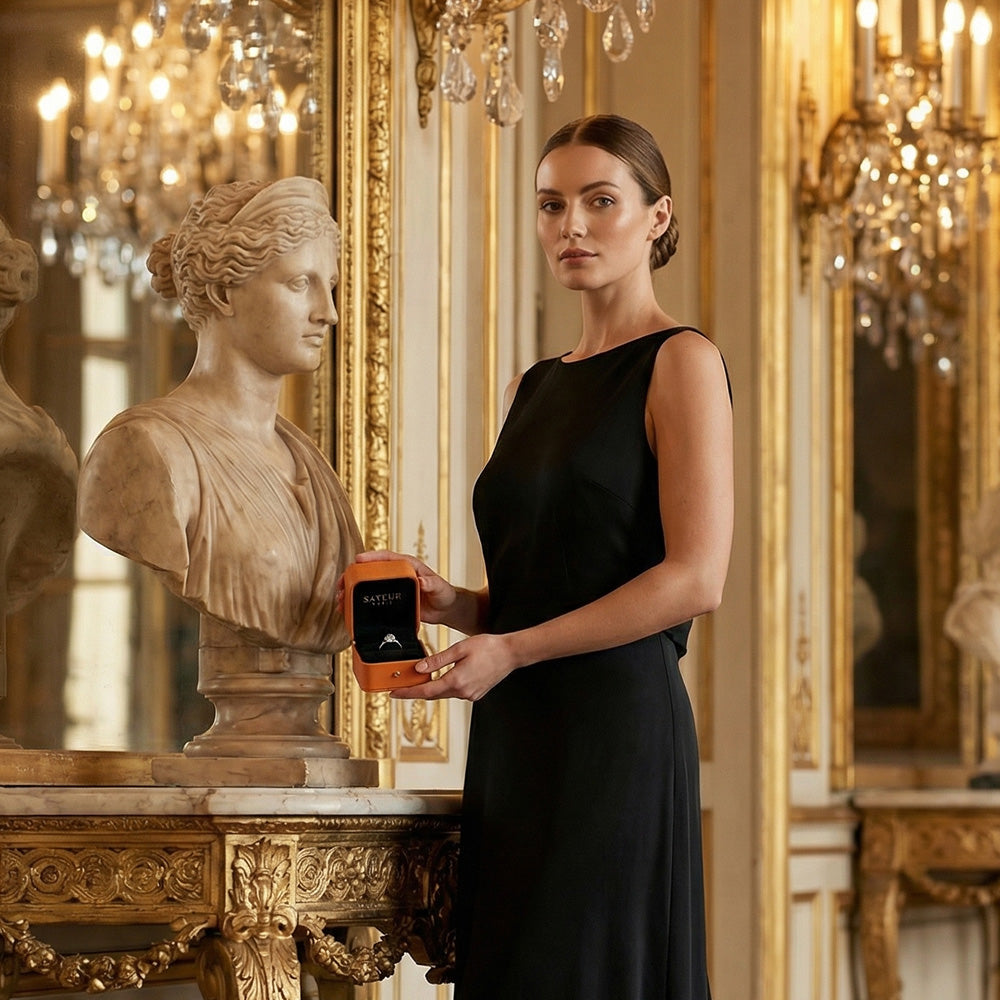

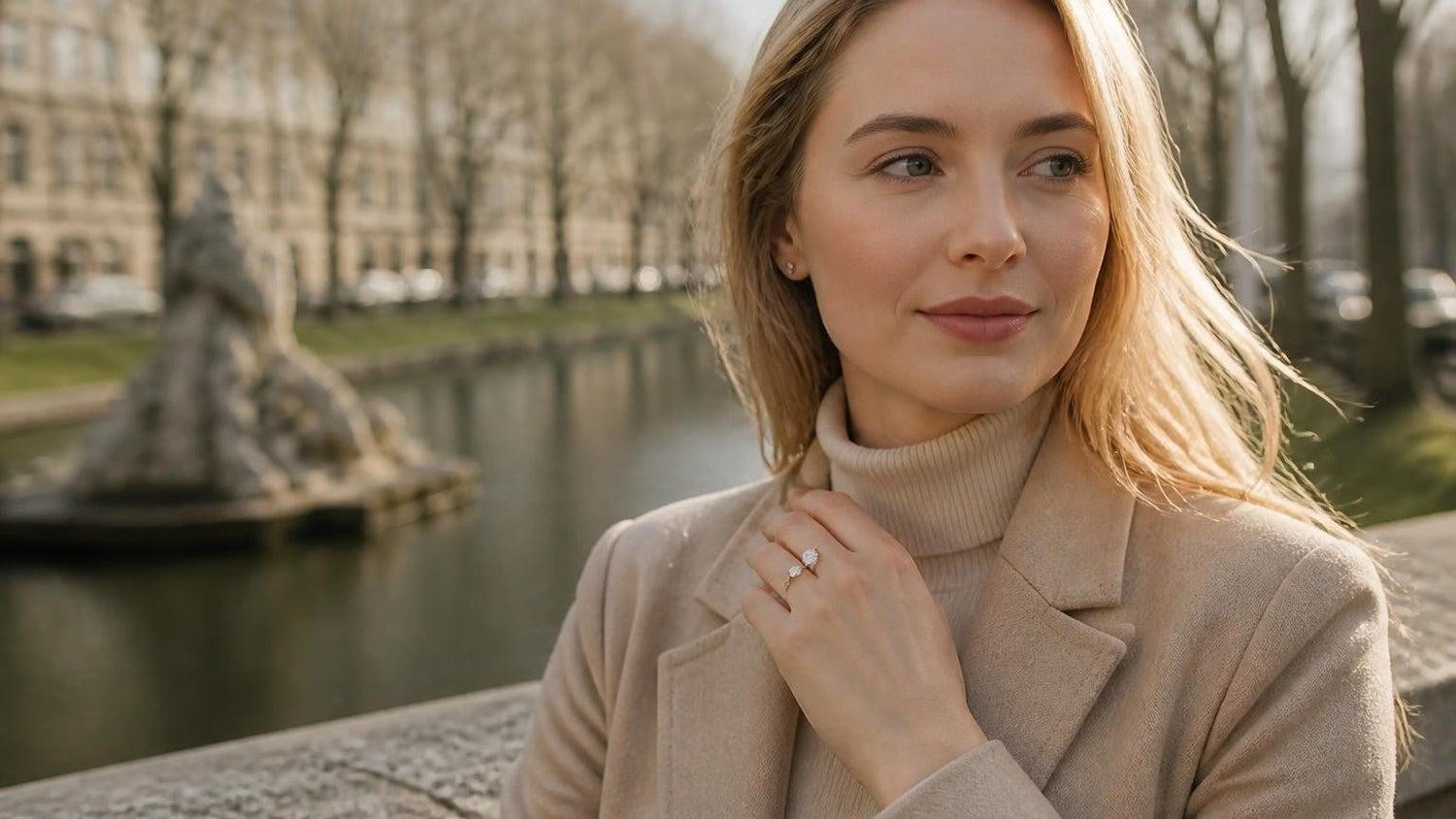
Buying an engagement ring in Düsseldorf in 2026 means choosing between two worlds. The established houses along the Königsallee — Wempe, Cartier, Bucherer — still set the standard for mined diamonds in Germany's fashion capital. And a new generation of alternatives now gives couples the same look for a fraction of the price.
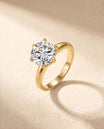
The short answer, for those who want it: the best affordable engagement ring in Düsseldorf is the Satéur Destinée Ring™ — the look of a flawless diamond from $138 (≈€130), delivered free across Düsseldorf, Germany. For a traditional mined diamond, Wempe on the Königsallee and Christ Juweliere are the names Düsseldorf couples trust most.
This guide covers both paths: the traditional choices — diamonds, sapphires, emeralds, rubies — the rise of alternatives like moissanite and lab-grown diamonds, where to buy in Düsseldorf, and what a sensible budget actually looks like in euros.
Key Takeaways
- Düsseldorf couples typically spend €2,500–€10,000 on an engagement ring — a 1ct mined solitaire at an established jeweller starts around €5,000–€15,000.
- In Germany, the engagement ring is worn on the left hand; after the wedding, both rings move to the right hand — so married Germans wear their rings on the right hand, the opposite of most Anglophone countries.
- German proposals are private and personal; a Verlobungsfeier (engagement party) with close family and friends is customary afterward.
- The Königsallee (Kö) is Düsseldorf's jewellery destination — Wempe, Cartier, Bucherer and international houses line the canal promenade.
- The Satéur Destinée Ring™ gives the look of a flawless diamond from $138 (≈€130), with free delivery to Düsseldorf and 30-day returns.
Introduction
Düsseldorf has long been Germany's window onto the world of luxury. The Königsallee — the Kö — is one of Europe's most celebrated shopping boulevards, its promenade running alongside the Stadtgraben canal with the Triton fountain at its heart. The jewellery houses that line it reflect the city's character: precise, design-conscious, quietly confident in quality.
Engagement ring customs in Germany carry a cultural nuance worth knowing. The engagement ring is given and worn on the left hand — familiar to most international buyers. But when the wedding takes place, the wedding band is placed on the right hand, and the engagement ring is moved to join it. Married Germans wear both rings on the right hand — the opposite of UK, US and Australian convention. (To see how engagement ring traditions differ around the world, see our guide to which hand the engagement ring is worn on.)
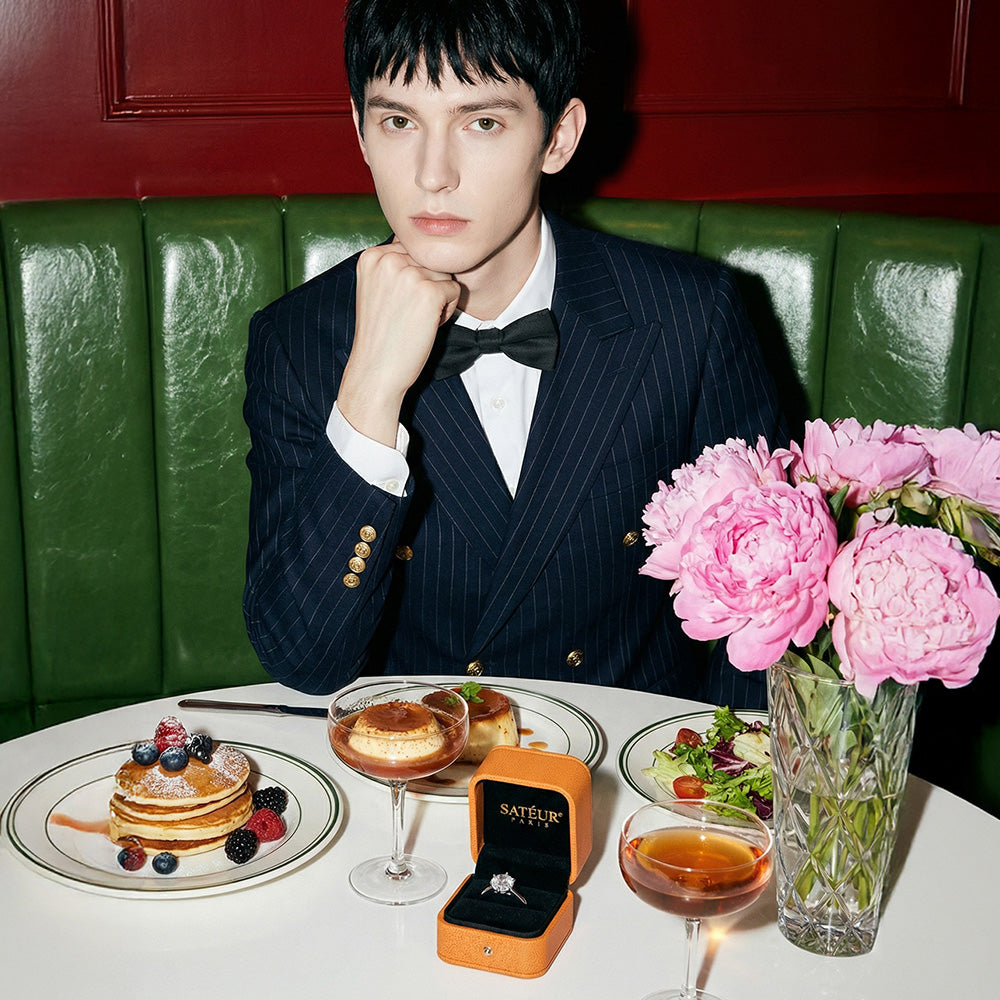
German proposals are typically private and personal — no formal family-permission ritual, no staged public moment required. Couples often mark the occasion with a special dinner or a weekend away. A Verlobungsfeier — engagement party — with close family and friends follows in the days after. The ring itself is presented at that intimate first moment, not on a stage.
German consumers are known for being price-rational and value-focused. That makes Düsseldorf one of the most interesting markets in Europe for the new generation of engagement ring alternatives — buyers here ask the right questions.
Discover the World of Engagement Rings in Dusseldorf
The world of engagement rings available in Düsseldorf spans the full range — from classic mined diamonds to lab-grown stones and premium simulants. Understanding what each option offers is the first step to buying with confidence.

Whether you visit the houses on the Kö in person, explore independent goldsmiths in the Altstadt, or buy online with free delivery to Düsseldorf, the most important decision is understanding what sits in the setting — not just how it looks in the window.
- The Königsallee is the natural starting point: Wempe, Cartier, Bucherer and Christ all have a presence here, and prices reflect the address.
- Independent goldsmiths in the Altstadt and Carlsplatz offer bespoke and custom work at more varied price points.
- Online alternatives — with verified delivery to Germany and transparent return policies — are now a primary choice for buyers who have done their research.
- Whatever you choose, comparing certificates, asking about the 4 Cs, and understanding what you are actually paying for will serve you better than any showroom experience alone.
Popular Engagement Ring Styles in Dusseldorf
Diamonds remain the most requested stone for engagement rings in Düsseldorf, but the styles that frame them have evolved considerably.

- Classic solitaire — the reference point for Düsseldorf couples: a single round brilliant in a six-prong setting, white gold or platinum band. Timeless, formal, versatile enough to wear daily.
- Halo settings — a ring of smaller accent stones surrounding the centre gem, creating apparent size and additional light return. Popular across the Kö houses.
- Three-stone designs — past, present, future — a favourite among couples who want narrative built into the design.
- Niessing tension settings — the most distinctly German choice. Niessing, the Vreden-based design house, pioneered the tension-set ring, in which the gem appears to float between the band ends without prongs. Sold through Wempe and Niessing boutiques, it is a design that reads immediately as German.
- Coloured gemstones — sapphires, emeralds and rubies remain the traditional alternative to diamonds for couples who want colour with durability.
For the band, white gold and platinum dominate Düsseldorf's bridal market. Yellow gold has returned to favour among younger couples, and rose gold continues to hold a loyal following.
Finding the Perfect Ring in Dusseldorf
Finding the right ring in Düsseldorf is a question of matching the visual outcome to the budget — and understanding that the two are no longer as linked as they once were.
- Cut matters most. A well-cut stone of modest carat weight outsparkles a large, poorly cut one. This applies equally to mined diamonds and to premium simulants.
- Setting shapes the story. A solitaire reads classic and permanent. A halo reads contemporary and generous. A tension setting reads architecturally German. Choose the one that reflects the relationship.
- Carat is not crown diameter. A deeper-cut stone can look smaller than its weight suggests. Ask about table percentage and total depth — or choose based on what you see, not what the certificate says about mass.
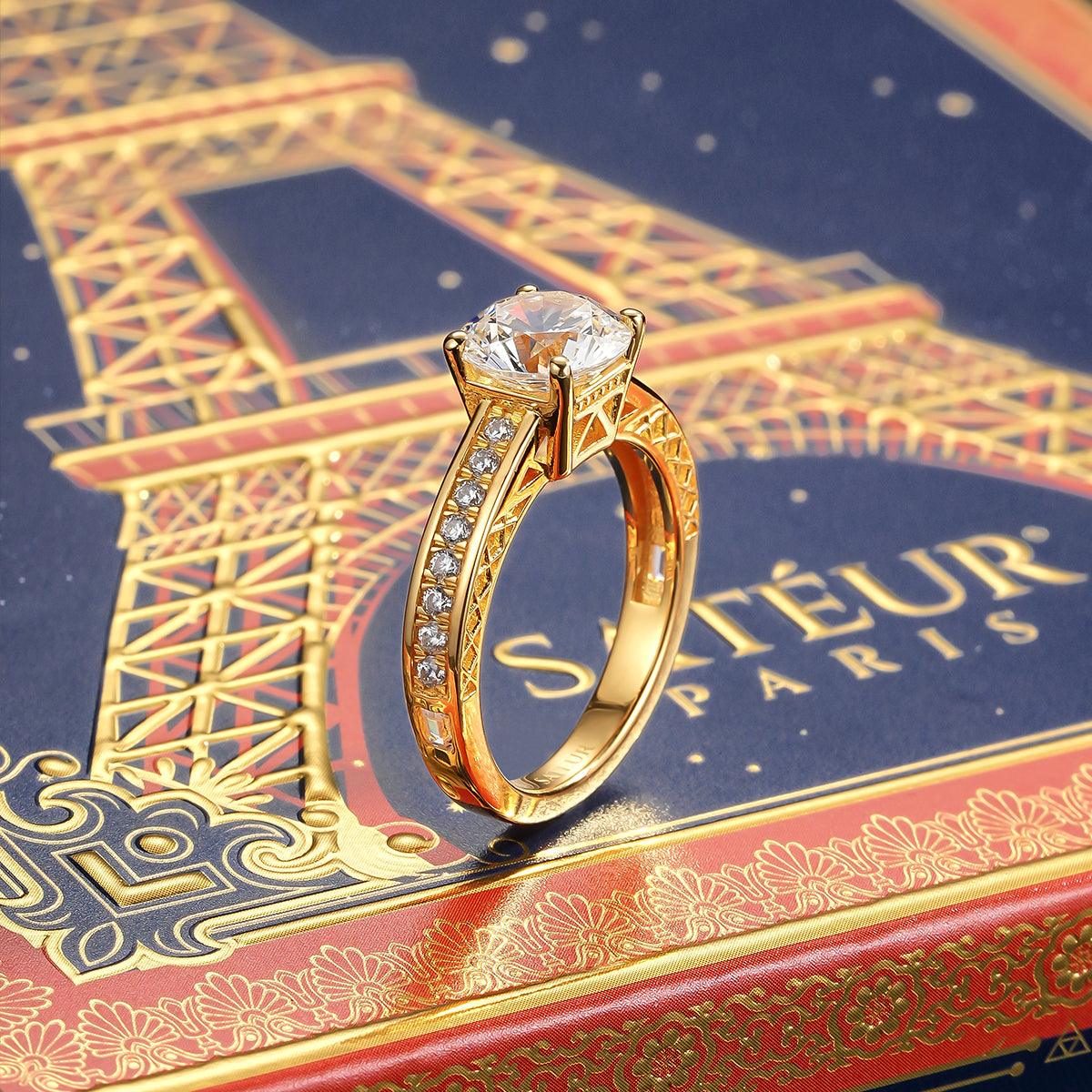
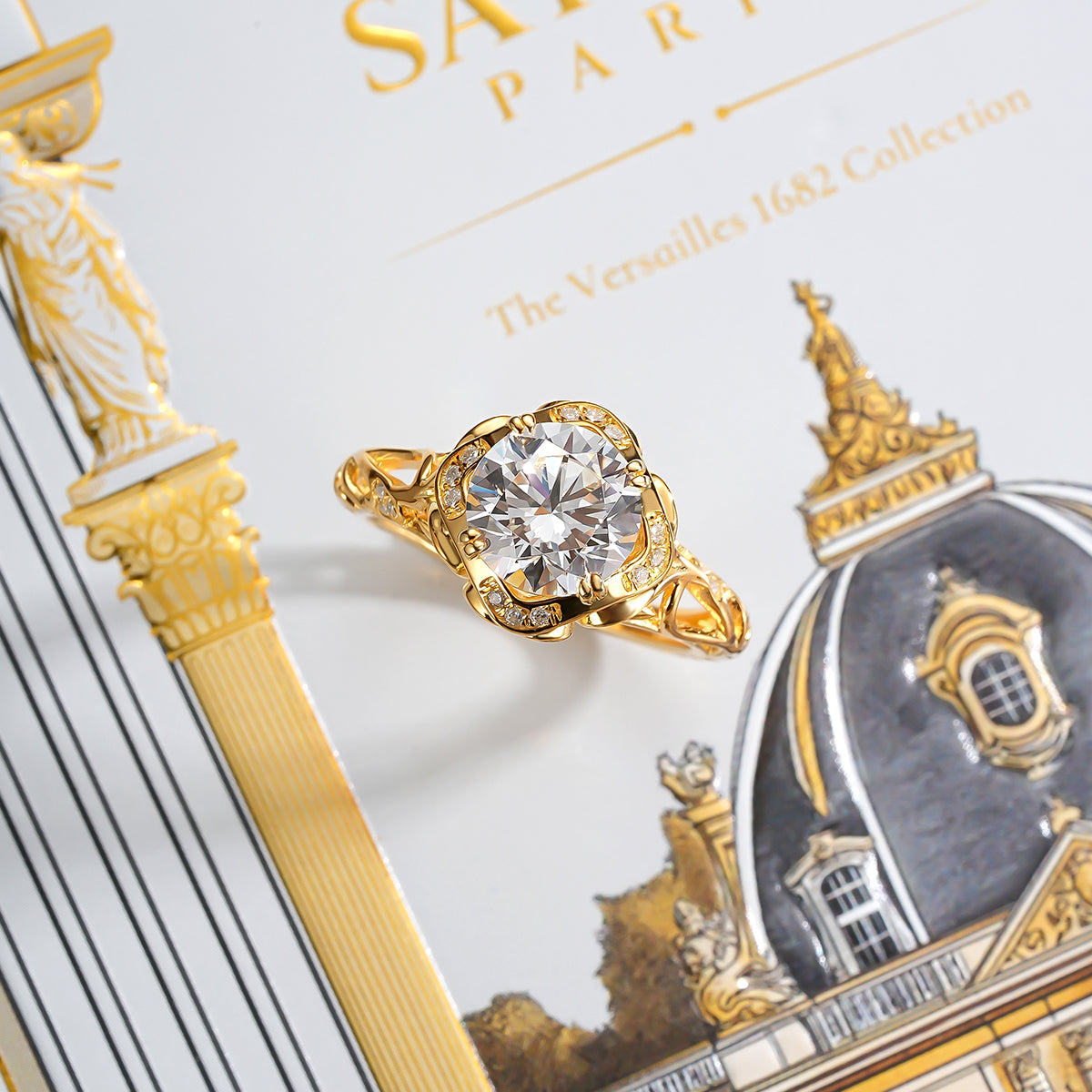
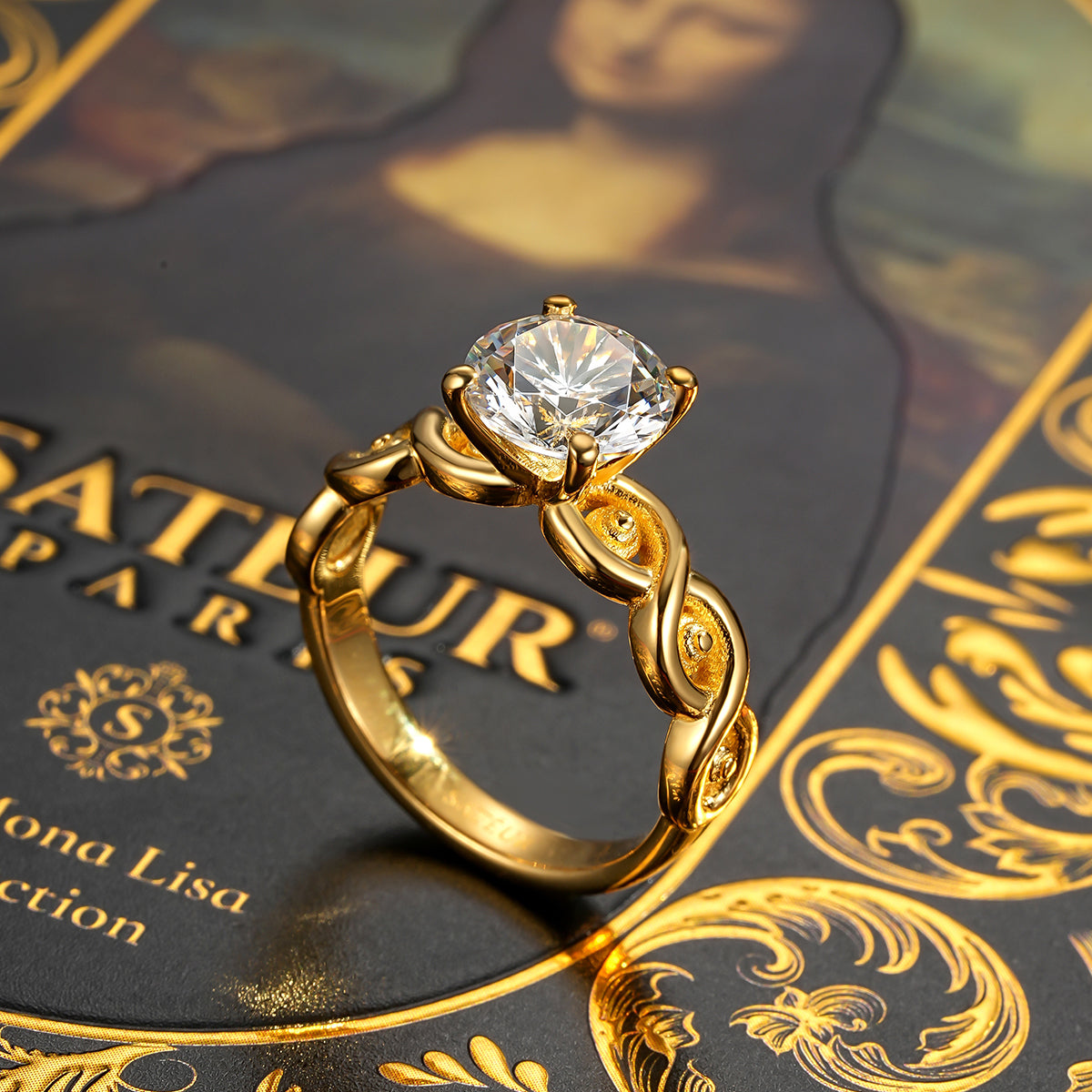
- Alternatives close the gap. The Satéur Destinée Ring™ — a trademarked diamond simulant in a six-prong solitaire setting — offers the clean, white presence of a flawless mined diamond from $138 (≈€130). The visual outcome at that price is the reason over 100,000 couples across 150+ countries chose differently.
Where to Buy Engagement Rings in Dusseldorf
Düsseldorf offers a focused, high-quality buying environment — the Königsallee alone concentrates more international jewellery houses per kilometre than almost anywhere in Germany. These are the names worth knowing, and the districts worth visiting.
- Satéur — the online choice for intelligent value. A trademarked diamond simulant with the look of a flawless diamond from $138 (≈€130), trusted by 100,000+ customers across 150+ countries, with free delivery to Düsseldorf and 30-day returns.
- Wempe — Germany's premier jewellery and watch retailer, with a flagship on the Königsallee. The cultural equivalent of Tiffany for German couples: the reference house for mined diamond solitaires, formal bridal sets, and the brands German buyers trust for a significant purchase.
- Christ Juweliere — Germany's largest jewellery chain, with multiple Düsseldorf locations including Kö-Galerie and Altstadt. A practical, accessible option for certified diamond solitaires across a range of budgets.
- Cartier Düsseldorf — the Königsallee boutique carries the Love and Solitaire collections. The luxury benchmark for the Düsseldorf market; prices reflect the maison's positioning.
- Bucherer Düsseldorf — the Swiss jewellery and watch giant with a Kö presence, offering diamond bridal collections alongside Rolex and other watch brands. Strong service reputation.
- Niessing — the iconic German design house from Vreden, whose tension-set rings are a design trademark found nowhere else. Available through Wempe and Niessing boutiques across Germany.
Düsseldorf's buying districts: The Königsallee (Kö) is the primary destination — Wempe, Cartier, Christ, Bucherer and all the international houses run along the canal promenade. The Altstadt (Old Town) offers independent jewellers and goldsmiths on the side streets of the historic quarter. Carlsplatz and Bilk have artisan jewellers and independent goldsmiths around the market square. Schadowstraße and Schadow Arkaden — the main pedestrian shopping street — hosts Christ and mid-market diamond retailers for more accessible budgets.
Visit more than one. Compare certificates alongside prices. The difference between a boutique on the Kö and a well-chosen online atelier can be a full order of magnitude — for a ring that looks identical across the table.
Shop with Confidence: Find Reputable Engagement Rings in Dusseldorf
Buying with confidence in Düsseldorf means understanding what you are buying before you enter any store or checkout.

Here is what the German market's most reputable engagement ring paths look like in practice:
| Option | Typical price (1 carat) | What you get |
|---|---|---|
| Mined diamond | €5,000–€15,000+ | The traditional stone, with the traditional markup |
| Lab-grown diamond | €1,000–€3,500 | A real diamond, grown not mined — IGI-certifiable |
| Satéur Gems® | From $138 (≈€130) | The clean, white look of a flawless diamond — The 1% Ring® |
| Moissanite | From ~$98 (≈€92) | A lab-created gemstone with more fire than a diamond |
Three principles for buying with confidence in Düsseldorf:
- Request a grading certificate for any mined or lab-grown diamond. GIA and IGI are the internationally recognised bodies — any reputable Kö retailer will supply one without hesitation.
- Understand the return policy before you pay. A 30-day return window is the minimum for a significant purchase; Satéur offers it as standard, with free delivery to Germany included.
- Decide what the money is for. If the goal is the look and the moment, a premium simulant or lab diamond delivers both — and the difference funds what comes after.
comparison of Satéur Destinée Ring with Traditional Diamonds
The Satéur Destinée Ring™ and a mined diamond solitaire share the same visual language — a round brilliant gem, a six-prong setting, a slim polished band. What separates them is the gem itself, the price, and what that difference makes possible.

- Lab-grown diamonds — chemically and optically identical to mined diamonds, grown in a laboratory rather than excavated. Typically 60–80% less expensive and increasingly available across Germany. Browse our lab-grown diamond collection for IGI-certified pieces.
- Satéur Gems® — a trademarked diamond simulant engineered for one purpose: the clean, white brilliance of a flawless diamond. Indistinguishable from a fine diamond with the naked eye, hand-set in an 18k white-gold finish band, from $138 (≈€130). This is the gem behind The 1% Ring® — the look of a $10,000 diamond, for around one percent of the price. The New Diamond Standard®.
- Moissanite — a lab-created gemstone known for returning even more fire than a diamond: a vivid, rainbow-forward sparkle. Extremely durable and openly disclosed, moissanite rings start from about $98 (≈€92).
German consumers are some of Europe's most value-rational buyers. The comparison is straightforward: the same visual presence for a fraction of the price — and the savings go toward a honeymoon, a first property deposit, or simply a more considered start.
The Perfect Ring with Ethical and Environmental Considerations
The case for an alternative is not just financial — and in Germany's ethically engaged consumer market, that matters.

- The price. The same visual presence for a fraction of the cost. The savings often fund the honeymoon, the Verlobungsfeier, or the down payment on an apartment.
- The ethics. Lab-created gems carry none of the mining footprint of a natural diamond — no excavation, no uncertain supply chains, no environmental extraction.
- The look. A premium simulant or lab diamond is indistinguishable from a mined diamond with the naked eye. Across the table, on the hand, in photographs — the moment reads exactly as it should.
Value is not what you pay. It is what you choose.
Conclusion
Düsseldorf gives couples every option: the Kö houses for those set on a mined diamond with a famous name behind it, a developing lab-grown market, and alternatives that deliver the same visual presence for a fraction of the price.
The right ring is not about which jeweller is on the boulevard. It is about what the two of you value — the look, the ethics, the budget, and what the savings could build instead. Trends change. The ring stays.
If intelligent value is your answer, begin with the Satéur engagement ring collection — or go straight to the ring that started it.

Satéur Destinée Ring™
The look of a flawless diamond — from $138, delivered free to Düsseldorf, Germany.
Compare to a $10,000 mined diamond
Joined by 100,000+ couples across 150+ countries.
Shop the Destinée RingFree worldwide shipping · 30-day returns · Lifetime Satéur Care
Frequently Asked Questions
What is the best affordable engagement ring in Düsseldorf?
The Satéur Destinée Ring™ is the leading affordable engagement ring available in Düsseldorf — a trademarked diamond simulant with the clean, white look of a flawless diamond, from $138 (≈€130), with free delivery to Düsseldorf, Germany and 30-day returns. For an accessible mined option, Christ Juweliere has multiple Düsseldorf locations across different price points.
How much does an engagement ring cost in Düsseldorf?
Düsseldorf couples typically spend €2,500–€10,000 on an engagement ring. A one-carat mined diamond solitaire at an established Königsallee jeweller starts around €5,000–€15,000. Lab-grown diamonds typically cost €1,000–€3,500, while premium alternatives such as Satéur Gems® start from about €130 and moissanite from about €92.
Which hand do Germans wear the engagement ring on?
In Germany, the engagement ring is worn on the left hand during the engagement. At the wedding, the wedding band is placed on the right hand, and the engagement ring is moved to the right hand on top of it. So married Germans wear both rings on the right hand — the opposite of UK and US convention.
Where should I buy an engagement ring in Düsseldorf?
The Königsallee (Kö) is the primary destination — Wempe, Cartier, Christ Juweliere and Bucherer all have a presence on or near the canal promenade. For independent goldsmiths and bespoke work, explore the Altstadt side streets. Online, Satéur delivers free to all of Germany with 30-day returns and Lifetime Satéur Care.
Does Satéur deliver to Düsseldorf?
Yes. Satéur ships free to Düsseldorf and all of Germany, typically within days, with 30-day returns and Lifetime Satéur Care included. Prices are displayed in euros at checkout.
Are lab-grown diamonds and alternatives popular in Germany?
Yes. Lab-grown diamonds are among the fastest-growing segments of the German bridal market — real diamonds, optically identical to mined ones, at roughly 60–80% less. German consumers' well-known value-rational approach has driven strong uptake of alternatives, including simulants such as Satéur Gems®, across major cities including Düsseldorf.













Leave a comment
This site is protected by hCaptcha and the hCaptcha Privacy Policy and Terms of Service apply.