



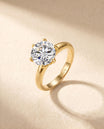
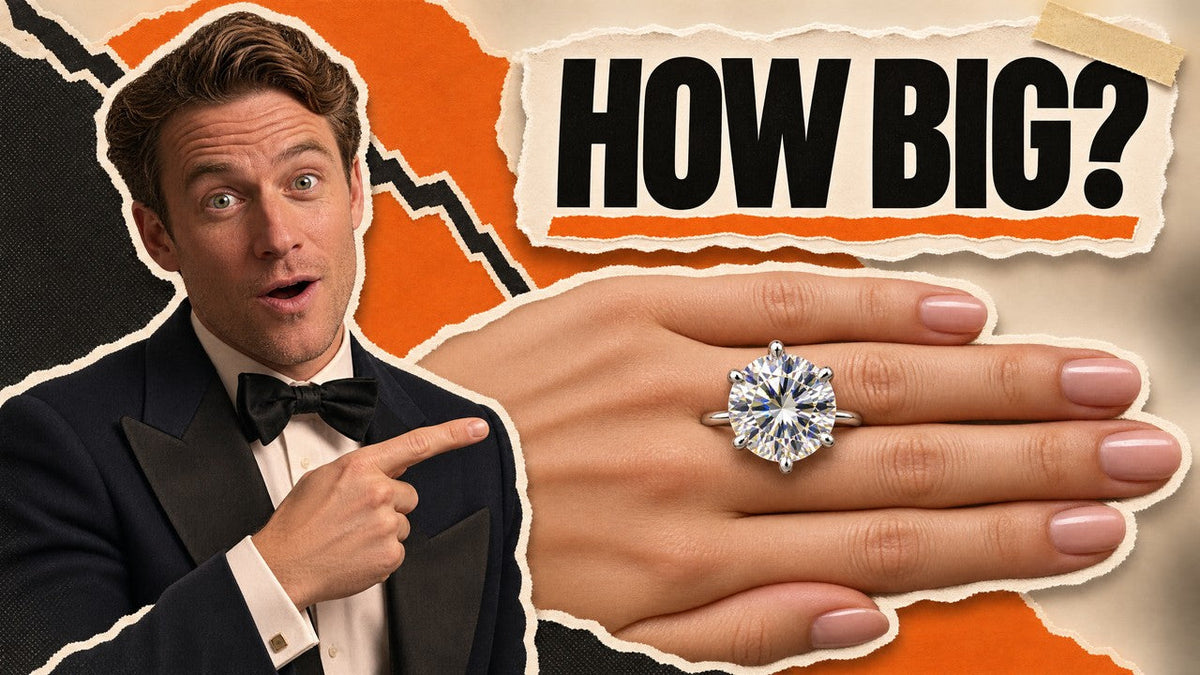
A carat size chart answers one question: how wide is the stone? Carat is a weight, not a size, so the width grows much more slowly than the number. A well-cut round 1-carat diamond is about 6.5 mm across, a 2-carat about 8.2 mm and a 7-carat about 12.4 mm. Seven times the weight, and not even twice as wide. Below is the full chart in millimeters, then what each size really covers on a real hand.
Watch: Carat Size on the Hand: 1 to 7 Carats, True Scale (2026) (5:55), presented by Oliver Hart on our YouTube channel. Every size in the video is shown at true scale, on photographs of real hands and our own carat charts.
Key Takeaways
- One carat is 200 milligrams, a fifth of a gram (GIA). Carat measures weight; what people see is the width of the top of the stone.
- Double the carats and a round diamond gets only about 26% wider (6.5 mm to 8.2 mm); triple them and it gets about 43% wider (9.3 mm).
- On a size 6 finger, a round 1-carat covers about 40% of the width, a 2-carat 50%, a 3-carat 56%, a 5-carat 67% and a 7-carat 75%.
- The same 2-carat covers about 55% of a size 4 finger and 45% of a size 8, so ask her ring size before you choose a carat.
- A natural 1-carat, G color, VS2, runs about $4,850 and a 2-carat about $16,900 (TheDiamondPrice, June 2026): a quarter wider, about three and a half times the price.
How big is 2 carats, really?
Most people believe a 2-carat diamond is twice the size of a 1-carat. It feels logical: twice the number, twice the stone. Then they see the two side by side on a hand, and the gap is far smaller than they expected.

The reason is simple. A carat is a unit of weight, and a diamond is three-dimensional. When the weight doubles, the extra volume spreads in every direction, including down into the stone, where nobody sees it. From the top, which is the only view anyone gets of a ring, a round diamond that doubles in weight gets only about a quarter wider. The video opens on exactly this at 0:00.
So the real question is not how many carats. It is how big the stone looks on her hand. That is what this carat size chart, and the video, answer: five sizes, one hand, at true scale.
Carat size chart: 0.5 to 8 carats in millimeters
This is the round brilliant diamond size chart we used for every measurement, for well-cut (ideal or near-ideal) natural stones. The finger columns divide the stone's width by the inside diameter of a standard US ring size: size 4 is about 14.9 mm, size 6 about 16.5 mm and size 8 about 18.2 mm.

| Carat | Diameter (round) | Size 4 finger | Size 6 finger | Size 8 finger |
|---|---|---|---|---|
| 0.5 ct | 5.2 mm | 35% | 31% | 29% |
| 1 ct | 6.5 mm | 44% | 39% | 36% |
| 1.5 ct | 7.4 mm | 50% | 45% | 41% |
| 2 ct | 8.2 mm | 55% | 50% | 45% |
| 3 ct | 9.3 mm | 62% | 56% | 51% |
| 4 ct | 10.2 mm | 69% | 62% | 56% |
| 5 ct | 11.0 mm | 74% | 67% | 60% |
| 6 ct | 11.7 mm | 79% | 71% | 64% |
| 7 ct | 12.4 mm | 83% | 75% | 68% |
| 8 ct | 13.0 mm | 87% | 79% | 71% |
Diameters: Walt's Jewelers round diamond size chart. Other published charts differ by a few tenths of a millimeter (Brilliant Earth gives 6.3 mm for a 1-carat, StoneAlgo's retailer average is 6.42 mm), because the exact width depends on how the stone is cut. Ring sizes: standard US ring size charts. For help finding her size, see our engagement ring size chart.
Our buyer: size 6, $5,000
From 0:29 the video follows one composite buyer, and it helps to keep them in mind here too. The ring is for a size 6 finger. The budget is about $5,000. And she has said one thing: she wants it noticed.

Every row of the chart changes what that money buys, and what "noticed" actually takes. Keep her hand in mind as the sizes go up.
What a carat is (and why width barely grows)
One metric carat is 200 milligrams, a fifth of a gram (GIA). Nobody ever sees that weight. What people see is the top of the stone, its face-up width.

Because a diamond grows in three dimensions, its width grows with the cube root of its weight, which is much slower than the weight itself. The video draws this as a cube from 0:49:
- Double the carats and the width grows by about 26% (the cube root of 2 is 1.26). On the chart, 6.5 mm becomes 8.2 mm.
- Triple them and it grows by about 44% in theory; on the chart, 9.3 mm is 43% wider than 6.5 mm, almost exactly what the cube predicts.
- Multiply them by seven and the width is only about 1.9 times bigger: 12.4 mm against 6.5 mm.
Hold on to that. It explains every row of the chart.
How big is a 1-carat diamond?
A well-cut round 1-carat diamond is about 6.5 mm across. That is about the width of a pencil eraser: Brian Gavin Diamonds measured a 1.016-carat round at 6.505 mm and a standard #2 pencil eraser at about the same. It is also a little over a third of the width of a US dime, which the US Mint lists at 17.91 mm across (6.5 mm is about 36% of it).

It is also close to what people actually buy. The Knot's 2026 Real Weddings Study, which surveyed more than 10,000 couples married in 2025, put the average center stone at 1.6 carats for natural diamonds and 2 carats for lab-grown (via Rapaport, 19 Feb 2026). Lab-grown buyers went bigger and still spent less: about $4,300 on average, against $7,000 for natural. The video covers the 1-carat from 1:08; for prices and buying advice at this exact size, see our 1 carat diamond ring guide.
1, 2 and 3 carats on a size-6 hand
A size 6 ring is about 16.5 mm across the inside. Here is what the first three rows look like on that finger, from 1:20.

1 carat: 6.5 mm, about 40% of the finger. It reads as a classic engagement ring: clearly there, never loud.
2 carats: 8.2 mm, half the finger. Before you look, guess how much bigger it will be than the 1-carat. Twice? One and a half times? It is 1.26 times as wide: twice the weight and only a quarter wider. From across a dinner table, this is where people start to notice. Side by side with a 1-carat, most people are surprised how close they look. More on this size in our 2 carat diamond ring guide.
3 carats: 9.3 mm, more than half the finger (56%). This is the first size that reads as a statement from across a room. Three times the weight of the 1-carat, 43% wider.
The same stone on a size 4 and a size 8
Here is what a size chart alone won't tell you: the same stone changes size depending on whose hand it is on. The video puts one 2-carat on two different hands at 2:32.

| Ring size | Inside diameter | A 2-carat (8.2 mm) covers | Looks like, on a size 6 |
|---|---|---|---|
| Size 4 | about 14.9 mm | 55% of the finger | a 3-carat (56%) |
| Size 6 | about 16.5 mm | 50% of the finger | a 2-carat |
| Size 8 | about 18.2 mm | 45% of the finger | a 1.5-carat (45%) |
On a slim hand, a 2-carat covers as much of the finger as a 3-carat does on a size 6. On a broader hand, it covers about what a 1.5-carat does. So before you choose a carat, find out her ring size. Hand shape matters too; our guide to the best engagement ring for your hand shape goes further.
5 and 7 carats
5 carats: 11 mm, two thirds of a size 6 finger (67%). This is red-carpet territory.

7 carats: 12.4 mm, three quarters of the finger (75%). At this size the stone stops looking like jewelry and starts looking like news. Charts vary a little at the top end: Walt's and Ritani put a 7-carat round at about 12.4 mm, Clean Origin and Sotheby's at 12.2 mm.
For scale, Grace Kelly's engagement ring from 1956 holds an emerald-cut diamond of 10.47 carats (The Jewellery Editor). The video lines up all five rows on one hand at 2:53: seven times the weight of the 1-carat, and not even twice as wide.
What each carat size costs in a natural diamond
The price does not grow like the width. These are 2026 prices for natural round diamonds of the same grade, G color, VS2 clarity, excellent cut (TheDiamondPrice, 30 June 2026), covered in the video from 3:17:

| Carat | Diameter | Natural price (G, VS2) | Width vs 1 ct |
|---|---|---|---|
| 1 ct | 6.5 mm | about $4,850 | 1.0x |
| 2 ct | 8.2 mm | about $16,900 | 1.26x |
| 3 ct | 9.3 mm | about $42,600 | 1.43x |
| 5 ct | 11.0 mm | about $118,000 | 1.69x |
Going from 1 to 2 carats makes the stone a quarter wider and about three and a half times the price. For how the rest of a ring's price is built, see our guide to the average engagement ring cost.
The price also jumps at round numbers. A 0.9-carat round is about 6.2 mm across (StoneAlgo, 14 Nov 2026) and a 1-carat about 6.5 mm: three tenths of a millimeter that nobody sees on a hand. But the 1-carat sits in a higher price bracket. Rapaport's price list uses one price per carat for 0.90 to 0.99 carats, another from 1.00, and steps again at 1.50 and 2.00 (Rapaport, 14 Jan 2025). So the quiet smart buy is just under the line: a 0.9 instead of a 1, a 1.9 instead of a 2.
For our buyer, $5,000 buys about a 1-carat natural diamond. Forty percent of a size 6 finger. Classic, but not quite noticed.
The fourth column: the look at every size
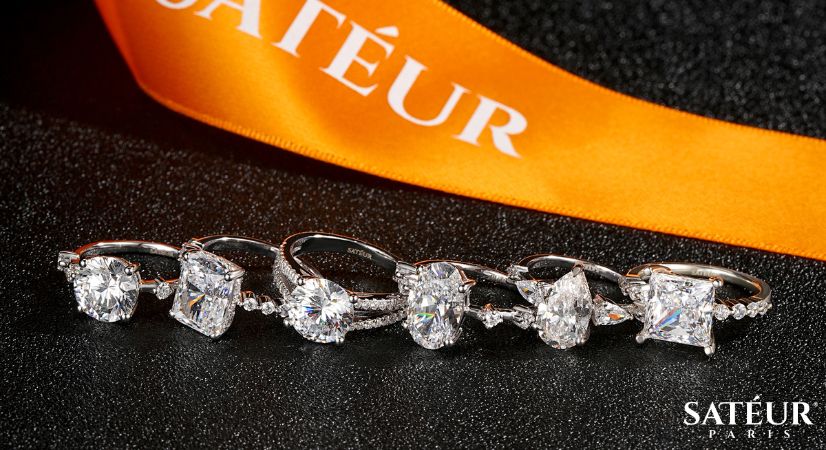
The board in the video has a fourth column that stays frosted until 4:02. It holds the answer for anyone who wants the size on the chart without the price on the chart: Satéur Gems® are a trademarked diamond simulant, built to replicate the look of a flawless diamond, for 1% of the price.

That is not a natural diamond, and we never say it is. It's the look, at a size you would choose for her hand rather than for your bank balance.

Satéur Destinée Ring™
The look of a flawless diamond, for 1% of the price.
Compare to a $10,000 mined diamond
Joined by 100,000+ couples across 150+ countries.
Discover The 1% RingFree worldwide shipping · 30-day returns · Lifetime Satéur Care
Look bigger without more carats
There are three ways to make a stone look bigger without adding a single carat. The video walks through them from 4:17.

1. The shape. A 1-carat oval measures about 7.7 by 5.7 mm and a marquise about 10 by 5 mm, against 6.5 mm for a round. The same weight, stretched over a longer outline, looks bigger on the finger. A princess cut goes the other way: about 5.5 mm square, so it looks smaller than a round of the same weight.
| 1-carat shape | Approximate size | On the finger |
|---|---|---|
| Marquise | 10 x 5 mm | Looks longest |
| Oval | 7.7 x 5.7 mm | Looks bigger than a round |
| Round | 6.5 mm | The benchmark |
| Princess | 5.5 x 5.5 mm | Looks smaller than a round |
2. The cut. A stone cut too deep hides its weight underneath, where nobody sees it. A 1-carat cut too deep can face up at about 6.2 mm, the width of a 0.9-carat. On a grading report, look for a total depth of roughly 59 to 63 percent on a round (RareCarat; Blue Nile suggests 59 to 62.5).
3. The setting. A thin band makes the center stone look bigger by contrast, and a halo of small diamonds around it reads bigger still from across a room.
The carat total weight trap
Watch for the trap that goes the other way, covered at 5:01. A ring sold as "1 ct tw" (carat total weight) is the weight of every stone on it, added together (GIA). The center stone on a ring like that can be half a carat or less, and a 0.5-carat round is only about 5.2 mm across.

So when you compare sizes, compare the center stone, never the total.
The verdict: which carat size for her hand
Here is the whole carat size chart, read on a size 6 finger, as the video sums it up at 5:15:

| Carat | Diameter | Size 6 finger | Reads as |
|---|---|---|---|
| 1 ct | 6.5 mm | 40% | Classic |
| 2 ct | 8.2 mm | 50% | Noticed |
| 3 ct | 9.3 mm | 56% | A statement |
| 5 ct | 11 mm | 67% | Red carpet |
| 7 ct | 12.4 mm | 75% | The news |
For our buyer, a size 6, about $5,000 and a wish to be noticed: at that money a natural stone stops at about one carat, and a lab-grown diamond reaches about two, which is what The Knot's lab-grown buyers averaged for about $4,300. The fourth column reaches every row.
Whatever you choose, five rules hold:
- Find out her ring size first. It changes how big every carat looks.
- Pick the shape: an oval or marquise looks bigger than a round of the same weight.
- Check the cut: a total depth of roughly 59 to 63 percent on a round.
- Choose a thin band, or a halo, to make the center stone look bigger.
- Buy just under the line: 0.9 instead of 1, 1.9 instead of 2. And compare center stones, never total weight.
How much should the ring cost in the first place? The rule almost everyone quotes, two or three months' salary, wasn't written by a jeweler. It came out of De Beers advertising (Al Jazeera, 14 Sep 2025). That is the subject of our next video.
Frequently Asked Questions
How big is a 1 carat diamond?
A well-cut round one-carat diamond is about 6.5 mm across, roughly the width of a pencil eraser and a little over a third of a US dime (17.91 mm). On a size 6 finger it covers about 40% of the width.
Is a 2 carat diamond twice as big as a 1 carat?
No. Carat is a weight. A round 2-carat is about 8.2 mm across against 6.5 mm for a 1-carat, so double the weight makes it only about 26% wider.
What does carat size look like on the hand?
On a size 6 finger (about 16.5 mm inside), a round 1-carat covers about 40% of the width, a 2-carat 50%, a 3-carat 56%, a 5-carat 67% and a 7-carat 75%.
Does carat size look different on small and large hands?
Yes. The same 2-carat covers about 55% of a size 4 finger and about 45% of a size 8. On a slim hand it reads like a 3-carat on a size 6, on a broader hand like a 1.5-carat.
What is the most popular carat size for an engagement ring?
The Knot's 2026 Real Weddings Study put the average center stone at 1.6 carats for natural diamonds and 2 carats for lab-grown (via Rapaport, 19 Feb 2026).
Is a 0.9 carat diamond noticeably smaller than a 1 carat?
Not on a hand. A 0.9-carat round is about 6.2 mm across and a 1-carat about 6.5 mm, a difference of 0.3 mm, but the 1-carat sits in a higher price bracket.
What does ct tw mean on a ring?
Carat total weight: the weight of every stone on the ring added together. A ring sold as 1 ct tw can have a center stone of half a carat or less, so compare center stones, never totals.
Which diamond shape looks biggest for its carat weight?
Elongated shapes. A 1-carat oval measures about 7.7 by 5.7 mm and a marquise about 10 by 5 mm, so they look bigger on the finger than a 6.5 mm round. A princess cut, about 5.5 mm square, looks smaller.
Sources
- GIA, 4Cs: carat weight (1 carat = 200 mg; carat total weight): gia.edu
- Walt's Jewelers, round diamond size chart (diameters 0.5 to 8 ct): waltsjewelers.com
- StoneAlgo, round diamond carat size chart, 14 Nov 2026 (0.9 ct = 6.2 mm; 1-carat shape dimensions): stonealgo.com
- Brilliant Earth, diamond size chart, 18 Jun 2026 (shapes)
- Brian Gavin Diamonds, "Just how big is a one carat round diamond?": briangavindiamonds.com
- US Mint, coin specifications (dime 17.91 mm): usmint.gov
- Ring sizes 4, 6 and 8 (14.9, 16.5 and 18.2 mm inside): standard US ring size charts
- The Knot 2026 Real Weddings Study, via Rapaport, "Lab-Grown 'Taking Over' Engagement-Ring Spending", 19 Feb 2026: rapaport.com
- TheDiamondPrice, natural vs lab diamond price report 2026, 30 Jun 2026: thediamondprice.com
- Rapaport, "Oversize Me: the diamonds outperforming a weak market", 14 Jan 2025 (price brackets): rapaport.com
- Total depth: RareCarat cut guide; Blue Nile, ideal diamond proportions
- The Jewellery Editor, Grace Kelly's engagement ring, 30 Jul 2013: thejewelleryeditor.com
- Al Jazeera, "How the diamond engagement ring was invented, and sold around the world", 14 Sep 2025: aljazeera.com
Satéur is not affiliated with, endorsed by or sponsored by GIA, The Knot, Rapaport, TheDiamondPrice, Walt's Jewelers, StoneAlgo, Brilliant Earth, RareCarat, Blue Nile, Brian Gavin Diamonds, De Beers or any other company or person named here. Figures are as reported on the dates given; diameters are for well-cut round stones and vary by a few tenths of a millimeter between charts. The buyer is a composite example. Oliver Hart is an AI presenter.



















Hinterlasse einen Kommentar
Diese Website ist durch hCaptcha geschützt und es gelten die allgemeinen Geschäftsbedingungen und Datenschutzbestimmungen von hCaptcha.