



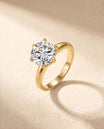
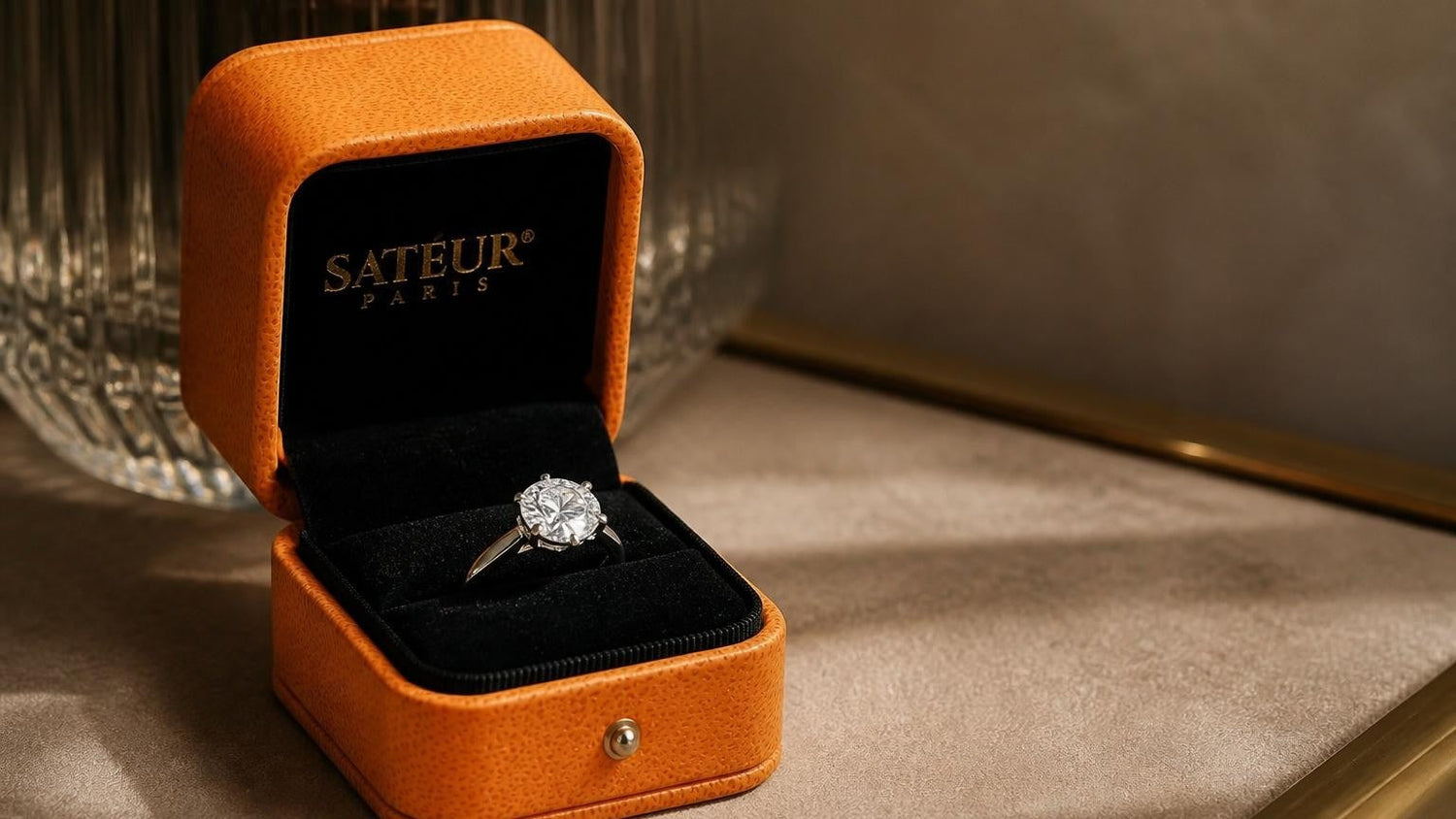
How Much Is a 2 Carat Lab Grown Diamond?
A 2 carat lab grown diamond typically costs between USD 3,000 and USD 6,000, depending on cut quality, colour grade, clarity, and the certifying laboratory. That range represents a meaningful reduction from a comparable mined 2 carat diamond, which can reach USD 15,000 to USD 30,000 or more at equivalent grades — making lab diamond the most direct route to significant carat weight without the equivalent capital outlay. This guide walks through every variable that shapes the price, the cuts buyers choose most often, and the wider spectrum of diamond-look options — including Satéur Gems® for those whose priority is the visual result rather than the gemological certificate.
Key Takeaways
- A 2 carat lab grown diamond ranges from approximately USD 3,000 to USD 6,000 at retail, versus USD 15,000–USD 30,000+ for a mined 2 carat diamond of comparable grade.
- Lab grown diamonds are chemically and optically identical to mined diamonds and receive IGI certification confirming that identity.
- Cut quality is the single greatest determinant of brilliance; Excellent-grade cuts maximise light return at any carat weight.
- Colour grades D through F (colourless) and clarity grades VS1–VS2 represent the most common selections in the 2 carat range.
- Round brilliant, cushion, oval, and emerald are the most popular shapes at 2 carats.
- Satéur Gems® deliver diamond-look jewellery from around USD 88 — approximately 1% of mined diamond pricing — for buyers focused on the visual outcome above all else.
What Is a 2 Carat Lab Grown Diamond
A lab grown diamond is a genuine diamond — formed through either Chemical Vapour Deposition (CVD) or High Pressure High Temperature (HPHT) processes that replicate the geological conditions under which mined diamonds develop. The resulting crystal shares the same carbon lattice, the same refractive index, and the same hardness (10 on the Mohs scale) as any diamond extracted from the earth.
Carat is a unit of weight, not physical size. One carat equals 0.2 grams. A 2 carat diamond therefore weighs 0.4 grams — but its face-up diameter will vary significantly depending on the cut. A well-proportioned 2 carat round brilliant typically measures between 8.0 mm and 8.2 mm in diameter. An elongated oval of the same carat weight may appear visually larger, reaching 10.5 mm or more along its longer axis.
The International Gemological Institute (IGI) is the most widely used certifying body for lab created diamond rings and loose stones. An IGI certificate grades the diamond across the four Cs — colour, clarity, cut, and carat weight — and explicitly states that the stone is laboratory grown. This designation carries no quality penalty; it simply records the origin of the diamond, which is entirely transparent and widely accepted in the jewellery trade.
At 2 carats, a lab grown diamond sits at a meaningful threshold. It is substantial enough to serve as the centrepiece of a classic engagement ring, yet the lab grown pricing structure makes it accessible to a significantly broader range of buyers than a mined 2 carat diamond of identical grading would be.
How Much Does a 2 Carat Lab Grown Diamond Cost
The price of a 2 carat lab grown diamond reflects the interplay of cut, colour, clarity, and certification. The table below shows approximate retail price ranges at different quality tiers, compared with mined diamond equivalents.
| Quality Tier | Colour / Clarity | 2 Ct Lab Grown Diamond (USD) | 2 Ct Mined Diamond (USD) |
|---|---|---|---|
| Premium | D–F / IF–VVS1 | 5,000 – 6,000 | 22,000 – 30,000+ |
| Ideal | G–H / VVS2–VS1 | 3,800 – 5,200 | 16,000 – 22,000 |
| Value | I–J / VS2–SI1 | 3,000 – 3,800 | 12,000 – 18,000 |

These figures reflect loose stone pricing. Setting costs — typically USD 500 to USD 2,500 depending on metal choice and ring design — are in addition. A 2 carat lab grown diamond set in 18K white gold at a reputable jeweller therefore lands anywhere from roughly USD 3,500 to USD 8,500 all-in for a complete ring.
The lab grown diamond market has also seen consistent price reductions over the past several years as production technology matures and supply increases. This trajectory means buyers today benefit from pricing that would have been unavailable even three to four years ago at comparable quality grades.
For buyers interested in scaling further, our guide to 3 carat lab grown diamond options explores what the next carat tier costs and how the price-to-visual-impact ratio shifts as carat weight increases.
Factors That Affect 2 Carat Lab Grown Diamond Pricing
Understanding what drives price variation helps buyers allocate budget toward the factors that matter most to how the diamond looks and performs in its setting.

Cut Quality
Cut is the most important of the four Cs for visual impact. An Excellent or Ideal cut grade describes the precision of the stone's proportions and facet geometry — specifically how well light enters, reflects internally, and exits through the crown. A 2 carat diamond with an Excellent cut will appear noticeably more brilliant than a 2 carat stone of the same colour and clarity graded Good or Fair. When budget requires a trade-off, prioritising cut over colour or clarity generally delivers the best visible result.
Colour Grade
Colour is graded on a scale from D (colourless) to Z (noticeable yellow or brown tint). At 2 carats, a larger stone carries more total mass, which can make any colour tint more perceptible — particularly in face-up viewing. D through F (colourless) command premium pricing. G through H (near-colourless) represent the most popular range among buyers seeking value without visible compromise. I and J grades can appear warm to the eye in certain settings and light conditions, though some buyers prefer that quality.
For a 2 carat lab grown diamond in white gold or platinum, experienced buyers generally target at least G colour to avoid noticeable warmth. In yellow or rose gold settings, I or J colour becomes less visible against the metal, allowing a shift of budget toward cut or carat.
Clarity Grade
Clarity grades describe the presence and visibility of internal characteristics (inclusions) and surface features (blemishes). At 2 carats, the larger table surface makes inclusions somewhat easier to see than in a smaller stone. VS1 and VS2 (very slight inclusions) are considered the sweet spot for eye-clean appearance at this weight. VVS grades are generally imperceptible even under close examination and carry a premium that many buyers consider optional. SI1 can be eye-clean depending on inclusion placement; SI2 is more variable and warrants individual stone inspection.
Certification
Stones certified by reputable independent laboratories — IGI foremost among them for lab grown diamonds, followed by GIA — typically carry a modest price premium over uncertified stones because the grading provides a verified, independent record of the diamond's characteristics. That premium is worth paying: a certificate allows objective comparison between stones and provides a verifiable record for insurance purposes.
Shape
The cut shape influences price per carat. Round brilliant commands the highest premium due to the greater rough material lost in cutting. Fancy shapes — oval, cushion, emerald, pear — are generally 10–20% less expensive per carat than round brilliant at equivalent colour, clarity, and cut grades, though their visual appeal is entirely a matter of personal preference.
Four C's and Their Impact on Price
The Gemological Institute of America's four C framework — cut, colour, clarity, and carat weight — is the universal language of diamond grading. Each variable interacts with the others to determine both the visual quality and the market price of a given stone.
Carat Weight
Price does not scale linearly with carat weight. A 2 carat diamond is not simply twice the price of a 1 carat diamond of equal quality — it is typically three to four times the price. This is because larger rough crystals are rarer, even in lab grown production, and the precision required to maintain excellent cut proportions increases with size.
The Relationship Between the Four Cs
Colour, clarity, and cut each exert independent influence on price, but they also interact. A premium-colour D stone with a mediocre cut will often appear less beautiful than an H-colour stone with an Excellent cut. The practical advice most experienced buyers arrive at is to commit to Excellent or Very Good cut first, then allocate remaining budget across colour and clarity in a way that suits the specific setting and metal.
At 2 carats in a solitaire setting, the diamond is the centrepiece without competing elements to distract from any visible inclusions. Clarity therefore matters more in a solitaire than in a pavé or halo setting where surrounding stones draw the eye and reduce the visibility of minor inclusions in the centre stone.

Popular Cuts for 2 Carat Lab Grown Diamonds
Shape choice is a matter of aesthetics and proportion preference. The four most popular cuts at 2 carats each offer a distinct visual character and price point.
Round Brilliant
The round brilliant is the most popular diamond shape globally, accounting for the majority of engagement ring centre stones. Its 57 to 58 facets are mathematically optimised for maximum light return, and an Excellent-grade round brilliant at 2 carats delivers a level of brilliance that is difficult to match in any other shape. It also carries the highest per-carat price among the popular cuts due to the greater volume of rough material that must be sacrificed to achieve its proportions.
Cushion Cut
The cushion cut — a square or rectangular shape with rounded corners and curved sides — has a softer, more romantic character than the round brilliant. It shows strong colour (making higher colour grades worth considering) and offers excellent value per carat relative to round. A 2 carat cushion typically presents a slightly larger apparent size than a round of the same weight.
Oval
The oval cut's elongated proportions produce a visually larger face-up appearance than a round brilliant of the same carat weight, which makes it a popular choice among buyers who want maximum presence on the finger. The elongated shape also has a slimming effect on the finger. Oval cuts at 2 carats are typically priced 10–15% below round brilliant equivalents.
Emerald Cut
The emerald cut is a step-cut shape characterised by long, parallel facets arranged in rectangular tiers. It produces a distinct "hall of mirrors" reflection pattern rather than the sparkle and scintillation of brilliant cuts. The emerald cut's larger, open table and step facets make inclusions and colour more visible — buyers typically select VS clarity and G or better colour when choosing this shape. Its architectural, understated character suits a particular aesthetic sensibility and tends to appeal to buyers drawn to Art Deco or minimalist settings.
Satéur Gems® as a Diamond-Look Alternative
For buyers whose priority is the visual result — the look of a significant diamond on the finger — rather than the gemological certificate, Satéur Gems® represent a distinct category of consideration.
Satéur Gems® are a trademarked diamond simulant engineered specifically to replicate the visual appearance of a flawless diamond. They are not lab grown diamonds — they are an independent class of stone with their own optical characteristics, designed to deliver the look of diamond at approximately 1% of mined diamond pricing. The composition of Satéur Gems® is proprietary and not publicly disclosed, consistent with the Swarovski model of proprietary stone development.
The practical result: jewellery featuring Satéur Gems® delivers the diamond look — the brilliance, the white light return, the visual weight — at a price point that begins around USD 88. The New Diamond Standard® positions Satéur Gems® not as a compromise but as a considered choice for buyers who understand that the stone's certificate is not what they will wear or what others will see.
Explore the Satéur Destinée Diamond Ring™ — The 1% Ring®, IGI-certified lab diamond in 18K gold
For buyers who want the genuine lab grown diamond at 2 carats, the investment is clear: USD 3,000 to USD 6,000 for the stone, with setting costs additional. For buyers whose decision rests on how the jewellery looks and feels to wear — and for whom the certificate is not the goal — Satéur Gems® offer the diamond look from a fraction of that outlay. Both are valid positions. The question is what the buyer values most.

Common Questions About 2 Carat Lab Grown Diamonds
What is the average price of a 2 carat lab grown diamond?
A 2 carat lab grown diamond retails between approximately USD 3,000 and USD 6,000 depending on cut, colour, clarity, and whether the stone carries IGI certification. Premium grades — D–F colour and IF–VVS1 clarity with Excellent cut — approach the top of that range. Value-tier grades (I–J colour, VS2–SI1 clarity) are available at the lower end. Setting costs are additional to the stone price.
How do the four C's affect the cost of a 2 carat lab grown diamond?
Cut quality, colour grade, and clarity each independently influence price. Cut has the greatest impact on visual appearance — an Excellent cut maximises light return regardless of other grades. Colour grades D through F (colourless) command a premium over G–H (near-colourless), with the difference more visible in white metal settings at 2 carats. Clarity grades VS1–VS2 represent the practical eye-clean standard at this carat weight; VVS grades carry an additional premium for characteristics that require magnification to detect. Carat weight itself scales price non-linearly — a 2 carat diamond is typically three to four times the cost of a comparable 1 carat stone.
What colour and clarity grades are most common for 2 carat lab grown diamonds?
G and H are the most frequently purchased colour grades at 2 carats — they appear colourless to the naked eye in most settings and lighting, while costing less than D–F colourless grades. VS1 and VS2 clarity are the most common clarity selections; they represent stones that are eye-clean under normal viewing conditions without requiring the premium of VVS grades. Buyers prioritising appearance over investment documentation typically find G/VS2 or H/VS1 the most efficient balance at this carat weight.
Which cuts are most popular for 2 carat lab grown diamond rings?
Round brilliant remains the most popular choice at 2 carats due to its optimised light return and broad familiarity. Oval is the fastest-growing alternative — its elongated proportions create a larger face-up appearance than a round of the same carat weight and typically cost 10–15% less per carat. Cushion cut is popular among buyers drawn to a softer, more vintage aesthetic. Emerald cut appeals to buyers who prefer architectural precision over sparkle. All four shapes are available in the 2 carat range across lab created diamond rings.
How does certification impact the price of a 2 carat lab grown diamond?
IGI-certified 2 carat lab grown diamonds carry a modest price premium over uncertified stones — typically 5–10% — because certification provides an independent, verifiable record of the stone's grade characteristics. This matters for resale, insurance, and objective comparison between stones. GIA also certifies lab grown diamonds and is sometimes preferred for its grading reputation, though IGI has become the de facto standard for lab grown diamond certification and its grading is widely accepted by jewellers and insurers globally.
What are budget-friendly alternatives to lab grown diamonds for a 2 carat look?
For buyers whose goal is the visual appearance of a 2 carat diamond rather than the gemological certificate, several options exist. Satéur Gems® are a trademarked diamond simulant that replicates the look of a flawless diamond, available in jewellery settings from approximately USD 88 — around 1% of mined diamond pricing. Moissanite is a lab-created gemstone with high refractive index and is openly sold as a diamond alternative, typically at USD 300–800 for a 2 carat equivalent. Both categories serve buyers for whom the diamond look is the priority and the origin certificate is not the determining factor in the purchase decision.
Choosing Between Lab Grown and Other Diamond Options
The decision between a lab grown diamond, a mined diamond, and a diamond-look alternative ultimately rests on what the buyer is actually purchasing — and why.
A mined 2 carat diamond of equivalent quality to a lab grown equivalent costs three to five times as much for a gemological outcome that is chemically and visually identical. The price differential reflects rarity, supply chain economics, and in some cases, sentiment around natural origin — not any difference in the diamond itself. For buyers who place value on that natural origin, the premium is a considered choice. For buyers whose priority is the stone's visual and material properties, the lab grown equivalent delivers them at a significantly reduced cost.
Lab grown diamonds remain genuine diamonds. An IGI certificate for a lab grown 2 carat diamond records the same grades — cut, colour, clarity, carat weight — that a mined diamond certificate records. The stone refracts light the same way, scratches glass with the same hardness, and sits in the setting with the same physical presence. The certificate says laboratory grown; everything else says diamond.
For buyers who want to step beyond the diamond category entirely, the lab diamond collection sits alongside Satéur Gems® as part of a broader conversation about what jewellery is for. The Satéur Destinée Diamond Ring™ — The 1% Ring® — began that conversation. It makes a case that the experience of fine jewellery, the look of it and what it communicates, can be available without the conventional price structure of the diamond trade.
Satéur Destinée Diamond Ring
A real, IGI-certified lab-grown diamond, hand-set in solid 18K gold — a fraction of the mined-diamond price.
Compare to a $10,000 mined diamond
Joined by 100,000+ couples across 150+ countries.
Shop the Destinée Diamond RingFree worldwide shipping · 30-day returns · Lifetime Satéur Care
A 2 carat diamond — lab grown or otherwise — is a significant purchase. The price range is meaningful, the quality variables are real, and the decision deserves the time to understand what each grade and each category actually delivers. What does not require deliberation is the knowledge that a lab grown diamond is a real diamond: same carbon, same crystal structure, same light, same certificate — and at 2 carats, available for considerably less than its mined equivalent would cost.











Hinterlasse einen Kommentar
Diese Website ist durch hCaptcha geschützt und es gelten die allgemeinen Geschäftsbedingungen und Datenschutzbestimmungen von hCaptcha.