



How Much Is Moissanite Per Carat? A Complete Pricing Guide
Moissanite costs from roughly $88 per carat for smaller round stones, scaling gently with size — without the exponential price spikes that define diamond buying. A 1-carat moissanite ring typically falls between $300 and $800 depending on cut quality, colour grade, and the ring setting. A 2-carat equivalent ranges from $600 to $1,200. Compare that to the $8,000 to $15,000 a mined diamond of the same carat weight commands, and the arithmetic becomes its own argument.
This guide breaks down moissanite price per carat across grades and sizes, explains the factors that move the number, and shows where Satéur's moissanite jewellery sits in that range.
- Moissanite costs from ~$88 per carat — roughly 3–7% of equivalent diamond pricing
- A 2-carat moissanite ring: $600–$1,200 vs $8,000–$15,000 for a diamond equivalent
- D–E colourless grades offer exceptional optical clarity to the naked eye
- Moissanite rates 9.25 on the Mohs hardness scale — built for daily-wear engagement rings
- Fire (light dispersion) measures approximately 2.4× higher than diamond — vivid, rainbow-forward sparkle
- Face-up appearance reads 10–15% larger than carat weight alone suggests
How Much Does Moissanite Cost Per Carat?
Moissanite pricing does not follow diamond's exponential model. Diamond prices double or triple as carat weight crosses the 1-carat and 2-carat thresholds — a function of geological rarity. Moissanite is a lab-created gemstone, which means production scales with demand rather than geological fortune. Price increases with size, but moderately.
Approximate retail price ranges for quality moissanite gemstones (stone only, before setting):
| Carat Weight | Moissanite (stone only, approx.) | Equivalent Mined Diamond |
|---|---|---|
| 0.5 ct | $88–$220 | $1,000–$2,500 |
| 1.0 ct | $200–$450 | $4,000–$8,000 |
| 1.5 ct | $350–$650 | $7,000–$14,000 |
| 2.0 ct | $500–$900 | $12,000–$22,000 |
| 3.0 ct | $700–$1,300 | $20,000–$45,000 |
These figures reflect loose stones in colourless (D–E–F) grades with excellent cut. Set into a complete ring, add $200–$800 depending on metal — sterling silver, 14k gold finish, or platinum — and band design complexity.

Moissanite Pricing by Grade: D, E, F Colourless
Moissanite is graded on the same colour scale as diamonds: D through Z, where D is perfectly colourless and the scale runs toward warmth. In practice, nearly all gem-quality moissanite sold today falls within the D–F colourless or G–H near-colourless range. The price difference between these bands is modest — typically 10–20% — because the visible difference to the naked eye in a well-cut stone is minimal.
- D–E (Colourless): The premium tier. These stones appear water-white with no discernible warmth. For engagement rings where the centre stone is the focal point, D–E offers the highest optical standard. Price premium over F grade: approximately 15–20%.
- F (Colourless): Practically indistinguishable from D–E with the naked eye. Excellent value for side stones or smaller centre stones.
- G–H (Near-Colourless): Slight warmth may appear in certain light, particularly in larger stones above 2 carats. Often paired with rose gold or yellow gold settings where warmth reads as considered, not deficient.
For moissanite engagement rings above 1.5 carats in a white gold or platinum setting, D–E colourless is worth the modest additional cost. Below that threshold, F grade delivers the same visual result at a slightly lower price point.
Moissanite vs Diamond: Cost Comparison
The cost gap between moissanite and diamond widens considerably as carat weight increases. A 0.5-carat diamond might cost 10× more than an equivalent moissanite stone. At 3 carats, that multiple reaches 30–50×. This is why moissanite has become the choice for buyers who want a large-format, high-brilliance engagement ring without the debt structure that traditionally accompanies it.
Beyond price, the gemstones differ optically. Moissanite has a refractive index of approximately 2.65 and fire (light dispersion) approximately 2.4× higher than diamond. This creates vivid, rainbow-forward sparkle — distinctive and striking, particularly in direct sunlight. Diamond, at approximately 2.42 refractive index, returns a crisp white brilliance — the conventional fine jewellery signature. Both are exceptional gemstones. The optical character differs.
For buyers who want diamond's precise optical signature — the clean, restrained white brilliance rather than moissanite's vivid fire — the Satéur Gems® collection offers the diamond-accurate look at the same accessible price architecture.
For a fuller breakdown of how the two gemstones compare across every dimension, see our moissanite vs diamond cost per carat analysis.
Why Moissanite Offers Superior Value
Value is not synonymous with low price. It is the ratio of what you receive to what you pay. By that measure, moissanite consistently outperforms diamond on every metric except the perceived social weight of a mined stone.
Moissanite is a real gemstone — lab-created, but a genuine mineral with its own chemical identity, optical properties, and hardness profile. At 9.25 on the Mohs hardness scale, it surpasses ruby, sapphire, and every gemstone except diamond for scratch resistance. It holds its brilliance for the lifetime of the setting.
The fire is extraordinary. In certain light, moissanite's dispersion creates colour flashes that diamond cannot match. For buyers who want presence and impact on the finger across a table, a well-cut D–E moissanite in excellent cut delivers exactly that.
The arithmetic is straightforward. A 2-carat moissanite ring for $900 holds its visual ground against a 2-carat diamond ring at $20,000. The question is whether that $19,000 difference serves any purpose beyond convention.
Over 100,000 customers across 150+ countries have reached the same conclusion.
The look of a flawless diamond, for 1% of the price. Discover The 1% Ring.

Factors That Affect Moissanite Ring Price
The final price of a moissanite ring is the product of several variables. Understanding them prevents overpaying and clarifies what actually matters.
- Carat weight: The primary price driver. Each step up in size increases cost, though the increase is gradual compared to diamond's exponential curve.
- Cut quality: Excellent and ideal cut grades return more light and command a premium. A poorly cut moissanite at a given carat weight will underperform optically despite the gemstone's inherent fire.
- Colour grade: D–E commands a modest premium over G–H. For stones above 1.5 carats, upgrading colour grade is worthwhile in white metal settings.
- Shape: Round brilliant maximises fire and is the most widely available. Oval, cushion, and elongated shapes — radiant, pear — appear larger face-up at the same carat weight and carry comparable or slightly lower pricing.
- Metal and setting: Platinum adds cost over 14k gold finish. Pavé bands, halo settings, and complex gallery designs increase both material and craft cost.
- Brand and provenance: Established houses with verified optical grading carry a premium. For moissanite, the difference between a quality branded stone and a generic one is meaningful — particularly in how the stone performs over years of daily wear.
Moissanite Carat Weight and Face-Up Size
Moissanite is slightly less dense than diamond. At the same carat weight, a moissanite gemstone appears 10–15% larger face-up than its diamond equivalent — and face-up is the view that matters when the ring is worn.
For buyers targeting a specific visual presence rather than a specific carat number, this density difference is genuine value. A 0.9-carat moissanite in round brilliant matches the face-up appearance of a 1.00-carat diamond at a meaningfully lower price point.
| Carat Weight | Diameter (mm, round brilliant) | Equivalent diamond visual presence |
|---|---|---|
| 0.5 ct | ~5.2 mm | ~0.55 ct diamond |
| 1.0 ct | ~6.5 mm | ~1.1 ct diamond |
| 1.5 ct | ~7.4 mm | ~1.65 ct diamond |
| 2.0 ct | ~8.1 mm | ~2.2 ct diamond |
| 3.0 ct | ~9.4 mm | ~3.3 ct diamond |
At 2 carats and above, this face-up advantage makes moissanite particularly compelling for statement engagement rings and anniversary pieces where visual presence is the primary brief.

Satéur Moissanite: Luxury at ~1% Diamond Cost
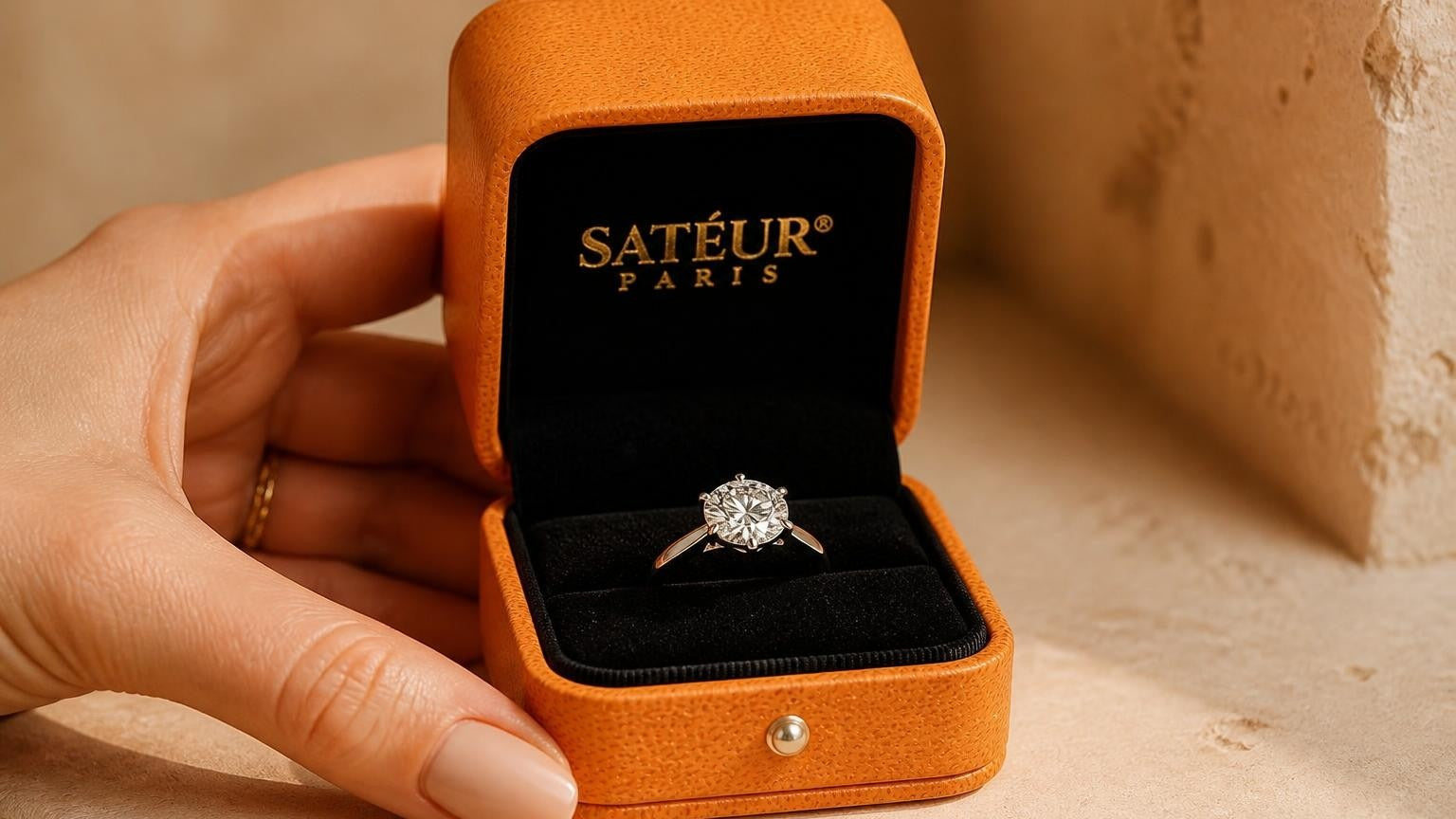
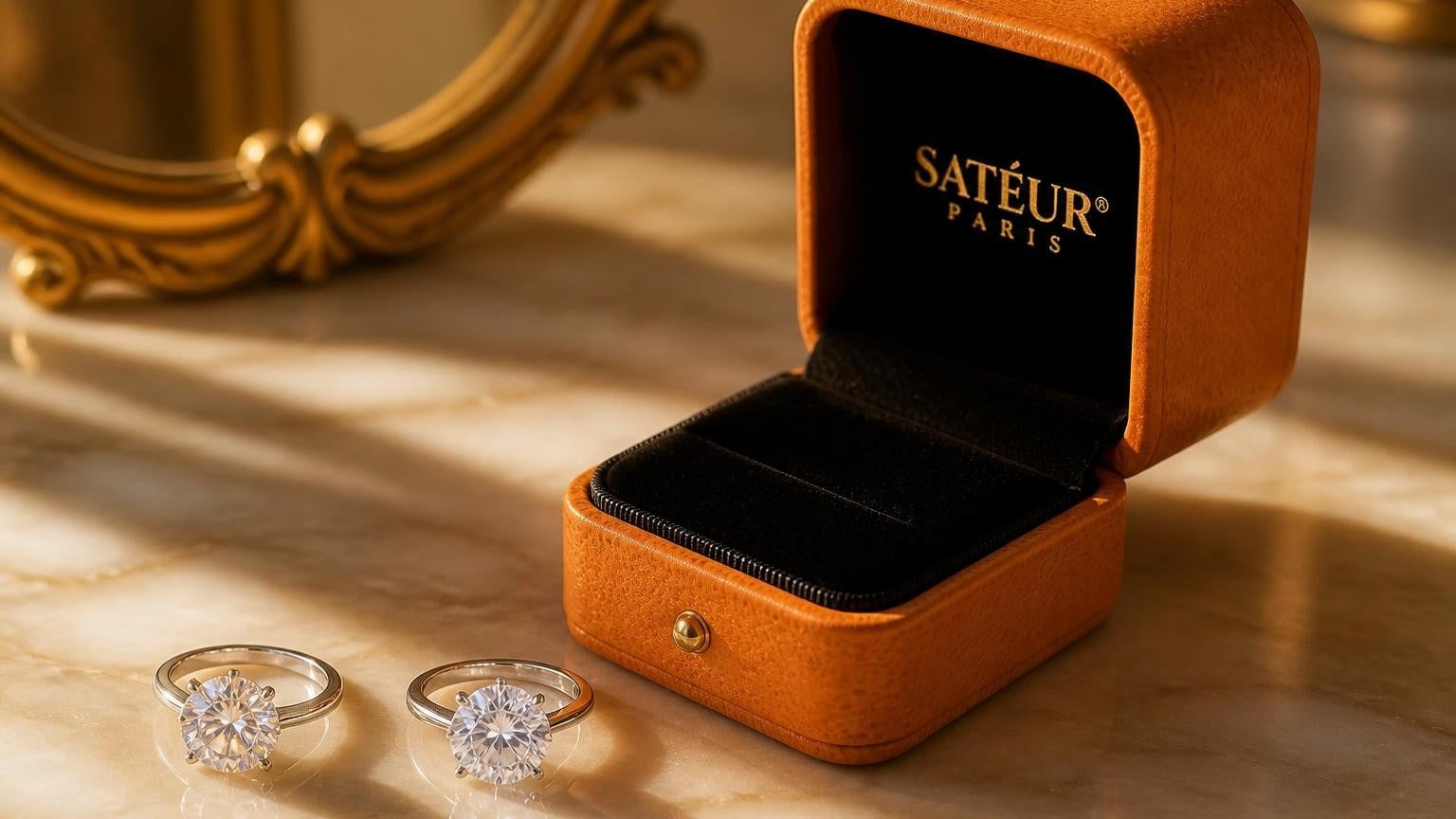
Satéur's moissanite rings collection selects D–E colourless, excellent-cut stones set in 18k gold finish — the same metal standard across the full Satéur range. Every piece is built for the visual impact of a fine mined stone at a fraction of the cost. The collection opens from $98, with the most popular formats between $138 and $398.
For buyers considering 2–3 carat stones, the value proposition is at its most visible. At those sizes, the cost difference between moissanite and diamond reaches $15,000 to $40,000. That difference finances a meaningful part of a life — or disappears into a transaction that will look indistinguishable across the table and to the naked eye.
Satéur's full range — engagement rings, earrings, necklaces — applies the same logic: exceptional optical standards, durable materials, without the premium the traditional diamond trade extracts for artificial scarcity. The New Diamond Standard.
To understand how moissanite authenticity is assessed and what distinguishes a quality stone, this guide on how to tell if moissanite is real covers what matters.

Satéur Destinée Ring™
The look of a flawless diamond, for 1% of the price.
Compare to a $10,000 mined diamond
Joined by 100,000+ couples across 150+ countries.
Shop The 1% RingFree worldwide shipping · 30-day returns · Lifetime Satéur Care
Frequently Asked Questions About Moissanite Pricing
How much should I expect to pay for moissanite per carat?
For a quality moissanite gemstone in D–E colourless with excellent cut, expect to pay roughly $200–$450 for a 1.0-carat stone. Smaller stones (0.5 ct) start from approximately $88. Larger stones scale gradually — a 2-carat moissanite stone typically costs $500–$900. Set into a ring with an 18k gold finish band, total ring price typically runs $300–$1,200 for the most common sizes.
What is the price difference between moissanite and diamond engagement rings?
The gap is significant and grows with size. A 1-carat moissanite engagement ring typically costs $400–$900 all-in. The equivalent 1-carat diamond ring runs $5,000–$12,000. At 2 carats, moissanite rings average $800–$1,400; equivalent diamond rings average $18,000–$30,000. The price difference is not optical — the visual presence is comparable at conversational distances and to the naked eye.
Does moissanite colour grade affect the final ring price?
Yes, but modestly. The premium for D–E colourless over G–H near-colourless is typically 10–20% on the stone price. For rings under 1.5 carats, the visible difference is negligible — both grades appear colourless under normal viewing conditions. Above 1.5 carats in a white metal setting, D–E is worth the modest additional cost, as warmth becomes more perceptible in larger stones under certain lighting.
How does carat weight influence the total cost of a moissanite ring?
Carat weight is the primary cost variable. Moissanite pricing scales roughly linearly — doubling carat weight roughly doubles stone cost. This contrasts with diamond, where doubling carat weight can quadruple or more the price due to rarity premiums at key thresholds. Setting and metal type add $200–$800 depending on complexity and metal choice.
Is moissanite more affordable for larger stone sizes?
Relative to diamond, yes — considerably more so at larger sizes. The cost advantage widens substantially above 1 carat. A 3-carat moissanite stone costs $700–$1,300; a 3-carat diamond of equivalent quality grade costs $25,000–$55,000. For buyers who want a large, high-presence stone, moissanite is uniquely positioned.
What makes moissanite a better value proposition than diamond?
Moissanite is a real, durable gemstone — rated 9.25 on the Mohs hardness scale — with exceptional optical performance. Its fire (light dispersion) measures approximately 2.4× that of diamond, producing vivid colour flashes that are genuinely striking. Price runs at 3–7% of equivalent diamond cost. The stone holds its brilliance indefinitely. For buyers who value optical beauty and lasting quality at an intelligent price, moissanite delivers a higher ratio of quality to cost than any comparable gemstone.













Hinterlasse einen Kommentar
Diese Website ist durch hCaptcha geschützt und es gelten die allgemeinen Geschäftsbedingungen und Datenschutzbestimmungen von hCaptcha.