




Is Moissanite Tacky? The Honest Answer
The word arrives uninvited at dinner tables and jewellery counters alike. Tacky. It is a judgment that says less about the gemstone and more about who is saying it — and why. The diamond industry has had a century to define what a ring should mean. Moissanite is a recent counter-argument, and like all counter-arguments, it attracts resistance. The honest answer to whether moissanite rings are tacky is this: the label is aesthetic preference dressed as objective fact. This article separates the two.
Key Takeaways
- Moissanite is a real, lab-created gemstone — not an imitation, not a synthetic diamond.
- It rates 9.25 on the Mohs hardness scale, making it exceptionally durable for daily engagement wear.
- Moissanite exhibits approximately 2.4× the fire of a diamond — a distinct, vivid sparkle some call brilliant and others find excessive. Taste decides.
- Modern D-E colour moissanite in an Excellent cut displays minimal rainbow effects under everyday lighting.
- A 2-carat moissanite engagement ring from Satéur starts under £1,200 — compared to £12,000+ for an equivalent mined diamond.
- The "tacky" charge is a subjective aesthetic position, not a material or quality verdict.
Why Some People Perceive Moissanite Rings as Tacky
Every aesthetic judgment has a social context. For much of the twentieth century, a mined diamond engagement ring was not merely jewellery — it was a financial statement, a rite of passage, a proof of commitment measured in carats and cost. De Beers spent decades cementing this equation. "A Diamond Is Forever" did not describe durability. It described meaning — and it worked.
Within that framework, choosing anything other than a mined diamond was read as compromise. Tacky became shorthand for: "you could not afford the real thing." The judgment was always about money, never about the stone.
That framework is now visibly aging. Younger couples increasingly reject the idea that a ring's worth is proportional to its retail markup. The moissanite rings market has grown substantially as buyers prioritise brilliance, durability, and considered value over inherited convention. What reads as tacky to one generation reads as intelligent to the next.
Moissanite vs Diamond: Key Visual and Physical Differences
To speak honestly about aesthetics, the physical differences matter.
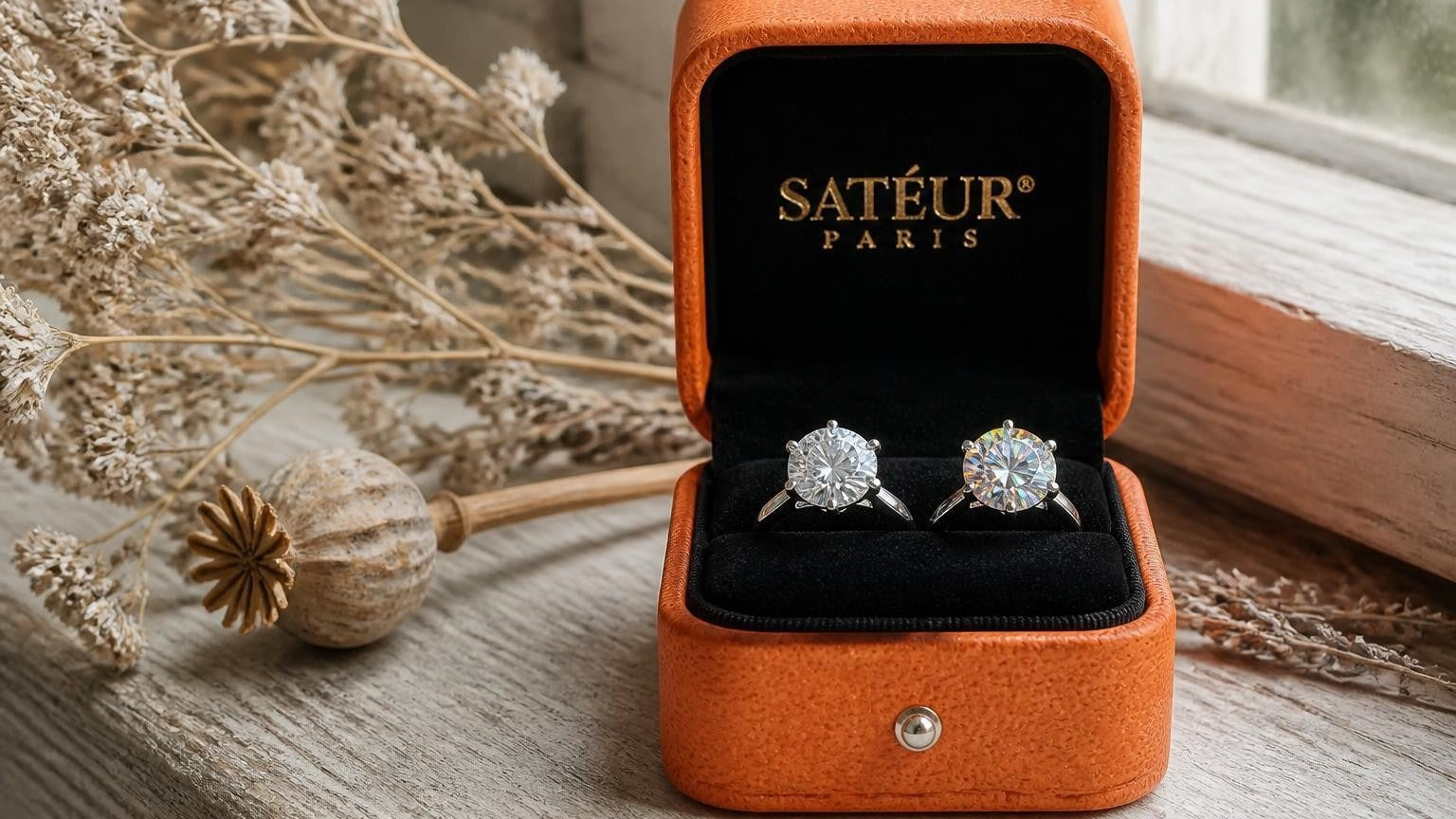
A diamond's refractive index sits at approximately 2.42, producing what gemologists call white brilliance — light returned as clear, clean flashes. Moissanite's refractive index is approximately 2.65. More light enters, more dispersion occurs, and the result is what the industry terms fire: rainbow-coloured spectral flashes. Moissanite produces roughly 2.4× the fire of a diamond.

This is where taste enters. For wearers who prize diamond-accurate, restrained brilliance, that additional fire can read as excessive — particularly under direct sunlight or overhead lighting. For wearers who love a stone that demands a room's attention, it is precisely the point.
The relevant caveat: modern moissanite graded D-E colour (near-colourless to colourless) in an Excellent or Very Good cut shows substantially fewer rainbow flashes under ordinary indoor lighting than older or lower-quality material. The "disco ball" perception largely traces to lower-grade moissanite from earlier production runs.
On durability, the gap between the two is negligible for everyday wear. Moissanite rates 9.25 on the Mohs hardness scale — second only to diamond's 10. Both are classified as excellent for engagement and daily-wear rings. For context, a sapphire — one of the most celebrated engagement gemstones in history — rates 9.0. No one calls a sapphire tacky.
The Science of Moissanite: Durability and Brilliance
Moissanite is silicon carbide, first discovered in a meteorite crater in Arizona by Nobel laureate Henri Moissan in 1893. Natural moissanite is extraordinarily rare. The material available today is lab-created — a process that produces optically flawless, chemically pure gemstones with complete traceability and no mining footprint.
It is not a diamond simulant. It is a distinct gemstone with its own crystal structure, refractive properties, and optical identity. Calling it an imitation diamond is like calling a sapphire an imitation aquamarine — both are blue, both are gemstones, and both have their own character.
The ethical dimension has become increasingly relevant to engagement ring buyers. Lab-created moissanite requires no open-cast mining, produces no artisanal mining displacement, and carries a fully auditable supply chain. For couples who view their ring as a statement of values as much as aesthetics, this matters.

Satéur Destinée Ring™
The look of a flawless diamond, for 1% of the price.
Compare to a $10,000 mined diamond
Joined by 100,000+ couples across 150+ countries.
Discover The 1% RingFree worldwide shipping · 30-day returns · Lifetime Satéur Care
Satéur's Moissanite Rings: Elegant Design, Accessible Price
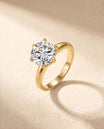
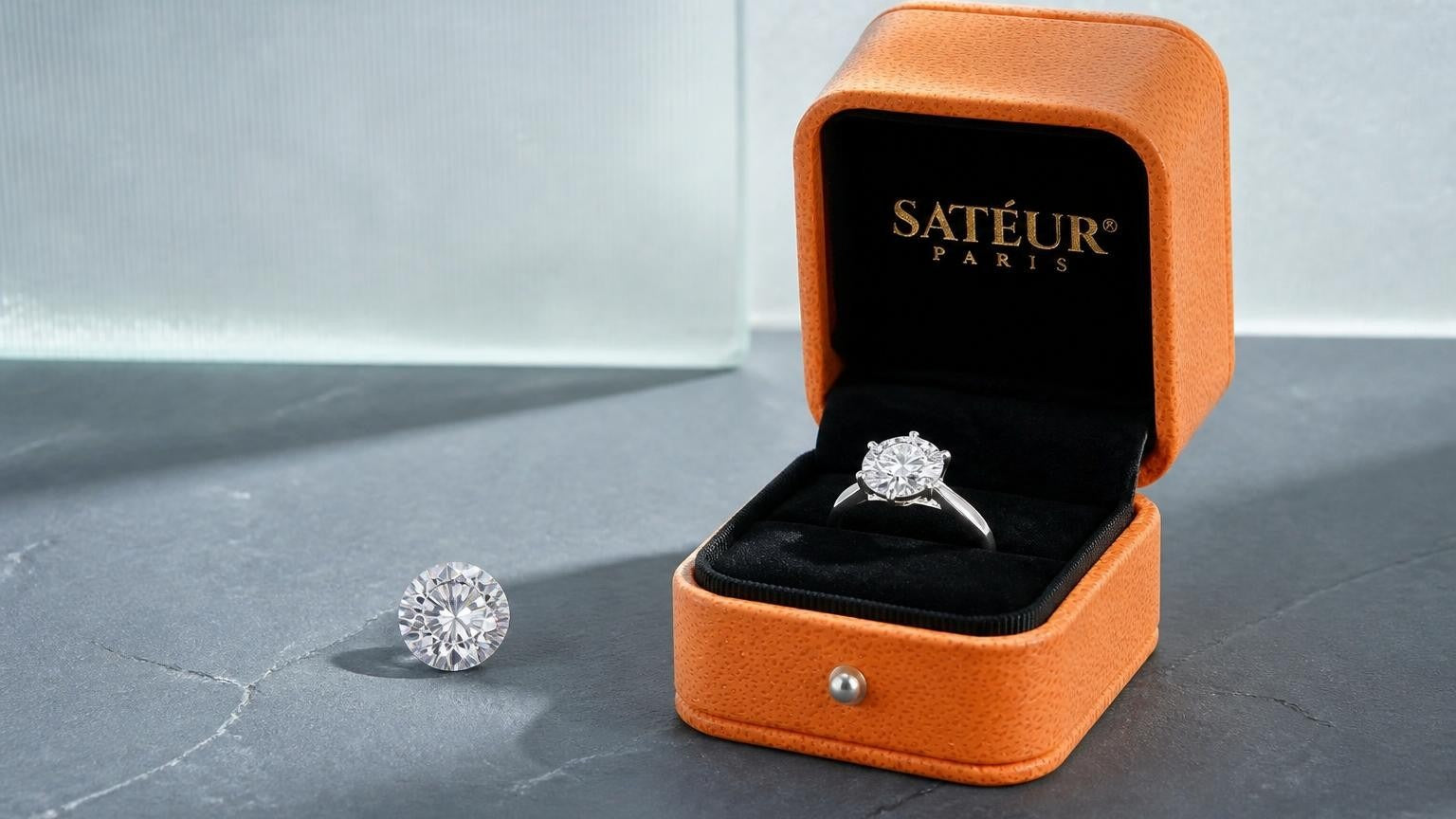
At Satéur, moissanite solitaire rings are set in 18k gold finish settings designed to the same proportional standards as fine diamond jewellery. The gemstones are graded D-E colour and cut to Excellent specification — the parameters that produce the cleanest, most diamond-accurate performance from moissanite.

A 2-carat moissanite engagement ring from Satéur starts under £1,200. The equivalent mined diamond — same cut grade, same colour grade, comparable carat weight — would retail at £12,000 or more. The ring does not look different across a dinner table. The financial calculation does.
This is the core of Satéur's position: not that moissanite is a cheaper substitute, but that it is a considered choice. Intelligent value is not the same as compromise. The Maison builds collections that demonstrate the difference.
How to Choose a Moissanite Ring That Feels Right for You
If the fire debate concerns you, the answer is in the specifications. Choose D-E colour (colourless) over lower grades — colour-grade moissanite can show a slight yellow or grey tint under certain lighting conditions, which is entirely separate from the fire question but contributes to perception. Opt for Excellent or Very Good cut. Round brilliant and oval cuts manage fire most elegantly; cushion and radiant cuts tend to amplify it.
Setting matters as much as stone. A classic four-prong or six-prong solitaire in a slender band reads with the same restraint as any fine diamond ring. An elaborate halo setting with multiple stones, by contrast, will amplify every optical characteristic — of any gemstone.
Metal choice plays a role. White gold and platinum allow the stone's own light to read cleanly. Yellow gold can complement lower-colour grades and create a warmer overall effect. The engagement ring should be considered as a complete composition, not a stone in isolation.
Moissanite Misconceptions: Separating Fact from Opinion
Several persistent myths deserve direct answers.
Moissanite looks fake. Under normal wearing conditions and to the naked eye, a well-cut, D-E colour moissanite solitaire is visually indistinguishable from a diamond with the naked eye. The fire difference is detectable in direct light. It is not detectable across a table in natural light.
Moissanite will not last. At 9.25 Mohs, moissanite is one of the most scratch-resistant materials on earth. It is harder than sapphire, ruby, emerald, or any other commonly used gemstone except diamond. Rings worn by multiple generations have shown no change in optical quality.
Choosing moissanite means settling. This conflates cost with quality. The manufacturing process for premium moissanite is exacting. The stone itself is not inferior — it is different. The choice to prioritise other values alongside the ring is not settling. It is a different set of priorities.

For further context on how moissanite compares materially, the Maison's guide on moissanite vs diamond rings addresses the full comparison in detail.
The New Diamond Standard is not a claim about chemistry. It is a claim about intelligence — the intelligence to evaluate a ring for what it delivers, rather than what convention says it should cost.
Frequently Asked Questions
What exactly is moissanite, and how is it made?
Moissanite is silicon carbide, a naturally occurring mineral first identified in a meteorite crater in 1893. Natural moissanite is exceedingly rare; all commercial moissanite is lab-created through a controlled crystal-growth process. It is a distinct gemstone — not a diamond, not a diamond simulant — with its own optical and physical properties. Lab creation ensures flawless optical quality, full chemical traceability, and no mining footprint.
How does moissanite compare to diamond in terms of durability and appearance?
Moissanite rates 9.25 on the Mohs hardness scale; diamond rates 10. Both are classified as excellent for daily wear. Visually, moissanite produces approximately 2.4× the fire of a diamond — meaning more vivid spectral colour flashes under direct light. Diamond produces crisper, whiter brilliance. Modern D-E colour moissanite in Excellent cut minimises rainbow effects under everyday indoor lighting.
Will a moissanite engagement ring look noticeably different from a diamond ring in everyday wear?
With the naked eye and under ordinary conditions — natural light, indoor restaurant lighting, everyday movement — a well-cut, D-E colour moissanite is visually indistinguishable from a diamond. The fire difference becomes apparent under direct overhead lighting or in direct sunlight. For most wearers in most settings, the visual performance is equivalent.
Why do some people consider moissanite rings tacky, and is that assessment fair?
The "tacky" judgment typically reflects the residual social convention that ring value should correlate directly with price. Within that framework, moissanite is read as compromise. The assessment is not a material or quality verdict — it is an aesthetic and social preference rooted in a particular set of values. Many buyers find the same choice intelligent. Taste varies; the word "tacky" carries more information about the speaker's values than about the gemstone.
What should I look for when selecting a moissanite ring to ensure it matches my style?
Prioritise D-E colour (colourless) to avoid any yellow or grey tint. Choose Excellent or Very Good cut grade for the cleanest optical performance. A round brilliant or oval cut manages fire most gracefully under varied lighting. A classic solitaire setting in a slender band reads with the same restraint as a fine diamond ring. Consider the setting and metal as a whole composition — the ring is more than the centre stone.
How much can I expect to spend on a high-quality moissanite engagement ring?
A well-specified 2-carat moissanite engagement ring — D-E colour, Excellent cut, set in 18k gold finish — starts under £1,200 from Satéur. A mined diamond of comparable carat weight and grade retails at £12,000 or more. The optical performance at a dinner table is equivalent. The financial difference is not.
















Hinterlasse einen Kommentar
Diese Website ist durch hCaptcha geschützt und es gelten die allgemeinen Geschäftsbedingungen und Datenschutzbestimmungen von hCaptcha.