



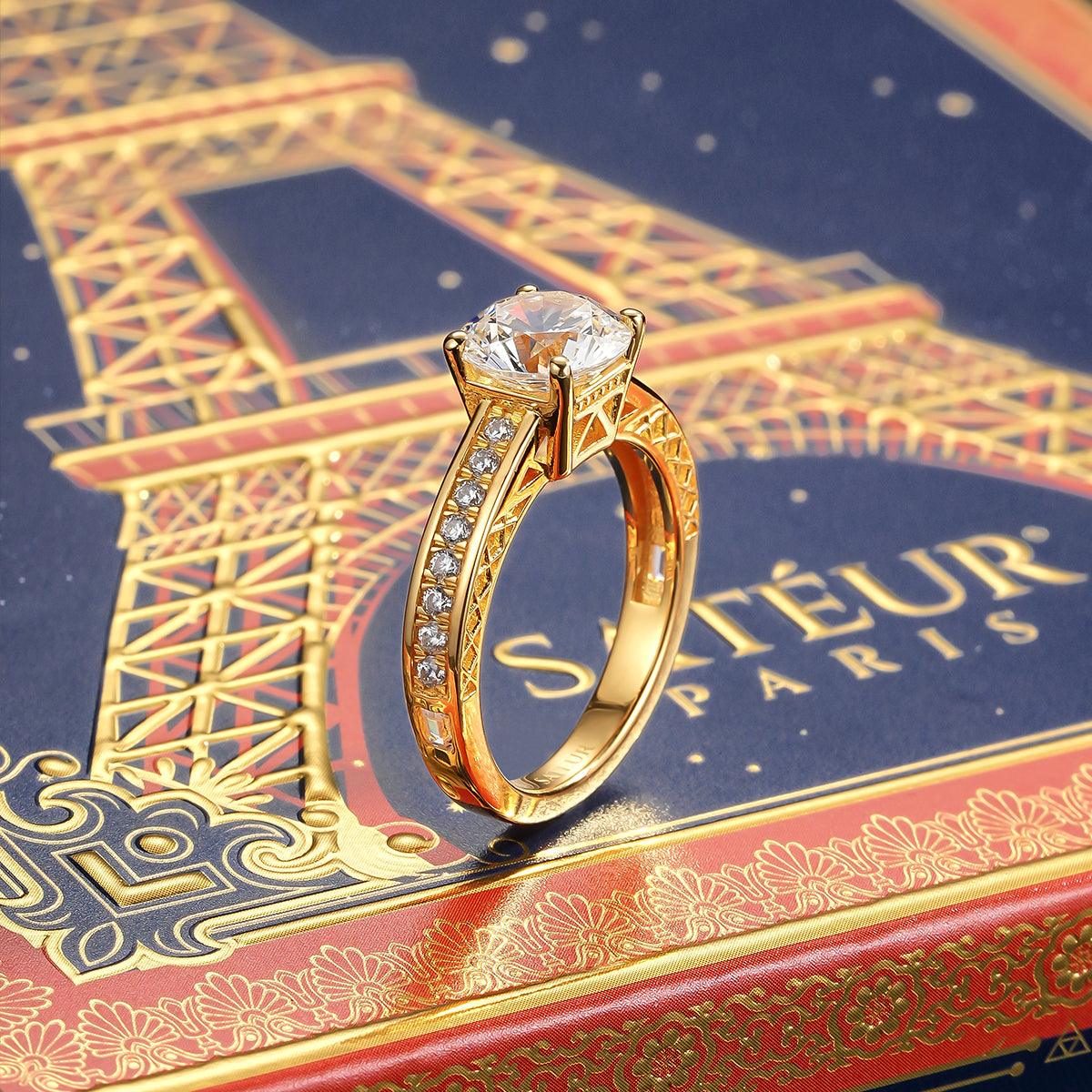
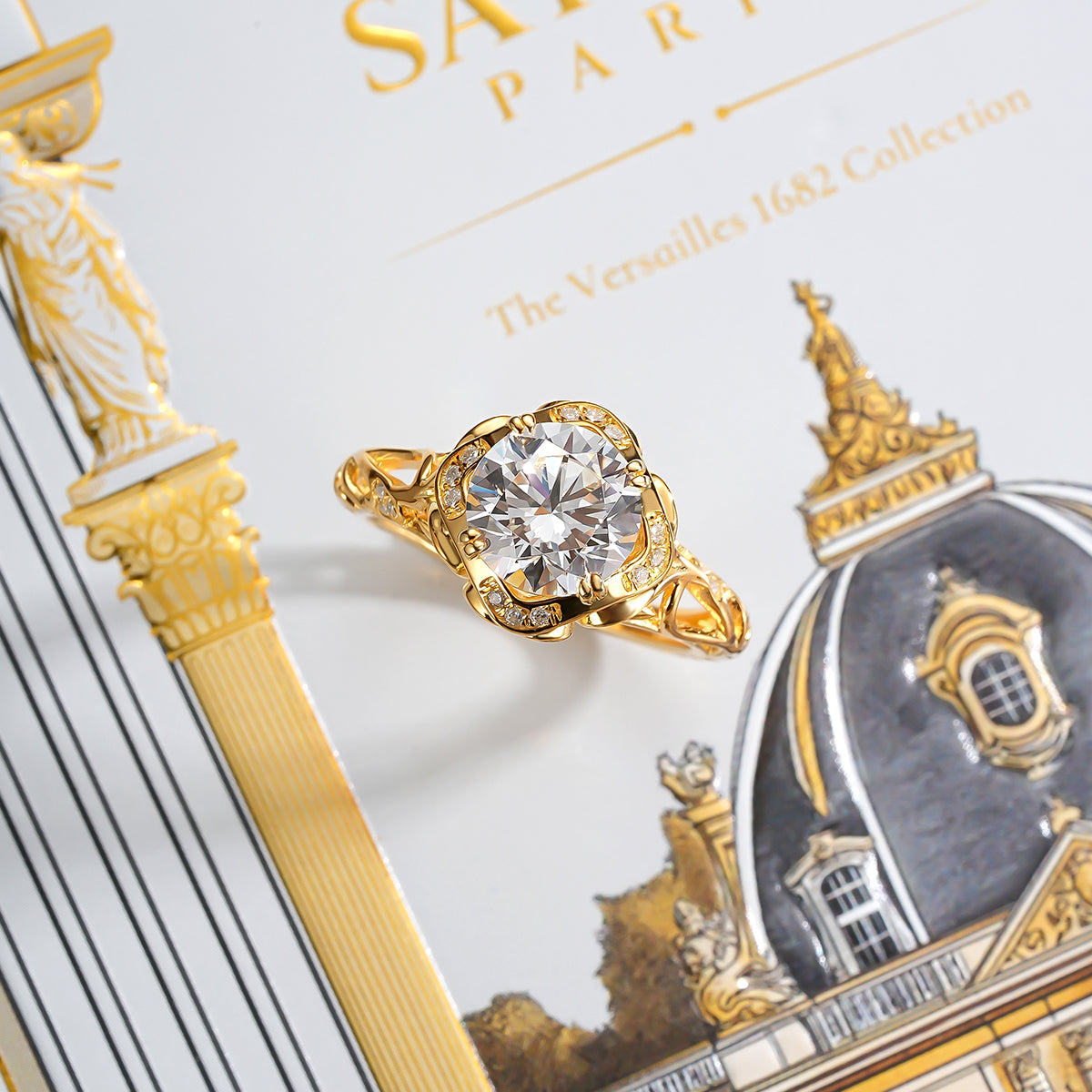
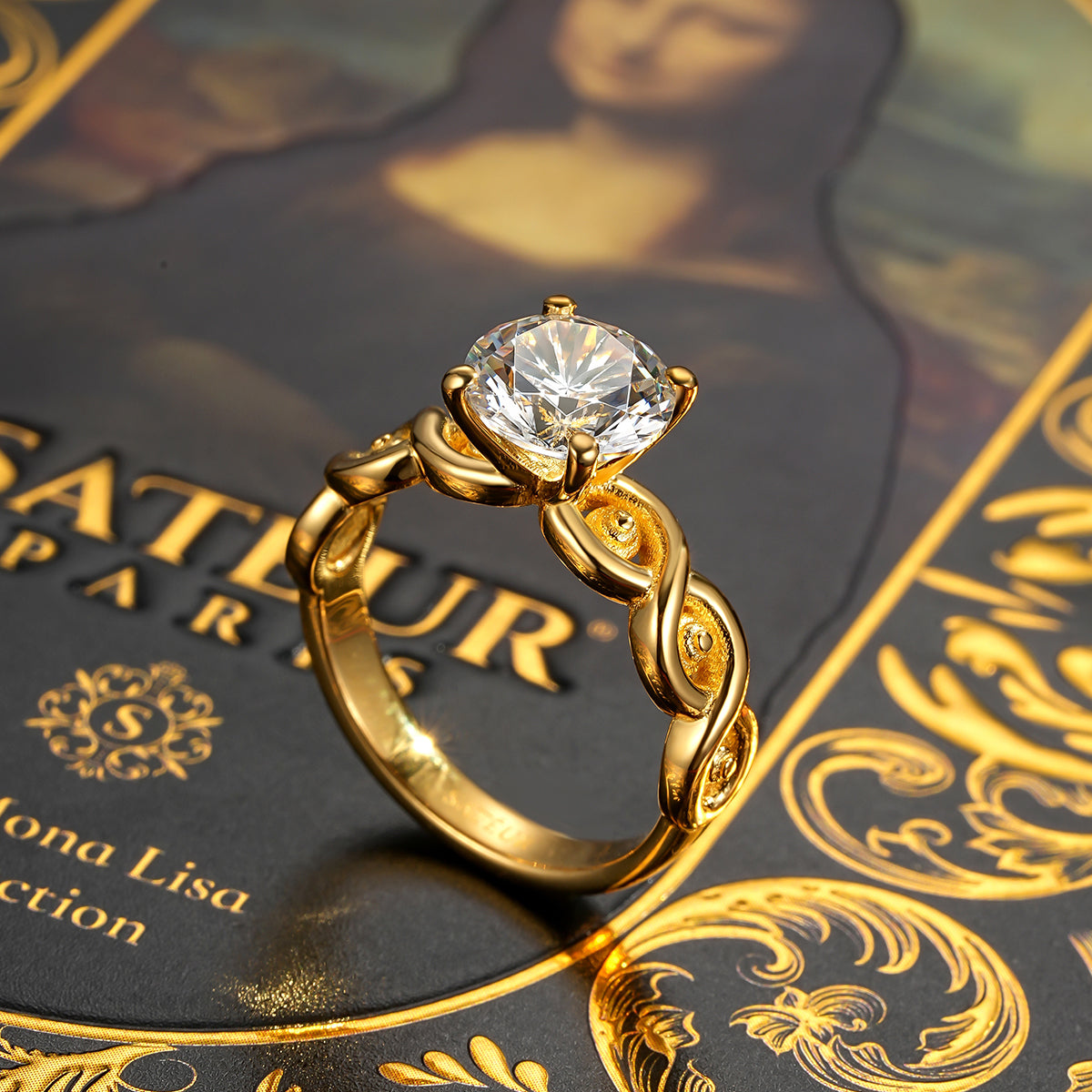

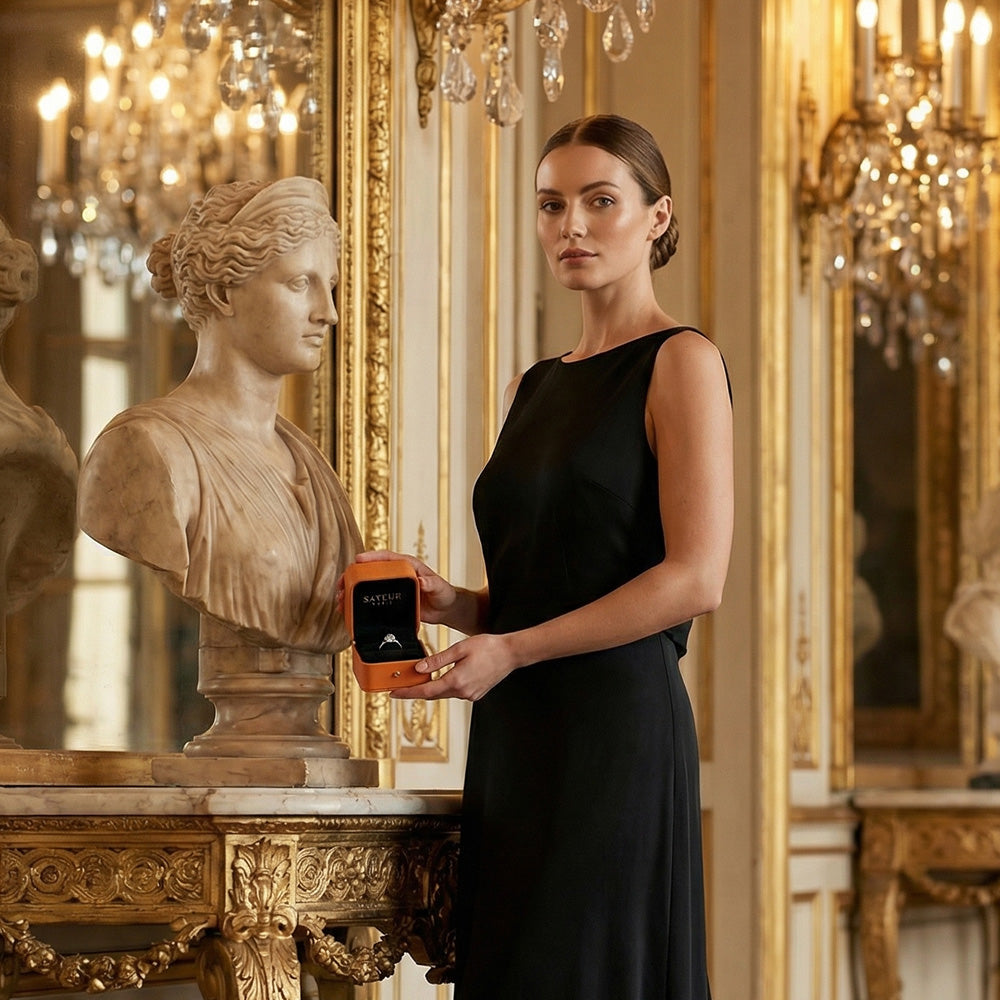
A moissanite ring costs roughly 90–95% less than a natural diamond ring of equivalent carat weight and setting — while offering Mohs 9.25 hardness and approximately 2.4 times the spectral fire of diamond. For most engagement ring budgets that means a visually larger, more brilliant centre gem at the same price. The decision comes down to priorities: budget and fire intensity favour moissanite; the tradition and rarity of natural diamond suit a different buyer.
Key Takeaways
- Moissanite rates 9.25 on the Mohs hardness scale — suitable for daily wear in any engagement ring setting.
- Moissanite exhibits approximately 2.4 times the fire (spectral dispersion) of diamond, producing visible rainbow sparkle in bright light.
- Diamond engagement rings typically range from several hundred to several thousand dollars; moissanite rings from Satéur start under $100.
- Both moissanite and diamond are graded for colour on similar scales, with D–E grades appearing colourless to the naked eye.
- Engagement ring selection depends on personal preference for sparkle intensity, budget, and aesthetic priorities rather than material rarity.

Moissanite vs Diamond: Side-by-Side Comparison
At the ring level the gap is dramatic. A 1-carat natural diamond solitaire in 18k white gold retails at $3,500–$8,000; a comparable moissanite ring costs $400–$700 from specialist retailers, and under $100 from Satéur.
| Attribute | Moissanite Ring | Natural Diamond Ring |
|---|---|---|
| 1 ct ring (typical retail) | $400–$700 | $4,000–$8,000 |
| 2 ct ring (typical retail) | $700–$1,400 | $15,000–$35,000 |
| Mohs hardness | 9.25 | 10 |
| Refractive index | 2.65–2.69 | 2.42 |
| Fire (dispersion) | ~2.4× that of diamond | Baseline reference |
| Origin | Lab-created gemstone | Earth-mined mineral |
For a broader comparison of these stones at the optical level, see the complete guide to moissanite vs diamond vs lab diamond.

Brilliance and Fire: What Sets Them Apart
Diamond produces crisp white brilliance — a sharp, controlled light return that is the conventional benchmark for engagement ring gems. Moissanite, with its higher refractive index of 2.65–2.69 versus diamond's 2.42, splits white light into more spectral colours. The result is visibly more rainbow fire under direct light, particularly in sunlit environments.
Whether this is an advantage depends on personal preference. Some buyers find moissanite's intensely colourful fire more arresting and modern. Others prefer diamond's restrained, white-dominant brilliance. Neither is objectively superior — they are different optical signatures.
- Moissanite: vivid spectral fire, rainbow dispersion — noticeably more colourful in direct light
- Diamond: crisp white brilliance, sharp and controlled — the conventional benchmark
Both gems retain their optical properties indefinitely. Moissanite does not yellow, cloud, or lose brilliance with age.
Colour and Clarity Grades
Colour
Moissanite is graded on a colour scale comparable to diamond's D-to-Z system. Premium moissanite — including Satéur's range — is produced to D–E colourless grades, appearing visually equivalent to top-graded diamonds to the naked eye.
Clarity
Lab-created moissanite is produced under controlled conditions, resulting in consistently high-clarity gems. For a buyer prioritising visible gem quality per dollar, moissanite at equivalent pricing will almost always outperform diamond in apparent clarity and size.
Durability and Hardness
Mohs Scale Comparison
Diamond rates 10 on the Mohs scale — the maximum. Moissanite rates 9.25 — harder than any other gemstone commonly set in rings, including sapphire and ruby (both 9). The practical scratch-resistance difference between 9.25 and 10 in everyday ring wear is negligible.
Long-Term Wear
Moissanite is thermally stable and resistant to common household chemicals. It will not chip or fracture under normal wear. For wearers who clean, exercise, or work with their hands, a well-set moissanite ring performs identically to diamond.
For context on how moissanite compares to other diamond alternatives on durability, see how moissanite compares to diamond and Satéur Gems®.

Price: The Moissanite Advantage
1-Carat Ring Comparison
A 1-carat natural diamond ring in an 18k white gold solitaire setting typically costs $4,000 to $8,000 in the US. A moissanite ring with the same carat weight and setting quality is available for $400 to $700 from quality retailers — and from $68 at Satéur. That is roughly 1 per cent of the price of a comparable natural diamond ring.
Larger Carat Sizes
The advantage compounds at larger stones. A 2-carat natural diamond ring commands $15,000 to $35,000. A 2-carat moissanite ring from Satéur sits at $138. At Satéur, a moissanite ring in an 18k white gold finish setting starts under $100 — for buyers whose priority is a large, brilliant centre stone, moissanite is the rational choice.

Setting and Wear Considerations
Compatible Settings and Cuts
Moissanite works in every standard engagement ring setting — solitaire, halo, pavé, three-stone, bezel, and tension. Its hardness (9.25) means prong settings hold it securely. It is available in every popular cut: round brilliant, oval, cushion, pear, princess, emerald, and radiant.
Daily Wear Performance
Both gems perform identically in practical daily wear — office, home, and active settings. Neither requires special care beyond routine cleaning with mild soap and water.
One practical note: moissanite's higher fire shows more spectral colour under fluorescent or LED lighting — a matter of preference, not quality.
Who Chooses Moissanite, Who Chooses Diamond
The Moissanite Buyer
Moissanite buyers want a large, brilliant centre gem at a fraction of the diamond price, and are comfortable with a lab-created stone.
The Diamond Buyer
Diamond buyers prioritise the cultural weight and geological rarity of a mined gem — for some, that narrative is the product itself.
Neither is more correct. For a visual comparison see moissanite vs diamond side by side.
Satéur's Moissanite: Specs and Value
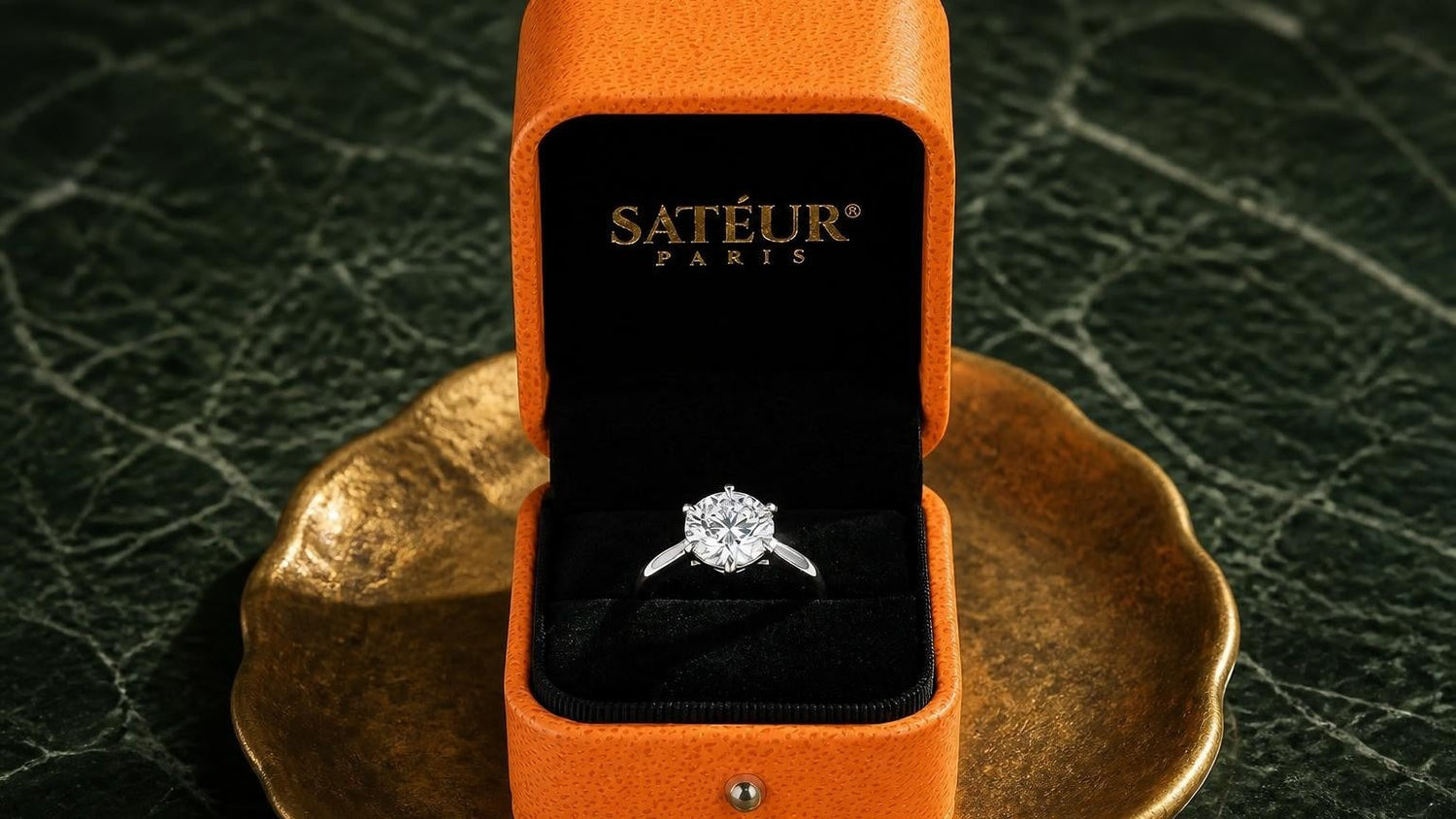
Satéur's moissanite rings are graded D–E colourless, Excellent cut, set in 18k gold finish. The Satéur Destinée Ring™ — the house flagship — starts at $68: roughly 1 per cent of the cost of a comparable natural diamond ring. For a 2-carat moissanite ring in an 18k white gold finish, Satéur starts at $138 — a category priced at $15,000 to $35,000 in natural diamond.

Satéur Destinée Ring™
The look of a flawless diamond — from $138.
D-E colour · Excellent cut · 18k gold finish
Free worldwide delivery. 30-day returns. Lifetime Satéur Care.
Shop the Destinée RingFree worldwide shipping · 30-day returns · Lifetime Satéur Care
Choosing Your Engagement Ring Stone
- Tradition of a mined, natural stone matters to you? Diamond.
- Largest, most brilliant gem your budget allows? Moissanite.
- Vivid rainbow fire in bright light? Moissanite.
- Classic controlled white brilliance? Diamond.
Both are genuinely durable, long-lasting choices. The decision is aesthetic and personal — not a compromise on quality in either direction.
Frequently Asked Questions
What is the main difference between moissanite and diamond engagement rings?
Price and optical character. Moissanite rings cost roughly 90–95% less than natural diamond rings of equivalent carat weight. Moissanite produces approximately 2.4 times the spectral fire of diamond — more vivid rainbow dispersion — while diamond produces controlled white brilliance. Both rate above 9 on the Mohs scale and suit daily wear.
Will moissanite lose its sparkle over time?
No. Moissanite's optical properties are stable — it does not yellow, cloud, or lose brilliance with age. It maintains its appearance indefinitely with routine cleaning, unlike CZ which clouds and scratches within a few years.
How do moissanite and diamond compare in hardness and durability?
Diamond rates 10 on the Mohs scale; moissanite rates 9.25. For daily ring wear the difference is negligible — moissanite is harder than sapphire and ruby, will not scratch in normal conditions, and is thermally and chemically stable.
What is the price difference between moissanite and diamond rings?
A 1-carat natural diamond ring typically costs $4,000–$8,000 in the US. A comparable moissanite ring costs $400–$700 from quality retailers — from $68 at Satéur. At 2 carats: $15,000–$35,000 for diamond versus $138 at Satéur for moissanite.
Can moissanite be used for any engagement ring style?
Yes. Moissanite suits every standard setting — solitaire, halo, pavé, three-stone, bezel, tension — and all popular cuts: round brilliant, oval, cushion, pear, princess, emerald, radiant. Compatible with platinum, white gold, yellow gold, and rose gold.
How do I choose between moissanite and diamond for my ring?
If the natural origin and cultural significance of diamond matters, choose diamond. If you prioritise optical performance and gem size per dollar with a lab-created stone, moissanite delivers more visible value. A Satéur moissanite ring starts under $100 in an 18k gold finish setting.
















Leave a comment
This site is protected by hCaptcha and the hCaptcha Privacy Policy and Terms of Service apply.