



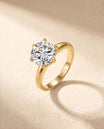

Best Wedding Band for Oval Engagement Ring
The oval engagement ring accounts for approximately 15 per cent of all engagement ring searches — a consistently popular cut whose elongated silhouette rewards deliberate pairing. The wedding band you choose either honours that geometry or competes with it. This guide covers every decision clearly: band profile, metal selection, width, and how Satéur's collection of engagement rings and wedding bands delivers that pairing at transparent value, with designs beginning at $88.
Key Takeaways
- Oval engagement rings suit curved contour bands best — a straight band creates a visible gap at the shoulders that interrupts the unified silhouette.
- Band width of 1.5–2.5 mm is the most harmonious range for a standard oval centre stone; wider bands shift visual focus away from the stone.
- White metals — platinum, white gold — let a D-E colour oval read at its clearest; yellow and rose gold create warmth and deliberate contrast.
- Satéur Gems® deliver D-E colour with Excellent cut, giving the appearance of a premium diamond for approximately 1% of a mined stone's price.
- Satéur entry-price wedding bands begin at $88 — a coordinated bridal set without design compromise.
- Oval cuts appear approximately 10% larger face-up than a round stone of equal carat weight, making the centre stone the natural visual anchor of the set.
Best Wedding Bands for Oval Engagement Rings
The first decision is profile: curved or straight. A curved contour band follows the belly of the oval mounting, nestling flush against the setting and creating a unified silhouette. A straight band sits slightly away from the setting, leaving a visible gap at the shoulders. For most oval rings, the curved profile is the cleaner choice — the eye reads the pair as one sculptural unit rather than two pieces in proximity.
Beyond profile, the key variables are metal, width, and surface finish. Each influences how the oval centre stone reads against the hand, and each can be matched or contrasted to achieve a specific visual effect.
Oval Wedding Band Styles and Designs
There are four primary band styles that pair well with an oval engagement ring, each producing a distinct visual effect.
Curved contour bands are purpose-shaped to sit against a specific setting profile. They are the most common choice for oval rings and are available in plain metal, pavé-set, or channel-set configurations. The curved profile eliminates shoulder gaps and creates the cleanest stacked look.
Straight pavé bands sit alongside rather than against the setting. The visible gap can work as a deliberate styling choice. The continuous diamond-set line draws its own light and complements a brilliant oval without visual clutter, provided the band width remains modest relative to the centre stone.
Eternity bands — full or half — encircle the finger with consistent stone coverage. A half-eternity in 1.5–2 mm pairs elegantly with an oval solitaire; the continuous line of stones echoes the oval's own light performance. A full eternity at matching width reads as a formal, coordinated set.
Plain metal bands offer the quietest pairing. A slim polished or matte band in any metal lets the oval stand alone. This is the Maison approach to restraint: one stone, one story.


How to Match a Wedding Band with Your Oval Engagement Ring
Three decisions govern a successful match: metal, width, and finish. Getting these right means the band enhances the oval rather than competing with it.
Metal. The most harmonious choice is to mirror the engagement ring's metal exactly — white gold to white gold, rose gold to rose gold. Mixed metals are a deliberate style decision, not an error. A yellow gold band against a white gold oval ring is a known editorial combination; a platinum band against a white gold oval is nearly indistinguishable in wear. For a D-E white stone, white metal is the sharpest pairing — it lets the gem read without a competing colour temperature.
Width. A 1.5–2.5 mm band sits proportionally against a standard oval (6×8 mm to 7×9 mm). Wider bands — 3 mm and above — can overwhelm a delicate oval setting, particularly east–west mounted stones. For larger oval stones above 2 carats, a 2.5–3 mm band scales correctly without shifting visual focus from the centre.
Finish. Polished metal maximises light return and reads most formally. Matte or brushed finish adds texture and contrast and reads more contemporary. Pavé-set bands introduce additional sparkle — a valid choice when the oval's own brilliance is the centrepiece, provided the band stones do not overpower the centre stone in scale.
For guidance on how solitaire settings navigate the same pairing decisions, the article on the best wedding band for a solitaire engagement ring covers the principles that translate across shapes.
Why Oval Engagement Rings Remain a Popular Choice
The oval cut appears approximately 10% larger face-up than a round stone of equal carat weight. The elongated shape creates a greater surface area impression without adding mass — more visual presence for the same spend. For slender fingers, the vertical axis adds a flattering line; for wider fingers, the horizontal east–west orientation adds breadth and balance.
The cut's elongated symmetry accommodates a wide range of band widths and styles. A narrow curved band reads delicate and classical. A wider half-eternity reads bold and formal. The oval provides broader pairing flexibility than many other fancy cuts, which explains its sustained demand across decades rather than cycling as a passing trend.
The characteristic bow-tie shadow — a shadow across the centre of the stone that varies by cutting quality — is a natural feature of the oval cut. Well-cut ovals minimise the bow-tie while maximising face-up brilliance. Satéur Gems® at Excellent cut grade address this directly: the cut is optimised for maximum light return, not carat yield alone.

Satéur Gems®: Diamond-Look Beauty at Transparent Value
Satéur Gems® carry D-E colour grading and Excellent cut, delivering the clean, white brilliance of a flawless diamond to the naked eye. The trademarked gemstone is the centrepiece of The 1% Ring® collection — priced at approximately 1% of an equivalent mined diamond. The appearance is diamond-accurate: restrained, bright white, quite different from the rainbow-forward over-fire that distinguishes moissanite from diamond visually.
Wedding bands in the Satéur collection begin at $88. A complete bridal set — solitaire ring and matched band — sits well under what the mined diamond industry charges for a single centre stone. The design quality is consistent across the range: 18k gold finish, precise setting work, and band profiles engineered to pair with the oval mounting. This is part of The New Diamond Standard — a reframing of what a bridal set can cost without compromising the look that defines it.
For couples who prefer lab-created stones with full gemological certification, the lab diamond collection offers IGI-certified diamonds — real diamond chemistry, ethically made, without the mined-diamond price structure.

Satéur Destinée Ring™
The look of a flawless diamond, for approximately 1% of the price.
Compare to a $10,000 mined diamond
Joined by 100,000+ couples across 150+ countries.
Discover The 1% Ring®Free worldwide shipping · 30-day returns · Lifetime Satéur Care
The pairing decision — oval ring and wedding band — is ultimately a design decision, not a transaction. The geometry of the oval, the width of the band, the temperature of the metal: each choice compounds. When the pieces are right together, the set reads as a single considered object. That is what a bridal set should be.
Frequently Asked Questions
What is the best metal for an oval engagement ring wedding band?
The clearest choice is to mirror the engagement ring's metal exactly. White gold and platinum are the most common pairings for oval rings — they let a D-E colour stone read at its whitest. Yellow and rose gold add warmth and visual contrast; this is a deliberate editorial combination, not a mismatch. Mixed metals work when the choice is intentional and consistent across the full set.
Can you wear a wedding band with an oval engagement ring, or should they be a set?
A matched set — both rings designed to nest together — gives the cleanest profile. It is not required. Many couples purchase an oval engagement ring first and source a wedding band that fits the setting's shoulder profile later. The key is that the band profile (curved or straight) aligns with the mounting's geometry.
How do I choose between a curved and straight wedding band for an oval ring?
A curved contour band follows the shape of the oval setting and creates a unified silhouette — the majority preference for oval rings. A straight band works when you want the two rings to read as distinctly separate pieces, or when sourcing a precisely curved band for the setting profile is not feasible. The curved option provides a cleaner stacked look and is the recommended starting point for most oval settings.
What width wedding band works best with an oval engagement ring?
For standard oval stones (6×8 mm to 7×9 mm), a 1.5–2.5 mm band is the most proportional range. Wider bands can overwhelm the setting and shift visual focus from the centre stone. For larger oval stones above 2 carats, a 2.5–3 mm band scales more naturally. Plain metal bands offer the most flexibility in width because they do not add pavé volume on top of the metal depth.
How do oval and round engagement rings differ in wedding band pairing options?
Round solitaires have a symmetrical setting that accepts curved and straight bands equally well — there is no directional axis to follow. Oval settings have an elongated geometry that benefits from a curved band at the shoulders; a straight band creates visible shoulder gaps that interrupt the visual line. The oval therefore rewards more deliberate band selection than the round brilliant.
What makes an oval engagement ring a timeless choice?
The oval cut creates approximately 10% more face-up surface area than a round stone of equal carat weight. The elongated shape flatters a range of finger proportions and creates a distinctive visual axis. These functional advantages — face-up presence, finger-flattering geometry, broad pairing flexibility — rather than trend alone, explain why the oval has maintained consistent demand across decades of changing bridal styles.














Hinterlasse einen Kommentar
Diese Website ist durch hCaptcha geschützt und es gelten die allgemeinen Geschäftsbedingungen und Datenschutzbestimmungen von hCaptcha.