



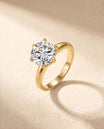

Best Wedding Band for a Pear Engagement Ring
The best wedding band for a pear engagement ring is a decision about geometry. The tapered tip that makes the pear cut so distinctive determines which bands sit well and which fight the silhouette. Two paths exist: follow the pear's curve with a V-tip or chevron band, or hold a clean straight line and let the contrast do the work. Both are correct. Neither is casual.
Pear-shaped rings account for approximately 8–12% of all engagement ring purchases globally — a significant share for a cut that demands more considered styling than a round or cushion.
Key Takeaways
- Curved and chevron bands follow the pear's apex, eliminating the gap and creating an integrated silhouette.
- Straight bands are valid — the small gap at the tip reads as intentional design, not a flaw.
- A V-tip prong in the engagement ring is the best predictor of how well a curved band will sit flush.
- Match the wedding band metal to the engagement ring finish — continuity is the principle.
- Satéur Gems® pear-cut rings begin from approximately $138, offering the clean white brilliance of a flawless diamond at roughly 1% of mined diamond pricing.
Pear Engagement Rings and Wedding Band Pairing
A pear brilliant combines the rounded base of an oval with the sharp apex of a marquise. Worn with the point toward the fingernail, it elongates the finger — and that orientation governs every band choice. The sharpest part of the ring sits at the edge of the stack, and whatever band is placed beside it must account for that geometry.
The pairing decision starts at the setting. A pear ring with a V-tip prong creates a natural recess that a curved or chevron band nestles into. Without one, a curved band may press against the setting rather than the gem, leaving a visible gap. Examine how the apex is protected before selecting a band style.
Why Pear Cut Works with Curved and Straight Bands
The curved band — also called a shadow or contour band — follows the profile of the engagement ring's centre gem with a gentle inward curve, allowing the two rings to sit without a gap. From above, the set reads as a single designed object rather than two adjacent pieces.
The chevron is a sharper variant: a pointed V that mirrors the apex of the pear. More architecturally precise than a smooth arc, it creates a graphic pairing that is visually deliberate. It works particularly well with a solitaire pear ring on a slim shank — two sharp lines in conversation.
A straight band is not a compromise. Many wearers choose a plain half-round and accept the small gap at the apex as an intentional design detail — barely noticeable in everyday wear, and more visible from the side than from above. Straight bands can also be worn on either side of the engagement ring without orientation concerns.

Metal and Stone Matching for Pear Shapes
Metal selection for a pear ring stack is a question of continuity. The most coherent sets keep both rings in the same metal: white gold with white gold, rose gold with rose gold. White gold and platinum allow the gem to read as the brightest element; rose gold creates a complementary warmth for those with warmer complexions. Neither is better — they are different visual temperatures. What matters most is that the engagement ring and band share the same finish.
Satéur Gems® Pear Rings: Colour, Clarity, and Brilliance
Satéur Gems® are the Maison's flagship — a trademarked diamond simulant that replicates the look of a flawless diamond. In a pear cut, D-E colour and Excellent cut grade matter more than in a round brilliant: the elongated shape concentrates colour at the tip, and an imprecise cut creates a dark "bowtie" shadow across the widest point. Satéur Gems® address both.
The brilliance profile is diamond-accurate: the clean, white brilliance of a fine diamond — not the vivid rainbow fire of moissanite. It reads as a flawless diamond with the naked eye. Both Satéur Gems® (approximately 8.8 Mohs) and the Maison's moissanite are extremely durable and built for everyday wear.
Pear-cut rings begin from approximately $88 — the look of a $10,000 mined diamond pear, for roughly 1% of the price. The New Diamond Standard. Explore The 1% Ring collection to find your pairing.

Satéur Destinée Ring™
The clean, white brilliance of a flawless diamond. For roughly 1% of the price.
Compare to a $10,000 mined diamond
Joined by 100,000+ couples across 150+ countries.
Discover The 1% RingFree worldwide shipping · 30-day returns · Lifetime Satéur Care

Curved Bands vs Straight Bands for Pear Cuts
The practical difference is felt during daily wear. A curved band sits flush and does not rotate away when the hand moves — the two rings behave as a unit. A straight band can shift slightly, a minor inconvenience some wearers notice and others ignore. Those who plan to wear both rings together every day will find the curved or chevron band more comfortable long-term; those who alternate will find the straight band more versatile. Width follows: a narrow band (1.5–2mm) keeps attention on the centre gem; a wider band (3–4mm) suits a larger-carat pear.

Custom Design Options for Your Pear Ring
A curved band can be made to order by tracing the exact profile of the engagement ring. If the ring was purchased without a matching band, the curved option can be made later — it simply requires having both pieces fitted together.
For diamond-set bands: smaller brilliants in a fine pavé setting serve the pear well; a channel-set band with larger gems creates a busier visual field where the centre gem loses focus. Over 100,000 customers across 150+ countries have chosen the look of a fine diamond without the traditional price structure. The pear cut is among the most considered choices in that movement.
Frequently Asked Questions
What makes a pear-shaped engagement ring unique?
The pear brilliant combines the rounded base of an oval with a sharp apex — an asymmetric silhouette that elongates the finger. The directional orientation informs every styling decision, including which wedding band will sit best beside it. Pear-shaped rings account for approximately 8–12% of all engagement ring purchases globally.
Should I choose a curved or straight wedding band with my pear ring?
A curved or chevron band reduces the visual gap at the pointed apex and creates an integrated look — the preferred choice for daily wear. A straight band works cleanly when the gap is intentional and suits those who alternate between wearing both rings and wearing only the band. The decision comes down to wearing habit and aesthetic preference.
What metals pair best with pear-shaped engagement rings?
White gold and platinum allow the gem to read as the brightest element in the set. Rose gold is a warm alternative that flatters a range of skin tones. Matching the wedding band to the engagement ring's finish — white or rose — creates the most cohesive stack. Satéur's 18k gold finish in both options carries the same visual presence as solid precious metal.
Can I wear a pear engagement ring with any wedding band style?
Yes, but the result varies. Curved and chevron bands create a flush fit at the apex. Straight bands leave a small gap — a design choice, not a flaw. The key is proportional balance: the band width should complement the engagement ring's shank width, with narrower bands suiting more delicate settings.
How do I ensure my pear ring and wedding band sit flush together?
A V-tip prong on the engagement ring creates a recessed channel that a curved or chevron band nests into cleanly. Without a V-tip, a curved band may press against the setting and leave a visible gap. Have both rings fitted together before purchasing — most jewellers offer a tracing service to match the band contour precisely.
What are the benefits of a Satéur Gems® pear-shaped ring?
Satéur Gems® deliver D-E colour and Excellent cut in a pear brilliant — critical for this shape, where colour at the tip and the bowtie effect are more visible than in a round cut. The gems offer the clean, white brilliance of a flawless diamond with the naked eye, and both Satéur Gems® and the Maison's moissanite are built for everyday wear. Entry begins at approximately $88 — the look of a $10,000 mined diamond pear, at roughly 1% of the price.















Hinterlasse einen Kommentar
Diese Website ist durch hCaptcha geschützt und es gelten die allgemeinen Geschäftsbedingungen und Datenschutzbestimmungen von hCaptcha.