

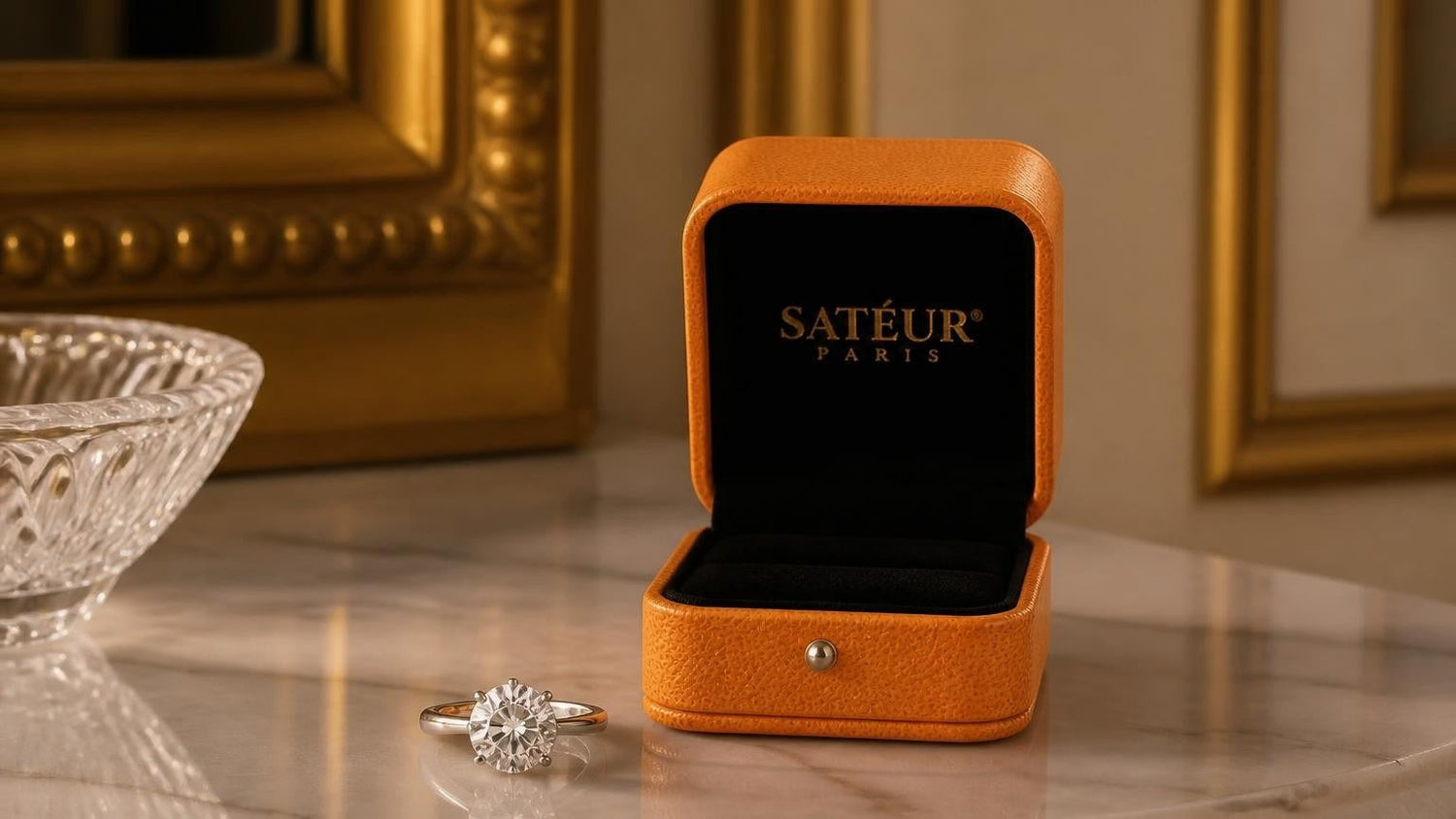
Celebrity Engagement Rings: The Styles, Cuts, and Design Principles Behind the Icons
Celebrity engagement rings have shaped the way the world imagines fine jewellery. From the swept-back solitaires of the 1950s to the elongated oval diamonds that dominate today's style conversation, these pieces are not simply markers of personal commitment — they are design documents. Each reflects a particular idea of beauty, a moment in cultural history, and the enduring grammar of the engagement ring as a form.
This guide examines the styles, cuts, and design choices that define iconic celebrity engagement rings — and explains how the same aesthetic principles are available to any buyer, at any budget, including those beginning at $88 through The 1% Ring® by Satéur.
Key Takeaways
- Round brilliant diamonds account for approximately 75% of diamond shapes chosen globally, prized for maximum light return.
- Oval, cushion, and emerald cuts appear frequently in high-profile engagement rings — each with distinct visual and brilliance properties.
- Art deco and vintage-inspired settings have seen sustained revival, characterised by geometric milgrain detail and side-stone clusters.
- Diamond colour grading spans D to Z; D-E stones are colourless and command premium positioning in the fine jewellery market.
- Satéur Gems® offer D-E colour appearance with the clean, white brilliance of a flawless diamond — at approximately 1% of mined diamond cost.
- Entry-level diamond-simulant engagement rings begin at $88, making fine-jewellery aesthetics accessible across a wide range of buyers.
Celebrity Engagement Rings Through the Decades
The history of the celebrity engagement ring is, in many ways, a compressed history of taste itself. Each decade carries a distinct visual signature — defined by the interplay of stone shape, metal choice, and the cultural mood of the moment.
The 1950s favoured restraint. The prong-set solitaire on a slender yellow gold band became the defining image: a single round brilliant diamond held aloft, its cut engineered to catch every available photon. The aesthetic was architectural, confident, and deliberately simple. These rings telegraphed not excess but precision.
By the 1960s and 1970s, larger stones began to enter the conversation. Cushion and pear cuts gained favour among certain prominent figures, with yellow gold giving way to platinum and white gold. Settings became more elaborate — halos, pavé shoulders, and side-stone arrangements introduced a vocabulary of surrounding brilliance that amplified the centre stone's apparent size.
The 1980s and 1990s brought the cluster ring to prominence alongside an increased interest in coloured stones — sapphires, rubies, and emeralds set against diamond surrounds. Certain of these designs entered the cultural lexicon so completely that they altered buying patterns for the following generation. The association of sapphire with royalty shaped an entire category of ring design that endures to this day.
The 2010s marked the arrival of the elongated stone. Oval, pear, and marquise cuts gained dramatic market share — their lengthening effect on the finger proved photogenic in an era increasingly shaped by social media. The oval cut diamond, in particular, achieved something approaching iconic status: the same carat weight as a round brilliant, presented across a larger visual footprint.

Today, celebrity engagement rings demonstrate a deliberate eclecticism. Vintage settings coexist with contemporary minimalist designs. Yellow gold has returned after decades of white metal dominance. Emerald cut diamonds — with their long parallel facets and distinctive step-cut geometry — have re-established themselves as a sophisticated choice for those who prefer understated visual depth over maximum sparkle.
What Makes a Celebrity Engagement Ring Iconic
The distinction between a ring that is merely expensive and one that becomes iconic lies not in carat weight alone. Several design factors converge to produce a piece that endures in the imagination.
Proportion. The relationship between the centre stone, the band width, and the overall height of the setting determines whether a ring reads as balanced or disproportionate. The most enduring designs maintain a clear visual hierarchy: the stone commands attention, the setting serves it.
Diamond shape. Different cuts carry different associations. The round brilliant communicates timelessness and maximum light return. The emerald cut signals sophistication and a preference for clarity over spectacle. The oval reads as modern and romantic simultaneously — a cut that photographs well and wears generously on the hand.
Metal choice. Yellow gold carries warmth and a connection to historical fine jewellery. Platinum and white gold provide a neutral backdrop that allows diamond colour to read accurately. Rose gold, popular through the mid-2010s, brings softness — though its prevalence has diminished somewhat in high-profile pieces, which have returned to cool-toned metals in the current decade.
Setting architecture. The prong count, the height of the head, the presence or absence of a halo, the treatment of the shoulders — each element contributes to the overall register of the ring. A four-prong cathedral setting reads differently from a six-prong low-profile design. Vintage-inspired milgrain detail communicates one kind of refinement; a clean bezel another.
Iconic celebrity engagement rings tend to succeed because every element is in deliberate conversation with every other. Nothing is accidental. That level of intentionality is precisely what the unique engagement ring category has begun to democratise — design intelligence, separated from the historic cost of natural stones.
Popular Diamond Shapes in Celebrity Rings
Diamond shape is the single most visible design decision in an engagement ring. It determines the visual language of the piece before any other detail registers. The following shapes have dominated high-profile ring design across the last several decades:
Round Brilliant. Accounting for approximately 75% of diamond shapes chosen globally, the round brilliant remains the most prevalent choice. Its 57 or 58 facets are mathematically optimised for maximum light return — the combination of brilliance (white light reflection) and fire (spectral dispersion) is highest in the round cut among all standard shapes. Its universality is not convention for its own sake: it genuinely outperforms other shapes in terms of visible sparkle.
Oval. The oval cut diamond has become one of the most sought-after shapes in contemporary fine jewellery. It shares the brilliance facet structure of the round cut — 57 or 58 facets, identical optical engineering — but its elongated outline creates the visual impression of a larger stone for equivalent carat weight. On the finger, the oval lengthens the appearance of the hand. In the context of celebrity engagement rings, the oval has appeared with increasing frequency over the last decade, often paired with a thin pavé band in platinum or white gold.
Emerald. The emerald cut is a step-cut diamond: rather than brilliant facets engineered for maximum dispersion, it features long, parallel rectangular facets arranged in a hall-of-mirrors geometry. The result is less fire and more a quiet, liquid depth — a stone that catches light slowly, in broad flashes rather than rapid scintillation. The emerald cut rewards high colour and clarity grades; its large open table makes inclusions more visible than in brilliant cuts.
Cushion. The cushion cut — a square or rectangular outline with rounded corners — occupies a middle position between vintage and contemporary design. Its facet structure varies between manufacturers, but the best examples combine good brilliance with a softer, more antique visual quality. Cushion cuts were among the most prevalent shapes in the 19th and early 20th centuries and have carried that association with romantic historicism into the current period.
Princess. The princess cut — a square brilliant — was developed in the 1980s and achieved significant popularity through the 1990s and 2000s. It maximises carat retention from the rough stone while delivering brilliant-cut optics in a rectilinear form. Its prominence in celebrity engagement rings peaked in the early 2000s; more recent high-profile choices have tended toward oval, emerald, or round brilliants.

Pear and Marquise. These elongated shapes — the teardrop pear and the pointed-oval marquise — appear periodically in high-profile ring choices. Both maximise finger coverage for a given carat weight. They demand careful calibration of setting height to protect the points, and their visual impact is dramatic rather than understated.
Vintage and Antique-Inspired Engagement Rings
The revival of vintage engagement ring aesthetics is one of the more enduring trends in contemporary fine jewellery. It is not nostalgia for its own sake. Vintage designs — particularly those from the art deco period — contain a density of craft and visual intelligence that straightforward contemporary solitaires rarely match.
Art deco rings, produced roughly between 1915 and 1935, are characterised by geometric precision, strong linear structures, and a preference for contrast. White metals — platinum, in the original period — were chosen to complement the colourless stones at the centre. Filigree work, milgrain edges (the tiny bead-like border along the setting's perimeter), and geometric side-stone arrangements gave these rings a visual complexity that rewards close inspection.
The Edwardian period that preceded art deco (approximately 1900 to 1915) favoured a lighter, lacier aesthetic — elaborate scrollwork in platinum, softer curves, and a certain feminine delicacy. These rings often incorporated European cut diamonds (the precursor to the modern round brilliant), with a larger culet and fewer facets, producing a characteristically softer, more languid sparkle.

Contemporary vintage-inspired engagement rings draw on these historical vocabularies without requiring museum prices. The milgrain detail, the floral halo, the geometric pavé band — all of these are achievable in contemporary production. What a buyer is choosing when they select a vintage-inspired ring is an aesthetic intelligence: the understanding that the most sophisticated jewellery often looks backward, not forward.
In terms of celebrity engagement rings, vintage styles have appeared persistently across the last twenty years. Art deco-inspired pieces — particularly those featuring emerald or cushion cut centres in elaborate geometric settings — have been worn by a range of prominent figures, contributing to a broader cultural rehabilitation of the period's design vocabulary.
Engagement Ring Cuts and Their Effect on Brilliance
Brilliance in a diamond is a function of its cut quality — specifically, how precisely the facets are angled to reflect light back toward the viewer's eye. The distinction between a diamond described as "Excellent" cut and one described as "Good" cut is not subtle; it is visible under any lighting condition.
The relationship between cut and the three other factors in the traditional diamond evaluation framework (colour, clarity, and carat weight) is often misunderstood. Cut is the only factor entirely within human control — a diamond's colour and clarity are determined by geological formation; its carat weight by the original rough crystal. But a diamond cutter chooses the facet angles, the table size, the depth percentage, and the symmetry of the finished stone. A poorly cut diamond of high colour and clarity will appear lifeless. An excellently cut stone of lower colour and clarity will often outperform it visually.
For gold engagement rings and those in white metals alike, the interaction between the metal colour and the stone's cut merits consideration. Yellow gold beneath a near-colourless diamond (G-H colour range) tends to warm the stone slightly — often positively. Platinum or white gold beneath the same stone reads cooler and cleaner. For D-E colour diamonds, where colourlessness is the primary virtue, white metals are the conventional choice.
Different cuts interact with light differently beyond pure brilliance metrics:
- Fire (spectral dispersion — the splitting of white light into its colour components) is highest in round brilliants and is also pronounced in cushion cuts. It is deliberately suppressed in step cuts like the emerald.
- Scintillation (the pattern of light and dark as the stone moves) is most dynamic in round brilliants; step cuts produce fewer, larger flashes.
- Face-up size (the visible area of the stone when viewed from above) varies considerably between shapes of identical carat weight. An oval typically presents approximately 10% more face-up area than a round brilliant of the same mass.
These distinctions matter when evaluating celebrity engagement rings as design objects. The choice of an emerald cut over a round brilliant is not a compromise — it is a deliberate stylistic position, a preference for measured depth over maximum spectacle.
The Evolution of Celebrity Ring Styles
Tracking the evolution of celebrity engagement rings over the last three decades reveals several consistent patterns alongside genuine shifts in taste.
The first consistent pattern is the pendulum of stone size. Periods of maximum conspicuousness — very large centre stones, halo settings, pavé-covered bands — tend to be followed by corrections toward restraint. The current period, broadly, favours the elegant rather than the overwhelming. This does not mean small stones: it means that scale is balanced by setting refinement, and that statement is made through design intelligence rather than sheer carat weight.
The second pattern is the return of yellow gold. After two decades in which platinum and white gold dominated high-profile ring design, yellow gold has reasserted itself. This is partly a generational shift — buyers who came of age seeing yellow gold engagement rings on their grandmothers' hands have arrived at an age where that association carries warmth rather than datedness. It is also a function of the oval cut's popularity: yellow gold beneath a large oval reads particularly well, the metal's warmth complementing rather than competing with the stone.
The third pattern is a growing interest in the non-round. Oval, emerald, pear, and elongated cushion cuts have all increased in market share over the last decade. This is in part photogenic calculation — elongated stones photograph well in close-up — and in part a genuine aesthetic shift toward shapes that carry more individual character than the universally optimised round brilliant.
What has remained constant across all of these shifts is the primacy of the centre stone. Settings evolve; the diamond remains the visual and cultural anchor of the engagement ring as a form.

Satéur Destinée Ring™
The look of a flawless diamond, for approximately 1% of the price.
Compare to a $10,000 mined diamond
Joined by 100,000+ couples across 150+ countries.
Shop The 1% RingFree worldwide shipping · 30-day returns · Lifetime Satéur Care
Satéur Gems: The Diamond-Look Alternative for Investment-Conscious Buyers
Celebrity engagement rings establish the aesthetic standard. They demonstrate that a round brilliant in a prong-set platinum solitaire is the classical choice; that an elongated oval with a pavé band represents a particular kind of contemporary sophistication; that the emerald cut signals a preference for measured elegance over spectacle.
None of these aesthetic positions require a six-figure expenditure. The design intelligence is separable from the material cost.
Satéur Gems® is a trademarked diamond simulant engineered to replicate the look of a flawless diamond. The stones carry D-E colour appearance and are cut to Excellent specifications — the same parameters that define the finest natural stones. The result is the clean, white brilliance of a fine diamond, visually indistinguishable from the real thing with the naked eye, at approximately 1% of the cost of a comparable mined diamond.
The Satéur Destinée Ring™ — The 1% Ring® — places a 1.00 carat round cut Satéur Gems® in an 18k white gold finish setting beginning at $138. The same form factor as the most classically desired celebrity engagement ring profile: round brilliant, solitaire, white metal. The design is identical. The provenance is different. The intelligence of the choice is demonstrably higher.
For buyers drawn to the oval or emerald cut styles documented through celebrity ring history, the Satéur collection extends across multiple shapes and settings — all built to the same D-E colour, Excellent cut specification. The The 1% Ring collection represents the full range. Every piece is backed by a 30-day return policy and free worldwide shipping.
The New Diamond Standard® is not about imitation. It is about making the same aesthetic decisions that define iconic engagement rings — round brilliant, white metal, diamond-accurate brilliance — without the artificial pricing structures that have historically gatekept them. Over 100,000 customers across 150+ countries have chosen this different path.
Frequently Asked Questions About Celebrity Engagement Rings
What diamond shapes are most popular in celebrity engagement rings?
Round brilliant diamonds remain the most prevalent globally, accounting for approximately 75% of all diamond shapes chosen. Within the celebrity engagement ring category, oval cuts have gained significant prominence over the last decade, followed by emerald, cushion, and pear shapes. Princess cuts, dominant through the 1990s and early 2000s, appear less frequently in recent high-profile choices. The prevailing direction in contemporary celebrity rings favours elongated shapes — oval, pear, and marquise — that maximise visual presence on the finger.
How do vintage engagement ring styles differ from modern designs?
Vintage engagement ring styles — particularly art deco designs from the 1915–1935 period — are characterised by geometric precision, white metal settings, milgrain border detail, and step-cut or European-cut centre stones. Modern designs tend toward cleaner lines, higher settings, and brilliant cuts engineered for maximum light return. The primary practical distinction is in facet structure: modern round brilliants are mathematically optimised in ways that earlier cuts were not, producing measurably more scintillation. Vintage and antique-inspired designs compensate with craftsmanship density — the visual complexity of their settings is rarely matched in contemporary production.
What factors influence the choice of diamond colour in fine engagement jewellery?
Diamond colour is graded on a D-to-Z scale, with D representing absolute colourlessness and Z a visible warm tint. D-E colour stones are colourless and command premium positioning in the fine jewellery market. The choice of metal interacts directly with colour perception: platinum and white gold beneath a D-E stone allows its colourlessness to read clearly; yellow gold beneath the same stone introduces subtle warmth. For step-cut diamonds like the emerald, where the open table makes colour more visible, higher colour grades are generally recommended. For brilliant cuts, colour differences become less visible under most lighting conditions below approximately H on the grading scale.
Can you achieve a luxury engagement ring look at a lower price point?
Yes. The design principles that define iconic celebrity engagement rings — round brilliant cut, solitaire prong setting, white metal band, D-E colour appearance — are entirely separable from the material cost of mined diamonds. Satéur Gems®, a trademarked diamond simulant, delivers D-E colour appearance and the clean, white brilliance of a flawless diamond with the naked eye, at approximately 1% of the cost of a comparable natural stone. The Satéur Destinée Ring™ begins at $138. The aesthetic intelligence of the finest celebrity engagement rings is a function of design choices, not price.
Which engagement ring cuts maximise brilliance and fire?
The round brilliant cut is engineered specifically for maximum brilliance (white light return) and fire (spectral dispersion). Its 57 or 58 facets are angled according to mathematical models that optimise light performance across a wide range of viewing angles. Among all standard shapes, the round brilliant produces the highest combined brilliance and fire scores. Oval cuts use an equivalent facet structure and perform similarly. Step cuts — emerald, Asscher — deliberately suppress fire in favour of a quieter, hall-of-mirrors visual depth. The choice between maximum sparkle and measured depth is an aesthetic preference, not an objective quality hierarchy.
What is the difference between solitaire and multi-stone engagement ring settings?
A solitaire setting features a single centre stone, typically held by four to six prongs, on a plain or lightly detailed band. It is the classical form — every element serves the stone's presentation. Multi-stone settings add side stones, which may be channel-set, pavé, or in three-stone arrangements that carry their own symbolic weight (representing past, present, and future in the most common interpretation). Halo settings surround the centre stone with a ring of smaller stones, amplifying its apparent size and adding sparkle. Vintage-inspired settings often combine halos with pavé shoulders and milgrain detail. The solitaire remains the most prevalent choice in high-profile celebrity engagement rings, though multi-stone pieces appear with consistency across all decades.
















コメントを残す
このサイトはhCaptchaによって保護されており、hCaptchaプライバシーポリシーおよび利用規約が適用されます。