

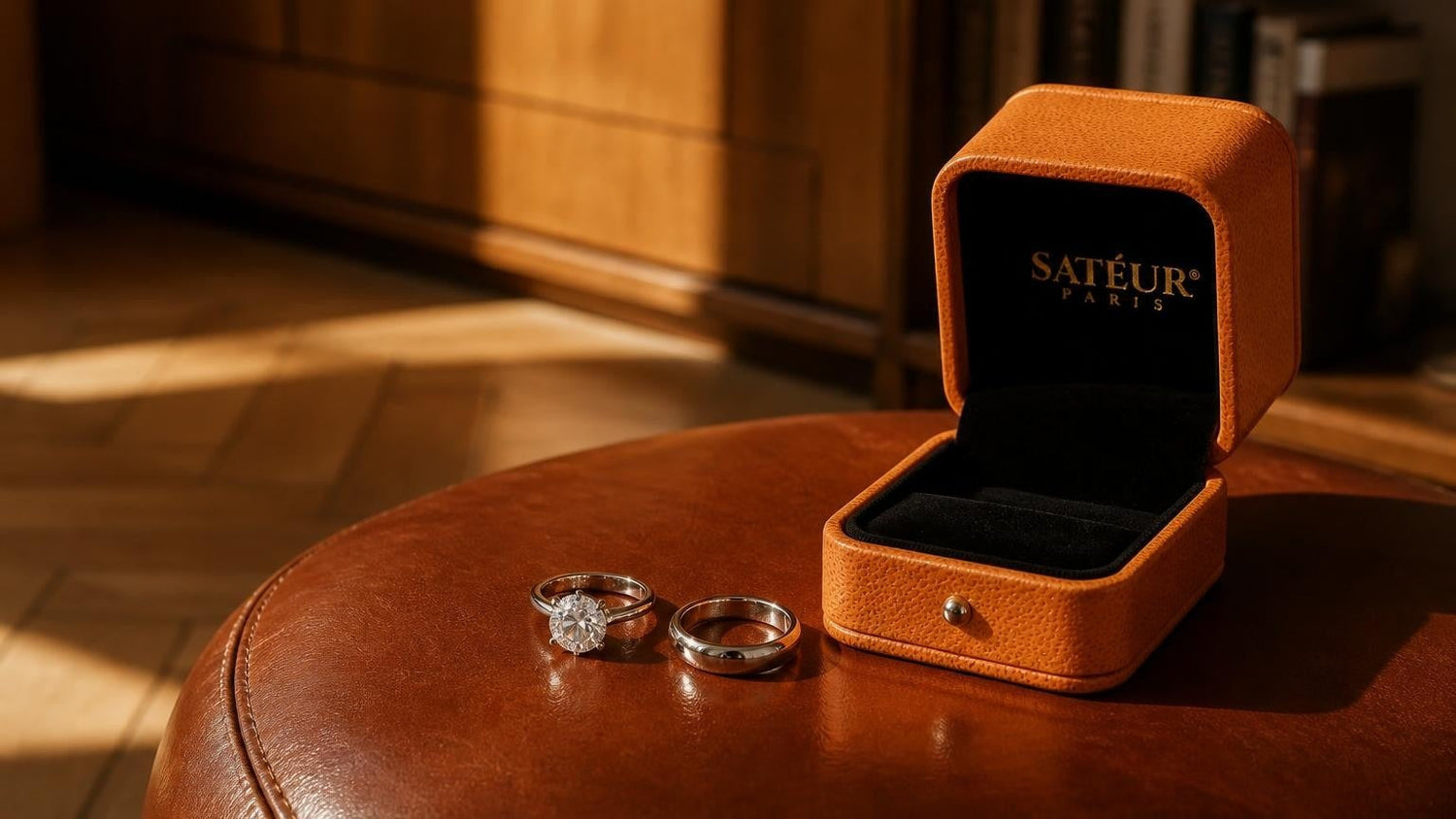
Engagement Rings vs Wedding Rings: Key Differences
Two rings. Two moments. One lifelong pair. The engagement ring and the wedding ring are often spoken of together — yet each is distinct in purpose, design, timing, and meaning. Understanding the difference is the first step towards choosing both rings well.
Key Takeaways
- An engagement ring is presented at the proposal; a wedding ring is exchanged at the ceremony.
- Engagement rings typically feature a centre gemstone; wedding bands are often a simpler, continuous loop.
- Both rings are traditionally worn on the ring finger of the left hand — the wedding band placed closest to the hand, the engagement ring above it.
- A coordinated set — shared metal, complementary profile — is the most popular choice for couples today.
- Satéur Gems® deliver the look of a flawless diamond at approximately 1% of the price of a mined ring stone.
Engagement Ring vs Wedding Ring: Key Differences
The simplest distinction: an engagement ring marks the beginning of a commitment; a wedding ring seals it. One ring is worn from the day of the proposal, the other from the moment of the ceremony — and both rings together form a matched pair for life.
In design, they solve different problems. An engagement ring is built to display — it typically features a raised centre gemstone, a setting chosen to catch light, and a silhouette with presence. A wedding band is built to endure alongside it — a low-profile continuous loop of metal, selected as much for comfort and stackability as for beauty.
| Feature | Engagement Ring | Wedding Band |
|---|---|---|
| When given | At the proposal | At the wedding ceremony |
| Primary design | Centre gemstone, raised setting | Simple continuous band, plain or pavé-set |
| Worn by | Primarily the person proposed to | Both partners |
| Symbolic meaning | Promise of marriage | Marriage itself |
| Stack position | Above the wedding band on the left ring finger | Closest to the hand, below the engagement ring |
| Typical cost driver | Centre gemstone quality and size | Metal weight and accent stone count |
What Is an Engagement Ring?
An engagement ring is a symbol of intent — presented during or after a proposal, worn as a visible mark of commitment to marry. Its presence on the hand is its own announcement. In Western tradition, the engagement ring is worn from the moment of the proposal through to the wedding, and then worn above the wedding band for the rest of the marriage.
The classic form is a solitaire: a single gemstone set in a metal band, elevated to catch light from every angle. Round brilliant cuts remain the most popular choice globally — they maximise the return of light, delivering brilliance that reads across a room. Oval, cushion, and emerald cuts each cycle through periods of dominance; the round endures as the standard against which every other engagement ring shape is measured.
What matters most is the centre gemstone: its cut quality, colour, and the precision of its setting. These are the details that determine how a ring reads in daily life — under office lighting, candlelight, daylight. They are also where the most significant variation in ring cost occurs, which is why a growing number of couples are rethinking the assumption that only a mined diamond belongs at the centre of an engagement ring.


What Is a Wedding Ring?
A wedding ring — or wedding band — is exchanged between partners during the marriage ceremony. It is the older of the two ring traditions. Ancient Egyptians exchanged simple reed circles as symbols of eternity; the Romans formalised the practice in metal. Today, the wedding band remains the definitive marker of marriage across virtually every culture.
In design, wedding rings tend toward simplicity. A plain polished or brushed band in white gold, yellow gold, or platinum is still the majority choice — continuous, uninterrupted, a loop without beginning or end. Some couples choose pavé-set or channel-set wedding bands with small accent stones; others prefer a textured or hammered finish. The governing principle is compatibility: the wedding band should sit flush with — or clearly complement — the engagement ring above it on the hand.
Unlike engagement rings, wedding rings are exchanged by both partners. A matching set — same metal, complementary finish — has become the most popular approach for couples, giving both rings a visual relationship that mirrors the partnership they represent.
The Significance of Each Ring
The engagement ring is about intention. It is worn in the period between proposal and wedding — sometimes months, sometimes years — as a public declaration. Its presence on the hand speaks before any introduction.
The wedding ring is about realisation. It is placed on the finger at the altar, in the most witnessed moment of the relationship. If the engagement ring is the question, the wedding band is the answer.
Both rings carry genuine weight — but at different registers. The engagement ring tends to be the more personal, the more considered, the more individual. The wedding band tends toward the universal: the enduring loop, the quietly permanent marker of a lifelong commitment.
When and How to Wear Both
The convention in most Western traditions: the wedding band is placed first, closest to the heart, during the ceremony. The engagement ring is then returned above it, so the band occupies the innermost position on the ring finger of the left hand. Engagement ring above the wedding band — that is the standard order.
Before the ceremony, many people temporarily move their engagement ring to the right hand, so the wedding band can be slipped on unobstructed, and then return the engagement ring to its place above the band on the left hand afterwards. This is a matter of personal preference, not protocol.
Wearing both rings together is the standard choice — they are designed as a pair. Some people choose to wear the wedding band alone when the engagement ring's raised setting might catch. Both approaches are correct.

Engagement and Wedding Ring Styles
The most harmonious sets share a metal colour and a design sensibility. A round solitaire engagement ring in white gold pairs naturally with a plain polished white gold band or a thin pavé-set ring. A yellow gold halo engagement ring calls for a matching yellow gold wedding band — or a shaped contour band that nests precisely against the halo's profile.
Contour or curved wedding bands are designed to sit flush against engagement rings with distinctive silhouettes: round, oval, or pear-shaped halos, marquise settings, or East-West set stones. They eliminate the gap that a straight wedding band leaves beside an irregularly shaped engagement ring setting.
For couples who want a cohesive set from the start, bridal sets — an engagement ring and matching wedding band sold together — are the simplest route. The two rings are designed as a unit, so fit and proportion are already resolved. See the guide to custom engagement ring design for a deeper look at setting styles and coordinated ring sets that last.
Satéur Gems®: The Value Alternative for Your Set
The assumption that a mined diamond is the only stone appropriate for an engagement ring is, at this point, convention rather than truth. The practical question is simpler: does the ring look exceptional, and does it hold that quality for life?
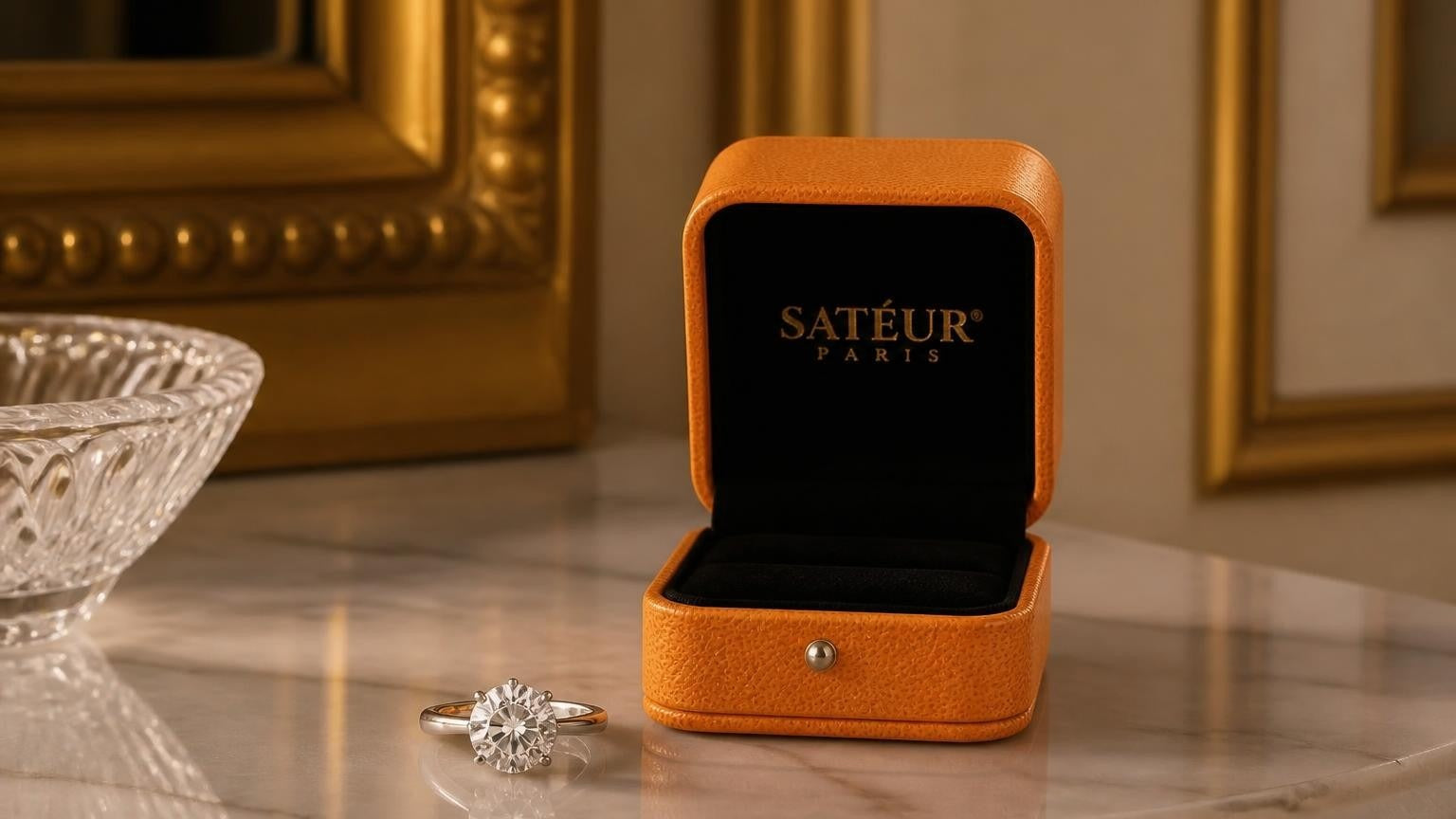
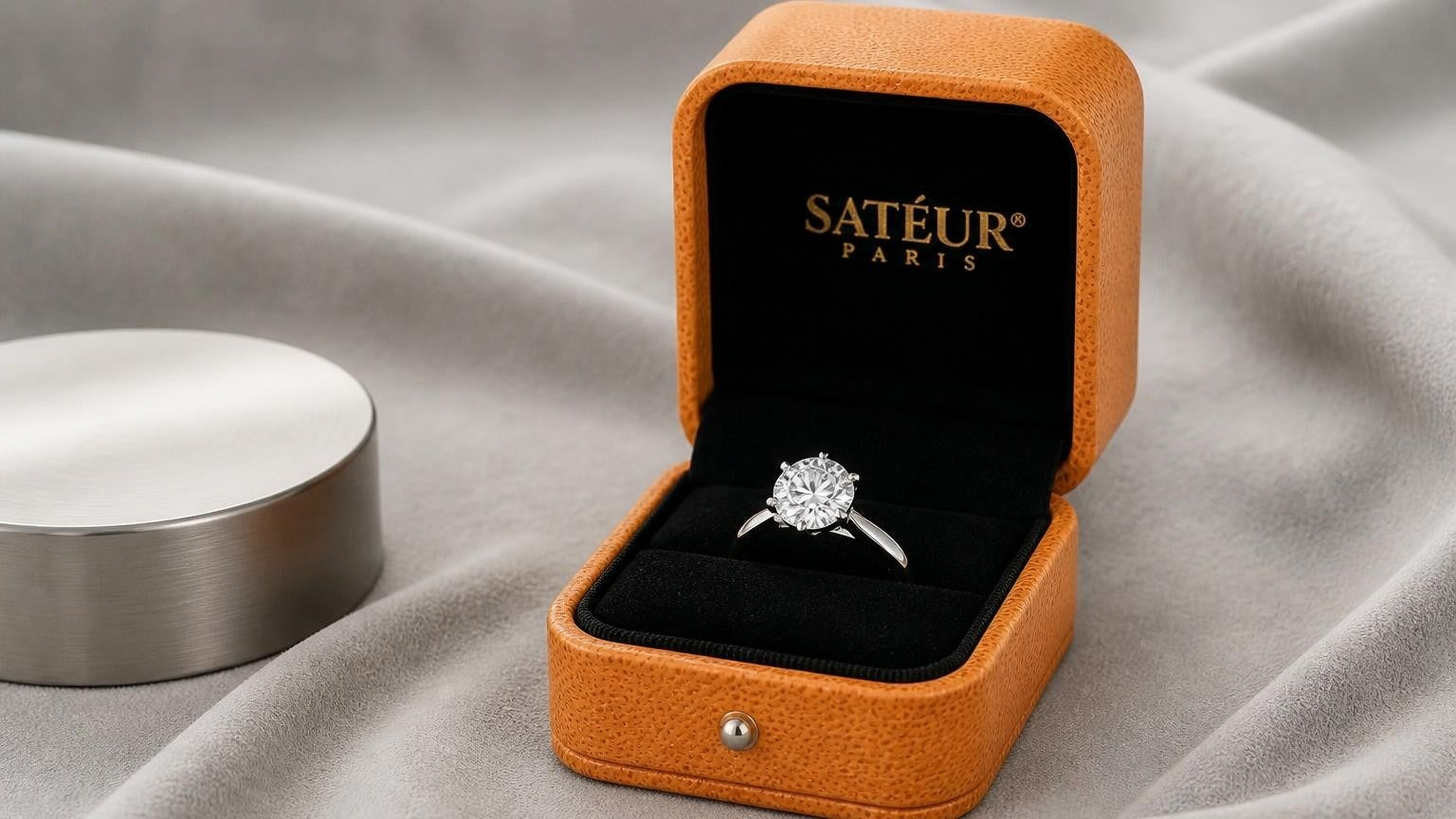
Satéur Gems® — the trademarked centre stone of The 1% Ring® — delivers the clean, white brilliance of a flawless diamond. D-E colour. Excellent cut. The light return calibrated specifically for diamond accuracy, so the ring reads as a flawless diamond with the naked eye and across the table.
The price: approximately 1% of a comparable mined ring stone. A 1-carat mined diamond at D-E colour with Excellent cut typically costs between $8,000 and $12,000. The Satéur Destinée Ring™ — The 1% Ring® — begins at $138. The same ring presence, the same daily-wear experience, at a fraction of the mined-diamond price. The difference can fund the wedding bands, the wedding itself, or simply remain as capital for the life the rings represent.
For couples building both an engagement ring and a wedding band set, the value compounds. The centre gemstone is the single largest driver of engagement ring cost; shifting that decision shifts the entire ring budget. The New Diamond Standard® was built on exactly this insight.

Satéur Destinée Ring™
The look of a flawless diamond — from $138.
Compare to a $10,000 mined diamond
Joined by 100,000+ couples across 150+ countries.
Discover The 1% RingFree worldwide shipping · 30-day returns · Lifetime Satéur Care
Over 100,000 couples across 150+ countries have chosen a different path. The Satéur approach to the engagement ring is not a compromise — it is the smarter choice. Explore the top jewelry brands for engagement rings for the broader landscape, review Satéur's best-selling engagement rings, or explore The 1% Ring collection directly.
Frequently Asked Questions
What is the difference between an engagement ring and a wedding ring?
An engagement ring is given at the proposal and features a centre gemstone. A wedding ring — or wedding band — is exchanged during the marriage ceremony and is typically a simpler, continuous band. Both rings are worn on the ring finger of the left hand, with the wedding band placed closest to the hand and the engagement ring above it.
Do I need both an engagement ring and a wedding ring?
Not by rule — but most couples choose both. The engagement ring marks the promise to marry; the wedding band marks the marriage itself. Some people wear only a wedding band, preferring a single, simpler ring. Others wear only their engagement ring. The convention is to wear both, but the choice is entirely personal.
When should I wear my engagement ring and wedding ring together?
After the wedding ceremony, both rings are traditionally worn together on the left ring finger — the wedding band closest to the hand, the engagement ring above it. During the ceremony, many people temporarily move the engagement ring to the right hand so the band can be placed first, then return it to the left hand above the wedding band afterwards.
What are popular styles for engagement rings versus wedding bands?
Engagement rings most commonly feature a round brilliant solitaire in white gold or platinum, though oval, cushion, and emerald cuts remain popular choices. Wedding bands tend toward simplicity — plain polished metal or a thin pavé-set band that complements the engagement ring above it. Matching metals and complementary profiles are the most widely chosen approach for a cohesive ring set.
Can an engagement ring and wedding ring be worn separately?
Yes. Some people wear only the wedding band on occasions when the engagement ring's raised setting might snag — physical work, sport, or active travel. Both rings are designed to function independently as well as together as a pair.
How do I choose between a traditional diamond and a Satéur Gems® stone for my engagement ring?
The question is whether the ring looks exceptional and holds its quality over time — not what the gemstone is made of. Satéur Gems® deliver the clean, white brilliance of a flawless diamond (D-E colour, Excellent cut) at approximately 1% of the price of a comparable mined ring stone. They read as flawless diamonds with the naked eye. If the goal is an engagement ring that looks and performs like a fine diamond, without the mined-diamond price, Satéur Gems® are the direct answer. See Satéur's top-selling engagement rings for the most popular configurations.

















コメントを残す
このサイトはhCaptchaによって保護されており、hCaptchaプライバシーポリシーおよび利用規約が適用されます。