

The Best Alternative to Tiffany & Co. Fine Jewelry
When Tiffany & Co. placed a single diamond solitaire in a blue box and sold the idea of that box as inseparable from the stone inside, it changed the jewelry industry permanently. The brand did not merely sell jewelry. It sold a language — of proposals, anniversaries, and quiet arrival. That language still carries weight. But today, a new generation of fine jewelry buyers is asking a different question: do you need the brand name to achieve the same presence?
The answer, in 2026, is no. Fine jewelry alternatives have matured. Direct-to-consumer Maisons now offer the visual standard of a $10,000 Tiffany piece for a fraction of the price — and the shift is not a compromise. It is a choice backed by improved gemstone technology, direct sourcing, and a generation that values what something looks like over where it was purchased.
Key Takeaways
- Tiffany & Co. prices reflect brand heritage and retail channel costs, not stone quality alone.
- Direct fine jewelry alternatives start from $88 — earrings, bracelets, rings, and necklace pieces at luxury-adjacent quality.
- Satéur Gems® delivers D–E colour clarity and diamond-accurate white brilliance at approximately 1% of a mined diamond price.
- Sterling silver and 18k gold finish remain the standard for fine jewelry durability and value across brands and price points.
- Over 100,000 customers across 150+ countries have chosen a different path to the same presence.
- Moissanite, at 9.25 Mohs hardness, offers lab-credibility and vivid rainbow fire for those who want a fully disclosable gemstone.
Why Tiffany and Co. Commands Premium Prices
Tiffany & Co. was founded in New York in 1837. It codified the engagement ring in the modern era — the Tiffany Setting solitaire of 1886 is one of the most reproduced jewelry designs in history. That is genuine cultural capital. The price of a Tiffany piece pays for something real: institutional heritage, global retail infrastructure, and a blue box that functions as social proof in nearly every market on earth.
But the price also reflects a retail model built for a different era. A Tiffany diamond solitaire engagement ring begins around $3,000 for a modest stone and scales rapidly into five figures for anything above a carat. The brand's sterling silver jewelry — the Return to Tiffany collection, the Tiffany T bracelet — carries premiums of 400–600% above material cost. The markup is not arbitrary. It is the cost of the brand itself, carried by every ring, bracelet, necklace, and pair of earrings that leaves a Tiffany boutique.

What You're Actually Paying For in Luxury Brand Jewelry
Understanding the Tiffany premium begins with separating the components of any luxury jewelry purchase: the stone, the metal, the craftsmanship, and the brand. In a Tiffany piece, the brand component is significant — and it does not vanish when you wear the piece or resell it. Tiffany jewelry holds secondary market value partly because the certification and provenance chain travel with the piece.
For those who wear jewelry daily — who want the presence without the documentation — the calculus shifts. Sterling silver ages identically whether it came from a Tiffany boutique or a direct Maison. Gold finish holds on the same timeline. A necklace pendant sits against skin the same way. The stone catches light by the same physics. What differs is the origin story and the price paid for it.
The informed buyer asks: how much of this price is stone and craft, and how much is the channel I bought it through? Direct fine jewelry brands eliminate the middleman markup typical of luxury retail. What remains is the object itself — at a fraction of the boutique price.
Alternatives to Tiffany: The Case for Direct Fine Jewelry
The rise of direct-to-consumer fine jewelry changed the arithmetic of the category. Brands that sell exclusively through their own channels — without flagship stores on Bond Street or Fifth Avenue — carry none of the overhead that luxury retail demands. That saving passes to the buyer. A piece that would retail at $2,000 in a luxury boutique arrives for $200–$400 from a direct Maison with equivalent materials and craftsmanship.
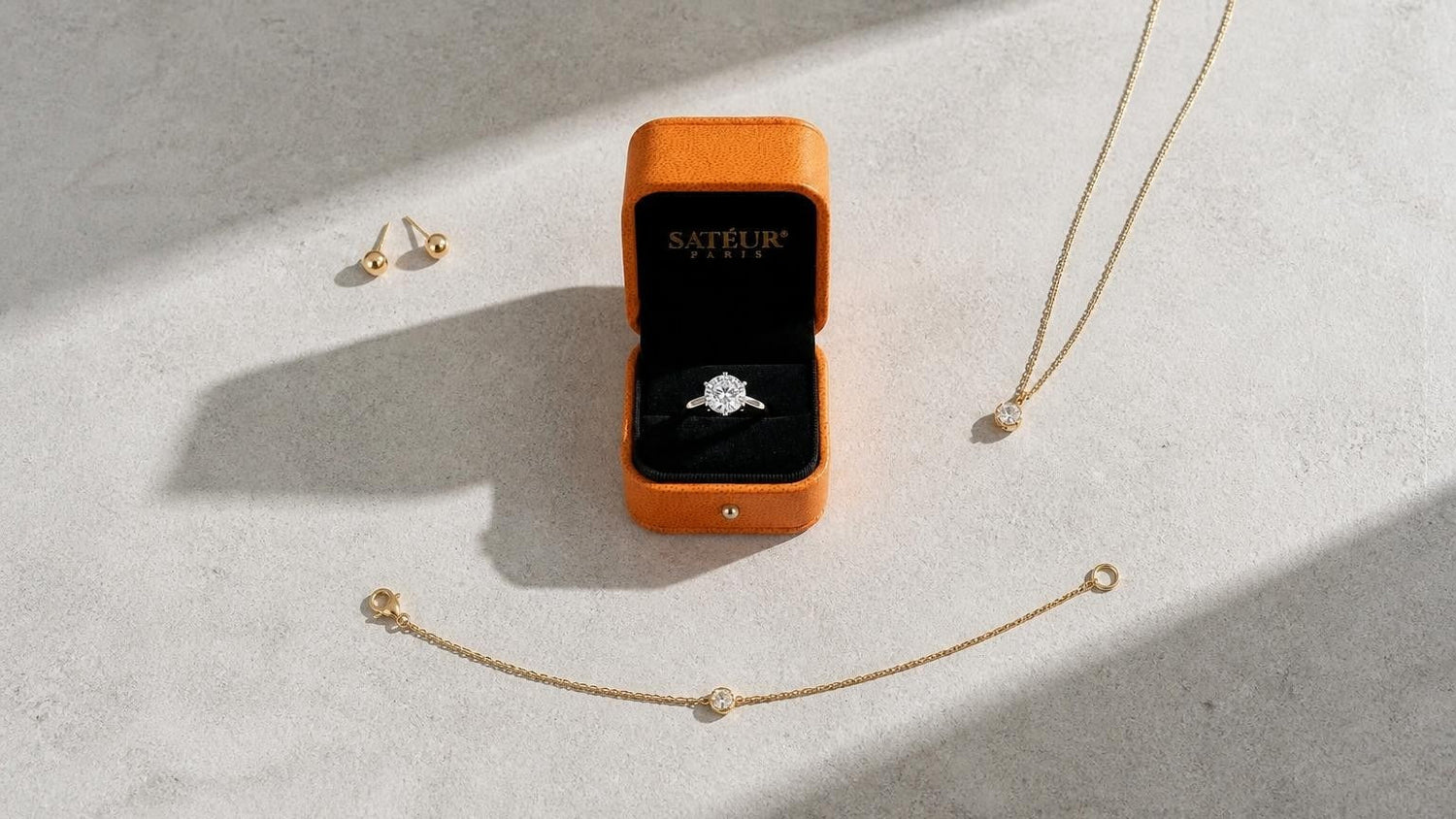
The category has also matured in quality. Early DTC jewelry was often undifferentiated — thin gold plate, generic settings, forgettable stones. The second generation is different. Satéur is among a small cohort of direct fine jewelry brands that built a genuine design identity before scaling. The The 1% Ring collection — Satéur's founding piece — set the standard: a trademarked diamond simulant in a precision solitaire setting, priced at entry where the comparison to a $10,000 mined diamond is not a marketing line but a visual fact.
Entry pieces in the direct fine jewelry space begin at $88. Statement collections — larger carat weights, more complex settings, necklace drops, and chandelier earrings — scale into the several hundreds. The price of a single Tiffany T bracelet in sterling silver covers an entire fine jewelry wardrobe from a direct alternative Maison. That is the arithmetic the category has made available.
Satéur Gems®: Diamond-Look Brilliance at Entry Pricing
Satéur Gems® is the proprietary gemstone tier that underpins The 1% Ring® and the Satéur collections. It is a trademarked diamond simulant engineered for diamond-accurate visual performance: D–E colour range, Excellent cut grade, and a refractive index that produces the clean white brilliance of a flawless diamond. Not the vivid rainbow fire of moissanite — the restrained, precise sparkle that a fine mined diamond produces under directional light. That distinction matters to buyers who want to wear their jewelry to a dinner and have it read as the real thing to anyone across the table.
The composition of Satéur Gems® is not publicly disclosed. The Maison follows the Swarovski model of protecting its proprietary formula. What is disclosed are the optical outputs: D–E colour, Mohs hardness of approximately 8.8 — extremely durable, built for everyday wear — and a refractive index of approximately 2.39 producing diamond-accurate optics with the naked eye.
The price point is approximately 1% of a comparable mined diamond. A 1-carat round brilliant mined diamond of comparable colour and cut retails for $8,000–$12,000. The Satéur Destinée Ring™ — the 1.00-carat solitaire that established the brand — begins at $138. The presence is indistinguishable with the naked eye. The choice is about what matters to you.

Satéur Destinée Ring™
The look of a flawless diamond, for 1% of the price.
Compare to a $10,000 mined diamond
Joined by 100,000+ couples across 150+ countries.
Discover The 1% RingFree worldwide shipping · 30-day returns · Lifetime Satéur Care
Sterling Silver and Gold Pieces Without the Brand Markup
Tiffany built its accessible tier on sterling silver: the Return to Tiffany heart tag bracelet, the Tiffany T wire bangle, the Elsa Peretti bean necklace and pendant pieces. These items sell for $300–$750. The sterling silver itself — the metal that gives them their weight and cool feel on skin — is a commodity traded at a known price. What you purchase in the Tiffany version is the hallmark, the blue box, and the cultural reference that hallmark carries.
Direct fine jewelry brands offer sterling silver and 18k gold finish pieces at comparable quality for 80–90% less. The metal is the same. Setting craftsmanship from a precision direct Maison is often equivalent to a mid-range luxury brand's secondary line. A direct necklace in sterling silver or yellow gold finish, set with a simulant gemstone, sits at the same aesthetic register as a Tiffany pendant or a Cartier-adjacent everyday piece — at a fraction of the price.
Yellow gold and 18k gold finish pieces have seen significant resurgence across fine jewelry at every price point. Satéur's yellow gold finish collection — rings, necklaces, bracelets — offers the warmth the current jewellery market has moved back toward. The finish is 18k gold over a solid sterling silver base — not solid 18k gold. That is an honest distinction found in every DTC fine jewelry brand and in most mid-range luxury jewelry globally. Quality at this level is defined by what you see and feel, not exclusively by what a specification sheet says.
Diamond Simulants vs. Mined Diamonds: Specs and Value
The fine jewelry alternative category has three meaningful gemstone tiers: diamond simulants (of which Satéur Gems® is the leading branded example), moissanite (lab-created silicon carbide, fully disclosed and certifiable), and lab-grown diamonds (IGI-certified, chemically identical to mined diamonds). Each occupies a different position on the price, transparency, and visual-performance spectrum.
| Property | Mined Diamond | Satéur Gems® | Moissanite | Lab Diamond |
|---|---|---|---|---|
| Brilliance | Crisp white, classic | Diamond-accurate white | Vivid rainbow fire | Crisp white, identical to mined |
| Mohs Hardness | 10 | ~8.8 | ~9.25 | 10 |
| Refractive Index | 2.42 | ~2.39 | ~2.65 | 2.42 |
| Price (1ct equiv.) | $8,000–$12,000 | From ~$138 | From ~$98 | $800–$2,000 |
| Disclosure | Full certification | Composition proprietary | Fully disclosed | IGI-certified |
Mined diamond buyers pay for geological scarcity and a certification chain. Lab-grown diamond buyers pay for chemical identity with a mined stone at a fraction of the mined price. Satéur Gems® buyers pay for the visual result — diamond-accurate presence — without the geological premium or the disclosure requirement. For buyers whose priority is how the piece looks on the hand, the price difference is the entire argument.

Engagement Rings and Bracelets: Quality Without the Luxury Brand Price
The engagement ring category is where the Tiffany alternative conversation carries the most commercial weight. The average spend on an engagement ring in the UK and US sits between $5,500 and $7,500. The Tiffany Setting solitaire — the category-defining piece — starts at approximately $5,500 for a 0.33-carat stone. A 1-carat equivalent approaches $20,000. The same presence — round brilliant, precision setting, white gold finish — is available from Satéur from $138.
Satéur's engagement ring collection offers the solitaire form in Satéur Gems® or moissanite. The moissanite ring collection extends into more elaborate settings and larger carat weights for buyers who want a disclosed, lab-created gemstone with 9.25 Mohs hardness and vivid fire. Charles & Colvard moissanite is another reference point in the direct moissanite market; Satéur offers an alternative for those who want the Maison aesthetic alongside the simulant or moissanite gemstone.
In the bracelet and necklace categories — where Tiffany's tennis bracelets, T bangles, and pendant necklaces define the aspirational tier — direct alternatives achieve the same wrist and neck presence. Sterling silver and gold finish bracelets from direct fine jewelry brands sit at $88–$250. Necklace pieces in sterling silver with simulant gemstone drops begin at a similar entry point. Tiffany equivalents start at $475 for silver pieces. The gemstones differ. The presence — the weight, the gleam, the ease of daily wear — does not.

FAQ: Choosing Fine Jewelry Beyond the Luxury Brands
What makes fine jewelry alternatives to Tiffany a practical choice?
The practical case rests on materials equivalence and price transparency. Sterling silver and 18k gold finish — the metals in Tiffany's accessible tier — are identical commodities whether purchased from a luxury boutique or a direct Maison. Diamond simulants and lab-created gemstones have reached a visual standard where, across the table and to the naked eye, the difference is imperceptible. The price differential — often 90% or more — reflects channel cost and brand equity, not a proportional difference in the object itself. For buyers who prioritise presence over provenance, the case is straightforward.
How do diamond simulant specs compare to mined diamonds in daily wear?
For daily wear durability, the relevant metric is Mohs hardness. Mined diamonds rate 10. Satéur Gems® rate approximately 8.8; moissanite rates approximately 9.25. Both are extremely durable and built for everyday wear — rings, bracelets, and necklace pendants worn continuously. The visual difference between a Satéur Gems® solitaire and a mined diamond solitaire is not detectable with the naked eye. The gemstone delivers the clean white brilliance of a flawless diamond under any light.
Is sterling silver or gold vermeil the better choice for lasting jewelry?
Both sterling silver and 18k gold finish (gold vermeil over sterling) are durable choices for fine jewelry at every price point. Sterling silver develops a patina over time and polishes easily. Gold finish pieces maintain their colour longer when kept away from chlorine and harsh detergents. Neither is inherently superior; the choice is aesthetic. Tiffany's sterling silver pieces and Satéur's sterling silver collection use the same base metal — the quality and longevity are consistent at this level regardless of brand.
Can you achieve a luxury aesthetic without the luxury brand price tag?
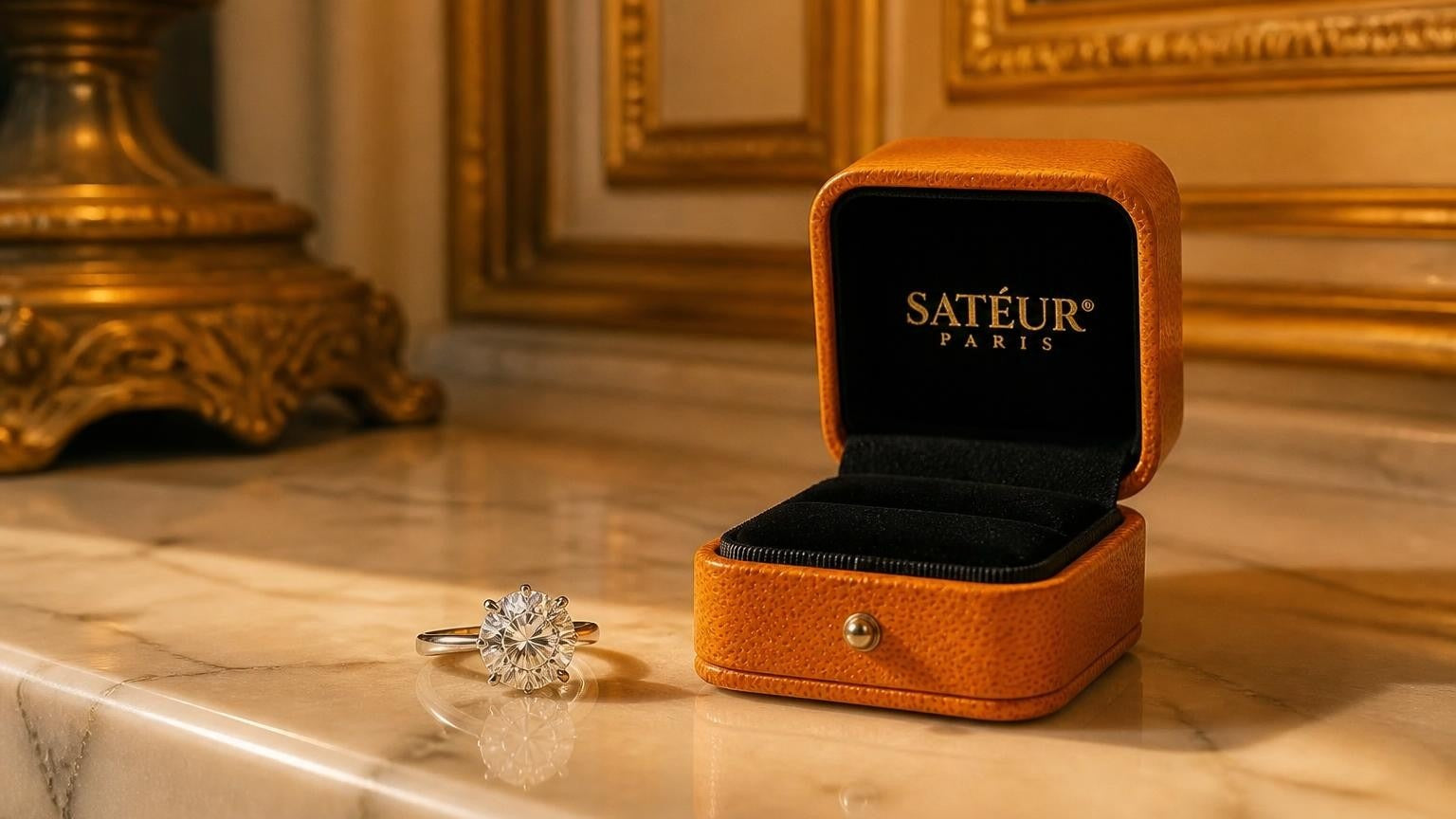
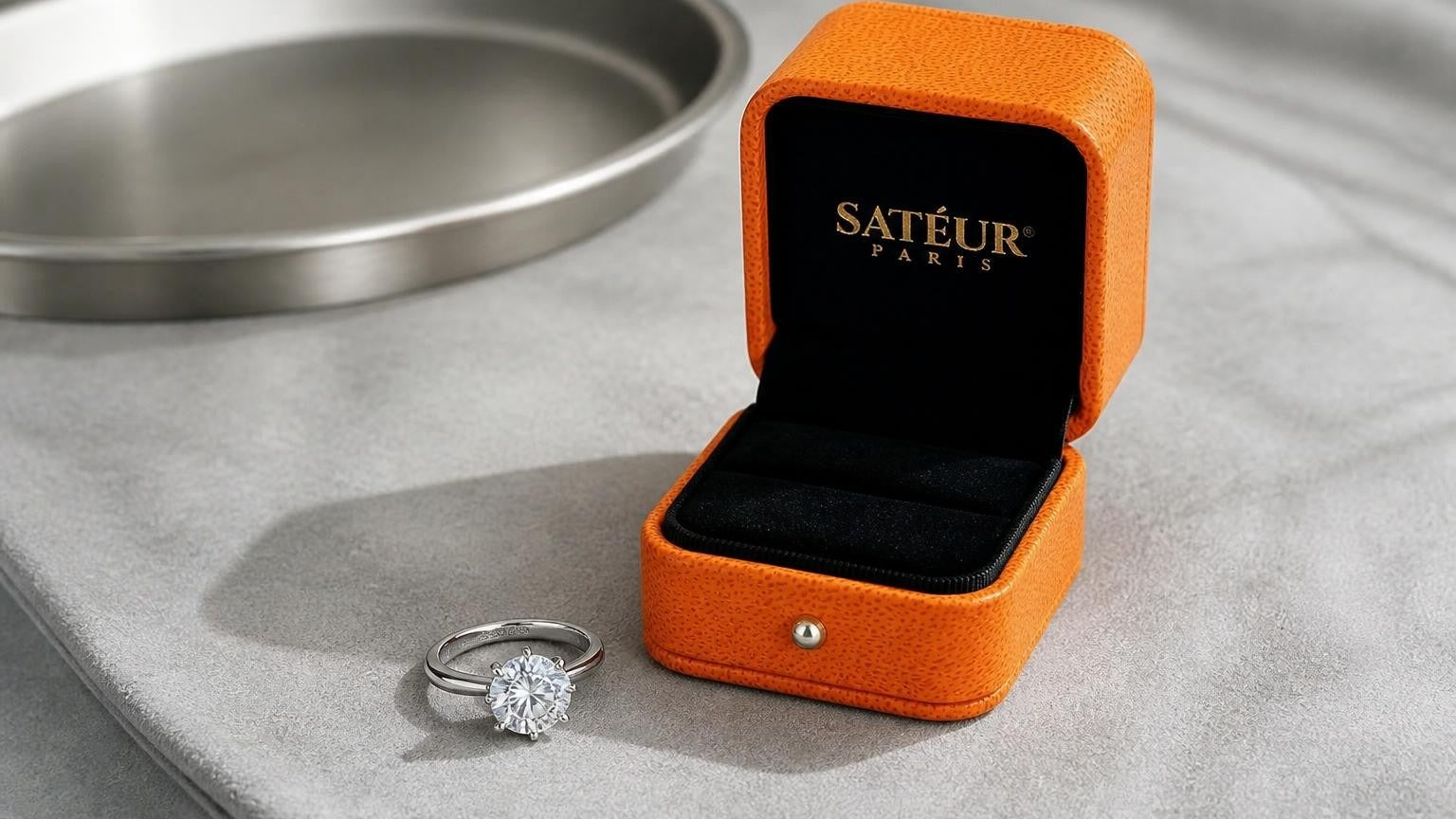
Yes. The luxury aesthetic in fine jewelry is primarily a function of form, proportion, finish quality, and gemstone optics — not the brand name. A precision-set round brilliant solitaire in an 18k white gold finish setting reads identically on the hand whether the gemstone is a $10,000 mined diamond or a Satéur Gems® simulant. The orange Satéur box — a ceremonial presentation piece — carries that register forward through the purchase and gifting experience.
What should you evaluate when comparing fine jewelry across price points?
Four criteria: metal quality (sterling silver, 18k gold finish, or solid gold — each should be clearly disclosed in a reputable brand's specifications); gemstone optics (brilliance pattern, colour grade, cut precision); setting craftsmanship (prong quality, finish, gemstone security); and brand transparency. A reputable direct fine jewelry Maison discloses its metal type, gemstone type, and specifications clearly. For buyers who weight heritage and certification chain, Tiffany's premium is justified. For buyers who weight visual presence and material quality, direct alternatives deliver the same result.
How do entry-level fine jewelry pieces hold their appeal over years of wear?
The longevity of fine jewelry at any price point depends on metal quality and gemstone hardness. A sterling silver bracelet or necklace from a direct Maison and one from Tiffany age on the same timeline. Satéur Gems® and moissanite hold their brilliance for life — neither clouds, yellows, nor loses facet definition with wear. The distinction is not luxury versus alternative; it is fine versus fashion. Satéur operates in the fine category, with the durability and optical permanence that entails.
Fine jewelry at the Tiffany price point is aspirational because the brand built it that way — one blue box at a time, over nearly two centuries. That heritage is real. It carries meaning for many buyers, and Tiffany has earned every part of it. For those who care more about what the piece looks like in the room than where it was purchased, the direct fine jewelry landscape in 2026 offers the same presence at a different price.
Satéur began with a single conviction: the brilliance of a gemstone has no necessary relationship to its price. Across the direct fine jewelry landscape, that conviction has become a category. The 1% Ring® is its most distilled expression — a round brilliant solitaire that delivers the diamond look without the diamond price, and an orange box that treats the moment of giving as ceremony. That is The New Diamond Standard.
















Deixe um comentário
Este site está protegido pela Política de privacidade da hCaptcha e da hCaptcha e aplicam-se os Termos de serviço das mesmas.