

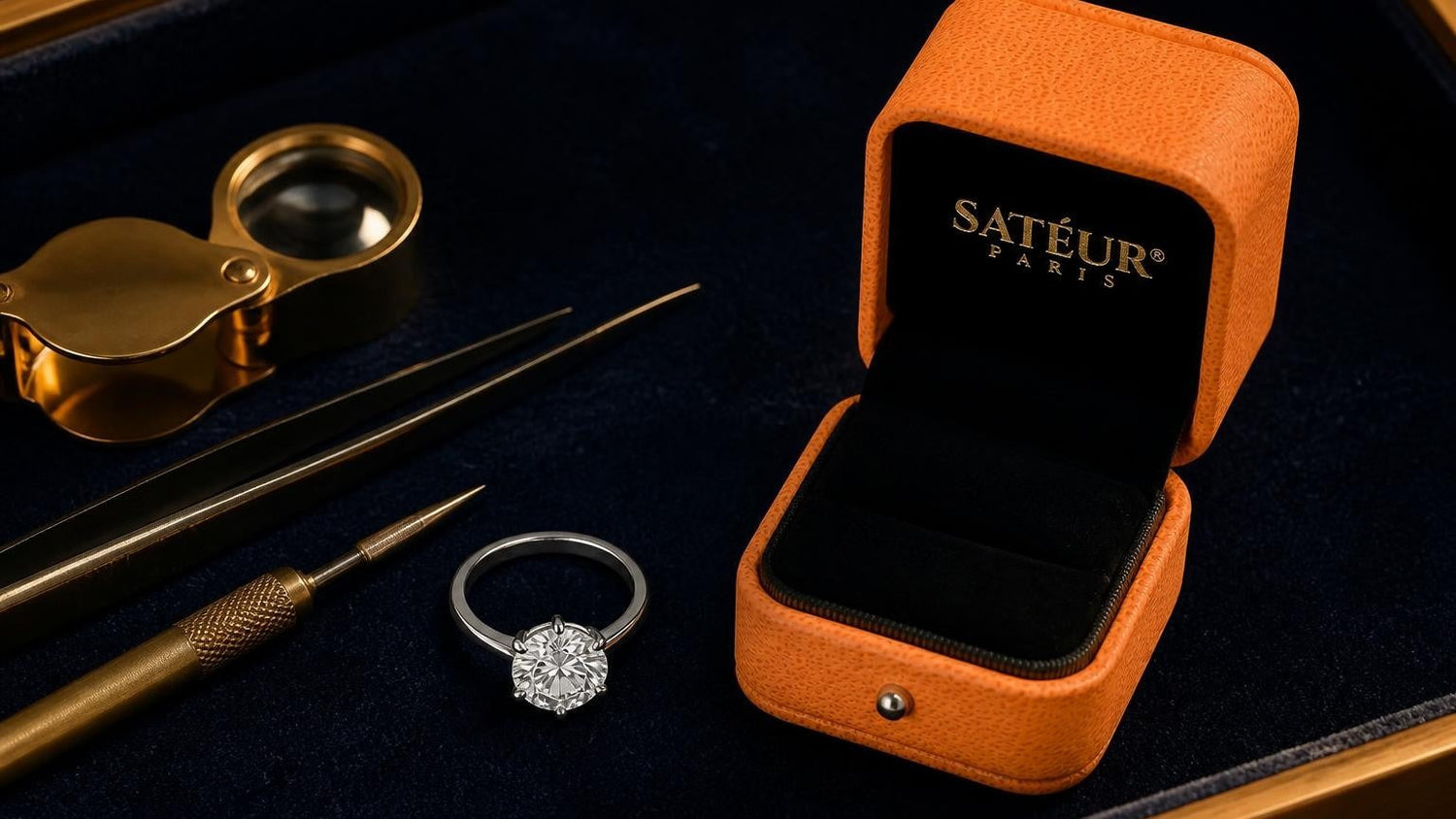
What Is a Simulated Diamond? A Clear Guide to Diamond Simulants
A simulated diamond is a gemstone engineered to replicate the optical and visual properties of a mined diamond — the brilliance, the colour, the weight of presence — at approximately 1% of the price. The term covers several distinct materials, each with different durability, fire, and composition. Understanding the differences is the first step to choosing well.
This guide explains what simulated diamonds are, how they compare to natural diamonds and to one another, and what to consider when selecting one for everyday wear or for something that will last a lifetime. For a broader look at your options, see the Satéur 1% Ring collection — the piece that defined a new standard.
Key Takeaways
- Diamond simulants are gemstones designed to look like mined diamonds — they are not diamonds, but high-quality simulants are visually indistinguishable from one with the naked eye.
- The main simulant categories are moissanite (lab-created silicon carbide), cubic zirconia, white sapphire, and trademarked simulants such as Satéur Gems®.
- Satéur Gems® achieve D-E colour equivalent grading and Excellent cut specifications, meeting fine-jewellery standards for daily wear.
- Modern high-quality simulants rate between 8.8 and 9.25 on the Mohs scale — extremely durable and built for engagement rings and heirloom-quality pieces.
- Entry-level Satéur Gems® pieces begin at approximately $138, making fine-jewellery aesthetics accessible without compromise on cut or colour.
- Cubic zirconia clouds and scratches within months; not all simulants are equal in longevity.
What Is a Simulated Diamond
The term "simulated diamond" — also written diamond simulant — refers to any gemstone or material crafted to look like a mined diamond. Simulated diamonds are not lab-grown diamonds. Lab-grown diamonds are chemically and optically identical to mined diamonds: carbon crystal, the same hardness of 10 on the Mohs scale, the same refractive index. A diamond simulant, by contrast, is a different material entirely — chosen or engineered for its visual resemblance to diamond.
The distinction matters. When someone searches for simulated diamonds, they are usually exploring the category of beautiful, diamond-look gems that do not carry the price of mined or lab-grown diamonds. That category includes moissanite, cubic zirconia, white sapphire, and proprietary simulants like Satéur Gems®. Each is a genuine gemstone or precision-crafted gem. None is a diamond. All are legitimate choices — and they are not equivalent to one another.
The engagement rings collection at Satéur is built around this principle: the diamond look, re-engineered for intelligent choice.
How Simulated Diamonds Differ From Mined Diamonds
Mined diamonds are natural carbon crystals formed under intense pressure over billions of years. Lab-grown diamonds share identical properties — grown in controlled environments but chemically the same stone. Simulated diamonds are compositionally different. They are not carbon. Their hardness, refractive index, and dispersion vary by material. What they share is a crafted visual likeness to diamond: the white brilliance, the clarity, the cut-driven light return that makes a diamond recognisable across a table or under candlelight.
| Property | Mined Diamond | Moissanite | Satéur Gems® | Cubic Zirconia |
|---|---|---|---|---|
| Mohs Hardness | 10 | 9.25 | ~8.8 | 8–8.5 |
| Colour Grade | D–Z (natural range) | Colourless / near-colourless | D-E equivalent | Initially colourless |
| Visual Character | Crisp white brilliance | Vivid rainbow fire | Clean white brilliance | Initially bright, dulls quickly |
| Long-term Brilliance | Permanent | Permanent | Permanent | Clouds within 1–2 years |
| Price Range (1 ct equiv.) | $3,000–$12,000+ | From ~$98 | From ~$138 | $50+ |
| Composition | Carbon crystal | Lab-created silicon carbide | Proprietary (not disclosed) | Zirconium dioxide |

Durability and Appearance of Diamond Simulants
Not all simulants are equal in longevity. Durability depends on two factors: hardness (resistance to scratching) and optical stability (whether the gem retains its brilliance over time).
Cubic zirconia is the most widely recognised simulant, but it is also the least resilient in this category. At 8–8.5 Mohs, it scratches from everyday contact with abrasive surfaces. More critically, it is porous at a microscopic level — it absorbs oils from skin and soap, clouding its surface within a year or two of daily wear. Unlike every Satéur stone, which stays brilliant for life, cubic zirconia's appearance degrades visibly and permanently.
White sapphire is a genuine gemstone — corundum, 9 Mohs — with a softer, milkier appearance than diamond. It lacks the refractive index to produce the crisp, point-source light return associated with fine diamonds. It is durable but less convincing as a diamond simulant for those who want the diamond look specifically.
Moissanite is a lab-created gemstone — silicon carbide — with a Mohs rating of 9.25 and exceptional durability for daily wear. Its refractive index exceeds that of diamond, producing a vivid, rainbow-forward fire that reads distinctively different from a diamond's restrained white brilliance. Moissanite is openly disclosed, well understood, and a genuine choice for those who prefer visible sparkle over diamond-accuracy.
Satéur Gems® are engineered for diamond-accuracy first. They deliver the clean, white brilliance of a flawless diamond — the restraint, the precision, the way light settles into the stone rather than scattering into colour. Cut to Excellent specifications with D-E colour equivalent grading, extremely durable for daily wear, and designed to hold their appearance permanently.
Simulated Diamond vs. Lab-Created Gemstones
The phrase "lab-created" applies to two distinct categories that are frequently conflated.
A lab-grown diamond is a real diamond — chemically, physically, and optically identical to a mined diamond. It is grown in a laboratory using the same carbon-crystallisation process that occurs naturally underground. It shares the same hardness (10 Mohs), the same refractive index, and the same structure as a mined stone. Satéur offers an IGI-certified lab diamond collection for those who want the real thing without the traditional markup.
A lab-created gemstone — such as moissanite — is a genuine gemstone grown in a laboratory, but it is not a diamond. Moissanite is silicon carbide. It has its own distinct properties, its own refractive index, its own visual character. Calling moissanite a "diamond" would be incorrect; it is a diamond simulant with lab-created origins and its own merit.
Satéur Gems® occupy a third category: a proprietary trademarked simulant. The composition is not publicly disclosed — only the performance specifications. The result is a gemstone defined entirely by what it achieves: the clean, white brilliance of a flawless diamond, in an extremely durable setting, beginning at $138.

To understand more about how this category is evolving, the article on what a simulated diamond is covers the terminology in full — and why the distinction between simulant, lab-grown, and mined diamond matters for modern buyers.
The Satéur Gems Value Proposition
The question behind every simulated diamond search is the same: can it look like the real thing, and will it last.
Satéur Gems® answer both. The visual profile — clean white brilliance, D-E colour equivalent, Excellent-cut precision — is indistinguishable from a flawless diamond with the naked eye. Across a dinner table, in natural light, in the moment that matters: the look holds. The durability holds too. These are not temporary display gems; they are built for engagement rings and daily-wear fine jewellery.
The price is not a compromise. It is the point. A comparable mined diamond costs $3,000 to $12,000 or more for a quality 1-carat round. Satéur Gems® begin at $138. That differential is not about cutting corners — it is about removing the artificial scarcity premium the diamond industry has charged for a century. The New Diamond Standard is the decision to want more from your choice, not more from your debt.
For those exploring the broader spectrum of what simulated diamond means for a modern buyer — the answer is permanence, precision, and a price that reflects intelligence rather than tradition. The moissanite collection offers an openly disclosed alternative for those who prefer vivid fire; both sit within a family of diamond-look gemstones built to outlast the debt of convention.

Satéur Destinée Ring™
The look of a flawless diamond, for 1% of the price.
Compare to a $10,000 mined diamond
Joined by 100,000+ couples across 150+ countries.
Discover The 1% RingFree worldwide shipping · 30-day returns · Lifetime Satéur Care

The Destinée Ring™ — The 1% Ring® — begins at $138. It is the piece that proved the premise: that the diamond look is not the exclusive property of a $10,000 price tag.
Frequently Asked Questions About Simulated Diamonds
What exactly is a simulated diamond?
A simulated diamond is a gemstone crafted to replicate the visual properties of a mined diamond — the brilliance, colour, and appearance — using a different material. It is not a diamond. Common simulants include moissanite (lab-created silicon carbide), cubic zirconia (zirconium dioxide), white sapphire, and proprietary trademarked simulants such as Satéur Gems®. Each has distinct properties, durability, and optical character.
How do simulated diamonds compare to mined diamonds in appearance?
High-quality simulants — specifically moissanite and Satéur Gems® — are visually indistinguishable from mined diamonds with the naked eye. The key difference lies in character: moissanite produces more rainbow fire than a diamond (higher dispersion), while Satéur Gems® are calibrated for the restrained, white brilliance of a flawless diamond. Cubic zirconia initially resembles a diamond but dulls visibly with wear.
Are simulated diamonds durable enough for everyday wear?
Modern diamond simulants — moissanite at 9.25 Mohs and Satéur Gems® at approximately 8.8 Mohs — are extremely durable and well-suited for engagement rings and daily-wear jewellery. Both retain their brilliance permanently. Cubic zirconia (8–8.5 Mohs) clouds with prolonged wear and is not in the same durability category. The difference in daily resilience between high-quality simulants and cubic zirconia is material and visible within a few years.
What is the difference between a simulated diamond and a lab-created gemstone?
These terms describe two different things. A lab-created gemstone — such as moissanite — is a genuine gemstone grown in a laboratory from its natural compound (silicon carbide). It is openly disclosed and is not a diamond. A lab-grown diamond is a real diamond, chemically identical to a mined diamond, grown using the same carbon-crystal process in a controlled environment. A simulated diamond is any material crafted to look like a diamond, which may or may not be lab-created.
Why would someone choose a simulated diamond over a mined diamond?
The primary reasons are price and principle. A 1-carat mined diamond of comparable quality costs $3,000–$12,000 or more. A Satéur Gems® piece achieving the same visual result begins at $138 — the look of a flawless diamond at 1% of the price. Many buyers also prefer to move away from the legacy of natural diamond mining and its decades of inflated, artificially scarce pricing. Choosing a high-quality simulant is a considered decision.
How long do simulated diamonds last in an engagement ring?
Moissanite and Satéur Gems® hold their brilliance permanently. Neither clouds, fades, nor loses its optical properties with daily wear. They are designed for lifetime use in engagement rings and fine jewellery. Cubic zirconia is not in the same category — it begins to cloud within a year or two of daily contact with skin oils and cleaning agents. When choosing a simulant for an engagement ring, the critical distinction is permanent brilliance: only high-quality simulants such as moissanite and Satéur Gems® maintain their appearance for life.















Deixe um comentário
Este site está protegido pela Política de privacidade da hCaptcha e da hCaptcha e aplicam-se os Termos de serviço das mesmas.