

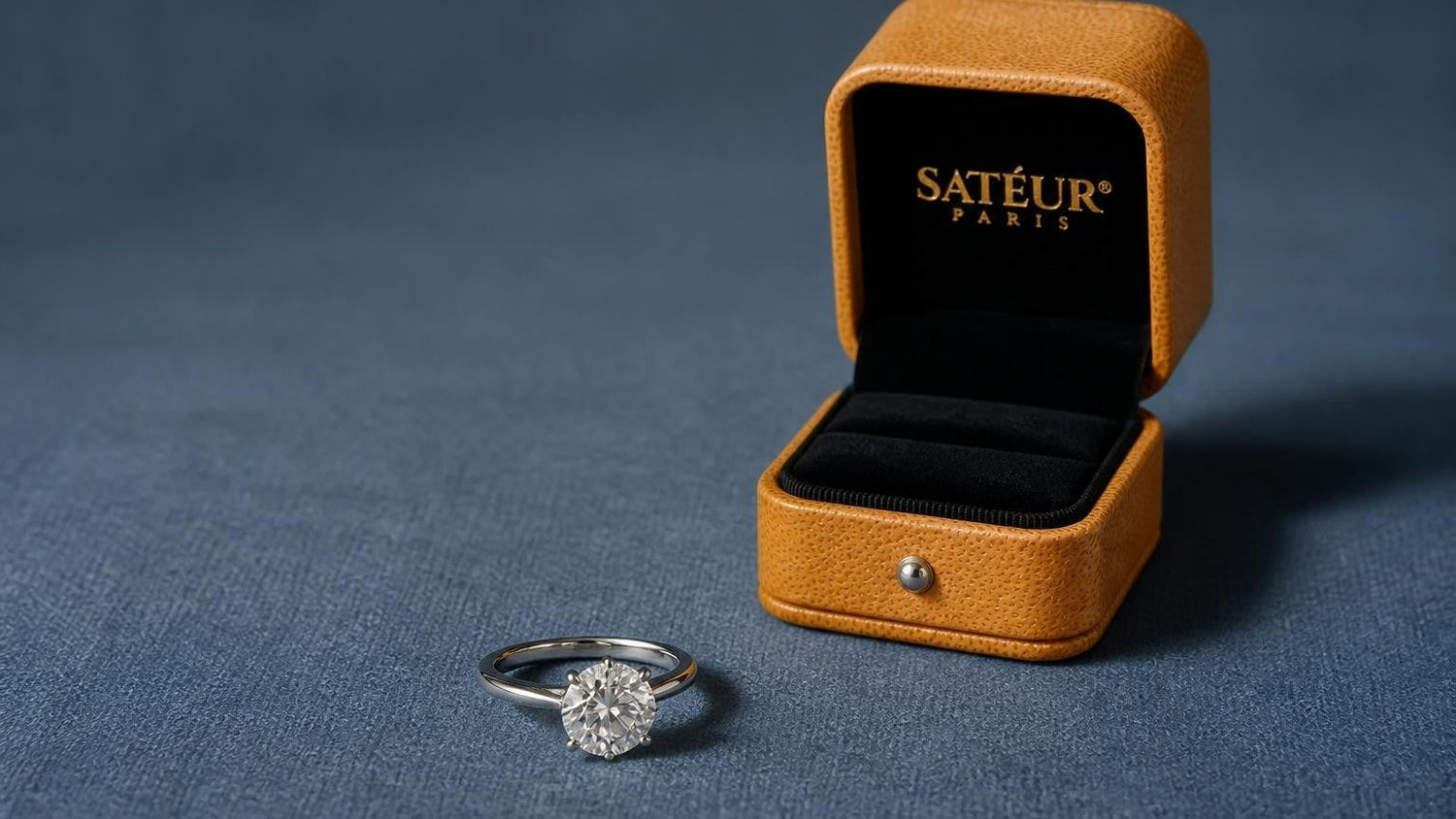
Moissanite Price Guide: What Does Moissanite Actually Cost?
The question most people type before buying is not "what is moissanite" — it is "what does moissanite cost, and why does it cost so much less than a diamond?" The answer is clear and worth understanding. Moissanite is a lab-created gemstone with its own distinct optical properties. Its price reflects production efficiency, not inferior quality. A 2-carat moissanite ring typically costs under $1,500. A 2-carat mined diamond in a comparable setting would exceed $15,000.
That is a cost ratio approaching 1:10, and it changes what a ring can mean without changing how it looks across the table. For a detailed look at the full cost stack, the moissanite vs. diamond price guide breaks down the comparison by metal, setting, and certification.
Key Takeaways
- A 2-carat moissanite ring typically costs under $1,500 versus $15,000+ for a diamond equivalent.
- Loose moissanite stones start around $115 for smaller cuts — rounds, ovals, cushions.
- Moissanite grades D–E colour and Excellent cut as standard; hardness is 9.25 Mohs, built for daily wear.
- Moissanite displays approximately 2.4× the fire of diamond — vivid rainbow sparkle under light movement.
- Moissanite face-up appears 10–15% larger than a diamond of equivalent carat weight.
- Satéur's moissanite delivers the diamond-look appearance at approximately 1% of premium diamond pricing.
What Is Moissanite
Moissanite is a lab-created gemstone composed of silicon carbide. It was first discovered in 1893 by Henri Moissan in a meteorite crater in Arizona — the natural form exists only in trace quantities. Every moissanite sold today is grown in a controlled laboratory environment, making it one of the few gemstones that is genuinely ethical by production.
Its properties place it among the hardest and most brilliant gemstones available. At 9.25 on the Mohs scale — suitable for everyday wear — moissanite is harder than ruby, sapphire, and nearly every other coloured gemstone. It is second only to diamond in hardness, and it carries none of the supply-chain complexity of mined extraction.
That character centres on fire. Moissanite displays roughly 2.4× the fire of diamond — the dispersion of white light into spectral colour. Under movement, it produces a vivid, rainbow-forward brilliance that many wearers actively choose. It is a different kind of beauty, openly so — and for those building a moissanite jewellery collection, that distinction matters: moissanite is not a substitute for diamond. It is a distinct gemstone with its own character and its own advantages.

Moissanite vs. Diamond: Price & Specs
Understanding moissanite price begins with understanding how it compares to diamond across the key value axes. The table below covers the measurable dimensions that drive both appearance and price:
| Property | Moissanite | Mined Diamond |
|---|---|---|
| Hardness (Mohs) | 9.25 | 10.0 |
| Colour Grade | D–E (colourless) | D–Z range |
| Cut | Excellent (standard) | Variable |
| Fire (Dispersion) | 0.104 — approx. 2.4× diamond | 0.044 |
| Refractive Index | ~2.65 | ~2.42 |
| Face-up size vs. diamond | 10–15% larger per carat | Reference |
| 1-carat ring price | $300–$600 | $4,000–$12,000+ |
| 2-carat ring price | $800–$1,500 | $15,000–$40,000+ |
| Origin | Lab-created | Mined or lab-grown |
Moissanite often appears 10–15% larger face-up than a diamond of equivalent carat weight — an effect of its refractive index. A 6.5mm moissanite reads as generously as a 1-carat diamond face-up. When carat weight is the reference, moissanite delivers more visible gemstone per dollar than any other premium stone.
Moissanite Engagement Ring Cost by Carat
Price scales with carat weight, as it does with diamond — but the trajectory is far more linear and accessible. Understanding moissanite price per carat is useful here: moissanite holds relatively steady per carat as size increases, whereas diamond pricing per carat compounds exponentially. At 3 carats, the gap between moissanite and mined diamond is not 10× — it is closer to 40×.
| Carat Weight | Moissanite Ring Range | Equivalent Diamond Ring |
|---|---|---|
| 0.5 ct | $150–$350 | $1,500–$4,000 |
| 1.0 ct | $300–$600 | $4,000–$12,000 |
| 1.5 ct | $500–$900 | $8,000–$20,000 |
| 2.0 ct | $800–$1,500 | $15,000–$40,000+ |
| 3.0 ct | $1,200–$2,200 | $40,000–$90,000+ |
These ranges hold across most reputable moissanite suppliers and assume a standard solitaire setting. Setting choice adds cost — a pavé or halo in 18k gold will sit toward the upper bound. At smaller carat weights, metal type often accounts for more of the final ring price than the moissanite itself.
For a dedicated breakdown at the most-purchased size, the 1-carat moissanite vs. diamond price comparison is the clearest reference point. A 1-carat moissanite ring at $300–$600 versus $4,000–$12,000 for the diamond equivalent is the number that moves most purchase decisions.
Satéur's Moissanite: Value & Visual Appeal
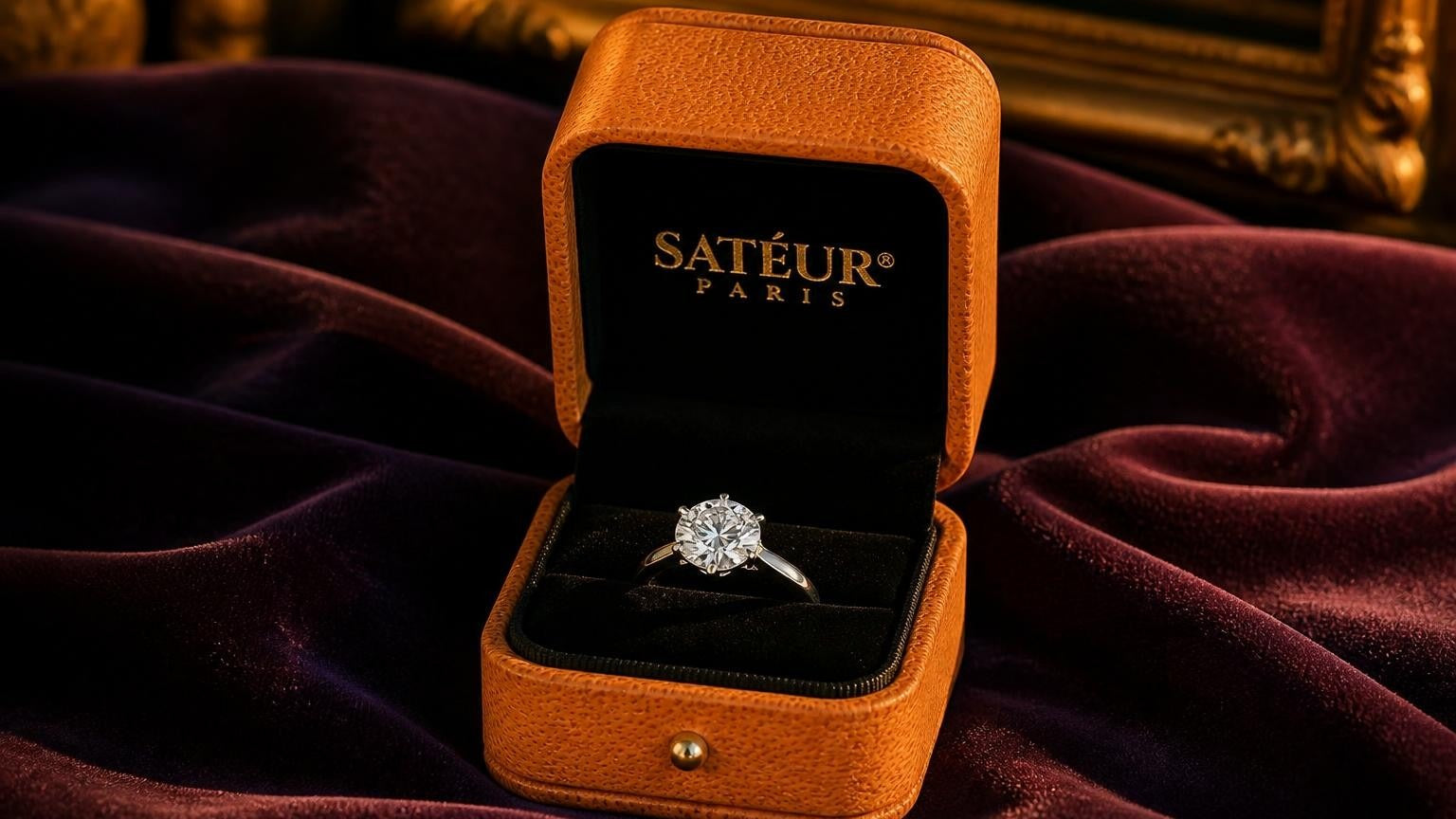
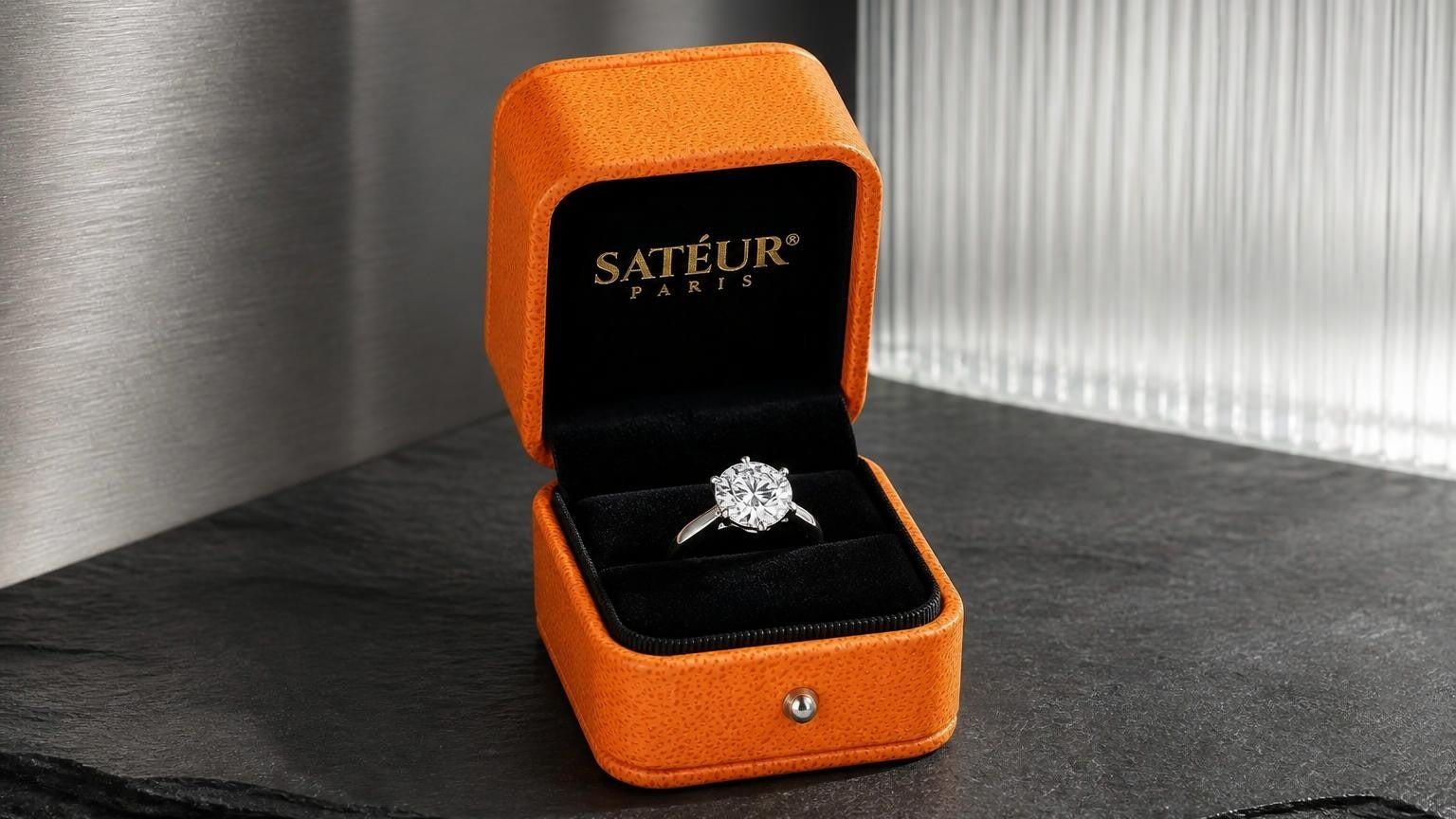
Satéur's moissanite collection is built on a clear conviction: the appearance of a premium diamond-look stone should not require a premium diamond budget. At approximately 1% of high-end diamond pricing, the Satéur moissanite delivers that appearance through precision — D–E colour, Excellent cut, and the vivid fire that makes moissanite its own category.
Over 100,000 customers across 150 countries have chosen a different path. The logic is not complicated: a stone that grades D–E colour, holds 9.25 hardness, and produces 2.4× the fire of diamond performs as jewellery. It earns its place at the table.
Satéur's moissanite sits above the Satéur Gems® tier in fire expressiveness. Where Satéur Gems® is calibrated to the restrained, clean white brilliance of a flawless diamond — diamond-accurate across the table and to the naked eye — moissanite is calibrated for those who prefer vivid, expressive brilliance. Two distinct signatures, both built to last.
Moissanite Loose Stones: Selection & Price
Loose moissanite stones are available across all major cuts and sizes, with pricing beginning well below finished ring prices. For those who intend to set a stone in an existing mounting or have a custom piece made, buying loose is the most cost-efficient route.
Typical loose moissanite pricing (stone only, unset):
- 0.5 ct round: $80–$150
- 1.0 ct round: $200–$400
- 1.5 ct round: $350–$600
- 2.0 ct round: $600–$1,000
Fancy cuts — oval, cushion, pear, radiant — are generally priced comparably to round within the same carat weight, though elongated cuts appear larger face-up for the same carat. At every size, loose moissanite pricing offers significant savings versus loose diamond per carat — a relationship that compounds meaningfully at 2 carats and above.

The Round Moissanite from $115
Round brilliant is the canonical moissanite cut. It maximises the stone's dispersion — the characteristic fire — and produces the most consistent face-up appearance across all lighting conditions. A round moissanite in a solitaire setting from $115 is a genuine starting point for those entering the category.
The round cut also has the broadest market context: its proportions are well-understood, and its face-up size relative to carat weight is the standard benchmark against which all other shapes are measured. For value, clarity of comparison, and daily wearability, round remains the reference choice.
The Oval Moissanite from $120
Oval moissanite has become one of the fastest-growing engagement ring shapes. The elongated silhouette makes the stone appear approximately 10% larger face-up than a round of equivalent carat weight — and it flatters a broad range of hand shapes. Starting from around $120 in a finished ring, it delivers the visual scale of a larger stone without the price of a larger stone.
The oval is particularly effective in a thin band or minimal bezel setting. The stone carries the composition. Its fire, distributed across the longer facet pattern, produces a different kind of movement from the round — sweeping rather than concentrated. For those who find the round too conventional, the oval is the natural alternative.
The Cushion Moissanite from $130
Cushion cut moissanite brings a warmer, more considered character to the moissanite price conversation. Its rounded corners and pillow-like profile scatter light differently from a round — producing broader, softer flash rather than the tight needle-fire of a modern brilliant. Starting from around $130, it is a refined choice for those drawn to something with more visual warmth.
In white gold or 18k gold finishing, a cushion moissanite reads with equal authority across formal and everyday wear. The cut was popular in the 18th and 19th centuries before modern brilliant-cutting emerged — its revival reflects an appetite for depth and character in a stone, not just maximum sparkle output.

With Side Stones & Matching Bands
Adding side stones — pavé bands, halo settings, three-stone configurations — increases the total price but compounds the visual effect significantly. A 1-carat cushion moissanite in a pavé halo setting can read as considerably more elaborate than its component prices suggest. The combination of centre stone and setting cost still sits well below a comparable diamond configuration at every carat weight.
Matching bands, anniversary bands, and stacking rings extend the moissanite ring purchase into a considered collection. For those building across occasions rather than making a single purchase, moissanite's price point allows the full set — not a deferred plan. Satéur's broader moissanite collection spans rings, earrings, and necklaces — each holding the same D–E colour, Excellent cut standard.
The engagement ring is the beginning. The rest follows from it.

Satéur Moissanite Collection
The diamond-look appearance. Vivid fire. D–E colour. At approximately 1% of the price.
Compare to a $10,000 mined diamond
Joined by 100,000+ couples across 150+ countries.
Shop MoissaniteFree worldwide shipping · 30-day returns · Lifetime Satéur Care
Frequently Asked Questions
What is moissanite and how is it made?
Moissanite is a lab-created gemstone composed of silicon carbide. It was first identified in 1893 in a meteorite crater; the natural form is extraordinarily rare. Every moissanite sold commercially is grown in a controlled laboratory environment — producing colourless, high-clarity gemstones with consistent optical properties. It is a genuine gemstone with its own distinct character, not a diamond substitute.
How does moissanite price compare to diamond cost?
Moissanite is significantly more affordable than mined diamond at every carat weight. A 1-carat moissanite ring typically costs $300–$600; a comparable mined diamond ring costs $4,000–$12,000. A 2-carat moissanite ring runs $800–$1,500 versus $15,000–$40,000+ for the diamond equivalent. The price difference reflects production method, not visual quality. Moissanite at D–E colour and Excellent cut is optically impressive at any size.
Is moissanite durable enough for engagement rings?
Yes. At 9.25 on the Mohs scale, moissanite is harder than ruby, sapphire, and nearly every other gemstone used in jewellery. Only diamond is harder. Moissanite holds its brilliance for life — it does not cloud, dull, or scratch under normal daily wear. It is built precisely for the demands of a ring worn every day.
What colour and clarity grades does moissanite come in?
Premium moissanite, including Satéur's collection, grades D–E colour — equivalent to the top tier of the diamond colour scale. The stone reads colourless in all lighting conditions. Clarity is consistently high: lab-grown production eliminates the inclusions common in mined stones. Excellent cut is the standard grade across reputable moissanite suppliers.
Will moissanite hold its value over time?
Moissanite does not carry the speculative investment value sometimes attributed to rare mined diamonds. Its value is in what it delivers — appearance, durability, optical performance — rather than resale. Most engagement jewellery, including mined diamond, depreciates significantly from retail. For those purchasing a ring as a ring rather than an asset, moissanite's value proposition is straightforward: a premium-appearing gemstone at a fraction of the cost, built to last.
How do I choose between moissanite, cubic zirconia, and white sapphire?
Moissanite, cubic zirconia (CZ), and white sapphire occupy different tiers entirely. CZ is a low-cost simulant that clouds and scratches within a year of daily wear — it is not suitable for an engagement ring worn long-term. White sapphire is a natural gemstone, but its low dispersion produces a dull face-up appearance compared to moissanite's fire. Moissanite is the clear choice for those who want a durable, brilliant gemstone that maintains its appearance for life — at a price far below mined diamond.












Deixe um comentário
Este site está protegido pela Política de privacidade da hCaptcha e da hCaptcha e aplicam-se os Termos de serviço das mesmas.