

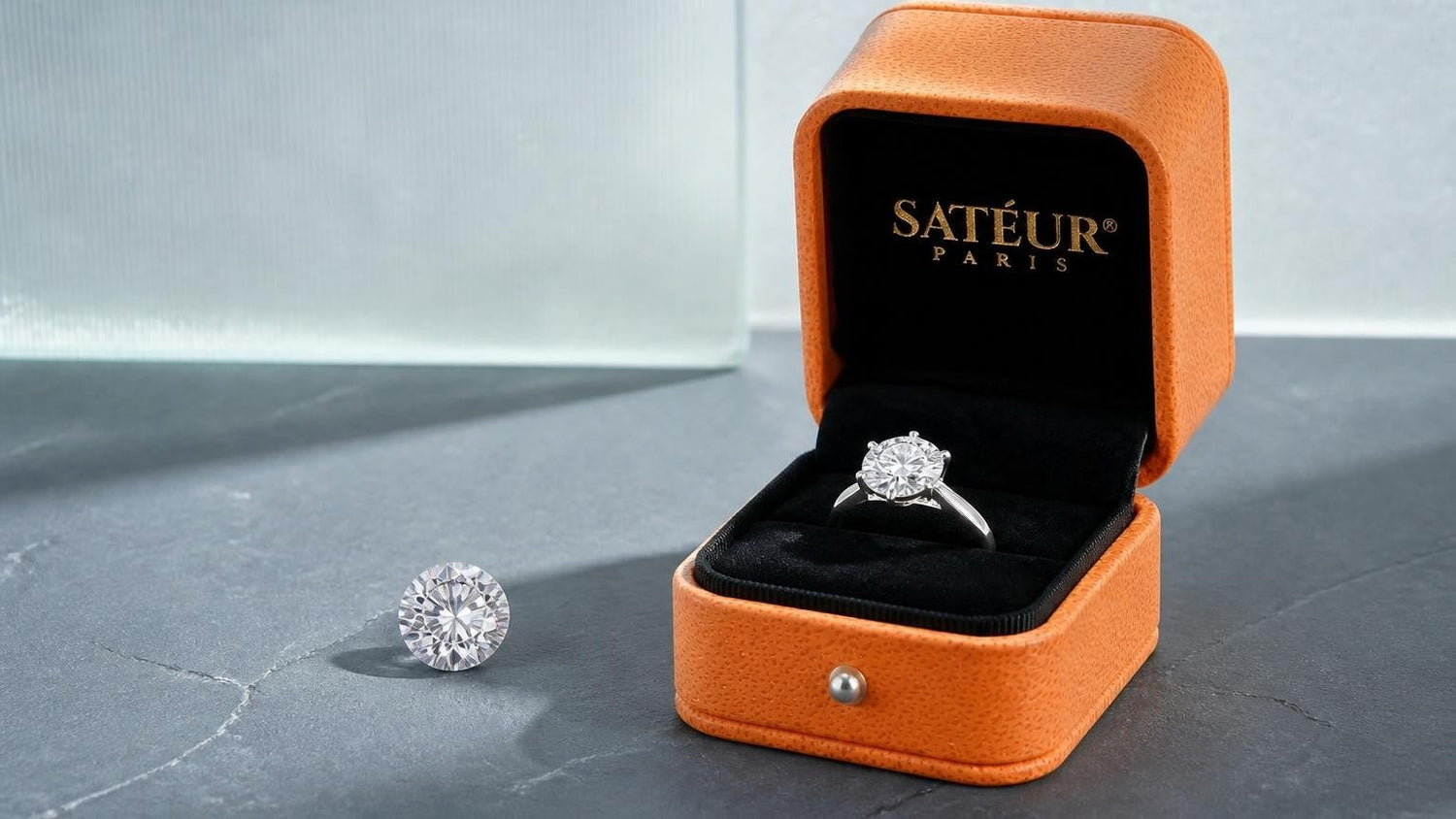
Moissanite vs White Sapphire: Durability, Sparkle, and Value
Two gemstones. Similar price points. Vastly different optical characters. When comparing moissanite vs white sapphire for an engagement ring, the differences go beyond hardness charts — they are written in light. Moissanite, a lab-created gemstone composed of silicon carbide, returns vivid rainbow fire and brilliant sparkle that exceeds even a diamond's dispersion. White sapphire, a mined corundum, reads glassy and quiet: colourless, yes, but with minimal brilliance and very little fire. This comparison sits at the heart of the moissanite vs diamond engagement ring debate that has reshaped how couples approach fine jewellery.
Key Takeaways
- Moissanite (Mohs 9.25) is slightly harder than white sapphire (Mohs 9.0) — both are durable for daily wear.
- Moissanite displays approximately 2.4× the fire of a diamond; white sapphire shows almost no fire and appears glassy.
- White sapphire is a mined corundum; moissanite is lab-created silicon carbide — neither is a diamond.
- Satéur moissanite rings begin from approximately $88, delivering diamond-comparable brightness at roughly 1% of comparable diamond pricing.
- Modern moissanite achieves D–E colour grades with Excellent cut precision, eliminating the yellowish tint of earlier generations.
- White sapphire stays colourless but dulls and requires more frequent cleaning; moissanite holds its brilliance for life.
Moissanite vs White Sapphire: Key Differences
The comparison begins with what each gemstone actually is. Moissanite is a lab-created gemstone — silicon carbide — first discovered in a meteor crater by Henri Moissan in 1893. Modern moissanite is grown in controlled laboratory conditions, making it consistent, ethical, and available in large carat weights. White sapphire is a natural corundum (aluminium oxide) without the trace elements that create coloured sapphires — the colourless variant of the same mineral that produces blue sapphire.
Both are genuine gemstones with excellent durability. Both are widely used in fine jewellery. But their optical behaviour under light is where the distinction becomes decisive.
| Property | Moissanite | White Sapphire |
|---|---|---|
| Composition | Lab-created silicon carbide | Mined corundum (aluminium oxide) |
| Mohs Hardness | 9.25 | 9.0 |
| Refractive Index | ~2.65 | ~1.77 |
| Fire (Dispersion) | High — vivid rainbow brilliance, ~2.4× diamond | Very low — glassy, minimal colour play |
| Brilliance & Sparkle | Very high — alive under light | Low — appears comparatively flat over time |
| Colour Grade | D–E (near-colourless to colourless) | Colourless, but can appear milky |
| Origin | Lab-created | Mined (corundum) |
| Entry Price | From $88 at Satéur; $300–$600 at retail | $200–$800 retail |
| Long-term Brilliance | Holds brilliance for life | Dulls with oils and residue; needs frequent cleaning |

What Is Moissanite
Moissanite is a lab-created gemstone composed of silicon carbide. It was first discovered in 1893 by chemist Henri Moissan inside a meteor crater in Arizona — he initially believed he had found diamond. Today, moissanite is grown entirely in laboratory conditions, enabling a consistency of quality, colour, and cut that is difficult to achieve in any mined gemstone.
Its defining optical property is fire: a refractive index of approximately 2.65 gives it colour dispersion roughly 2.4 times that of a diamond. Under natural or warm light, moissanite scatters light into vivid spectral colour — the rainbow sparkle that distinguishes it from both diamond and white sapphire. Modern Satéur moissanite achieves D–E colour grades with Excellent cut precision, eliminating the warm tint that characterised earlier generations. A full comparison is available in our moissanite vs diamond vs lab diamond guide.
Satéur's moissanite collection begins from approximately $88 — delivering the visual presence of a significantly more expensive gemstone at roughly 1% of the price of a comparable mined diamond. This is The New Diamond Standard applied to the most optically brilliant lab-created gemstone available.
What Is White Sapphire
White sapphire is a naturally occurring corundum (aluminium oxide) — the colourless variant of the same mineral family as ruby and blue sapphire. Without the trace elements that create colour, white sapphire appears transparent and glassy. It is a genuine gemstone with real durability, but its optical character is fundamentally different from moissanite.
White sapphire has a refractive index of approximately 1.77 — lower than both diamond (~2.42) and moissanite (~2.65). This means it bends light less, disperses far less colour, and appears notably quieter under direct light. Where moissanite dazzles with rainbow fire, white sapphire offers a calm, glassy transparency. Over time, surface oils and environmental residue accumulate more visibly on white sapphire — the lower optical return means the stone requires more frequent cleaning to maintain its appearance. For buyers seeking the sparkle of a diamond without the price, white sapphire does not replicate that quality. Moissanite does — and then surpasses it. See the moissanite vs diamond vs Satéur comparison for the full optical context.

Durability and Hardness Comparison
Moissanite ranks at 9.25 on the Mohs scale; white sapphire ranks at 9.0. Both are excellent choices for daily-wear jewellery — a Mohs rating of 9.0 and above is well within the threshold required for engagement rings worn continuously. The difference between 9.0 and 9.25 is measurable, but marginal in practice. Both resist everyday scratching from the vast majority of common materials.
Where the practical difference emerges is in long-term surface appearance. Moissanite's exceptional hardness combines with its intrinsic optical depth: the gemstone holds its brilliance both structurally and visually. White sapphire at Mohs 9.0 resists scratches well, but because its visual quality relies more on surface clarity, any residue reads more obviously. A slightly dulled white sapphire appears noticeably flatter; the same condition on a moissanite is far less visible because its fire and brilliance originate deep within the stone's optical structure.
For an engagement ring worn daily, both gemstones are durable. Moissanite is the more resilient long-term choice.
Optical Properties: Fire and Brilliance
This is where the comparison becomes unambiguous. Moissanite is the more brilliant gemstone — by a measurable, visible margin.
Fire, in gemology, refers to colour dispersion: the stone's ability to separate white light into spectral colour. Moissanite's dispersion of 0.104 compares to diamond's 0.044 — meaning moissanite produces approximately 2.4 times the fire of a diamond. Under natural light, this translates to vivid rainbow flashes visible to the naked eye. White sapphire has a dispersion of approximately 0.018. It returns almost no spectral fire. Across a table, with the naked eye, the difference between moissanite and white sapphire is not subtle: one reads as alive and brilliant; the other appears glassy and comparatively inert.
For those seeking a diamond alternative, moissanite is the significantly closer optical proxy. The 1% Ring® was built on exactly this premise — brilliant gemstones at 1% of the price — and moissanite carries that same commitment to optical performance without the traditional mark-up.

Price and Long-Term Value
On a like-for-like basis, moissanite and white sapphire sit in a comparable price range at independent retailers — both significantly less expensive than mined diamonds. The value calculation shifts when long-term performance enters the equation.
A white sapphire that requires frequent professional cleaning and dulls more visibly over time is a different proposition from a moissanite that holds its optical character indefinitely. Superior fire, superior hardness, and superior long-term brilliance all point in the same direction: moissanite delivers more value over the life of the ring.
At Satéur, moissanite engagement rings begin from approximately $88. This is not a concession on quality — it is the removal of the traditional mark-up applied to mined gemstones. The result is a D–E colour, Excellent cut moissanite ring at a fraction of what a comparable diamond — or even a fine white sapphire — would command at a high street jeweller.
Satéur Moissanite: The Comparative Value Advantage
Satéur offers moissanite as a fully disclosed, openly presented gemstone — lab-created silicon carbide, graded to D–E colour with Excellent cut precision, set in 18k gold-finish settings designed to hold their appearance over time. Over 100,000 customers across 150 countries have chosen this path.
The value position is direct: vivid brilliance and fire at approximately 1% of the price of a comparable mined diamond. A gemstone that returns more light than a diamond, in a setting indistinguishable from fine jewellery with the naked eye, beginning from $88. Not a compromise — a different kind of discernment.

Satéur Destinée Ring™
The look of a flawless diamond, for 1% of the price. Satéur moissanite — D–E colour, Excellent cut, set in 18k white gold finish.
Compare to a $10,000 mined diamond
Joined by 100,000+ couples across 150+ countries.
Discover the CollectionFree worldwide shipping · 30-day returns · Lifetime Satéur Care
FAQ: Moissanite and White Sapphire for Engagement Rings
What is the main visual difference between moissanite and white sapphire?
Moissanite returns vivid rainbow fire — approximately 2.4 times the colour dispersion of a diamond — along with high brilliance and sparkle. White sapphire has a much lower refractive index and minimal fire, appearing glassy and quieter under light. The visual difference is clear to the naked eye: moissanite reads as alive under direct light; white sapphire appears comparatively flat or inert.
Is moissanite or white sapphire more durable for an engagement ring?
Moissanite at Mohs 9.25 is slightly harder than white sapphire at Mohs 9.0. Both are durable for daily wear in engagement rings. In practice, moissanite holds its optical appearance better over time — white sapphire is more susceptible to appearing dull as surface oils and residue accumulate, owing to its lower light-return characteristics.
Why does moissanite cost less than a white sapphire of similar size?
Moissanite is lab-created at scale, removing the costs of mining, geological rarity premiums, and traditional supply chain mark-ups. White sapphire, though less valuable than coloured sapphires, still carries a mined-stone premium. The result: moissanite consistently delivers superior optical performance at the same or lower price point.
Does moissanite yellow or change colour over time?
Modern moissanite — including all Satéur moissanite — achieves D–E colour grades, meaning near-colourless to colourless. Unlike earlier generations of moissanite that carried a warm or yellowish tint, current D–E moissanite does not yellow. It holds its colour and brilliance for life.
Can white sapphire and moissanite be set in the same ring design?
Both gemstones are compatible with all standard ring settings — solitaire, pavé, halo, and multi-stone designs — in white gold, yellow gold, rose gold, and platinum. In mixed gemstone designs, moissanite works well as the centre stone delivering fire, with white sapphire as quieter accent stones providing a calm contrast.
What colour grade does Satéur moissanite typically achieve?
Satéur moissanite achieves D–E colour grades — the highest classification for colourless moissanite — with Excellent cut precision. This is comparable to the finest diamond colour grades, and the result is a gemstone that reads crisp, white, and brilliant to the naked eye.
The choice between moissanite and white sapphire is a question of what you want light to do. White sapphire is quiet and colourless — a genuine gemstone with its own understated appeal. Moissanite is vivid, alive, and measurably more brilliant — a lab-created gemstone with superior fire, hardness, and long-term optical performance. For an engagement ring worn every day, meant to remain as present a decade from now as it is today, moissanite engagement rings offer the more complete answer. The Satéur moissanite collection begins from $88 — the smarter choice, made beautiful.
















اترك تعليقًا
This site is protected by hCaptcha and the hCaptcha Privacy Policy and Terms of Service apply.